

The properties of ultraviolet light depend on the wavelength, and the UV from different sources varies in spectrum. Let's discuss which sources of ultraviolet light to use to maximize its bactericidal effect while minimizing risks of undesirable biological effects.
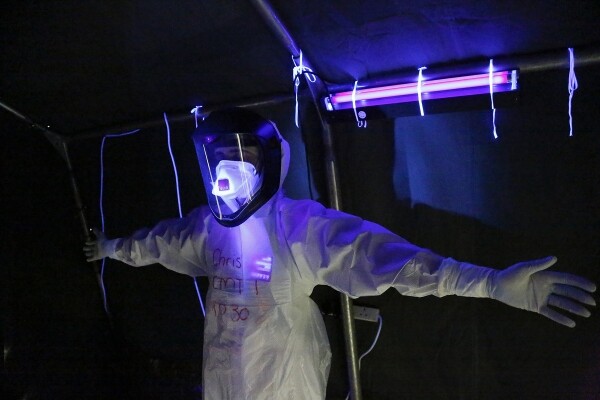
Fig. 1. The photo shows not disinfection by UVC radiation, as one might think, but training in using protective suits while identifying luminescent spots of training bodily fluids in UVA rays. UVA is soft ultraviolet and does not have a bactericidal effect. Closed eyes are a justified safety measure since the wide spectrum of the used UVA fluorescent lamp overlaps with UVB, which is harmful to eyesight (source: Simon Davis/DFID).
The wavelength of visible light corresponds to the energy of a quantum at which photochemical activity just becomes possible. Quanta of visible light excite photochemical reactions in a specific photosensitive tissue – the retina of the eye.
Ultraviolet is invisible, with a shorter wavelength, higher frequency, and energy of quanta, making radiation harsher, with a broader variety of photochemical reactions and biological effects.
Ultraviolet is classified into:
- Longwave / soft / near UVA (400…315 nm);
- Medium-hardness – UVB (315…280 nm);
- Shortwave / far / hard – UVC (280…100 nm).
Bactericidal Action of Ultraviolet Light
The bactericidal action is exerted by hard ultraviolet – UVC, and to a lesser extent, by medium-hard ultraviolet – UVB. The curve of bactericidal effectiveness shows that only a narrow range of 230…300 nm exhibits clear bactericidal action, which is about a quarter of the range referred to as ultraviolet.
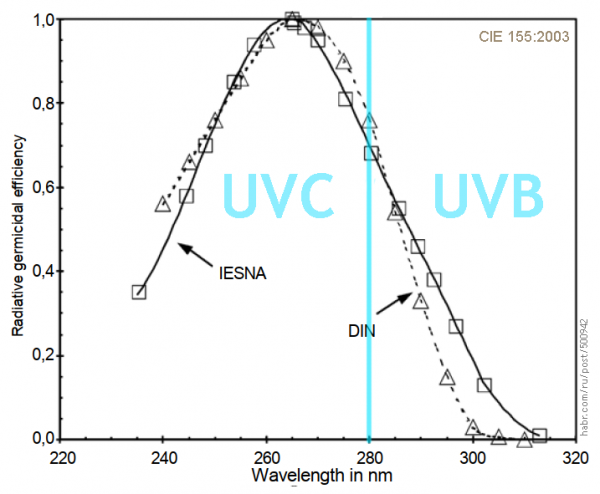
Fig. 2 Bactericidal effectiveness curves from []
Quanta with wavelengths in this range are absorbed by nucleic acids, leading to the destruction of DNA and RNA structures. Besides the bactericidal (i.e., killing bacteria) effect, this range also has virucidal (antiviral), fungicidal (antifungal), and sporicidal (killing spores) effects. This includes the elimination of the RNA-containing virus SARS-CoV-2 that caused the 2020 pandemic.
Bactericidal Action of Sunlight
The bactericidal effect of sunlight is relatively small. Let's look at the solar spectrum above and below the atmosphere:
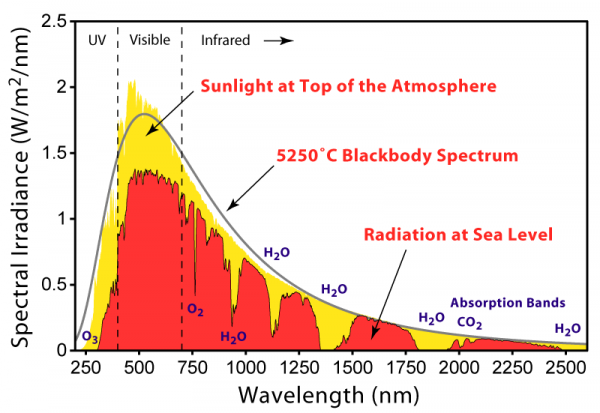
Fig. 3. The spectrum of solar radiation above the atmosphere and at sea level. The most intense part of the ultraviolet range does not reach the Earth's surface (adapted from Wikipedia).
Attention should be paid to the portion of the above-atmospheric spectrum highlighted in yellow. The energy of a quantum at the left edge of the spectrum of above-atmospheric sunlight, with a wavelength of less than 240 nm, corresponds to a chemical bond energy of 5.1 eV in an oxygen molecule "O2". Molecular oxygen absorbs these quanta, breaking the chemical bond and forming atomic oxygen "O", which recombines into oxygen molecules "O2" and, partly, ozone "O3".
Above-atmospheric solar UVC creates ozone in the upper layers of the atmosphere, known as the ozone layer. The chemical bond energy in an ozone molecule is lower than that in an oxygen molecule, and therefore ozone absorbs quanta of lower energy than oxygen. While oxygen absorbs only UVC, the ozone layer absorbs both UVC and UVB. Thus, the sun generates ozone at the very edge of the ultraviolet part of the spectrum, and this ozone then absorbs most of the harsh solar ultraviolet, protecting the Earth.
Now, carefully aligning the solar spectrum with the spectrum of bactericidal effect, paying attention to wavelengths and scale.
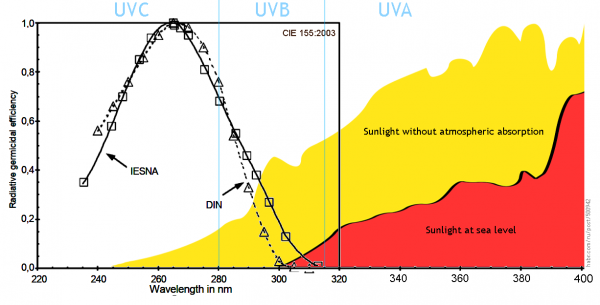
Fig. 4 The spectrum of bactericidal action and the spectrum of solar radiation.
It can be seen that the bactericidal effect of sunlight is insignificant. The part of the spectrum capable of exhibiting bactericidal action is almost entirely absorbed by the atmosphere. While the situation varies slightly by season and latitude, its qualitative nature remains similar.
The danger of ultraviolet radiation
The leader of a major country proposed: "to cure COVID-19, sunlight must be delivered inside the body." However, bactericidal UV destroys RNA and DNA, including that of humans. If "sunlight is delivered inside the body," the person will perish.
The epidermis, primarily the stratum corneum of dead cells, protects living tissue from UVC. Below the epidermal layer, less than 1% of UVC radiation penetrates [WHO]. Longer wavelengths UVB and UVA penetrate to a greater depth.
If there were no solar ultraviolet rays, it is possible that humans would not have an epidermis and a horny layer, and the surface of the body would be mucous, like that of snails. However, since humans evolved under the sun, only the areas protected from the sun are mucous. The most vulnerable mucous surface is the eye, conditionally protected from solar ultraviolet rays by eyelids, eyelashes, eyebrows, facial motor skills, and the habit of not looking at the sun.
When they first learned to replace the lens with an artificial one, ophthalmologists faced the problem of retinal burns. They began to investigate the reasons and found that the living human lens is opaque to ultraviolet light and protects the retina. After that, they began to make artificial lenses opaque to ultraviolet light as well.
The image of the eye under ultraviolet rays illustrates the opacity of the lens to ultraviolet light. It is not advisable to illuminate one’s own eye with ultraviolet light, as over time the lens becomes clouded, partly due to the accumulated dose of ultraviolet light over the years, and needs replacement. Therefore, let us take the experience of brave individuals who ignored safety, shone ultraviolet flashlights into their eyes at a wavelength of 365 nm, and posted the results on YouTube.
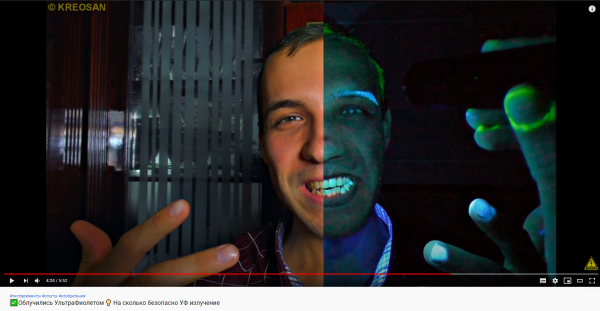
Fig. 5 Frame from the video of the YouTube channel "Kreosan."
Ultraviolet flashlights emitting luminescence with a wavelength of 365 nm (UVA) are popular. They are purchased by adults but inevitably fall into the hands of children. Children shine these flashlights into their eyes, carefully and for long periods examining the glowing crystal. Such actions should be prevented. If this has occurred, one can reassure themselves that cataracts in studies on mice are consistently caused by UVB exposure to the lens, but the catarogenic effect of UVA is unstable [].
And yet, the exact spectrum of the effect of ultraviolet light on the lens is unknown. Considering that cataracts are a significantly delayed effect, it takes a certain amount of wisdom not to shine ultraviolet light into one’s own eyes in advance.
Mucous membranes of the eye become inflamed relatively quickly under ultraviolet light, a condition known as photokeratitis and photoconjunctivitis. The membranes turn red, and there is a feeling of 'sand in the eyes'. The effect subsides after a few days, but repeated burns can lead to corneal clouding.
The wavelengths that cause these effects approximately correspond to the weighted UV hazard function provided in the photobiological safety standard [IEC 62471] and closely match the range of bactericidal action.
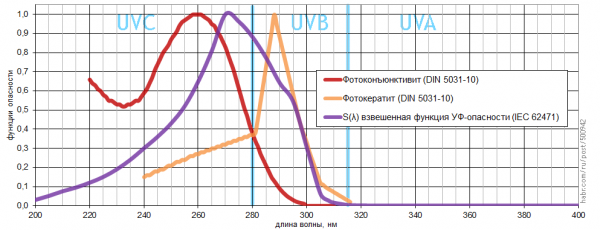
Fig. 6 Spectra of ultraviolet action causing photoconjunctivitis and photokeratitis from [] and the weighted actinic UV hazard function for skin and eyes from [].
The threshold doses for photokeratitis and photoconjunctivitis are 50-100 J/m², which does not exceed the doses used for disinfection. It is not possible to disinfect the mucous membrane of the eye with ultraviolet light without causing inflammation.
Erythema, or 'sunburn', is caused by ultraviolet light in the range of up to 300 nm. According to some sources, the maximum spectral efficacy of erythema occurs at wavelengths around 300 nm []. The minimum dose that causes barely noticeable erythema MED (Minimum Erythemal Dose) varies from 150 to 2000 J/m² for different skin types. For residents of the middle belt, the typical MED can be considered to be around 200…300 J/m².
UVB in the range of 280-320 nm, peaking around 300 nm, causes skin cancer. There is no threshold dose; the higher the dose, the greater the risk, and the effect is delayed.
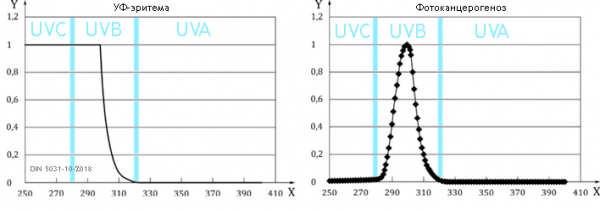
Fig. 7 Curves of ultraviolet action causing erythema and skin cancer.
Photo-induced skin aging is caused by ultraviolet light across the entire range of 200…400 nm. An infamous photograph shows a truck driver who was predominantly exposed to sunlight through the open driver's window on the left side. The driver had a habit of driving with the window down, but the right side of his face was protected from sunlight by the windshield. The difference in skin aging on the right and left sides is striking:
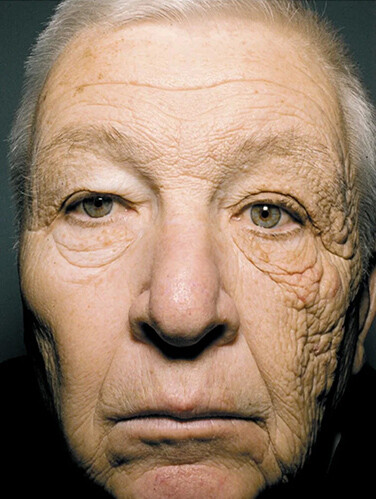
Fig. 8 Photograph of a driver who drove for 28 years with the driver's window down [].
To roughly assess that the age of the skin on different sides of this person's face varies by twenty years, and that this difference is due to one side being exposed to sunlight for about twenty years while the other was not, one can cautiously conclude that a day under the open sun ages the skin by one day.
According to reference data [] it is known that in the mid-latitudes during summer, under direct sunlight, the minimal erythema dose of 200 J/m2 is reached in less than an hour. Comparing these figures with the earlier conclusion allows us to arrive at another point – periodic and brief exposure to ultraviolet lamps does not pose a significant danger for skin aging.
How much ultraviolet light is needed for disinfection
The number of surviving microorganisms on surfaces and in the air decreases exponentially with increasing doses of ultraviolet light. For instance, the dose that kills 90% of tuberculosis mycobacteria is 10 J/m2. Two such doses kill 99%, three doses kill 99.9%, and so on.
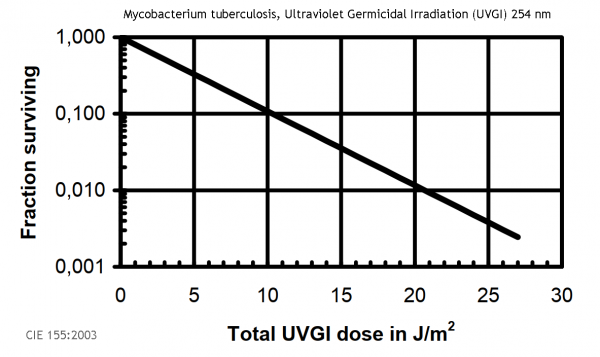
Fig. 9 Dependence of the share of surviving tuberculosis mycobacteria on the dose of ultraviolet radiation at a wavelength of 254 nm.
The exponential relationship is notable in that even a small dose kills a large proportion of microorganisms.
Among the pathogenic microorganisms listed in [] salmonella is the most resistant to ultraviolet light. The dose that kills 90% of its bacteria is 80 J/m2. According to the review [Kowalski2020], the average dose that kills 90% of coronaviruses is 67 J/m2. However, for the majority of microorganisms, this dose does not exceed 50 J/m2. For practical purposes, it can be remembered that the standard dose for 90% disinfection efficiency is 50 J/m2.
According to the approved methodology by the Ministry of Health of Russia for the use of ultraviolet light for air disinfection [] the maximum disinfection efficiency of 'three nines' or 99.9% is required for operating rooms, maternity hospitals, etc. For school classrooms, public building premises, etc., 'one nine' is sufficient, meaning 90% of microorganisms are destroyed. This means that depending on the type of premises, one to three standard doses of 50...150 J/m2 are sufficient.
Example of calculating the necessary exposure time: suppose it is required to disinfect the air and surfaces in a room measuring 5 × 7 × 2.8 meters, for which one open Philips TUV 30W lamp is used.
The technical description of the lamp specifies a germicidal output of 12 W []. Ideally, the entire output is directed strictly at the surfaces to be disinfected, but in reality, half of the output will be wasted, for example, by excessively illuminating the wall behind the fixture. Therefore, we will assume a useful output of 6 W. The total area of surfaces being exposed in the room is – floor 35 m2 + ceiling 35 m2 + walls 67 m2, totaling 137 m2.
On average, the bactericidal radiation flux hitting the surfaces is 6 W / 137 m2 = 0.044 W / m2. In one hour, or 3600 seconds, this will yield a dose of 0.044 W / m2 × 3600 s = 158 J / m2, or approximately 150 J / m2. This corresponds to three standard doses of 50 J / m2 or 'three nines' – 99.9% bactericidal efficiency, i.e., meeting the requirements for operational efficiency. And since the calculated dose has passed through the volume of the room before hitting the surfaces, the air has also been disinfected with equal effectiveness.
If the sterility requirements are low and only 'one nine' is needed, the exposure time needed in the discussed example is three times shorter – approximately 20 minutes.
Protection from ultraviolet rays
The main measure of protection during ultraviolet disinfection is to leave the room. Being near a working UV lamp while diverting your gaze will not help; the mucous membranes of the eyes will still be exposed.
A partial measure of protecting the mucous membranes of the eyes can be wearing glass goggles. The absolute statement 'glass does not transmit ultraviolet' is incorrect; it does transmit to some extent, and different types of glass transmit differently. But in general, as the wavelength decreases, the transmission coefficient decreases, and UVC is effectively transmitted only by quartz glass. Lenses are not quartz glass in any case.
It can be confidently stated that lenses with the UV400 marking do not transmit ultraviolet.
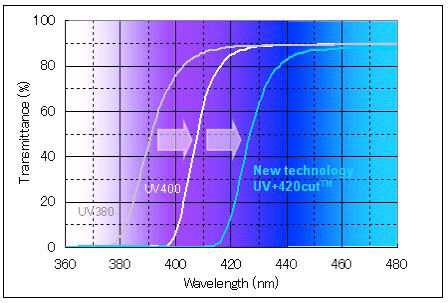
Fig. 10 Transmission spectrum of spectacle lenses with indices UV380, UV400, and UV420. Image from the site []
Another protective measure is the use of UVC germicidal range sources, which do not emit potentially harmful but ineffective UVB and UVA ranges for disinfection.
Ultraviolet sources
UV diodes
The most common ultraviolet diodes operate at 365 nm (UVA) and are designed for 'police flashlights,' which cause luminescence to detect UV-invisible contaminants. Disinfection with such diodes is not possible (see Fig. 11).
For disinfection, shortwave UVC diodes with a wavelength of 265 nm can be used. The cost of a diode module that would replace a mercury germicidal lamp exceeds the cost of the lamp by three orders of magnitude, so in practice, such solutions are not used for disinfecting large areas. However, compact UV-diode devices for disinfecting small areas—like tools, phones, skin lesions, etc.—are emerging.
Low-pressure mercury lamps
A low-pressure mercury lamp is the standard against which all other sources are compared.
The majority of the energy emitted by mercury vapor at low pressure during an electrical discharge falls at a wavelength of 254 nm, which is ideal for disinfection. A small portion of the energy is emitted at a wavelength of 185 nm, which intensely generates ozone. Only a very small amount of energy is emitted at other wavelengths, including the visible range.
In conventional white light mercury fluorescent lamps, the glass envelope does not transmit ultraviolet radiation emitted by mercury vapor. However, the phosphor, a white powder on the walls of the envelope, glows in the visible range under the action of ultraviolet light.
UVB or UVA lamps are structured similarly; the glass envelope does not allow transmission of the peaks at 185 nm and 254 nm, but the phosphor emits not visible light but longwave ultraviolet light under the action of shortwave ultraviolet. These are lamps for technical purposes. Since the spectrum of UVA lamps is similar to sunlight, such lamps are also used for tanning. A comparison of the spectrum with the curve of bactericidal effectiveness shows that it is impractical to use UVB and, especially, UVA lamps for disinfection.
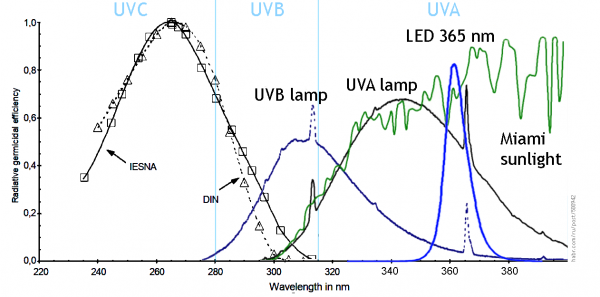
Fig. 11 Comparison of the bactericidal efficiency curve, the spectrum of the UVB lamp, the spectrum of the UVA 'tanning' lamp, and the spectrum of the 365 nm diode. Lamp spectra are taken from the website of the American Paint Manufacturers Association [].
It is worth noting that the spectrum of the UVA fluorescent lamp is broad and encompasses the UVB range. The spectrum of the 365 nm diode is significantly narrower, representing 'true UVA'. If UVA is needed to induce fluorescence for decorative purposes or to detect contamination, using a diode is safer than using a ultraviolet fluorescent lamp.
A low-pressure mercury UVC bactericidal lamp differs from fluorescent ones in that it does not have phosphor on the walls of the bulb, allowing ultraviolet light to pass through. The primary 254 nm line is always transmitted, while the ozone-generating line at 185 nm may be included in the lamp's spectrum or eliminated by using glass with selective transmission.
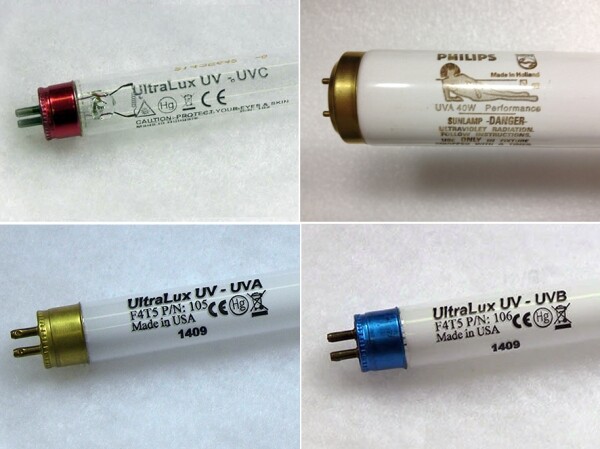
Fig. 12 The emission range is indicated on the labeling of ultraviolet lamps. A UVC bactericidal lamp can be identified by the absence of phosphor in the bulb.
Ozone has an additional bactericidal effect but is a carcinogen, so to avoid waiting for ozone to dissipate after disinfection, lamps that do not generate ozone without the 185 nm line in the spectrum are used. These lamps have an almost ideal spectrum — the main line with high bactericidal efficiency at 254 nm, very low emission in non-bactericidal ultraviolet ranges, and a slight 'signal' emission in the visible range.
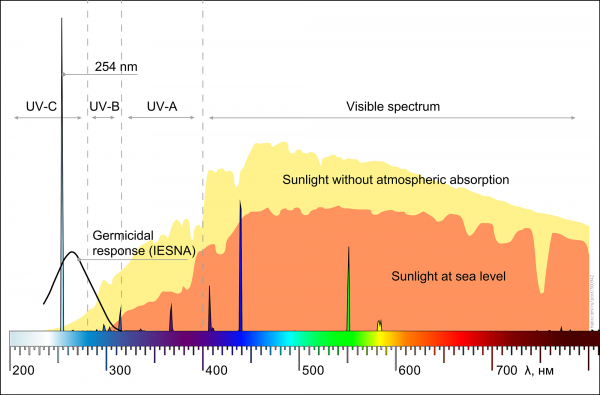
Fig. 13 The spectrum of a low-pressure mercury UVC lamp (provided by the journal lumen2b.ru) is combined with the spectrum of solar radiation (from Wikipedia) and the bactericidal efficiency curve (from ESNA Lighting Handbook []).
The blue glow of bactericidal lamps allows one to see that the mercury lamp is on and operating. The glow is weak, creating a misleading impression that looking at the lamp is safe. We do not realize that the radiation in the UVC range constitutes 35…40% of the total power consumed by the lamp.
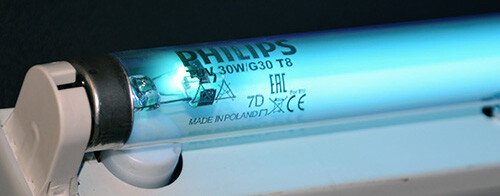
Fig. 14 A small fraction of the energy emitted by mercury vapors falls in the visible range and appears as a weak blue glow.
The bactericidal mercury lamp of low pressure has the same base as a regular fluorescent lamp but is made in a different length to prevent it from being inserted into standard fixtures. The fixture for the bactericidal lamp, besides its size, differs in that all plastic parts are UV-resistant, the wires are covered from ultraviolet radiation, and there is no diffuser.
For home bactericidal needs, the author uses a 15W bactericidal lamp previously used for disinfecting the nutrient solution of a hydroponic system. Its equivalent can be found under the query 'aquarium uv sterilizer.' While the lamp operates, ozone is emitted, which is not good, but it is useful for disinfecting items like shoes.
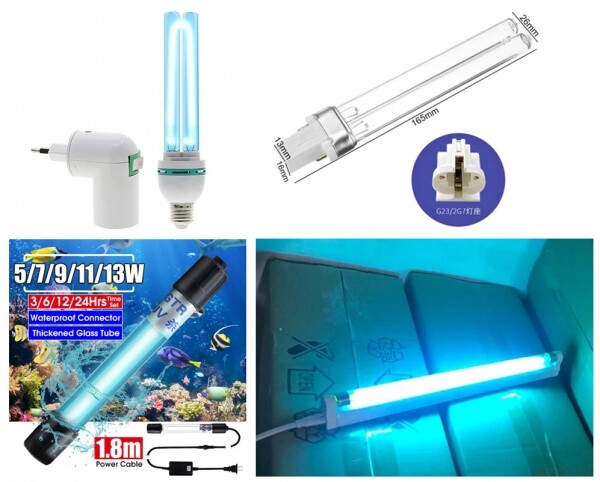
Fig. 15 Low-pressure mercury lamps with various types of bases. Images from the Aliexpress website.
Medium and high-pressure mercury lamps
Increasing the pressure of mercury vapor complicates the spectrum, expanding it and introducing more lines, including at wavelengths that generate ozone. The introduction of additives into mercury leads to an even greater complexity of the spectrum. There are many types of such lamps, and each spectrum is unique.
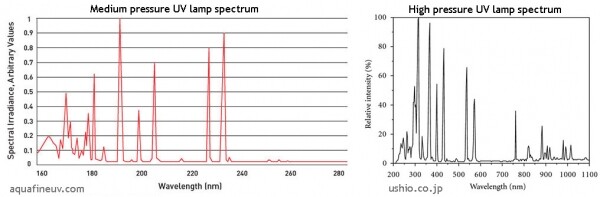
Fig. 16 Examples of the spectra of medium and high-pressure mercury lamps
Increasing pressure reduces the lamp's efficiency. For example, the Aquafineuv brand medium-pressure lamp emits only 15-18% of the consumed power in the UVC range, as opposed to 40% like low-pressure lamps. The cost of equipment based on one watt of UVC output is higher.].
The decrease in efficiency and increase in lamp cost is offset by its compactness. For instance, disinfecting flowing water or drying high-speed applied varnish in printing require compact and powerful sources, where specific cost and efficiency are not crucial. However, using such a lamp for disinfection is inappropriate.
UV emitter from the DRL burner and DRT lamp
There is a 'folk' way to relatively cheaply obtain a powerful source of ultraviolet light. The lamps of the DRL white light, ranging from 125 to 1000 W, are becoming obsolete but are still available. These lamps contain a 'burner'—a high-pressure mercury lamp—inside an outer bulb. It emits broad-spectrum ultraviolet light, which is absorbed by the outer glass bulb but causes the phosphor on its walls to glow. If the outer bulb is broken and the burner is connected to the network through the standard ballast, a powerful broad-spectrum ultraviolet emitter can be obtained.
Such a homemade emitter has its drawbacks: a lower efficiency compared to low-pressure lamps, a significant portion of ultraviolet light outside the bactericidal range, and it's unsafe to stay in the room for some time after turning off the lamp until the ozone decomposes or dissipates.
However, the benefits are undeniable: low cost and high power in a compact size. Generating ozone can also be considered an advantage. Ozone disinfects shaded surfaces that ultraviolet rays cannot reach.
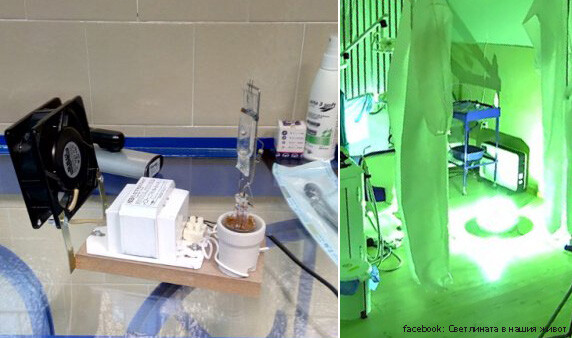
Fig. 17 Ultraviolet emitter made from DRL lamps. The photo is published with the permission of the author, a Bulgarian dentist who uses this emitter in addition to the standard Philips TUV 30W bactericidal lamp.
Similar sources of ultraviolet light for disinfection, in the form of high-pressure mercury lamps, are used in emitters like the OUFK-01 'Solnyshko'.
For example, for the popular lamp 'DRT 125-1', the manufacturer does not publish the spectrum but provides parameters in the documentation: irradiation intensity at a distance of 1 m from the lamp UVA – 0.98 W/m2, UVB – 0.83 W/m2, UVC – 0.72 W/m2, bactericidal flow 8 W, and ventilation is required after use to clear the ozone []. In response to a direct question about the difference between the DRT lamp and the DRL burner, the manufacturer stated on their blog that the DRT has an insulating green coating on the cathodes.
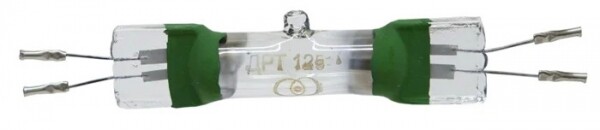
Fig. 18 Broad-spectrum ultraviolet source – DRT-125 lamp.
The specified characteristics indicate that the spectrum is broad with nearly equal emission in soft, medium, and hard ultraviolet light, including the ozone-generating hard UVC. The bactericidal flux constitutes 6.4% of the consumed power, meaning the efficiency is 6 times lower than that of a low-pressure tubular lamp.
The manufacturer does not publish the spectrum of this lamp, and the same picture of the spectrum from some DRT has been circulating on the internet. The original source is unknown, but the energy ratio in the UVC, UVB, and UVA ranges does not match the claims for the DRT-125 lamp. The DRT claims approximately equal ratios, but the spectrum shows that the energy in UVB is significantly greater than the energy in UBC. Moreover, the energy in UVA is substantially higher than in UVB.
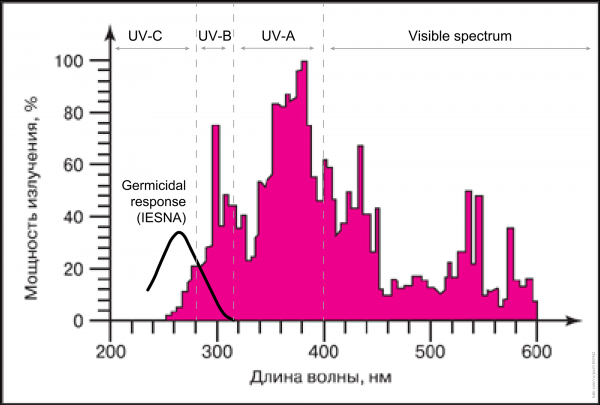
Fig. 19. Spectrum of a high-pressure mercury arc lamp, most commonly illustrating the spectrum of the widely used DRT-125 for medical purposes.
It is clear that lamps with different pressures and additives in mercury emit differently. It is also clear that uninformed consumers tend to imagine desired characteristics and properties of a product, acquire confidence based on their own assumptions, and make a purchase. Publishing the spectrum of a specific lamp will spark discussions, comparisons, and conclusions.
The author once purchased a UFK-01 unit with a DRT-125 lamp and used it for several years to test the UV resistance of plastic products. Two products were irradiated simultaneously, one of which was a control made of UV-resistant plastic, to see which would yellow faster. For such applications, knowing the exact shape of the spectrum is not necessary; it is only important that the emitter is broadband. But what is the point of using broadband ultraviolet if disinfection is required?
The purpose of the UFK-01 states that the irradiator is used for acute inflammatory processes. That is, in cases where the positive effects of skin disinfection outweigh the potential harm of broadband ultraviolet. Obviously, even in such cases, it is better to use narrowband ultraviolet, without wavelengths in the spectrum that have other effects besides bactericidal.
Air disinfection
Ultraviolet is considered an insufficient means of disinfecting surfaces, as the rays cannot penetrate where, for example, alcohol can. However, ultraviolet effectively disinfects the air.
When sneezing and coughing, droplets of several micrometers in size are formed, which can linger in the air from several minutes to several hours []. Tuberculosis studies have shown that just one aerosol droplet is enough to cause infection.
Outdoors, we are relatively safe due to the vast volumes and mobility of air, which can disperse and decontaminate any sneeze over time and with sunlight. Even in the subway, while the share of infected individuals is low, the overall air volume per infected person is high, and good ventilation keeps the risk of infection transmission low. The most dangerous place during airborne illness pandemics is an elevator. Therefore, those who sneeze should stay in quarantine, and the air in public spaces with inadequate ventilation needs decontamination.
Recirculators
One method of air disinfection is closed UV recirculators. Let's discuss one such recirculator – 'Dezar 7', known to be spotted even in the office of the head of state.
The recirculator's description states that it pushes out 100 m3 of air per hour and is designed to treat a room volume of 100 m3 (approximately 5 × 7 × 2.8 meters).
However, the ability to disinfect 100 m3 of air per hour does not mean that the air in a 100 m3 room will be processed as effectively in that time. Processed air dilutes contaminated air and enters the recirculator again and again in that state. It's not difficult to build a mathematical model to calculate the effectiveness of such a process:
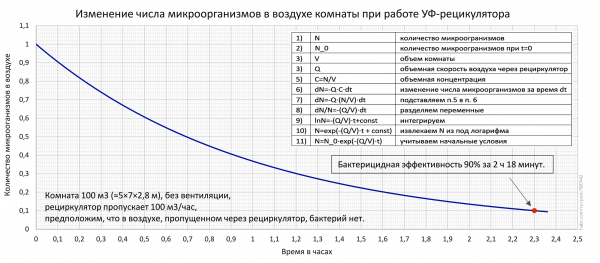
Fig. 20 The effect of the UV recirculator on the number of microorganisms in the air of a non-ventilated room.
To reduce the concentration of microorganisms in the air by 90%, the recirculator needs to run for more than two hours. In a non-ventilated room, this is possible. But rooms with people and without ventilation are generally not normal. For example, [] prescribes a minimum outdoor air expenditure of 3 m3 per hour per 1 m2 of apartment area. This corresponds to a complete air replacement once an hour, rendering the recirculator's operation useless.
If we consider a model of not complete mixing, but laminar jets that follow a complex established trajectory in the room and exit into the ventilation, the benefit of disinfecting one of these jets is even lower than in the complete mixing model.
In any case, the UV recirculator is not more beneficial than a window left open.
One reason for the low effectiveness of recirculators is that the bactericidal effect per watt of UV flow is extremely low. The beam travels about 10 centimeters inside the unit and then reflects off aluminum with a coefficient of about k=0.7. This means the effective range of the beam inside the unit is about half a meter, after which it is absorbed without any benefit.
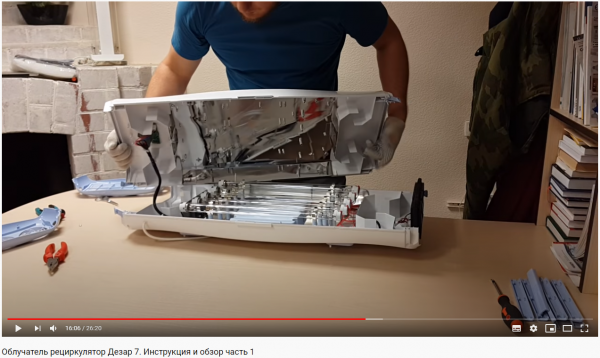
Fig. 21. A frame from a YouTube video showing the recirculator. The bactericidal lamps and aluminum reflective surface are visible, reflecting ultraviolet light significantly worse than visible light [].
A bactericidal lamp that hangs openly on the wall in a clinic room and is turned on by the doctor according to a schedule is many times more effective. The rays from the open lamp travel several meters, first disinfecting the air and then surfaces.
Air irradiators in the upper part of the room
In hospital wards where bedridden patients are constantly present, UV units that irradiate circulating air flows near the ceiling are sometimes used. The main drawback of such units is that the grid covering the lamps only allows rays traveling in a strict direction to pass, absorbing over 90% of the remaining airflow without any benefit.
Air can additionally be blown through such an irradiator to also make a recirculator, but this is usually not done, likely due to the undesirability of creating a dust collector in the ward.
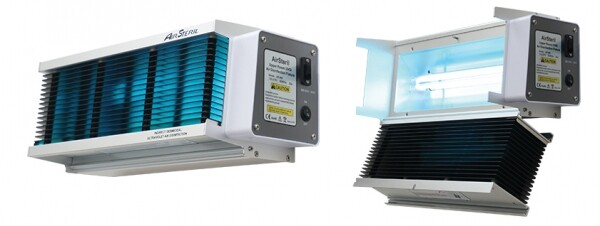
Fig. 22 Ceiling-mounted UV air irradiator, image from the site [].
Grilles protect people inside a room from direct ultraviolet light, but the light that passes through the grille hits the ceiling and walls and reflects diffusely, with an approximately 10% reflection coefficient. The room fills with omnidirectional ultraviolet radiation, and people receive a dose of ultraviolet light proportional to the time spent indoors.
Reviewers and Authors
Reviewers:
Artyom Balabanov, electronics engineer, developer of UV curing systems;
Rumen Vasilev, PhD, lighting engineer, Interlux Ltd., Bulgaria;
Vadim Grigorov, biophysicist;
Stanislav Lermontov, lighting engineer, Complex Systems LLC;
Alexey Pankrashkin, PhD, associate professor, semiconductor lighting and photonics, INTECH Engineering LLC;
Andrey Khamov, lighting design specialist for medical facilities;
Vitaly Tsvirko, head of the lighting testing laboratory at CSOT NAS of Belarus
Author: Anton Sharakshane, PhD, lighting engineer and biophysicist, First Moscow State Medical University named after I.M. Sechenov
Links
Links
[Airsteril]
[Aquafineuv]
[CIE 155:2003] CIE 155:2003 ULTRAVIOLET AIR DISINFECTION
[DIN 5031-10] DIN 5031-10 2018 Optical radiation physics and illuminating engineering. Part 10: Photobiologically effective radiation, quantities, symbols and action spectra. Physics of optical radiation and lighting engineering. Photobiologically active radiation. Quantities, symbols, and action spectra.
[ESNA] ESNA Lighting Handbook, 9th Edition. ed. Rea M.S. Illuminating Engineering Society of North America, New York, 2000
[IEC 62471] GOST R IEC 62471-2013 Lamps and lamp systems. Photobiological safety
[Kowalski2020] Wladyslaw J. Kowalski et al., 2020 COVID-19 Coronavirus Ultraviolet Susceptibility, DOI: 10.13140/RG.2.2.22803.22566
[Lisma]
[Mitsuichemicals]
[Nejm]
[Paint]
[TUV]
[WHO] World Health Organization. Ultraviolet Radiation: Official Scientific Review on the Impact of UV Radiation on the Environment and Health Mentioning Global Ozone Layer Depletion.
[Dezar]
[R 3.5.1904-04] R 3.5.1904-04 Use of ultraviolet bactericidal radiation for air disinfection in premises.
[SP 60.13330.2016] SP 60.13330.2016 Heating, ventilation and air conditioning.
Source: habr.com
