

Popov may have been the first — but he did not patent his inventions or attempt to commercialize them.
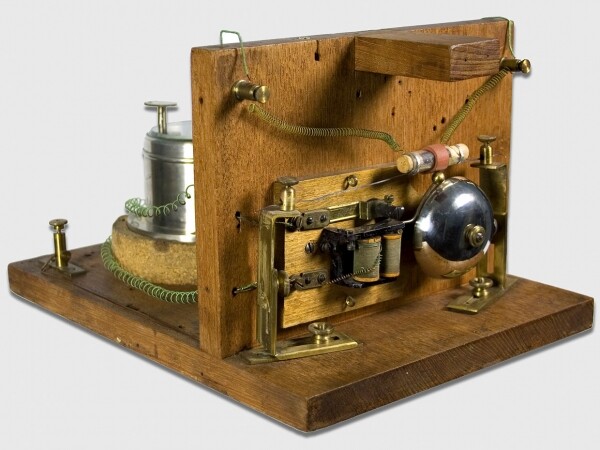
In 1895, Russian physicist Alexander Popov used his instrument to study thunderstorms to demonstrate the transmission of radio waves.
Who invented the radio? Your answer will likely depend on where you are from.
On May 7, 1945, the Bolshoi Theatre in Moscow was filled with scientists and state officials from the Communist Party of the Soviet Union, celebrating the 50th anniversary of the first demonstration of radio conducted by . It was an opportunity to pay tribute to the domestic inventor and attempt to steer historical records away from the achievements of who is recognized as the inventor of radio in many countries around the world. May 7 was declared in the USSR which is still celebrated today in Russia.
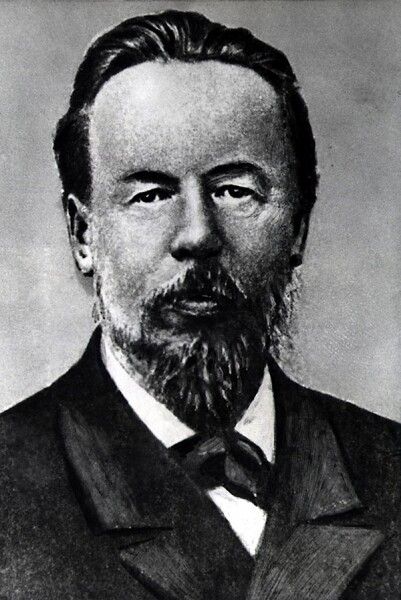
The claim of Popov's priority as the inventor of radio is based on his lecture "On the Relation of Metallic Powders to Electric Oscillations" read on May 7, 1895, at St. Petersburg University.
Alexander Popov developed the first radio capable of transmitting Morse code.
 Popov's device was simple, ["Branly's tube"] – a glass bulb containing metal filings, with two electrodes positioned a few centimeters apart. The device was based on the work of French physicist who described a similar scheme in 1890, and on the work of English physicist who improved the device in 1893. Initially, the resistance of the electrodes is high, but when an electrical impulse is applied, a path for current with low resistance will appear. The current will flow, but then the metal filings will start to clump together, increasing the resistance. The coherer needs to be shaken or tapped each time to disperse the filings again.
in St. Petersburg, Popov's device was the first radio receiver capable of recognizing signals by their duration. He used Lodge's coherer indicator and added a polarized , which functioned as a DC amplifier. The relay allowed Popov to connect the receiver’s output to an electric bell, a recording device, or a telegraph, providing electromechanical feedback. An image of such a device with a bell from the museum's collection is shown at the beginning of the article. The feedback automatically returned the coherer to its original state. When the bell rang, the coherer would shake automatically.
On March 24, 1896, Popov conducted another revolutionary public demonstration of the device – this time transmitting information in Morse code via wireless telegraphy. Once again at St. Petersburg University, during a session of the Russian Physical and Chemical Society, Popov sent signals between two buildings located 243 meters apart. The professor stood at the board in the second building, recording the letters received in Morse code. The result was words: .
Schemes like Popov's, based on the coherer, became the foundation for first-generation radio equipment. They continued to be used until 1907 when they were succeeded by receivers using crystal detectors.
Popov and Marconi had completely different views on radio
Popov was a contemporary of Marconi; however, they developed their equipment independently, unaware of each other. It is difficult to precisely determine who was first due to inadequate documentation of events, contentious definitions of what constitutes radio, and national pride.
One reason why some countries attribute priority to Marconi is that he was more aware of the nuances of intellectual property. One of the best ways to secure a place in history is to register patents and publish one's discoveries in a timely manner. Popov did not do this. He did not apply for a patent for his lightning detector, and there are no official records of his demonstration conducted on March 24, 1896. As a result, he abandoned the development of radio and turned to the recently discovered X-rays.
Marconi filed a patent application in Britain on June 2, 1896, making it the first application in the field of radiotelegraphy. He quickly gathered the necessary investments for commercializing his system, established a large industrial enterprise, and is therefore considered the inventor of radio in many countries outside of Russia.
Although Popov did not attempt to commercialize radio for message transmission, he recognized its potential for recording atmospheric disturbances—as a lightning detector. In July 1895, he installed the first lightning detector at the Meteorological Observatory of the Forest Institute in Saint Petersburg. It was capable of detecting storms from a distance of up to 50 km. The second detector he set up the following year at the All-Russian Manufacturing Exhibition held in Nizhny Novgorod, 400 km from Moscow.
A few years later, the clock company Hoser Victor in Budapest began manufacturing lightning detectors based on Popov's developments.
Popov's device made its way to South Africa.
One of his machines even reached South Africa, covering a distance of 13,000 km. Today it is displayed in a museum. (SAIEE) in Johannesburg.
Museums often are not accurately aware of the details surrounding the history of their own exhibits. Tracking the origins of outdated equipment is particularly difficult. Museum records are incomplete, staff changes frequently, and as a result, information about an object and its historical significance may be lost from the organization’s memory.
This could have happened with Popov's detector in South Africa were it not for the keen eye of Dirk Vermeulen, an electrical engineer and long-time member of the history enthusiasts group at SAIEE. For years, Vermeulen believed that this exhibit was an old ammeter with recording capabilities used for measuring current strength. However, one day he decided to examine the exhibit more closely. To his delight, he discovered that it may well be the oldest exhibit in the SAIEE collection and the only surviving instrument from the Johannesburg Meteorological Station.
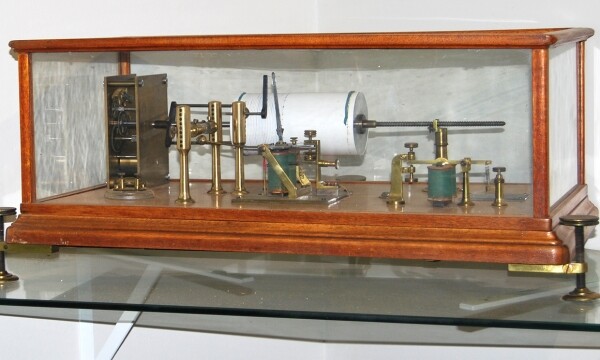
Popov's lightning detector from the Johannesburg Meteorological Station, displayed in the museum of the South African Institute of Electrical Engineers.
In 1903, the colonial government ordered a Popov detector among other equipment needed for the newly opened station located on a hill at the eastern edge of the city. The design of this detector matches Popov's original development, except that the trembler shaking the sawdust also deflected the recording pen. The recording material was wrapped around an aluminum drum that made one revolution per hour. With each drum rotation, a separate screw shifted the material by 2 mm, allowing the equipment to record events for several consecutive days.
Vermuelen for the December issue of the Proceedings of the IEEE from 2000. Unfortunately, he left us last year, but his colleague Max Clark was able to send us a photograph of the South African detector. Vermuelen actively advocated for the establishment of a museum for the collection of artifacts housed in SAIEE, achieving this in 2014. It seems fair, in an article dedicated to the pioneers of radio communication, to acknowledge Vermuelen's contributions and recall the radio wave detector he discovered.
Source: habr.com
