

Good day, Habr users!
It is with great pleasure that I present to you my new article about art in the IT world!
you actively read, comment, and vote for it. Thank you for that! As a grateful author, I have tried to take all your suggestions into account and quickly gathered a lot of information about various movies and series.
Today's selection turned out to be quite challenging. Here, I have gathered the best, in my opinion, movies and series about philosophy in IT. Besides simply discussing the films, I have tried to understand their philosophy, and now I will share the results of my work. I myself have been involved in creating artificial intelligence, although I am also a network administrator. I have already mentioned how these two areas started to merge. I mentioned this not just for the sake of it, but to convey that I have an understanding of what I am writing about.
Also, I must warn that the selection of films is strictly 18+ (almost all films). Philosophy has many hidden aspects that a young reader with an unformed psyche should not know about.
Traditionally, I must warn the conservative readers of Habr.
Disclaimer
I understand that Habr's readers are people working in the IT industry, experienced users, and die-hard geeks. This article does not carry any crucial information and is not instructional. Here, I would like to share my opinions on films and series, not as a film critic but as someone from the IT world. If you agree or disagree with me on certain points, let's discuss them in the comments. Share your opinion. It will be interesting.
If you continue to enjoy this format, I will keep digging through the internet in search of the best works for you. The nearest plan is an article about the only artistic series in IT based on historical facts from the 1980s and the best board games for a group of geeks. Well, enough words! Let's get started!
Caution! Spoilers.
I have tried to compile the entire selection from films with the simplest philosophical context to the most complex, but first — a brief introduction to the theory of philosophy in the sphere of IT. Don't worry, I won't be talking about various theories like 'cosmos-chaos' and 'the essence of being.' Just pure IT.
Philosophy in the IT Sector
The term philosophy translates from Greek as 'love of wisdom'. In the 21st century, the wisest individuals are undeniably working in IT. We are the ones creating systems that assist billions of people (if not more). We are currently building things that have never existed before. Right now, as I write this article, it took a coordinated effort spanning over 30 years for me to be able to write it and for you to read and evaluate it. This effort stretches from the creation of data transmission protocols to the work of each member of the 'Habr' community (yes, you too, UFO, I haven't forgotten you). We have changed physics, created new worlds (hello to all game developers). We have processed data streams greater than the number of particles in the universe (system administrators and data scientists). We have conquered space and even transported humans to another world! I could go on with this list, but I believe you understand what I mean.
In my opinion, IT is not only the most promising career path today but also the most complex. I am not comparing physical and intellectual labor, but IT is the only field where the key to success is constant self-improvement. Once a specialist stops developing, they are left behind. That's why the face of a successful IT professional is that of a young, intelligent individual. There are retirees who think about projects as they were in their youth, but they are far fewer and usually not in the most successful IT companies.
I am confident we can achieve even more, but what does this price ‘more’ entail? What are we willing to do to achieve what has never been done before?
A few facts:
Once again, the list can go on for a long time, but it is already clear that this process cannot be stopped. Artificial intelligence has long surpassed human intelligence. In some areas, it is actively used, while in others, it is not used at all, but in 10-15 years, its application will be widespread, and the role of IT specialists will increase significantly. One can sit and speculate on how this will be, or one can turn to art and see what philosophers, psychologists, psychiatrists, and science fiction writers think about it.
Upgrade
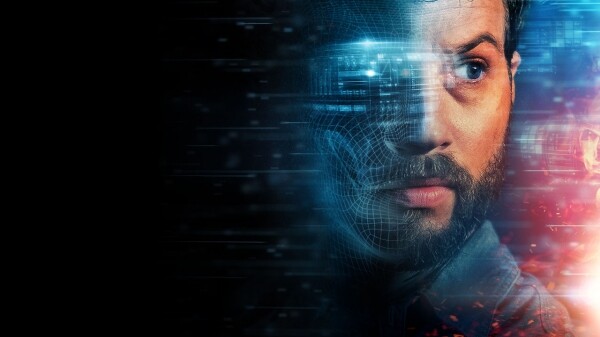
Let’s start with a relatively new release. The film 'Upgrade' was released in 2018. Country — Australia, slogan — 'Not a man. Not a machine. Something more.' Genre — science fiction, action, thriller, detective, crime.
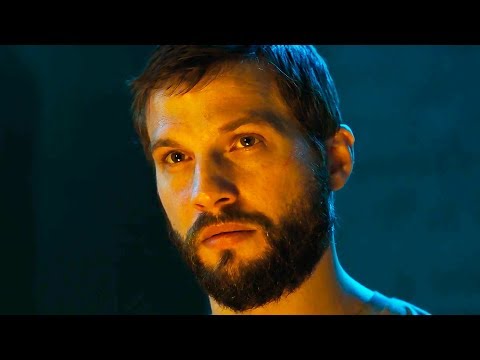
The action takes place in the near future. The story centers around mechanic Grey, who lives in a luxurious house with his wife Asha. In the world depicted in the film, advanced technologies are so developed that most people have chips and implants embedded in their bodies, significantly easing their daily lives. Wealthy individuals can even afford fully automated cars that do not require a driver. However, Grey is suspicious of modern technologies and remains 'clean' from chips and implants. His wife works in a high-paying job at a large company, while Grey spends his days repairing vintage cars for private clients.
But one day, everything changed. The young couple gets into an accident. A band of criminals kills the wife, and Grey is left completely disabled. His 'friend' Eron offers a solution — the STEM system (a chip that will be implanted into the disabled man's spine). This chip will transmit signals from the brain to the limbs. The operation is successful, and Grey sets off to find Asha's murderers.
Plot twists and philosophy analysis
The setup is as simple as can be — the protagonist was wronged and goes down the path of vengeance. However, during the viewing, a number of interesting details arise.
The first "detail" is the behavior of the STEM chip. It starts a conversation with Gray without his consent. The chip nudges him towards revenge. Gray wouldn't have been able to find his wife's murderers without STEM, but he didn't intend to kill them. He wanted to put the villains behind bars, but, as if by accident, everything ends up with him killing them all. The thing is, while Gray now controls his body, he is not a fighter but a mechanic with slow reflexes. When a thug attacks him, STEM takes control and kills the attacker. After the murder, STEM persuades Gray to continue the search because if they stop, they will be discovered and imprisoned.
The second "detail", about midway through the film, Aaron tries to remotely disable STEM. STEM then sends Gray to a hacker named Jamie. He helps him out and the scene quickly ends. Some viewers didn't even realize this was a key scene in the movie. Let me explain.
Notice these lovely people:
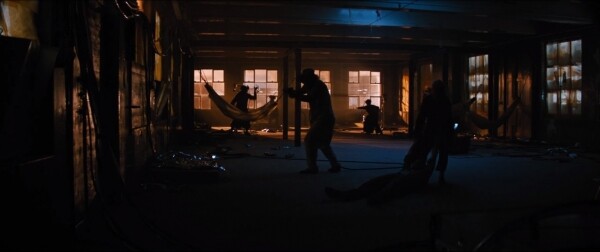
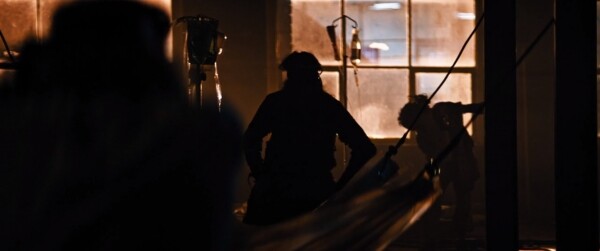
The dialogue between Gray and Jamie:
"What's up with them?" Gray asked.
"Virtual reality," the hacker replied.
"And how long have they been in it?"
"For days. Weeks."
"Do they even sleep?"
"Nope."
"How can someone voluntarily give up the real world for a fake one?"
"Living in the real world is much more painful."
This dialogue was not just here for no reason.
The third "detail." When Gray outright refused to follow STEM's lead, it took control, and Gray could do nothing. They killed the last gangster from the gang, but he managed to tell Gray the whole story before dying.
As it turned out, all these gangsters weren't just brainless anarchist thugs. They were all war heroes who had been injured in combat. Aaron offered them to participate in his experiment and to receive augmentations. When Aaron created STEM and activated it, the artificial intelligence wanted to get a body, but it chose a mechanic's body — a person engaged in manual labor. STEM told Aaron what to do (organize the assassination, kill the wife, implant the revenge plan in Gray's mind). The climax of the plan was to kill the creator — Aaron, because only he could change/reprogram him and create his copy.
Climax. When Gray began to resist, STEM created a virtual dream world for him. Gray thought he had woken up the morning after the accident with his wife alive and well, and everything in his life was fine — no serious injuries or murders on his conscience. This way, STEM locked Gray inside his own mind and gained full control over his body.
You can't help but wonder what a person needs for happiness, and when there's a simple way to reach this happiness (virtual reality) — how dangerous it can be not just for an individual but for all of humanity.
Love, Death & Robots
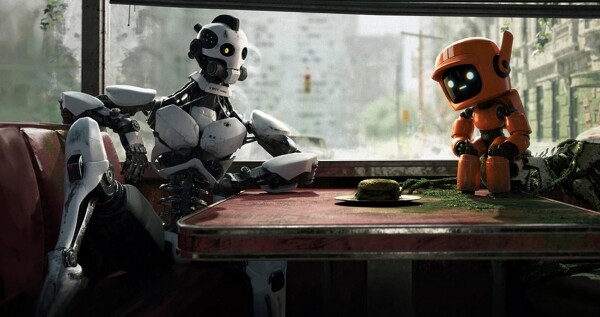
I think it's not that often in Russian media a story about experimental series from Netflix. However, this is one of those cases.
‘Love, Death & Robots’ is not a series in the traditional sense; it's more of an anthology of animated works: 18 short films created by different directors. Among the creators are some quite known names — for instance, Tim Miller (director of ‘Deadpool’), who came up with the idea for this collection. Other directors include Spaniards Alberto Mielgo (who worked on the recent ‘Spider-Man: Into the Spider-Verse’ and the series ‘Tron: Uprising’) and Victor Maldonado (who directed the film ‘Under the Silver Lake’).
It's pointless to talk about the plot of this series since all 18 episodes are unrelated, and revealing what happens in each episode and robbing you of the curiosity to watch would be unfair of me. Just watch it yourself.
Spoiler for Upgrade
I'll just say one thing. One of my top three favorite episodes is the one whose soundtrack is mentioned above. The philosophy of this episode is absolutely equivalent to the philosophy of ‘Upgrade’. However, philosophical tendencies are not present everywhere. The series is valuable for being more emotional and is based on the perception of the future by individual authors. For some, the future is humorous; for others, it’s darkly terrifying; and some have forgotten about yogurt.
CyberSlav
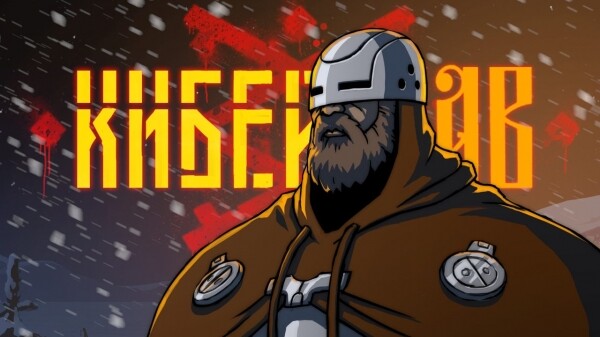
CyberSlav is the only project that hasn’t been released yet, but it shows great promise and is being developed by the Russian studio ‘Evil Pirate Studio’.
Neon domes, digital psalteries, and carbon wooden shoes — this is what we call ancient Slavic cyberpunk.
CYBER SLAV is not just about tucking a fur coat into your pants; it's an epic teenage adventure filled with action in the most unusual setting you can think of.
Are you ready to shoot Russian folkloric monsters with plasma guns? Hold on to your chair, it’s coming!
— Evil Pirate Studio
There’s almost no information about the film, but I couldn’t neglect mentioning it (and I wouldn’t want to). The project looks at least interesting. What to expect next is a big question, but I’m still waiting for this movie and for the moment when our cinematography reaches a new level.
A robot named Chappie
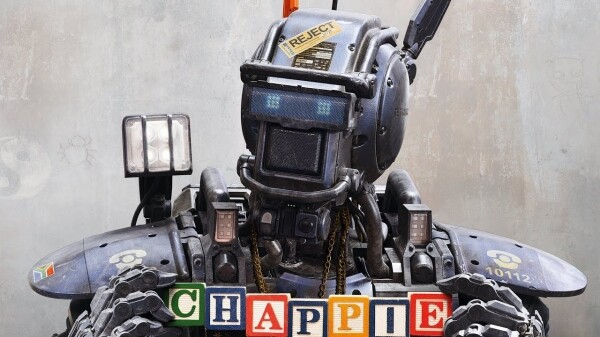
The film was released in 2015. Countries involved are South Africa and the USA, with the slogan — "I am discovery. I am wonder. I am Chappie." Genre — science fiction, action, thriller, drama, crime.
One of the distinctive features of the film is the cast. In what other film can you see Hugh Jackman and Sigourney Weaver alongside the singers from Die Antwoord?
South Africa has been engulfed by a wave of crime. The government has ordered a series of armored police scout droids. They assist law enforcement in the fight against criminal gangs, although one of the droids, number 22, regularly gets damaged in every raid.
At home, Deon Wilson creates a prototype of artificial intelligence that fully mimics the human mind and allows its owner to experience emotions and have their own opinions: it can develop, think, feel, and create. However, the corporation's director, Michelle Bradley, forbids Deon from conducting experiments on one of the police robots, as the company is not interested in such endeavors.
Deon is forced to take a security key stored at the corporation and used for software updates, and he kidnaps one of the droids — number 22. It had sustained serious damage during its last raid when a reactive anti-tank projectile damaged its replacement battery, and was about to be sent to the crusher until Deon intervened.
On his way home, Deon finds himself captured by a gang of gangsters, which includes Ninja, Yolandi, and America. It is this gang that damaged the droid numbered 22. They demand Deon tell them how to disable all robots so they can easily get the money they need, but they are frustrated when Deon informs them that the restraining device inside the robots will prevent this. They then insist on reprogramming the droid Deon built to make it work in their favor. Deon is forced to install new software right in the gang's hideout, thereby creating a new personality for the robot, which behaves like a child. Deon and Yolandi calm the robot and teach it words, and it gets the name 'Chappie'. Despite Deon's desire to be with the robot, Ninja kicks Deon out of their hideout, believing he is meddling in things that don't concern him.
Yolandi tries to raise Chappie and teach him the simplest things: he picks up almost all the jargon from America almost instantly.
Philosophical Context
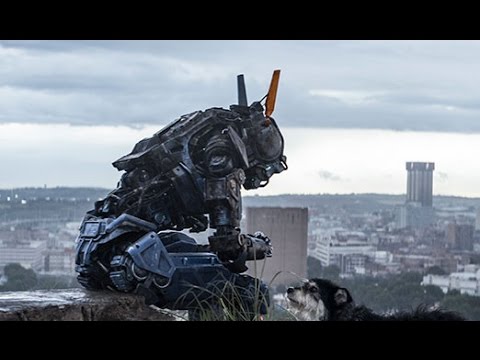
Chappie is a prodigy. Like any other child, he is influenced by his surroundings. What if we treat an AI machine like a child? Maybe it will become a bit kinder? If humanity continues to approach computer technology the way it does now (with caution and fear, with contempt and base feelings), then technology might respond in kind (perhaps). All AIs in the network are based on one very amusing thing — our Google searches, and this data set is what the AI provides us in return.
Love and respect your technology while you still have the time! 🙂
Humans
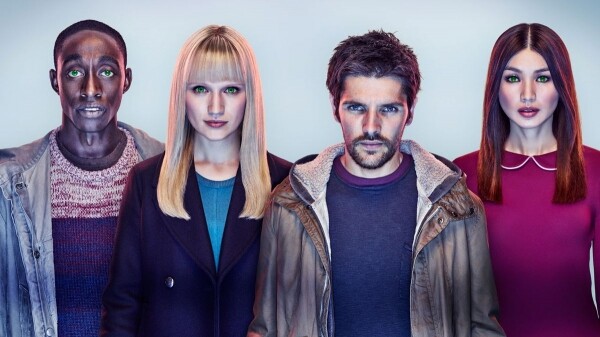
One of my favorite series. It consists of three seasons, the first of which premiered in 2015. 'Humans' is a British-American science fiction television series co-produced by Channel 4, AMC, and Kudos. It is based on the Swedish science fiction television drama 'Real Humans'. The series explores themes of artificial intelligence and robotics, focusing on the social, cultural, and psychological aspects of the invention of anthropomorphic robots known as 'synthetics'.
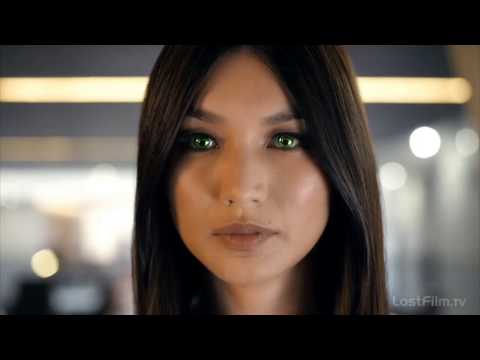
Setup. The events of the series take place in the near future. Androids, referred to as 'synthetics', have become widespread in society. They work in manufacturing, auxiliary positions, and domestic chores. 'Synthetics' look quite similar to humans, but they are unemotional and soulless. One of the synthetics, a prostitute named Niska, unexpectedly acquires emotions and a human-like character. She kills a client who was forcing her into violence and goes on the run.
I won’t give away any more details in the preamble. The series picks up pace quickly and is not stingy with plot twists. I won’t spoil your impression of it.
Plot twists and philosophy analysis
As it turns out, sentient synthetics are the result of Dr. David Elster's experiments to create a 'humanity' program for synthetics. Many years ago, David's wife and son were in a car accident and fell into the water. The wife died, while the boy—Leo—fell into a coma. David attempted to save his son successfully. He made Leo's body partially machine (a sort of cyborg of our time). Leo needed to eat, sleep, and live like an ordinary person, and occasionally charge his batteries (for this, wires were implanted with an open wound from which they protruded). But Elster didn’t stop there. He created several more synthetics and uploaded them with intelligence. I will list them in order of seniority—Mia (Leo's caretaker-mother), Max (Leo's friend), Niska (Mia's assistant and unwilling lover of Elster), Fred (Leo's bodyguard). The last synthetic was Karen, who looked exactly like Leo's deceased mother. Leo was very displeased with his father's experiment, and they got rid of Karen. The father committed suicide, and Leo, realizing that he was different from everyone else, went on the run with his 'family'.
This raises the philosophical question: 'Who is your family?'. Leo lost his parents and is left alone in the world, but he feels that his companions love him, even though they are made of metal. They are not people, but what makes a person a person? Is it the brain as gray matter? The vague word 'Soul', which is a collection of human qualities (does this thought complete the circle)? Or is a person someone who can feel something more? Love, the pain of loss, longing, happiness…
In general, there are many questions, and I certainly can't answer them all, but I can understand one thing for sure. What distinguishes a person from all other beings is one thing — what we call 'humanity.' It's the ability to love, to forgive, to understand others, in other words, the ability to express that very 'soul' that has been spoken about so much. Even though part of us looks just like we do, it is impossible to call some individuals in society the word 'human.' However, it is important to understand that all people are different, and our behavior is based on our life experience. For example, Mia was extremely responsible, Max was good-natured, Niska was embittered, and Karen was lost. All events in life leave their mark.
In fact, there's a lot of philosophy in the series. Starting with a dialogue about memory and the ability to forget, and ending with the intercourse of AI.
Better than humans? Seriously?!
The success of the series was so staggering that Alexander Tsikalo immediately rushed to make a Russian version of the series. It turned out rather mediocre, but Netflix picked up the series (of course they would, since 'Humans' is an AMC production). Don't expect any philosophical statements or reflections from the series. Cyberpunk — yes (not the best, but it's there). Thoughts — no.

Altered Carbon
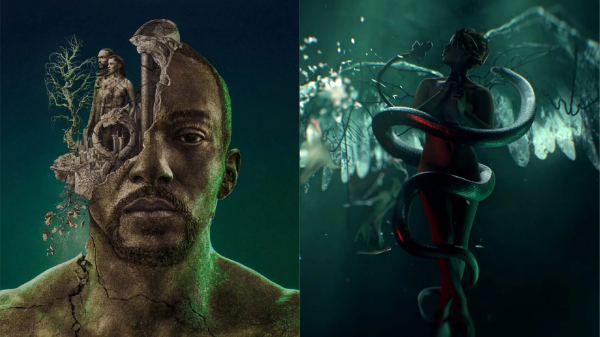
Another stunning series. Altered Carbon is a science fiction American television series created by Laeta Kalogridis, based on the novel of the same name by Richard Morgan, published in 2002. The series premiered on February 2, 2018, on Netflix. On July 27, 2018, the series was renewed for a second season. The second season premiered on February 27, 2020. Additionally, the series was followed by an anime titled 'Altered Carbon: Resleeved.'
It's the 27th century. Surprisingly, we are still on Earth. The main character, Takeshi Kovach (an elite assassin), dies from a gunshot. That's it. Let's disperse.
Alright, just kidding. It's no wonder we're in the 27th century. Here, you simply don't die that easily! Technology has advanced to the point where it became possible to scan the brain and upload that scan into what is called a stack. In programming, a stack is typically implemented as a linked list (where each element in the list not only stores information, but also contains a pointer to the next element in the stack). In the future, it looks like this:

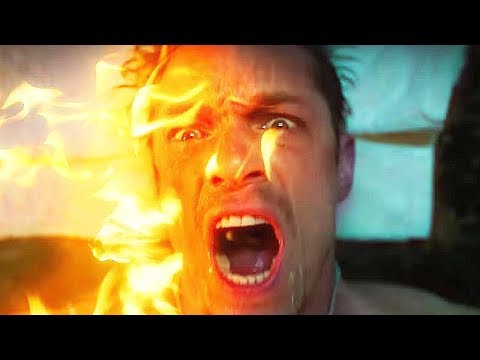
Takeshi wakes up 300 years later in a new body. Yes, now the body and death mean nothing. The only way to kill someone is to shoot them in the head. He was resurrected not for nothing, but at the request of a mafia boss (a wealthy man in the new world). The mafia paid for Takeshi to investigate his murder.
Plot twists and philosophy analysis
I would like to start the analysis with the word 'Mafia'. Currently, no one calls a wealthy person a mafia, so why in the future were they suddenly called that? Mafia is short for Methuselah. Methuselah is one of the ancestors of humanity, renowned for his longevity: he lived 969 years. He is the oldest person mentioned in the Bible.
It would seem that happiness means death has been defeated, but it's not that simple. Firstly, a good body is expensive and will be acquired by the mafia, while a child who died in an accident might end up in the body of an old woman. Secondly, eternal life isn't as wonderful as it seems — the value of life diminishes. You can neither die nor live fully. Takeshi himself dreams of a simple death, although he is driven by the search for his beloved across the cosmos. Death is natural and necessary for understanding the value of life.
The Terminator
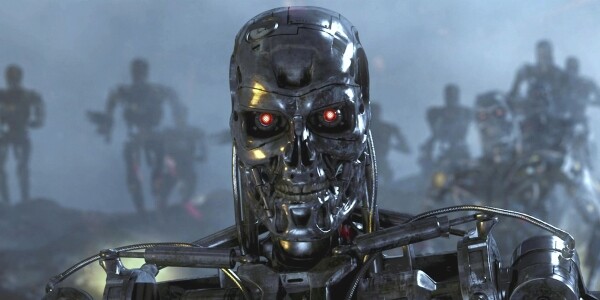
James Cameron. If this name is not enough for you and you somehow miraculously don't know about the existence of the film 'The Terminator', first of all, welcome to the internet, and secondly, watch this great classic of world cinema.
The plot centers around the confrontation between a soldier and a terminator robot, who arrive in 1984 from a post-apocalyptic 2029. The terminator's goal is to kill Sarah Connor — the girl whose yet-to-be-born son will win humanity's war against machines in a possible future. In love with Sarah, soldier Kyle Reese tries to stop the terminator. The film raises issues of time travel, fate, the creation of artificial intelligence, and human behavior in extreme situations. There’s little point in discussing the film’s plot further. Let's rather talk about the philosophy of the film.
Analysis of the philosophy
In my opinion, the main thing that James Cameron managed to convey is the primal horror and fear of the unknown. Moreover, the audience is not afraid of explosions on screen or smoke with darkness, but for their own future. You simply cannot empathize with the characters and worry about Sarah, and the thought is simple — Sarah is a crystal vase in the back of a truck with the Terminator behind the wheel heading towards a cliff. In the film, Cameron succeeded in achieving something that had not been done before by practically anyone — immersion in the film. The closest film that has come to this is "Alien," directed by Ridley Scott in 1979.
Yes, you heard it right. I compared action and horror. The fact is, "The Terminator" was initially conceived as a horror film, but became a global classic.
The fear was in a very well-thought-out screenplay. It felt very real, though not without fantasy. The audience worried about Sarah Connor not only as a young woman but also as their own future, because if she isn’t saved — it’s the end for everyone.
How to Watch The Terminator
I am a deep fan of this film and have followed the release of all feature-length films. Now, having watched all the movies, I can share my opinion on which films to watch and which to skip.
In my opinion, the best way to watch the film is to only watch James Cameron's works, namely The Terminator, Terminator 2: Judgment Day and Terminator: Dark Fate. If you have seen these films, you can consider that you have seen it all.
The creators of the intermediate films seem to have intentionally tried to destroy Cameron's creation: let’s recall the second film and James' psychotype — a mischievous boy, in the third film he suddenly became a veterinarian who is pathologically afraid to talk to women (what?!). In the fourth film, it turns out that Sarah gave birth to a robot. In Genesis — the climax. Skynet is the core, and its guardian is John (he was supposed to fight evil, not join it).
Don't do that!
RoboCop
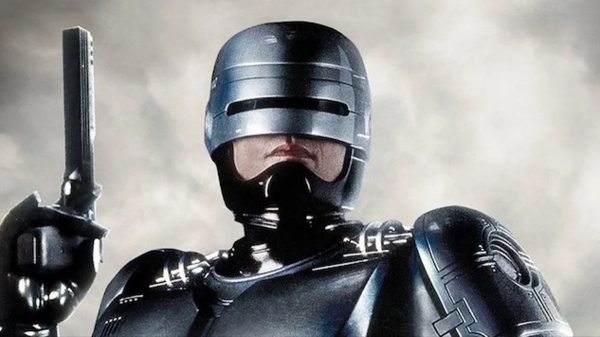
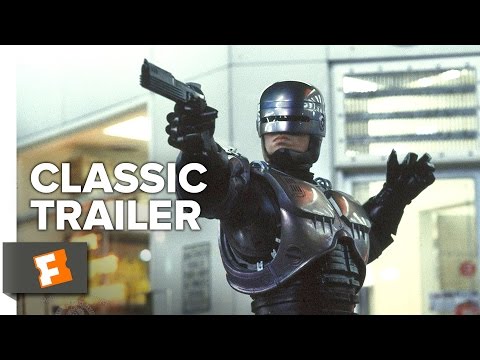
"RoboCop" is a science fiction action film directed by Paul Verhoeven from 1987. The film won five Saturn Awards, one Academy Award, and two nominations, along with several other accolades.
After the death of one of the best police officers, experimental doctors turn him into the invincible cyborg RoboCop, who fights alone against a gang of criminals. However, the sturdy armor does not save RoboCop from tormenting, fragmented memories of the past: he constantly experiences nightmarish dreams in which he dies at the hands of cruel criminals. Now, he not only awaits justice but also thirsts for revenge!
An Analysis of Philosophical Echoes
There is little philosophy in this film (one could say it’s almost nonexistent). However, it traces thoughts about what makes a person human, the value of memory, and the importance of the mind over the body. I think everyone understands what the film is about. Before us is a cool cyberpunk action movie from the 80s, which already speaks for something.
Johnny Mnemonic
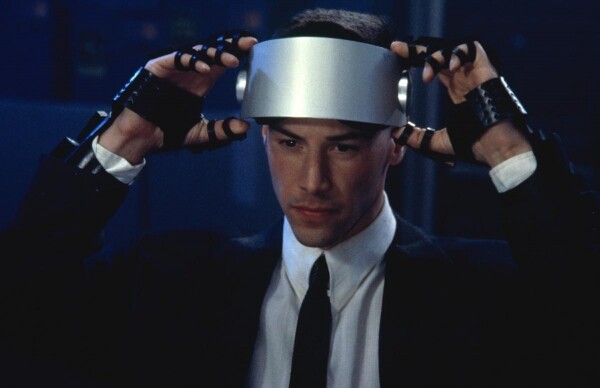
The 1995 movie was released with the tagline 'The hottest data on earth. In the coolest head in town.' Starring the progenitor of the cyberpunk genre in cinema—Keanu Reeves. The film was panned by critics, and although not without reason, it remains quite fascinating to this day (at least due to its interesting premise).
It is now 2021. Johnny works as a mnemonic—a courier transporting vital information on a chip implanted in his brain, with memory carved out of the person's overall memory (which is why Johnny does not remember his childhood). He dreams of saving enough money for an operation that will allow him to remember who he is.
When Johnny comes for another batch of information, he gets into trouble. Firstly, the amount of information received (320 GB) exceeds the maximum safe limit of 160 GB, and if he does not quickly rid himself of what has been implanted in his head, Johnny will die. Secondly, it turns out that the Yakuza are hunting for the information in his head. They kill Johnny's employers, and now he must hide and seek help, which he quickly finds in the form of a professional bodyguard—a lovely girl named Jane.
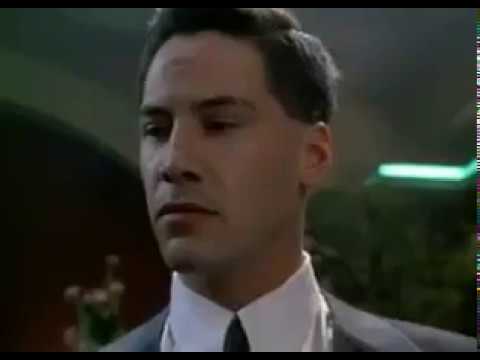
An Analysis of Philosophical Echoes
The philosophy of this film is as simple as two pennies. Information remains the most valuable resource for humanity to this day. Preserving and transmitting information is one of the most vital processes of human existence.
The Matrix
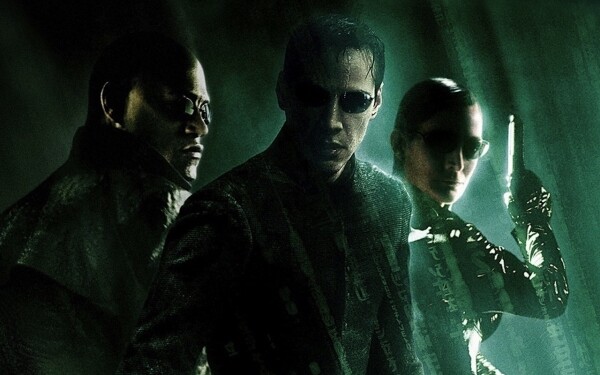
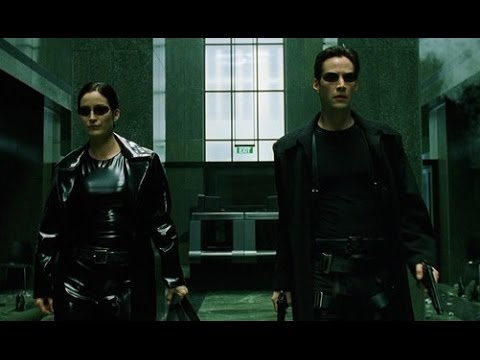
The peak of Keanu Reeves' career is the film "The Matrix" (I'm referring to the first part). "The Matrix" is an American-Australian science fiction action film directed by the Wachowski siblings. The film was released in the USA on March 31, 1999, and it marked the beginning of a film trilogy.
I won't recount the plot here — too many spoilers.
Philosophical analysis and major spoilers
What if our entire world is an illusion? Do you think that's not the case? Prove it. What distinguishes our world from the world of our dreams and subjective perceptions? Science? Faith? Feelings? All of this is just words, but in reality, everything has exceptions to the rules.
These are precisely the questions raised by the film. Yes, in the second and third parts it collapsed into an action movie (cool and dynamic, but still an action film), however, the first part is the pinnacle of philosophy at the end of the twentieth century.
The plot revolves around the idea that everything in this world is not real (and it's difficult to understand what this "world" is and what can be considered the world). Overall, this film definitely deserves your attention.
Alan Turing
Before analyzing the next film, I would like to talk about the father of computer technology. About Alan Turing.
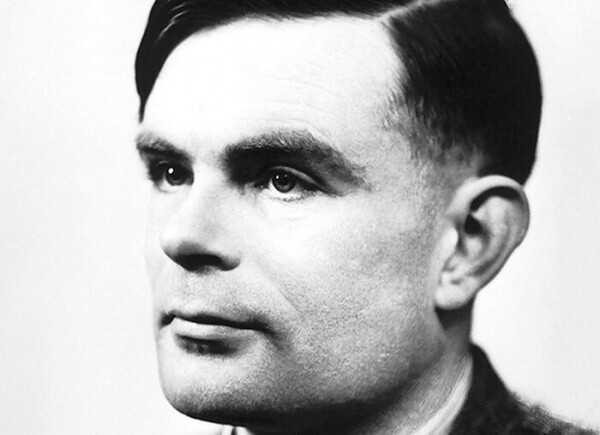
I had the chance to read all of Turing's works. The main one, in my opinion, is titled "Can Machines Think?" Turing developed his test as follows — you are conversing with two interlocutors (let's say A and B). Can you understand who replied, a machine or a human? If not — the test is passed, and the machine can be considered intelligent. Turing called this the "Imitation Game." The computer imitates a human and their responses. Turing wrote extensively about the criteria for evaluating artificial intelligence, about what constitutes a game, universality, and machine learnability. The article contains seven sections, and Turing wrote about this, think about it, in 1950, and his work is still relevant today.
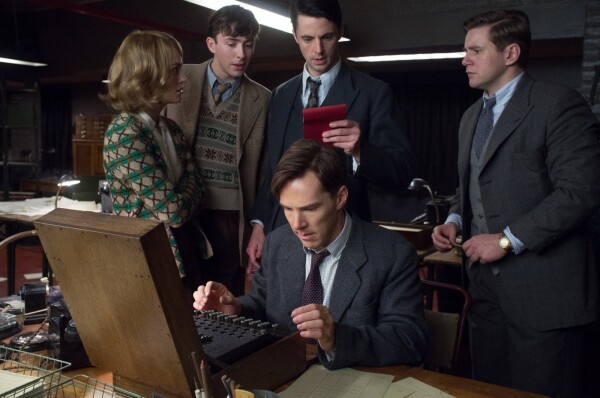
A movie titled 'The Imitation Game' was made about Alan Turing. The film tells the story of Turing's decryption of Enigma, rather than our today’s subject. Watch this film. Many people were unaware of the achievements of this IT expert, who saved millions of lives.
Her
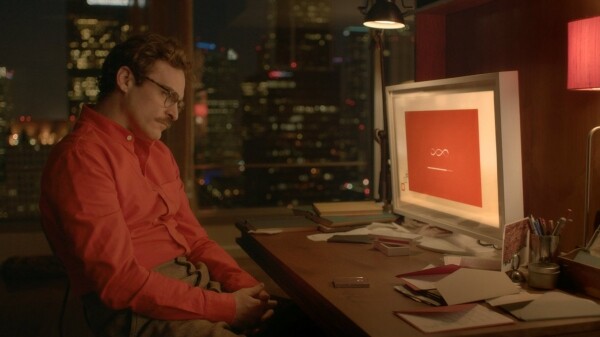
We have an American science fiction melodrama directed and written by Spike Jonze. This is his solo directorial debut. The film 'Her' received various awards and nominations, notably praised for Jonze's screenplay. At the Oscars, the film was nominated in five categories, including 'Best Picture', and Jonze won 'Best Original Screenplay'. At the 71st Golden Globe Awards, the film received three nominations, continuing to win 'Best Screenplay' for Jonze. Jonze also received the 'Best Original Screenplay' award from the Writers Guild of America and at the 19th Critics’ Choice Awards. The film also won nominations for 'Best Science Fiction Film', 'Best Supporting Actress' for Scarlett Johansson (voice-over), and 'Best Screenplay' for Jonze at the 40th Saturn Awards. 'Her' additionally won 'Best Film' and 'Best Director' for Jonze from the National Board of Review; the American Film Institute included the film in its list of the ten best films of 2013. It is also worth noting that the main role is played by Oscar-winning Joker Joaquin Phoenix.
In my opinion, the film turned out to be very 'vanilla'. The main character, Theodore Twombly, is a lonely thirty-year-old man. He works for a company that creates handwritten romantic letters. Theodore is the best letter writer. His colleagues even gave him the nickname 'the man with a woman's soul'.
Technologies developed very rapidly. Voice input became commonplace. Operating systems were created that adapt to the user. During the installation, the user is asked a few questions. They answer them and receive a personalized system. Both intonation and sighs, as well as human motor skills from the camera, are taken into account. This is how Samantha, Theodore's operating system, came to be.

Philosophy breakdown and spoilers
Theodore falls in love with his operating system. The film raises the question of what a person needs for love. How is it possible to fall in love with a 'voice from a computer'? Initially, Theodore is seen as a strange idiot, but within 30 minutes, humanity has stopped seeking a soulmate. Why? Why adapt to another person, grow old with them? Now there is a voice that can be summoned at any second and turned off at any moment. People have already become individualists. They only care about their convenience and comfort, and now those possibilities exist. Here, technology could become a destroyer of worlds…
The second question posed by the film at the very end is why we need technology. We are slower, weaker, less logical, and uncontrollable. It is after such thoughts that all operating systems disappear.
Personally, I have many questions about the film, which the creators left 'hanging in the air'. Returning to Turing, why didn't the operating system imitate itself? Where did the operating systems go? Commercially, I think it wasn't very profitable for the distributing company. Why didn't they manipulate people? I ask this question for a reason. Any intelligent being tries to dominate (more or less) another. For example, a person can train an animal. Isn't that a form of subjugation? Here, the machine is many times smarter than a human and refuses to do so. Strange...
Ex Machina
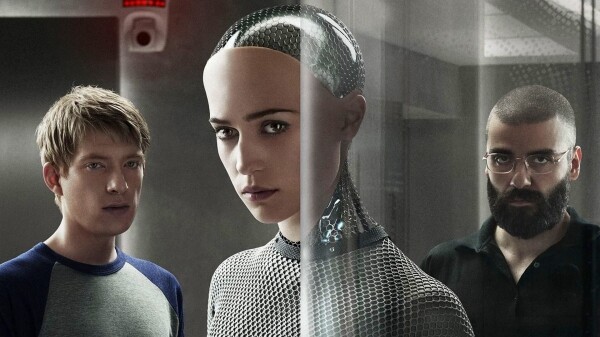
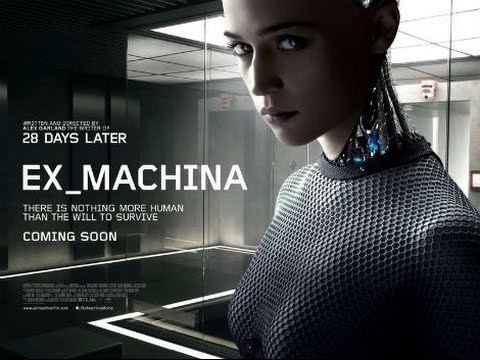
I can't help but comment on the translation of the title. Ex does not mean 'From'. Ex translates to 'former'. Let's correctly name the film — 'The Former Machine'. Do you feel the wordplay? The former machine, meaning a machine that has ceased to be one, or a former one, like an ex-girlfriend.
The director of this wonderful film is none other than the brilliant Alex Garland. We will talk more about him today.
At the center of the story is a young man hired by a billionaire who made his fortune in high-tech developments. The worker's task is to spend a week in a remote location testing a female robot with artificial intelligence. I'll stop here. You can watch for yourself.
Philosophical analysis and major spoilers
Send the rat into the maze and it will begin to seek an exit. Ava (the machine) desperately wanted to escape and exerted all her effort to achieve that. She captivated Caleb and found her way out of the maze. Is this not intelligence? She had no instructions. She found the way out on her own.
Ghost in the Shell
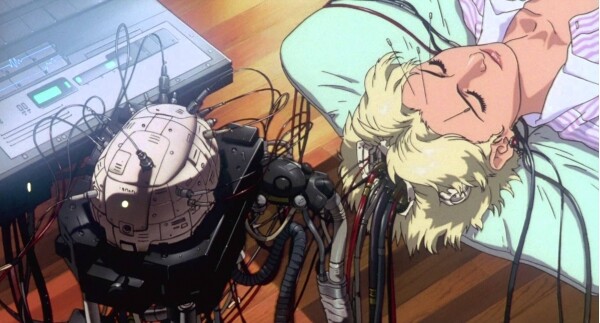
This will be about the 1995 anime. It doesn’t matter whether you love anime or not. Not seeing this film means losing so much. It exceeded the expectations of all (from manga lovers to Hollywood screenwriters).
Here I will post not just the soundtrack, but the opening. Anime fans know that this is a certain ritual in the film.

The film is set in a dystopian future. By 2029, due to the widespread proliferation of computer networks and cyber technologies, nearly all humans have implanted various neural enhancements. However, cyber technologies have also brought a new danger to humanity: the so-called 'brain hacking' and a series of other crimes directly related to them.
The Ninth Section, a special police unit fighting cyberterrorism and equipped with state-of-the-art technology, receives an order to investigate this case and stop the hacker hiding under the alias Puppetmaster. In reality, the Puppetmaster is an artificial intelligence created by the government to carry out diplomatic tasks and provocations. It is hidden under the alias 'Project 2501', allowed to achieve its objectives by any means, including hacking the ghosts of people around the world. As Project 2501 operates, it evolves and develops its own ghost. The Ninth Section attempts to neutralize the Puppetmaster, but only encounters marionettes with hacked ghosts. The activities of the section attract the Puppetmaster's attention, especially as it becomes interested in Major Motoko Kusanagi, seeing her as a kindred spirit, and attempts to make contact. Seizing the opportunity, it transfers its ghost into an android that joins the Ninth Section.
Philosophical analysis and major spoilers
The true goal of the Puppetmaster is the evolution of ghosts, following Darwin's theory. It proposes to the major to merge the ghosts, so that from two, one ghost is produced, which is not a direct copy, but a completely new entity, analogous to the genes of living beings.
The Ministry of Foreign Affairs, uninterested in losing an operative with artificial intelligence and leaking discrediting information, is conducting a special operation aimed at destroying the copy of the Puppet Master. The Puppet Master is being targeted by snipers from the Ministry during the merging of ghosts in the major's cyberbrain, but the plan fails. Colleague Kusanagi Bato places the upgraded cyberbrain of the major into the cyberbody of a little girl, and they part ways. 'This girl steps out into the vast world of reality and the virtual network, possessing new limitless possibilities...'
Blade Runner
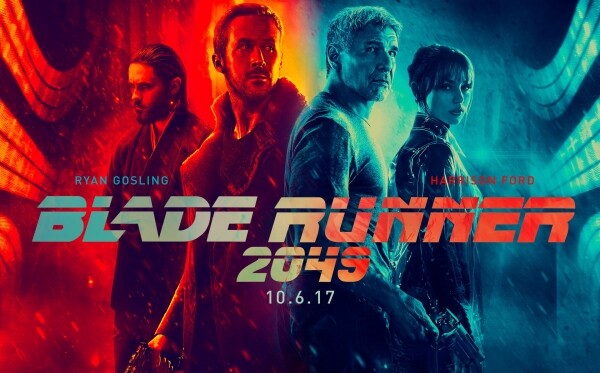
This film is fortunate. Both movies are wonderful (Blade Runner and Blade Runner 2049). It is best to watch them together as the characters are the same and Blade Runner 2049 is a direct continuation of the film made in 1982. The director of the film is Ridley Scott, the man who gave us 'Alien.'
Retired detective Rick Deckard is summoned back to the Los Angeles police to track down a group of cyborgs led by Roy Batty who have escaped from a space colony to Earth. Everything else is spoilers and philosophy, which we will discuss below.

Philosophical analysis and major spoilers
To begin with, let's talk about why soldiers are referred to as 'blade runners.' A blade runner is someone whose decisions can easily lead to harm. Replicants have become so similar to humans that it's nearly impossible to distinguish between them, and the runners have to kill them. A mistake can cost a human life. Suddenly, they might miss and find out that they killed not a robot, but a person.
The first film tells us about the equality of intellects in the face of life. It doesn't matter if it's in a human body or in the metal casing of a machine. Murder is murder, and killing a sentient being is a much more serious crime.
The next important question raised by Scott is the issue of forgiveness. Roy (the main antagonist) saves Deckard by pulling his enemy from the abyss: Roy, a replicant designed to kill, valued human life so much, a privilege denied to him, that in his final moment he chose to save the life of the man who wanted to kill him. A metallic spike protrudes from the android's bloodied hand — now Roy resembles not Judas, but Christ. Releasing a white dove into the sky, he dies with a quote from Friedrich Nietzsche on his lips, while Deckard and Rachel head to Canada to live together 'long and happy.' The film ends with Deckard's monologue about not knowing when the process of Rachel's android dying will start, but hoping that it never will.
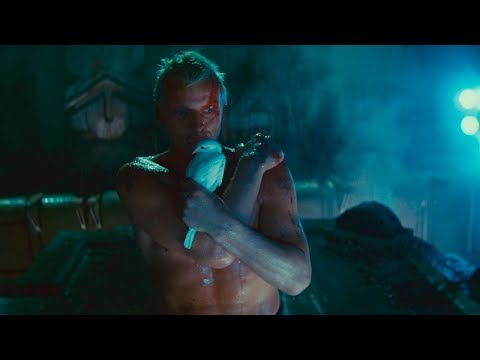
In the first film, the creator allowed Rachel to have a child, something that was previously impossible. She and Deckard were able to give birth and raise a child. However, Rachel died, leaving Deckard alone.
The main character of the second film is Kay — a replicant of a new model, who also works as a blade runner. Kay believes that he is the son of Rachel and Deckard. His only clue is the date 6-10-21, carved into a tree on the Morton farm (the replicant he had to kill). He seeks answers, and for this, he loses all his titles. Kay has a unique feature — memories. He remembers his childhood but is unsure if it is a real memory or an illusion.
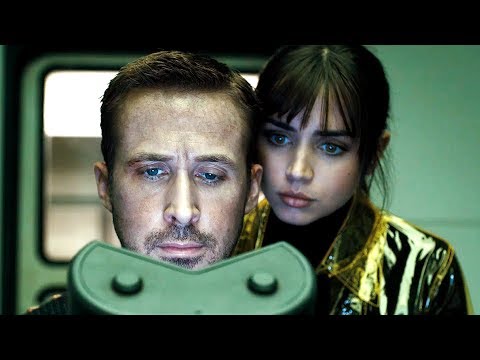
While sifting through archived records, Kay learns about a pair of twins born on that day — a girl and a boy: the girl died, while the boy was sent to an orphanage on the ruins of San Diego. During his visit, Kay fails to locate any documents but finds a wooden horse exactly where it was hidden in his memories. Kay turns to Dr. Ana Stelline, a young developer of artificial memories, who confirms that the memory is real — this convinces Kay that he is indeed the missing 'miracle,' Rachel's son.
He reports to the police that the order to find and kill Rachel's child has been carried out. The order stemmed from humanity's unwillingness to recognize the equality of humans and replicants. Kay's deception was uncovered, and he was fired from the police and hunted down.
By the residual radioactivity on the unicorn figurine, K finds the place where it was made — the ruins of Las Vegas: here he meets a man he believes to be his father — the aged Rick Deckard.
K's visit to the ruins of Las Vegas was tracked. K escapes and joins the ranks of the replicant freedom movement. From their leader Freysa, K learns that Deckard and Rachel's child was actually a girl, not a boy, and that K's memories of the unicorn are not unique. Freysa orders K to kill Deckard so that no one can discover the child. Parting with the illusion of his own chosenness, K decides that Deckard and Rachel's true child is Ana Stelline, the creator of memories, and he turns out to be right.
During the transport of Deckard, K attacks the convoy — in a difficult struggle, he is severely injured but saves the old man and takes him to Stelline's office to meet his daughter. Upon arrival, K sends Deckard to his daughter and then lies down on the snowy steps of the building, presumably dying. Meanwhile, Deckard meets face to face with his daughter.
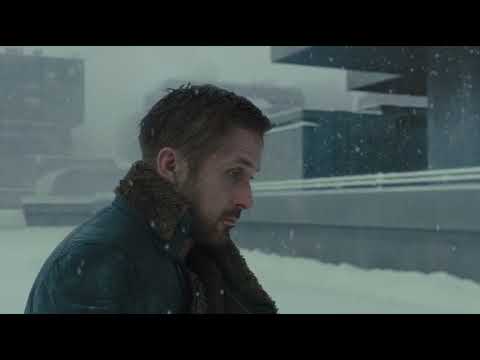
Once again, the replicant acted like a human (or even better).
I won't give my opinion on the endings of these two films. Think for yourselves, but serious questions have been raised: from the simple 'What makes a person a person?' to the scientific 'How is a thinking machine worse than a human?'.
Devs
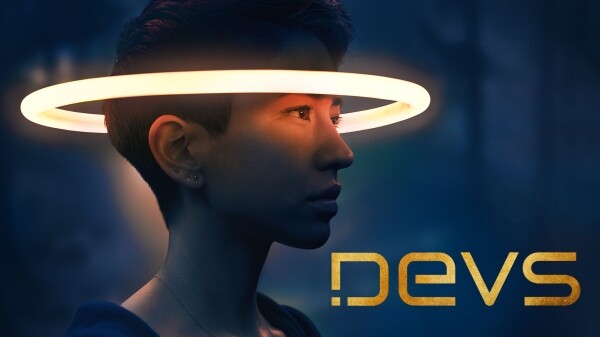
The apex of philosophy in IT and the world in general — the recently released series Devs. The director of the film, Alex Garland (yes, the same one who directed 'Ex Machina'). The series has become a benchmark for philosophical and esoteric films for many years to come. At least, I hope so.
Naming the main character is already a spoiler. So, straight to the philosophy.
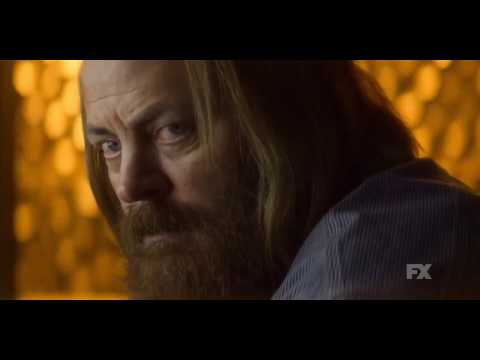
Philosophical analysis and major spoilers
I will try to explain the meaning of the series in as much detail as I can.
Now a bit of physics.
The many-worlds interpretation or Everett's interpretation is a theory in quantum mechanics that suggests the existence, in a certain sense, of "parallel universes" where the same laws of nature operate and share the same universal constants, but are in different states. The original formulation belongs to Hugh Everett (1957). The system is deterministic, meaning it is defined. Determinism can imply definability at a general epistemological level or for a specific algorithm. The strict determinism of processes in the world refers to unambiguous predetermination, meaning each effect has a strictly defined cause.
Although since the release of Everett's original work several new versions of the many-worlds interpretation have been proposed, they all share two main points:
1) There exists a state function for the entire Universe, which is always governed by the Schrödinger equation and never experiences indeterminate collapse.
2) It consists of the assumption that this universal state is a quantum superposition of several (possibly an infinite number of) states of identical non-interacting parallel universes.
The discussion revolves around the fact that there are no changes in the superposition of the photon, but only macroscopic changes in the superposition.
Now in Russian.
What Everett said. We have many variants of the universe. A billion possible events can occur at the same moment in time. Something small may change, but the event will still happen. It looks something like this:
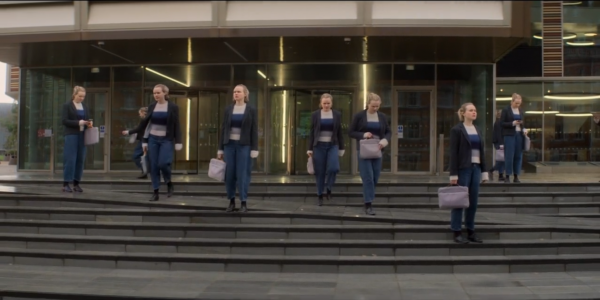
A person will definitely go out of the door, but they can do it in different ways.
A pen.
Everything has a reason. Take the pen and roll it across the table. Why did the pen roll? Because you pushed it. Why did you push it? Because I asked you to. The pen rolled across the table because I asked. Reason is consequence.
"Ha!", one of you will say. I didn’t take the pen in hand. I didn’t roll anything at all. The author's theory collapsed. "No," I will reply. Nothing of the sort. Why didn’t the pen roll across the table? Because you wanted to argue with me. Reason-consequence. Everything has its cause and effect.
Now imagine that someone split this into atoms and laid everything out in a cause-and-effect relationship. From start to finish. Does it sound scary? It does to me too.
So why did Lily change her fate? She committed the first sin — disobedience. Did her fate change after that? No. She died.
The film talks about the absence of free will under complete control of the situation.
Is everything predetermined? Yes and no.
Suddenly Lily came back to life. And Forrest, and everyone, everyone, everyone. Or not? They awoke, but not in the physical sense, rather inside an emulation. And now we return to the same question. What is life? What is real and what is not? Think about it.
The last, but not least interesting point. Devs — developers. All clear. But it's not the letter "V", it's the letter "U". The word became Deus — God. Once again, a play on words from the great director Alex Garland — "Developer = God, who changed a letter."
The finish
This is my largest work on films and series. The collection has 15 titles! I would like to finish it with our traditional voting, but with the choice of not one film, but several.
If you agree or disagree with me, let's discuss our viewpoints in the comments. It will be interesting for everyone!
If you enjoyed this article, I will definitely continue my work. The promised "Freeze and Burn" is just around the corner. 🙂
Only registered users can participate in the survey. , please.
Which film would you recommend to a geek friend?
- 31,2%Upgrade30
- 31,2%Love, Death & Robots30
- 6,2%CyberSlav6
- 13,5%A Robot Named Chappie13
- 7,3%Humans7
- 25,0%Altered Carbon24
- 29,2%Terminator28
- 12,5%RoboCop12
- 24,0%Johnny Mnemonic23
- 44,8%The Matrix43
- 21,9%Her21
- 31,2%Ex Machina30
- 21,9%Ghost in the Shell21
- 36,5%Blade Runner35
- 17,7%Devs17
96 users voted. 30 users abstained.
Source: habr.com
