

The RUVDS blog on Habr has seen it all: from the popularization of JavaScript and cool translated materials to yachting, educational and professional development issues, burgers, cheeses, beers, and calendars featuring cyber-girls. The idea of discussing the basics of trading and working in the stock market has been on our minds for a long time, and here's why. Most companies writing on stock-related topics have a clear goal: to attract clients for their tools and brokerage accounts, which means that in their articles, investing is presented as an exclusively appealing activity that should become a hobby for every geek. The only thing we can offer novice traders is VPS with trading platforms, and we have no motives to represent the world of stock trading as a means to get rich.
We decided to create a series of articles about the basics of trading and the most popular assets for beginners. Honestly, without any calls to hand over money to a broker or open an account with a specific bank. Ultimately, the decision of whether this is your path or not is entirely up to you. Sometimes it is much more profitable and even faster to master a new development stack and boost your salary and stable income to the level you need.
How much money should a beginner investor have and where can they get it?
There is no established amount. Among brokers, you might hear figures starting from 100,000 rubles, but it's clear that this is a narrative for the passive behavior of the novice investor (that is, if you entrust capital management to a broker and don't make decisions on trades yourself). If you decide to try earning on your own, you can use the following minimums as a guideline:
- the "standard" minimum — 10,000 rubles
- IIS (individual investment account) — up to 400,000 rubles per year
- to purchase domestic blue chips — 10,000 rubles
- to purchase foreign products — heavily depends on the selected assets
But, I reiterate, these are conditional amounts: you can choose your own, and sometimes the minimum account balance is set by the broker you will be working with.
The key is to determine the important parameters of the funds you are willing to invest.
- At the beginning of your investment journey, do not invest your last funds; you should always keep a reserve of cash. One of my best practices is to set aside 10% of any income (from side jobs, main jobs, bonuses, and even gifts). If you don’t have a saving goal for something important, part of this money can be tested in trading on the stock market.
- Do not take out loans for investments (except for leverage, which is special margin from a broker) — you may lose borrowed funds instead of multiplying them. Losing your own money is upsetting, but losing someone else’s is frightening.
- Be prepared to 'free up' your funds for around 3 years — sometimes this is related to a tax refund, sometimes to forming a long-term low-risk portfolio, etc. Plus, you definitely won’t immediately find the most advantageous strategy for you.
How to start trading on the exchange?
Directly — you can’t. In Russia, individuals are not allowed to make independent investments in the stock market. To gain access to the Moscow Exchange and other platforms, you need to sign a brokerage service agreement and open a brokerage account. After that, you can entrust a professional market participant with managing your money (for large amounts) or start trading on your own (if the amounts are small).
- Working directly with a broker — you sign a contract, set up trading platforms, and start experimenting based on your knowledge or (which is not bad but risky) discussions on forums with professional traders and amateur traders. This is the optimal option for beginners.
- QUIK — a toolkit for analysis and trading with extremely fast data updates. You can trade on Russian and foreign stock markets. It is secure due to data encryption.
- MetaTrader5 — a program for trading in futures, currency, and stock markets. It allows you to create custom reports and trading algorithms in the MQL5 programming language.
- Working in the mobile app of a broker or bank is a very accessible version for novice investors, offering all the features of trading (news, analytics, retrospectives, tips, portfolios, ready-made strategies, etc.), but without diving into the most interesting and complex details of investing.
- Using ready-made trading strategies is a tool for investors who are not interested in personal growth; they simply want to invest money for future returns. You invest in a pre-built portfolio strategy and just wait for it to perform and yield profit (typically, they always show positive results, although often small). Despite the straightforwardness of this choice, don't turn away from this investing method: by ‘digging into’ your portfolio, you can learn the principles of portfolio formation, product and risk combination, and the analytics underlying the strategy.
- Starting to program and write your own trading robots for high-frequency trading is an option for strong coders in the tech community. However, it’s not the best approach for practical work, as platforms sometimes seek ways to counteract this method, and robots can be targeted by malicious actors. Yet, writing your own trading robot means mastering the intricate nuances of stock and currency markets, which could lead you to a new profession or a role within a team of brokers and banks.
How to trade?
There are numerous trading strategies on the stock market (trading), but not all of them are suitable for beginners. Let’s break down the basics.
Scalping is a popular type of trading in which the trader profits from any price movement. It involves working on short timeframes (sometimes even 5 minutes or less). It's suitable for those for whom trading is a primary job (profession), requiring focus and attention to detail.
Fundamental trading – a type of trading where the trader operates with a medium-term perspective using fundamental analysis. They analyze and forecast market movements and a set of indicators of the securities issuers in their portfolio, making trades based on the conclusions drawn. This is a rather conservative trading method, suitable for beginners starting off with fundamental analysis.
Technical trading – traders operate on any time frame based on technical analysis. Trades are closed not based on market information or the issuer, but on price change predictions based on how they have fluctuated under similar external conditions. Essentially, this is trading based on trend analysis. It suits more experienced traders; however, even at the training stage, it's worth starting to grasp the basics of technical analysis.
Another strategy suitable for beginners is medium-term trading. The principles are the same as in scalping, but profits or losses are fixed based on price movements in the medium term (hour, several hours, day). This duration is sufficient to conduct a thorough analysis and make decisions or define strategies. It is a very stable and comfortable trading method.
High-frequency trading (if you've been on Habr for a long time, you've probably read about it) – this is trading where computers constitute the traders, executing millions of computational operations per second to achieve maximum profit. It is interesting, promising, and increasingly relevant for programmers, but one must know that it is not without risks, requires knowledge and experience in trading, and can be attacked or blocked. It is still unclear whether high-frequency trading is the future of the entire global trading system, but it certainly has potential.
Also, two types of trading are used exclusively by professionals and large institutional market participants.
Momentum trading – trading based on price movements within different time frames.
Long-term time frame trading – trading based on a set of aggregated economic processes, external factors, market conditions, and trends.
There’s another trading strategy—replicating the actions of others in your strategy—that won’t lead you to professionalism or help you build sound relationships with the stock market. It’s interesting and enlightening to read similar stories, but basing your trading solely on copying is a very bad idea.
You can always ‘laboratorily’ test your chosen strategy on past period data and calculate what results you could have obtained. This is an additional ‘training’ for your analytical skills.
So, you are familiar with the types of trading and…
Next, I recommend reading the blogs of major brokers (but remember, they are sometimes written not by professional financial copywriters or experienced traders, but by marketers with a background in liberal arts, so be critically aware!), watching educational materials (you can even use basic university textbooks), or taking an online course from well-known companies (for example, I like the free beginner's school, , among Russian-language materials it is the most balanced). There’s another option—hire a stock market instructor from former traders or a university, who can quickly explain the basics to you. But don’t hesitate to ask about their practical experience.
Throughout your learning, you will need a demo account, where you can operate with virtual money and not incur real losses (though you also won’t gain real profits). (By the way, note that the demo account should not inspire you, since, firstly, it is greatly simplified compared to actual situations, and secondly, it can motivate you and ‘play along’).
And once you are armed with the basic theory and know that Japanese candlesticks are not sold on AliExpress and do not fit Toyota and Honda, you can try starting to work with real money on a brokerage account.
But wait, hold on. I don’t want to seem like an amateur psychologist, but I know from experience: prepare yourself that you are not a wolf from Wall Street. No confidence, no relaxation, no excitement. You are an inexperienced sapper in a minefield without a map of the mines. This means maximum rationality, reasoning, and caution.
Alright, let’s get started.
You need a broker, specifically an organization where you can open a brokerage account. The broker will provide you with access to trading instruments and will take on all technical and legal risks. All actions are carried out by the broker on your behalf and at your expense (unless otherwise agreed), while you, as the trader, decide which assets to acquire, how to build your portfolio, etc. If desired (often after reaching a certain investment volume), you may be assigned a personal broker, with whom you can consult via chat or phone regarding risky trades, structured products, access to specific instruments, etc.
How to choose a broker?
A professional participant in the securities market who engages in brokerage activities is called a broker. This is a company that has access to stock market trading venues and will execute trades on your behalf and at your expense. Additionally, the broker acts as a tax agent and will properly prepare and submit tax declarations or arrange for tax deductions. The money credited to your account will already be 'cleaned' of taxes. For its services, the broker charges a commission—typically a very small amount, but guarantees and convenience are of a high standard.
- First and foremost, your broker or forex dealer must have a license from the Central Bank of the Russian Federation. You can verify it . If you are told that the license is about to be updated, refuse to engage with such a company.
- Brokerage accounts from well-known banks are trustworthy. Investment offers are available from Sberbank, VTB, Alpha Bank, Tinkoff Bank, and others. They differ in capabilities, minimum requirements, range of instruments, and accessibility.
- The broker should not only enter into an agreement for the brokerage account but also inform you about all the instruments and provide access to desktop and mobile applications necessary for investment activities.
- Even if you plan to invest passively (entrusting capital management to a broker), you need tools for monitoring and controlling the status of your accounts, allowing you to see the details of all trades and transactions.
- I recommend paying attention to foreign brokers; for example, one of the popular options with some Russian-speaking support is Interactive Brokers. It is characterized by trading programs with a vast number of functions and analytical capabilities.
- An additional safeguard is the length of time a company has been operating in the market. Typically, if it has been in business for over 3 years, it can generally be trusted.
Despite the stringent regulations on the financial organization market, new fraudulent companies continuously emerge, masquerading as brokers. They collect money from potential investors, only to disappear without fulfilling any obligations. They present convincing and 'technical' arguments: 'we use neural networks', 'we work with Bitcoin, so we don't need a license', 'we are for high-frequency trading', etc. In reality, these fraudsters are far from being technological. Be cautious.
Do not confuse a broker with analysts, let alone robo-advisors. While brokers have a multitude of obligations by contract, these entities bear no responsibility for their advice and recommendations. Nevertheless, every brokerage firm has dedicated analytical departments that provide brokers with the foundation for decision-making and data for analysis.
How to form a portfolio?
There are three basic parameters of investing: yield, investment period, and risk. Accordingly, each portfolio is defined by the ratio of these factors. Here, as in the old joke: choose any two. The graph shows the ratio for different types of investors.
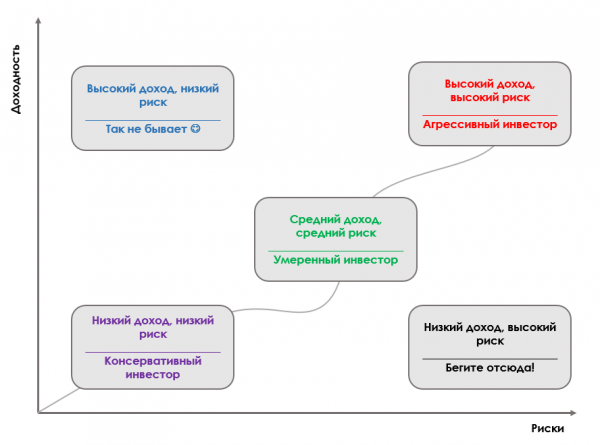
I think the optimal investment ratio is: diversify - invest at least 40% in reliable instruments, 10% in high-risk ones, and distribute the remaining 50% based on liquidity and your main strategy. The optimal investment term is up to three years (partly due to tax legislation). The simplest option to start with is to open an IIS (Individual Investment Account, which we will discuss further).
How can you lose money with a guarantee?
Most beginners in private investing make the same typical mistakes, differing only in the scale of their losses. Don’t do it.
- Don’t trade on luck or chance. Every action must be well thought out and justified — and, importantly, based on data and analytics. For example, you noticed signs of growth for Gazprom stocks and decided to 'sell' your holdings amidst the rise, only for them to increase by 40% the next day. Why? Because the market was anticipating the release of positive financial statements and increased dividends — the reports came out, and growth followed. You accurately read the market signal, but missed the profit because you rushed. For an experienced investor, the condition of the issuing company and information about all events are crucial tools. Even if you can’t give a precise forecast or deep explanation of market processes, you at least need to know which trends warrant selling, buying, or holding your investment portfolio’s assets.
- Don’t expect instant spectacular profits — you can’t 'invest 10,000 and withdraw 100,000 in a week' (even for scammers). The return on investment varies according to the investment strategy and can even be negative. 'Fairy-tale' profits may result from risky investments made by experienced investors, but even then, it’s mostly just a matter of luck, as the results of high-risk investments are poorly predictable.
- Quitting your job to become an investor is the worst thing that can happen to a novice. The path from the first thought to becoming an experienced broker can take 3 to 5 years of intensive training. From my experience, even after 3 years of specializing in financial mathematics, securities management, and stock exchange practices at university, the only thing you can do professionally and reliably is recognize fraudsters. "Making money" on the stock exchange isn't straightforward; additional training and practice are necessary. Generally, brokers who handle client accounts work for financial organizations and, in addition to commission payments, receive a salary and can easily transition to analytics or training roles. If you drop everything, set up QUIK, open an account, and start "playing the market," be prepared to eat poorly, dress poorly, and save a lot. The conclusion is simple: either trading on the stock market is a secondary income source and an intellectual hobby for you, or you are deliberately training to change professions. And yes, trading on the stock exchange is not a game; it is work, even for a private investor.
- There is no mistake scarier than the previous point, but confidently in second place is using money for your first steps in the stock market that you need now or in the near future. For instance, if you are saving for a mortgage, a car, or any other significant and necessary purchase, and suddenly decide to quickly 'top off' your investments, abandon that idea— the risk is too high. However, if you have a 'buffer' where you set aside spare funds and are sure that you won't need the money in the near future (I recommend considering an investment period of 3 years), you can calmly try to enhance your capital through a brokerage account. But remember—you might not only miss out on additional profits but also lose the principal investment amount.
- Don't get involved with virtual currency.
The next two mistakes relate directly to the choice of investment instruments and represent two extremes of investment behavior.
- It is a mistake to use only one investment tool (for example, investing only in the stocks of one company, only in dollars, only in gold, etc.). In fact, in such a case, you are not engaging in active investing but rather using a rather conservative tool for 'saving' money, which may yield returns over the long term. This type of investing can be compared in effectiveness to a bank deposit.
- It is equally mistaken to invest in everything indiscriminately, especially in risky instruments, unclear startups, new companies, or stocks driven by hype around certain events. Such an approach to your portfolio leads to a loss of profitability and a misunderstanding of the fundamentals of structured investments. Ultimately, you may find yourself in a situation where you cannot predict the behavior of market participants and the market's reaction to them.
This tweet
I am selling almost all physical possessions. Will own no house.
— Elon Musk (@elonmusk)
triggered this movement:
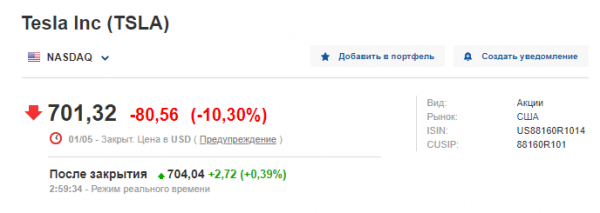
So, you might as well predict your portfolio based on Twitter (by the way, it's a great approach — there is already an understanding that tweets from corporate CEOs and, in particular, politicians like D. Trump actively influence stock market trends)
Do you know what indicates that you are approaching work in the stock market correctly? You should be bored. Excitement in investing (any kind!) is the worst advisor.
We choose the stock market for various reasons: out of interest, to invest and preserve spare funds, out of a desire to earn, or simply to learn something new. Some developers change their specialization and move into developing trading robots after getting acquainted with the stock market.
The stock market is a complex story. In reality, no one can constantly predict the future of the stock market successfully: today you might hit the target, and tomorrow other investors might (that’s what speculative trading is about — in a good sense of the word). Of course, it’s not roulette or a slot machine, but the difficulty lies in identifying trends and learning to conduct technical and fundamental analysis. Everything else is based on this. Programmers, mathematicians, and technicians are often good at trend analysis, but to declare "I am an expert in economics" from day one is overly self-confident and could backfire on you. Remember: risk is always present.
What to read on the topic?
- — a go-to site for Russian investors (one of them)
- — pretty good analytical materials and examples, but remember that the site is dedicated to forex, and there are many kinds of forex (we will talk about currency later).
- (can be broken down as tasks)
- — a lot of great separate videos
And of course, read financial, political, and insider channels on Telegram — that’s where information appears first (after Twitter ;-)).
The list of literature and websites varies greatly depending on the selected tools, so articles on different instruments will have additional references.
If you have investment experience (positive or negative), share in the comments how you started, what you encountered, and whether you gave it up.
Source: habr.com
