

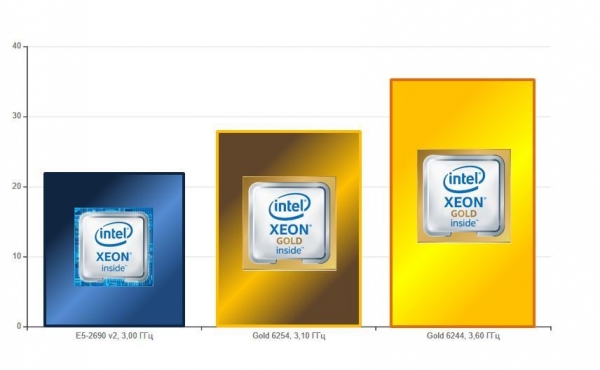
We won't discover America by saying that virtual machines on new processors are always more efficient than those on older generation processors. The interesting part is that when analyzing systems with seemingly similar technical specifications, the results can be vastly different. We experienced this firsthand when we tested Intel processors in our cloud to determine which ones provide the greatest return while running 1C systems.
Spoiler alert: as our test showed, it all depends on the task at hand. We managed to select a product from the entire lineup of new Intel processors that provided a multiple performance increase due to the fact that the Intel Xeon Gold 6244 has fewer cores, more L3 cache per core, and a higher clock frequency — both base and in Turbo Boost mode. In other words, these processors excel at resource-intensive tasks when measured in terms of performance per ruble. This is perfect for 1C: with the new processors, 1C applications in our cloud literally began to 'breathe'.
Now let’s explain how we conducted the testing. Below are the results of the Gilev synthetic tests. These can serve as a reference, but you should independently check the real utilization for your tasks.
Testing Conditions
Important note: we made comparisons without any additional optimizations, not as a benchmark. With further tuning of the cloud systems, results will be guaranteed to improve.
Given: two virtual machines with 8 vCPUs and 64 GB RAM with FLASH disks offering 10,000 IOPS.
The first virtual machine is running Windows Server 2016 with 1C version 8.3.10.2580 installed. For the second, we used an image of a virtual machine with a database (CentOS + PostgreSQL) taken from .
The PostgreSQL database is no coincidence, as its operation is most akin to the real usage conditions of 1C by our clients. Yes, we conducted synthetic tests resembling standard installations, meaning this is not a universal answer to all questions of the Universe, but rather a guideline for your own analysis.
It is important to note that when using file architecture instead of a database, test results tend to be higher. However, in reality, this type of architecture is used only for very small installations. Here on file architecture. And here is what Vyacheslav Gilyov:
If we are talking about renting 1C in file mode, then yes, but what I see is exclusively working in client-server mode. It makes sense: 1) either to include this clarification in the article; 2) or to test the client-server option, because the difference in architecture is significant, and the file version lacks complete functionality.
No additional operating system or 1C product settings were made.
Processors
- In the left corner of the ring — Intel Xeon E5-2690 v2, 3.00 GHz.
- In the right corner of the ring — Intel Xeon Gold 6254, 3.10 GHz.
- In the center of the ring — Intel Xeon Gold 6244, 3.60 GHz.
Let the fight begin!
Results
Intel Xeon E5-2690 v2, 3.00 GHz:
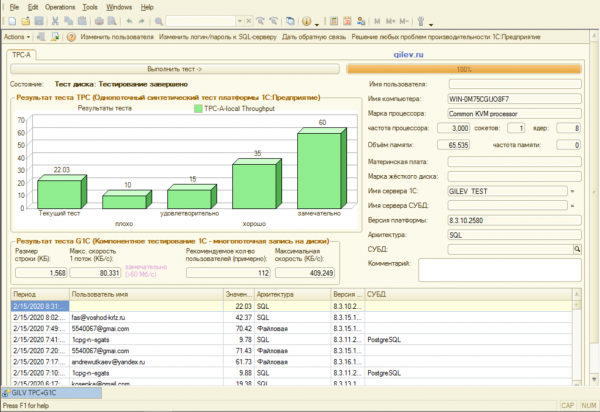
"Good" for us is the minimum score that guarantees a comfortable level of work for the client with 1C systems.
Result — 22.03.
Intel Xeon Gold 6254, 3.10 GHz:
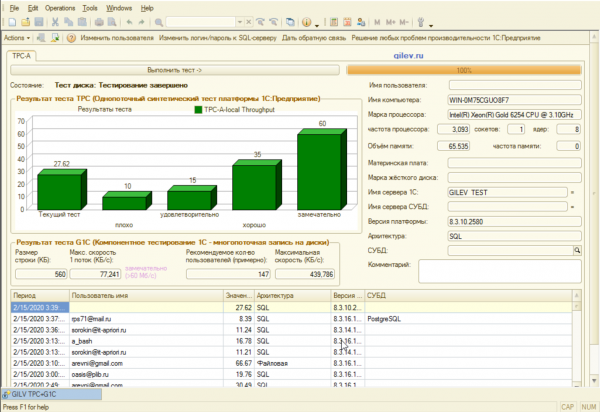
Result — 27.62.
Intel Xeon Gold 6244, 3.60 GHz:
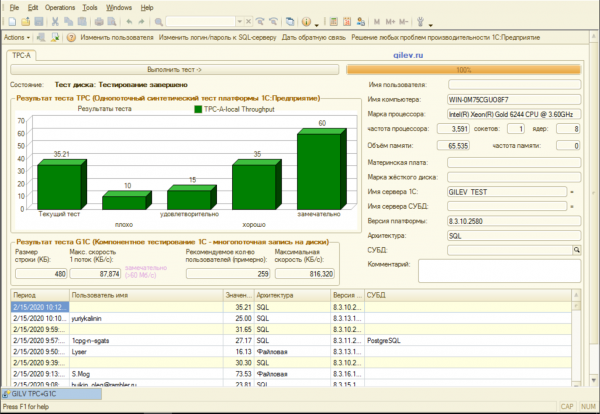
Result — 35.21.
In total: even if a virtual machine on Intel Xeon Gold 6244 at 3.6 GHz costs 60% more than E5-2690 v2 at 3.0 GHz, it is worth choosing it. With a smaller price difference, the benefits increase even more. However, our price gap is much smaller, so such VMs are significantly more profitable.
Cascade Lake processor cores demonstrate performance gains not only due to increased frequency but also due to more modern architecture. Different processor models from this lineup yield different results, which must be taken into account when solving one's task.
In the cloud, we plan to use these processors in Turbo Boost mode, where the processor clock frequency reaches 4.40 GHz, which will increase its performance gap and make the choice in favor of this product even more obvious.
What does this mean for us?
For a long time, we lived in the old paradigm where a single processor had relatively few cores, resulting in a limited number of virtual machines per server. We had to make numerous adjustments to achieve some level of optimization in fitting VMs into these servers. Now, with up to 28 or even 56 cores per socket, the density issue nearly resolves itself. This gives us the resources to think about additional perks for clients of our Cloud KROK. For example, we've set up a separate pool with 6244 processors for databases.
An added bonus is that this architecture has turned out to be quite suitable for 1C. The point is that when transitioning from a 3 GHz processor to a 4 GHz processor, most tests yield not +30% but about +15–20%... Yet this change gives you +45%. This means the frequency increases by 30%, but the performance gain grows non-linearly with the frequency. Moreover, processors are about 40% more expensive. Ultimately, new processors are pricier, but 1C finally starts to operate smoothly. You can move to the cloud without worrying that the processors are not up to par. This is very important for many of our clients right now.
Source: habr.com
