

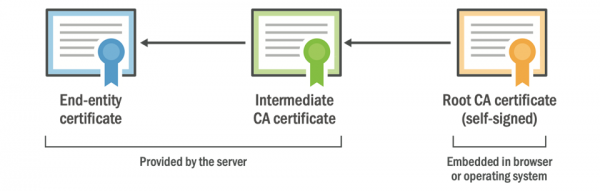
For a browser to authenticate a website, it presents itself with a valid chain of certificates. A typical chain is shown above, which may contain more than one intermediate certificate. The minimum number of certificates in a valid chain is three.
The root certificate is the heart of the certificate authority. It is literally embedded in your OS or browser and physically exists on your device. It cannot be changed from the server side. A forced update of the OS or firmware on the device is required.
Security specialist Scott Helme , notes that the main issues will arise for the Let's Encrypt certificate authority, as it is currently the most popular CA on the internet, and its root certificate will soon "expire." The renewal of Let's Encrypt's root .
End-entity and intermediate certificates from the certificate authority (CA) are delivered to the client from the server, while the root certificate is on the client side, already have, allowing a chain to be constructed and the website to be authenticated.
The problem is that every certificate has an expiration date after which it needs to be replaced. For example, starting September 1, 2020, Safari browser plans to impose restrictions on the validity of server TLS certificates, .
This means that all of us will have to replace server certificates at least every 12 months. This restriction only applies to server certificates; it do not also applies to root CA certificates.
CA certificates are regulated by a different set of rules, so they have different expiration restrictions. Intermediate certificates often have a 5-year lifespan, while root certificates can last even 25 years!
There are usually no problems with intermediate certificates because they are delivered to the client by the server, which more frequently changes its own certificate, thus replacing the intermediate one during that process. It is quite easy to replace along with the server certificate, unlike the root CA certificate.
As we mentioned, the root CA is embedded directly in the client device, in the operating system, browser, or other software. The root CA of a website cannot be controlled. An update is needed on the client side, whether it's an OS or software update.
Some root CAs have existed for quite a long time, around 20 to 25 years. Soon, some of the oldest root CAs will reach the end of their natural life; their time is nearly up. For most of us, this shouldn't be an issue because CAs have created new root certificates that have been distributed worldwide in OS and browser updates for many years. However, for anyone who has not updated their OS or browser in a long time, this could be somewhat problematic.
Such a situation arose on May 30, 2020, at 10:48:38 GMT. This is the exact time when from the certification authority Comodo (Sectigo).
It was used for cross-signing to ensure compatibility with outdated devices that do not have the new USERTrust root certificate in their store.
Unfortunately, the issues arose not only in outdated browsers but also in non-browser clients based on OpenSSL 1.0.x, LibreSSL, and . For example, in streaming devices , the service , in Fortinet apps, Chargify, on the .NET Core 2.0 platform under Linux, and .
The problem was expected to affect only outdated systems (Android 2.3, Windows XP, Mac OS X 10.11, iOS 9, etc.), since modern browsers can rely on the second USERTrust root certificate. But in fact, failures occurred in hundreds of web services that utilized the free libraries OpenSSL 1.0.x and GnuTLS. Secure connections ceased to be established, resulting in errors about certificate expiration.
Next is Let’s Encrypt.
Another good example of an upcoming root CA change is the Let’s Encrypt certification authority. Back in , they planned to transition from the Identrust chain to their own ISRG Root chain, but this .
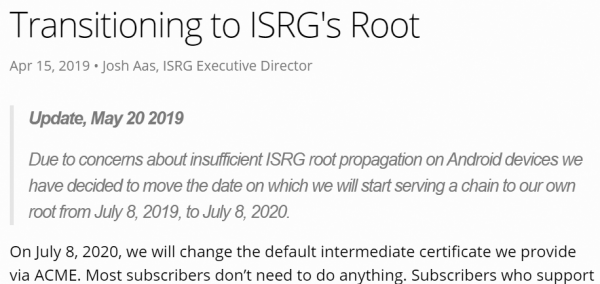
"Due to concerns about insufficient distribution of the ISRG root on Android devices, we decided to postpone the date for moving to our own root from July 8, 2019, to July 8, 2020," stated the official Let’s Encrypt announcement.
The date had to be postponed due to a problem known as "root propagation", or rather, the lack of root propagation when the root CA is not widely distributed across all clients.
Currently, Let’s Encrypt is using a cross-signed intermediate certificate with a chain leading to the IdenTrust DST Root CA X3. This root certificate was issued back in September 2000 and expires on September 30, 2021. Until then, Let’s Encrypt plans to switch to its own self-signed root, ISRG Root X1.
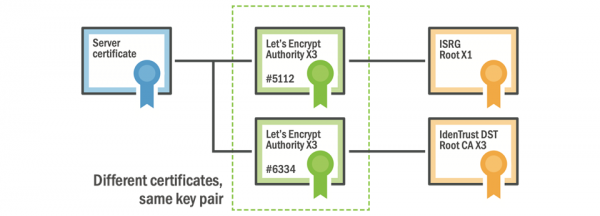
The ISRG root was issued on June 4, 2015. After that, the process of its approval as a certification authority began and was completed Since then, the root CA has been available to all clients through operating system or software updates. All that needed to be done was to install the update.
But therein lies the problem.
If your mobile phone, television, or another device hasn't been updated for two years — how will it know about the new ISRG Root X1 certificate? If it is not installed in the system, then all server certificates from Let’s Encrypt will be considered invalid by your device as soon as Let’s Encrypt switches to the new root. And within the Android ecosystem, there are many outdated devices that have not been updated for a long time.
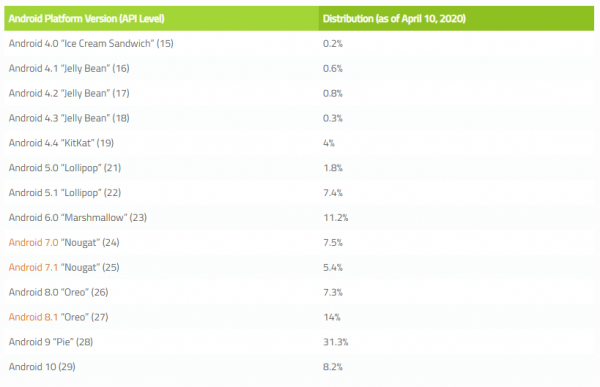
The Android ecosystem.
This is why Let’s Encrypt postponed the transition to its own root ISRG and is still using the intermediate link that leads down to the IdenTrust root. But a transition will have to happen anyway. The root switch date is set for .
To check if the ISRG X1 root is installed on your device (TV, set-top box, or another client), open the test site . If no security warning appears, everything is generally fine.
Let’s Encrypt is not the only one facing the issue of transitioning to a new root. Cryptography on the internet has been in use for just over 20 years, so now is the time when many root certificates are reaching their end of life.
This issue may confront owners of smart TVs that have not updated their Smart TV software in many years. For example, the new root GlobalSign was released in 2012, and therefore some older Smart TVs cannot establish a chain to it because this root CA is simply missing for them. In particular, these clients were unable to establish a secure connection with the bbc.co.uk website. To resolve the issue, BBC admins had to resort to a workaround: they through additional intermediate certificates, utilizing older roots and , which have not yet expired.
www.bbc.co.uk (Leaf)
GlobalSign ECC OV SSL CA 2018 (Intermediate)
GlobalSign Root CA - R5 (Intermediate)
GlobalSign Root CA - R3 (Intermediate)
This is a temporary solution. The problem will not go away unless the client software is updated. A Smart TV is essentially a limited-functionality computer running Linux. Without updates, its root certificates will inevitably expire.
This applies to all devices, not just televisions. If you have any device that is connected to the internet and promoted as a 'smart' device, then the issue with expired certificates almost certainly affects it. If the device does not receive updates, the root CA store will become outdated over time, and eventually, the problem will come to light. How soon the issue arises depends on the last update date of the root store. This could be years before the actual release date of the device.
By the way, this is the problem of why some major media platforms cannot use modern automated certificate authorities like Let’s Encrypt, Scott Helme writes. They are not suitable for smart TVs, and the number of roots is too small to ensure certificate support on outdated devices. Otherwise, the TV simply won't be able to run modern streaming services.
The recent incident with AddTrust showed that even large IT companies can be unprepared for the expiration of a root certificate.
There is only one solution to the problem — updating. Developers of smart devices must ensure beforehand a mechanism for updating software and root certificates. On the other hand, manufacturers are disinclined to ensure the functionality of their devices after the warranty period has expired.
Source: habr.com
