

The working group began developing the standard back in 2014, and work is now underway on draft 3.0. This differs somewhat from previous generations of the 802.11 standards, where all work was contained within two drafts. This change is due to a considerable number of planned comprehensive updates, which require more detailed and complex compatibility testing. The initial goal for the group was to improve spectrum efficiency to enhance WLAN throughput in environments with high densities of client stations and access points. Key drivers for the development of the standard include the increase in mobile subscribers, live streaming on social media (with an emphasis on upload traffic), and of course, IoT.
The innovations can be schematically represented as follows:
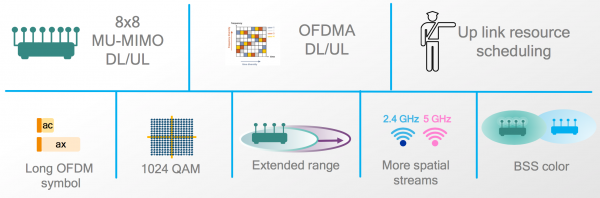
MIMO 8×8, more spatial streams
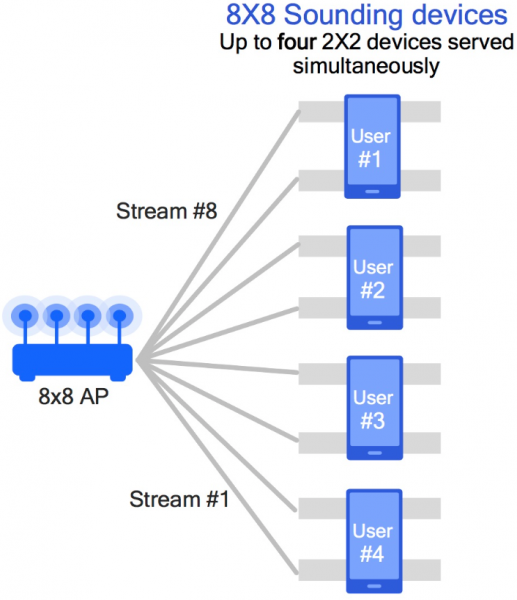
Support for MIMO 8×8 will be introduced, with up to 8 spatial streams (SS). The 802.11ac standard also theoretically described support for 8 SS, but in practice, 802.11ac "wave 2" access points were limited to supporting 4 spatial streams. Therefore, access points with MIMO 8×8 support will be able to serve up to 8 clients simultaneously using 1x1, four clients using 2x2, and so on.
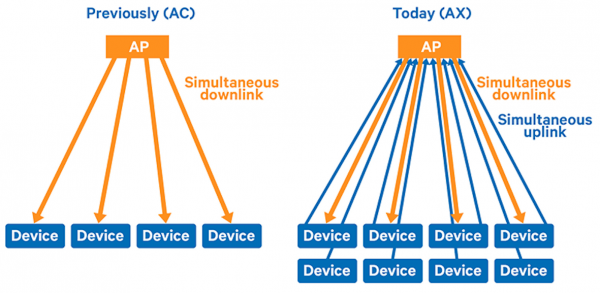
MU-MIMO DL/UL (Multi-User MIMO Downlink/Uplink)
Simultaneous support for multi-user mode for both download and upload channels. The ability for simultaneous competitive access to the upload channel, along with the grouping of both data and control frames, will significantly reduce overhead, leading to increased throughput and decreased response times.
Long OFDM symbol
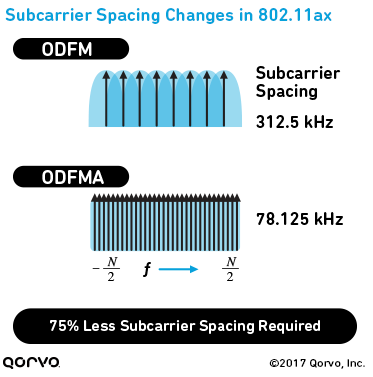
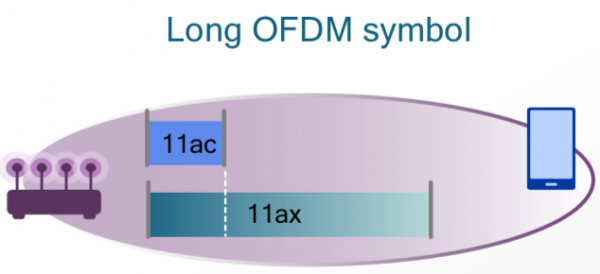
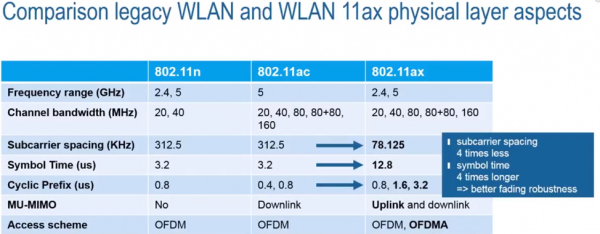
OFDM has been in use in the 802.11a/g/n/ac standards for about 20 years without any changes. According to the standard, in a 20MHz channel, there are 64 subcarriers spaced 312.5 kHz apart (20MHz/64). Over the years, the semiconductor industry has advanced significantly, and the 802.11ah standard proposes a fourfold increase in subcarriers to 256, with a spacing of 78.125 kHz between subcarriers. The length of the OFDM symbol (time) is inversely proportional to frequency, which will also increase fourfold from 3.2 µs to 12.8 µs. This improvement will enhance the efficiency and reliability of data transmission, especially in outdoor WLAN settings.
Extended Range
New values for protective intervals between frames have been added, which can now be 1.6 µs and 3.2 µs for "outdoor" WLAN, while the interval for "indoor" remains at 0.8 µs. The new packet format features a longer, more reliable preamble. All of the above will enable up to a fourfold increase in connection speed at the edge of the network.
OFDMA DL/UL (Orthogonal Frequency Division Multiple Access)
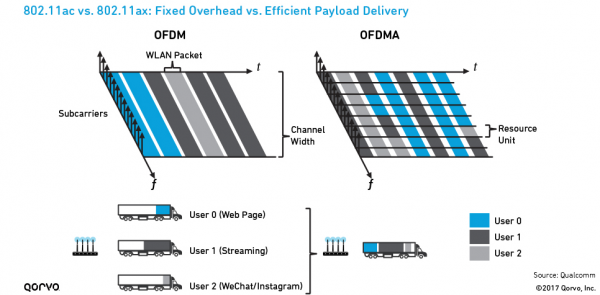
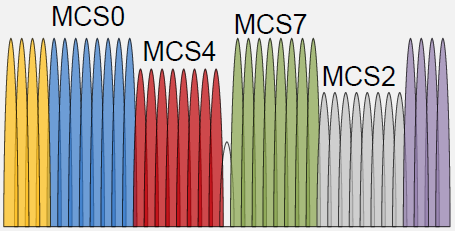
One of the main changes is the implementation of OFDMA instead of OFDM. The OFDMA technology is used in LTE networks and has proven its high efficiency. The difference is that in OFDM, the entire frequency channel is occupied during transmission, and until the transmission is complete, the next client cannot use the frequency resource. In OFDMA, this issue is resolved by dividing the channel into subchannels of varying widths, known as RUs (Resource Units). In practice, this means that 256 subcarriers of a 20MHz channel can be divided into RUs of 26 subcarriers each. Each RU can have its own MCS encoding scheme and transmission power assigned.
Overall, this will lead to a significant increase in network capacity overall, as well as throughput for each individual client.
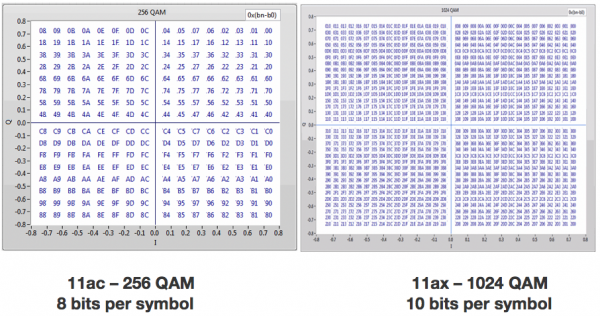
1024 QAM
New MCS (Modulation and Coding Sets) 10 and 11 for 1024-QAM modulation have been added. This means that one symbol in this scheme will carry 10 bits of information, which is a 25% increase compared to 8 bits in 256-QAM.
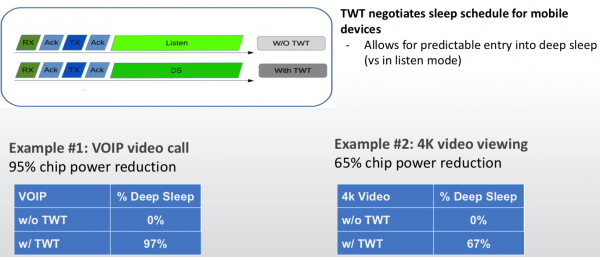
TWT (Target Wake Time) – "Up Link resource scheduling"
An energy-saving mechanism that has proven effective in the 802.11ah standard and is now adapted in 802.11ax. TWT allows access points to inform clients when to enter sleep mode and provides a schedule for when to wake up for data reception or transmission. These are very brief periods, but the ability to sleep through many short intervals will significantly impact battery life. Reducing contention and collisions between clients will increase the time spent in sleep mode. Depending on the type of traffic, improvements in energy consumption can range from 65% to 95% (according to Broadcom tests). For IoT devices, TWT support is extremely important.
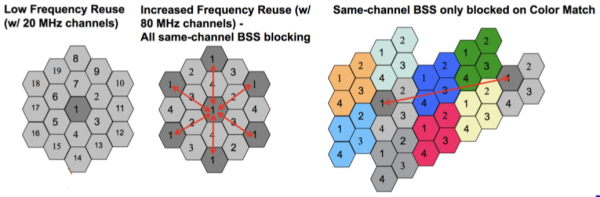
BSS Color – Spatial Reuse
To increase the capacity of high-density WLAN networks, it is necessary to enhance the frequency of channel resource reuse. To reduce the impact of neighboring BSS operating on the same channel, it is recommended to label them using the "color-bit". This will enable dynamic adjustment of CCA (clear channel assessment) sensitivity and transmitter power. The network capacity will increase due to a denser channel plan, while existing interference will have a lesser impact on the choice of MCS.
Due to the upcoming update of security standards to , not everyone will be able to address security issues simply by updating software, which is why Extreme Networks will introduce access points with hardware support for 802.11ax and WPA3 in the fourth quarter of 2018.
Additional information about .
Source: habr.com
