

<< Before this:
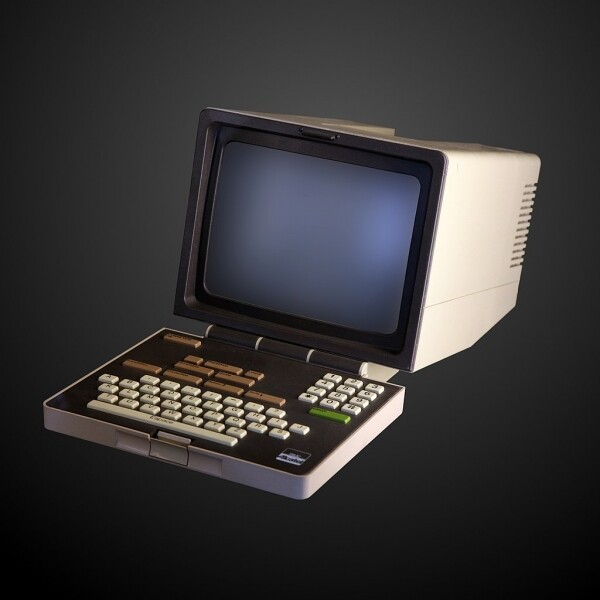
In spring 1981, after several small trials, the French telecommunications administration (Direction générale des Télécommunications, DGT) initiated a large-scale experiment to implement the technology in Brittany, in a place called Ille-et-Vilaine, named after two nearby rivers. This was a prelude to the full-scale launch of the system across the , planned for the following year. The new system was named Télétel by DGT, but it quickly became known as Minitel – this was a , derived from the name of the , which were distributed for free by the hundreds of thousands to French subscribers to telephone services.
Among all systems of consumer information services in this 'era of fragmentation,' Minitel deserves our special attention, and thus a separate chapter in this story – for three specific reasons.
All articles in the series:
- The History of Relays
- The History of Electronic Computers
- The History of the Transistor
- The History of the Internet
- The Era of Fragmentation
The first is the motivation for its creation. Systems based on videotex technology were also built by other postal, telegraph, and telephone services – however, no other country invested as much effort in ensuring the success of this system, nor was the strategy for leveraging this success so well thought out. Minitel was closely intertwined with hopes for an economic and strategic renaissance in France, and was meant not only to generate new revenue in telecommunications or new traffic but also to stimulate the entire technological sector of France.
The second is the extent of its reach. DGT provided telephone subscribers with terminals completely free of charge, and collected money only based on usage time, without requiring any upfront payment for a subscription. This meant that, although many used the system infrequently, more people had access to Minitel than to even the largest American online services of the 1980s, despite the significantly smaller population. The system stands in stark contrast to the British Prestel, which never exceeded 100,000 subscribers.
The third point is the server-side architecture. All other digital service providers were monolithic, hosting all services on their own equipment. While they collectively formed a competitive market, each of their systems represented an administrative-command economy. However, despite the state monopolizing this product, ironically, Minitel became the only system of the 1980s to establish a free market for information services. DGT operated as an information broker rather than a provider, creating one of the possible models for moving away from the era of fragmentation.
Tag game
The experiments with Minitel began in Brittany for good reason. Over the decades after World War II, the French government deliberately shifted the region's economy, which largely relied on agriculture and fishing, towards electronics and telecommunications. This also affected the two largest research telecommunications laboratories located there: the Centre Commun d’Études de Télévision et Télécommunications (CCETT) in the regional capital Rennes, and the Centre National d’Études des Télécommunications (CNET) unit in Lannion, on the northern coast.
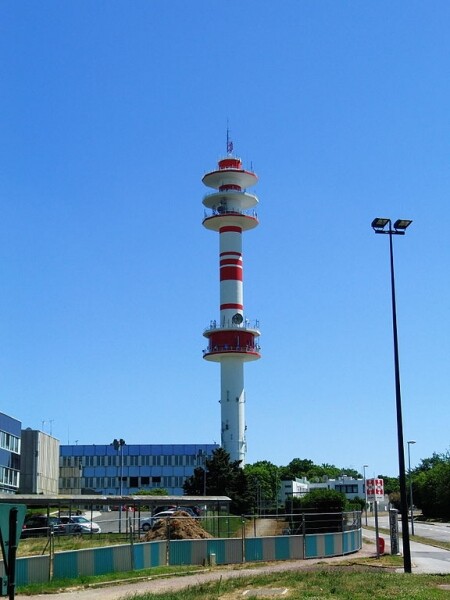
CCETT Laboratory in Rennes
These laboratories, established in an attempt to bring the lagging region into the modern era, found themselves, by the end of the 1960s and early 1970s, playing catch-up with their colleagues from other countries. By the late 1960s, France's telephone network was in a disgraceful state for a country that, under de Gaulle's leadership, wanted to see itself as a resurgent world power. It still heavily depended on telephone switches built in the early decades of the 20th century, and by 1967, only 75% of them were automated. The remaining parts relied on operators who manually switched calls—a practice that had almost been eliminated in both the U.S. and Western European countries. There were only 13 phones for every 100 people in France, compared to 21 in neighboring Britain and nearly 50 in countries with the most advanced telecommunications systems, like Sweden and the U.S.
Therefore, by the 1970s, France began to actively invest in the , meaning 'catch-up'. Rattrapage quickly began to gain traction after the 1974 elections, when Valéry Giscard d'Estaing became president , and appointed Gérard Thery as the new head of DGT. Both were graduates of France's top engineering school, l’École Polytechnique, and both believed in the possibility of improving society through technology. Thery focused on enhancing the flexibility and responsiveness of bureaucracy within DGT, while Giscard secured 100 billion francs in parliament for the modernization of the telephone network. This funding went towards installing millions of new phones and replacing old equipment with computerized switches. In this way, France shed its reputation as a laggard in telecommunications.
Meanwhile, in other countries that began developing telecommunications in new directions, new technologies were emerging – video phones, fax machines, and a blend of computer services with data transmission networks. DGT wanted to ride the wave of this innovation, rather than consistently playing catch-up. In the early 1970s, Britain announced the creation of two separate teletex systems that delivered changing information screens to televisions via broadcasting. CCETT, a joint venture between DGT and the French broadcasting corporation Office de radiodiffusion-télévision française (ORTF), launched two of its own projects in response. The DIDON project (Diffusion de données sur un réseau de television) was designed following the British model. ANTIOPE (Acquisition numérique et télévisualisation d’images organisées en pages d’ecriture) became a more ambitious attempt to explore the possibility of delivering text screens independent of the communication channel.

Bernard Marti in 2007
The ANTIOPE team in Rennes was led by Bernard Marti. He was another alumnus of the polytechnic school (class of 1963) and transitioned to CCETT from ORDF, where he specialized in computer animation and digital television. In 1977, the team combined ANTIOPE display technology with ideas taken from the TIC-TAC project (terminal intégré comportant téléviseur et appel au clavier – integrated television terminal with keyboard control) from CNET. The latter was a system for delivering interactive digital services over the phone. This merger was named TITAN (Terminal interactif de télétexte à appel par numérotation – interactive teletext terminal with telephone dialing), and it was essentially equivalent to the British Viewdata system, which later evolved into Prestel. Like ANTIOPE, it used televisions to display digital information pages, but it allowed users to interact with the computer rather than passively receive data. Moreover, both the commands to the computer and the data screens were transmitted over telephone lines instead of wirelessly. Unlike Viewdata, TITAN supported a full-size alphanumeric keyboard rather than just a phone keypad. To demonstrate the system’s capabilities at the Berlin trade fair, the team used the French packet-switched network Transpac as an intermediary between the terminals and the CCETT computer located in Rennes.
The Teri Laboratory prepared an impressive technical demonstration, but by that time it had not yet gone beyond the lab, and there were no clear pathways for ordinary people to use it.
Telematics
In the autumn of 1977, DGT director Gérard Teri, satisfied with the progress in modernizing the telephone network, shifted focus to competing with the British videotex system. To develop a strategic response, he first studied the experiences of CCETT and CNET and discovered ready-to-use prototypes of TITAN and TIC-TAC. He sent these raw experimental materials to his development office DAII to transform them into products with a clear market output and business strategy.
DAII recommended developing two projects: an experiment with videotex to test various services in a city near Versailles, and investments in an electronic telephone directory intended to replace the telephone book. The projects were to use Transpac as the network infrastructure and TITAN technology on the client side - featuring colored images, character graphics, and a full keyboard for input.
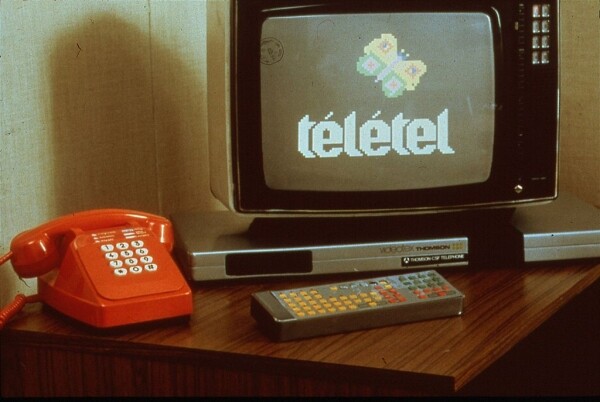
The early experimental model of the TV set-top box Télétel, which was later abandoned in favor of an integrated terminal.
The strategy for implementing videotex developed by DAII differed from the British model in three significant ways. Firstly, while Prestel hosted all content on its own, DGT planned to operate solely as a switch, allowing users to access a multitude of different private service providers that worked with any computers capable of connecting to Transpac and delivering any data compatible with ANTIOPE. Secondly, they decided against using a television as a monitor and opted to invest in specialized integrated terminals. DGT leaders reasoned that people buy televisions to watch TV, and would not want to occupy the screen with new services like an electronic telephone directory. Additionally, the rejection of televisions meant that DGT wouldn't have to negotiate a launch with competitors from Télédiffusion de France (TDF), as negotiations with television manufacturers had become one of the main obstacles for Prestel in Britain. Finally, France decisively cut this Gordian knot, addressing the 'chicken or egg' problem (where a network without users does not attract service providers, and vice versa), planning to distribute all these integrated videotex terminals for free.
However, despite all these grand plans, videotex remained secondary for Terry. To ensure DGT a prominent place in communication technologies, he focused on making fax a widely available consumer service. He believed that faxing could capture a significant portion of the written communication market from mail, whose bureaucrats DGT considered to be stale conservatives. However, Terry's priorities shifted within just a few months, by the time the government report 'Computerization of Society' was completed in 1978. In May, this report was distributed to bookstores, selling 13,500 copies in the first month and a total of 125,000 copies over the next decade, which is equivalent to a bestseller for a government report. How did such a seemingly technically complex topic capture the minds of the citizens?
The Giscard government commissioned this report to Simon Nora and Alain Minc, officials from the French General Finance Inspection, to analyze the threats and opportunities posed by the growing economic and cultural importance of computers. By the 1970s, most technically savvy intellectuals were beginning to understand that computing power could and should be delivered to the masses in the form of new types of services enabled by computers. Yet, for several decades, the United States had led in all areas of digital technology, and the positions of American companies in the market seemed unshakeable. On one hand, French leaders believed that the democratization of computers would offer immense opportunities to the French community; on the other, they did not want France to become an appendage of a dominant foreign power.
The report by Nora and Mink presented a synthesis that resolves this issue and proposed a project capable of propelling France into the postmodern information era in a single leap. The country would immediately shift from being a laggard to a leader, creating the first national infrastructure for digital services—data centers, databases, standardized networks—which will become the foundation of an open and democratic market for digital services. This, in turn, will stimulate the development of France's own expertise and industry in computing, software, and networking technologies.
Nora and Mink referred to this merger of computers and communications as télématique, combining the words "telecommunications" and informatique ("computer science"). "Until recently," they wrote,
computers were a privilege of the large and wealthy. From now on, mass computerization will take center stage, fueling the community as electricity once did. However, unlike electricity, la télématique will transmit not a passive current but information.
Nora and Mink's report and the resulting resonance in Giscard's government cast the attempts to commercialize TITAN in a new light. Prior to this, the development strategy of videotex in DGT was a response to the actions of British competitors, aiming to ensure that France was not caught off guard and forced to operate within British technical standards for videotex. But if that were all it entailed, French efforts to develop videotex would have withered like Prestel, remaining a niche service for curious enthusiasts of new technologies and a handful of businesses for which it could be useful.
But after the report, videotex could no longer be considered anything other than a central component of télématique, the foundation for building a new future for the entire French nation, and thanks to the report, the project received much more attention and funding than could have been hoped for. The project to launch Minitel nationwide garnered government support that might not have been forthcoming otherwise—much like the "faxization" project of the entire country by Terry, which ultimately turned into a mere peripheral addition to Minitel in the form of a printer.
As part of its support, the government decided to distribute millions of terminals for free. DGT claimed that the costs for the terminals would be partially offset by the cessation of printing phone directories and the network traffic that would stimulate the Minitel service. Whether they truly believed this or not, these arguments were able to at least nominally justify the massive stimulation program that began with Alcatel (which received billions of francs for manufacturing the terminals) and extended to the Transpac network, Minitel service providers, the computers purchased by these providers, and the software services required for the operation of the entire online business.
Intermediary
In commercial terms, Minitel did not bring anything particularly significant. It first achieved annual self-sufficiency in 1989, and all costs were only recouped by the end of the 1990s when the terminals had finally fallen into decline. It also failed to meet the goals set by Nora and Minc for launching a renaissance in French industry and society through information technology. Profits were made by Alcatel and other manufacturers of telecommunications equipment, while the French Transpac network benefited from increased traffic, although they unfortunately chose the wrong packet-switching technology with their X.25 protocol. At the same time, thousands of Minitel service providers mainly bought their equipment and system software from American companies. Technicians who were developing their own online services tended to avoid both the services of the French giant Bull and the large and intimidating industrial company IBM, preferring modest boxes with Unix inside from manufacturers such as Texas Instruments and Hewlett-Packard.
If the Minitel system did not succeed in raising the industry, what about its role in democratizing the French community through new information services penetrating everywhere, from the most elite municipal districts of Paris to small villages in Picardy? Here, the project achieved more, although with mixed success. The Minitel system grew rapidly, with 120,000 terminals at the time of its first large-scale deployment in 1983, increasing to 3 million in 1987 and 5.6 million by 1990. However, aside from the initial moments as an electronic phone book, long-term use of the terminals required a per-minute fee, so there is no doubt that their usage was not as widespread as the equipment itself. The most popular services, namely online chat, could easily consume several hours every evening at a basic rate of 60 francs per hour (about $8, which was more than double the minimum hourly wage in the U.S. at that time).
By 1990, however, nearly 30% of citizens had access to a Minitel terminal from home or work. France was undoubtedly the most online presence in the world, so to speak. That same year, two of the largest online service providers in the U.S., this giant of information technology, gathered just over a million subscribers in a country with a population of 250 million. The catalog of services that could be reached grew as quickly as the number of terminals – from 142 in 1983 to 7,000 in 1987 and 15,000 by 1990. The irony is that it took an entire phone book to list all the services available to the terminals – the very one they were supposed to replace. By the end of the 1980s, this book, Listel, had already reached 650 pages.
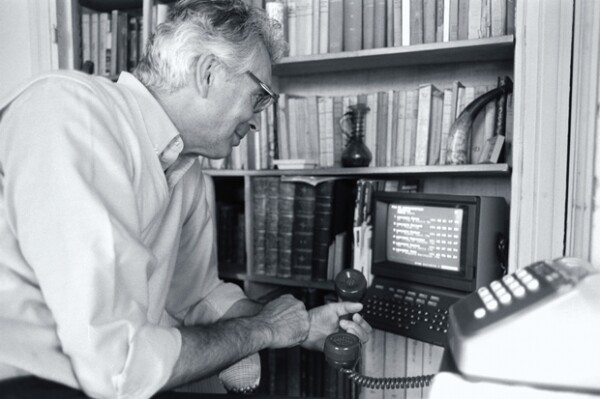
A man is using a Minitel terminal.
In addition to the services offered directly by DGT, the range of services provided was quite broad, from commercial to social, and they were divided into similar categories that we still see online today: shopping, banking services, travel services, chat rooms, message boards, and games. To connect to the service, a Minitel user dialed an access number, most often 3615, which linked their phone line to a special computer at their local exchange, known as point d’accès vidéotexte, or PAVI. After connecting to PAVI, the user could enter a code corresponding to the desired service. Companies displayed their access codes on advertising banners in a mnemonic alphanumeric form—similar to how they would later format website addresses in subsequent decades: 3615 TMK, 3615 SM, 3615 ULLA.
The code 3615 connected users to the 'kiosk' pricing system for PAVI, which was introduced in 1984. It allowed Minitel to function like a news kiosk, offering various products for sale from different suppliers at a single convenient point of sale. Of the 60 francs charged for an hour of kiosk services, 40 went to the service, while 20 went to DGT for the use of PAVI and the Transpac network. All of this was completely transparent for users—charges automatically appeared on the next phone bill, and they did not need to provide their payment information to the providers to engage in financial transactions.
When access to the open internet began to spread in the 1990s, online service enthusiasts started to These services from the era of fragmentation – all those CompuServes, the AOL – were akin to "walled gardens." The metaphor implies a contrast between them and the open, wild terrain of the new internet. From this perspective, if CompuServe was a well-maintained park, then the internet was pure Nature itself. Of course, in reality, the internet is no more a natural phenomenon than CompuServe or Minitel. Online services can be built in various ways, all of which are based on people’s choices. However, if we use this metaphor of the natural versus the cultivated, Minitel falls somewhere in the middle. It can be compared to a national park. Its boundaries are protected, maintained, and crossing them incurs a fee. Yet inside, you can move freely and visit any places that interest you.
The DGT position, situated in the middle of the market, between the user and the service, with a monopoly on the entry point and the entire communication path between the two parties of the service, had advantages over both the monolithic all-in-one service providers like CompuServe and the more open architecture of the later internet. Unlike the former, after passing through the bottleneck, the system opened up an open market of services to the user unlike anything else available at the time. Unlike the latter, there were no monetization issues. Users automatically paid for the time they used, thus eliminating the need for the bloated and intrusive advertising technology that supports the modern internet. Minitel also offered secure end-to-end connections. Every bit traveled solely on DGT equipment, so as long as you trusted DGT and the service provider, your communications were protected from attacks.
However, compared to the internet that replaced it, it had several obvious drawbacks. Despite its relative openness, one could not simply turn on a server, connect it to the network, and start working. Access to the server via PAVI required prior government approval. Worse, the technical structure of Minitel was horribly inflexible and tied to the videotex protocol, which was cutting-edge in the mid-1980s but became woefully outdated and limited a decade later.
The rigidity of Minitel depends on what we consider Minitel. The terminal itself (which, strictly speaking, was called Minitel) could connect to any computers over the regular telephone network. However, it is unlikely that many users resorted to this method – and it essentially was no different from using a home computer with a modem to connect to services like The Source or CompuServe. It was not tied to the service provisioning system (officially named Télétel), and all the benefits existed thanks to the kiosk and the Transpac network.
The terminal supported text pages, 24 lines of 40 characters each (with primitive character graphics) – and that was it. None of the characteristic features of the 1990s web – scrolling text, GIFs, JPEGs, streaming audio – were available on Minitel.
Minitel offered a potential way out of the era of fragmentation, but no one outside of France took this route. In 1988, France Télécom acquired DGT and repeatedly attempted to export Minitel technology — to Belgium, Ireland, and even the USA (through a system in San Francisco called 101 Online). However, without government incentives in the form of terminal financing, none of these attempts came close to the success of the original. By that time, it was expected that France Télécom and most other postal, telegraphic, and telephone networks worldwide would start cutting costs to function successfully in the competitive international market, and the era in which such incentives were politically justified had passed.
Although the Minitel system was fully operational only until 2012, its usage began to decline in the mid-1990s. In its final years, it remained relatively popular for banking and financial services due to the network's security and the availability of terminals and special peripheral devices capable of reading and transmitting data from bank cards. Meanwhile, French online enthusiasts gradually transitioned to the internet. But before returning to the history of the internet, we need to make one more stop on our tour of the fragmentation era.
What else to read:
- Julien Mailland and Kevin Driscoll, Minitel: Welcome to the Internet (2017)
- Marie Marchand, The Minitel Saga (1988)
Next: >>
Source: habr.com
