

There are two options for installing a containerization system in an already operational machine room (I'll discuss the installation of isolation systems in under-construction machine rooms in the next part). In the first case, the cold corridor is isolated, while in the second, the hot corridor. Each option has its own characteristics, advantages, and disadvantages.
Cold Corridor Isolation
Operating principle: perforated plates installed in front of the cabinet's front door are used to supply cold air to the corridor. Hot air is 'pushed out' into the common space of the room.
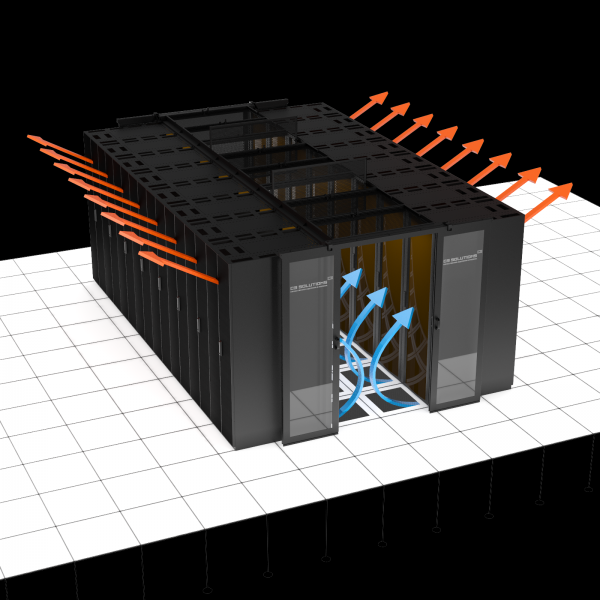
Rack Installation: to isolate the cold corridor, rack-mounted air conditioners are positioned around the perimeter of the room, blowing cold air under the raised floor. Meanwhile, the rack cabinets are lined up facing each other.
Pros:
- relatively low cost,
- ease of scaling: a rack-mounted air conditioner can be installed in any free space around the machine room.
Cons:
- complexity of scaling: in multiple corridors, there may be issues with the uniformity of air distribution to different rows,
- in the case of heavily loaded equipment, it's challenging to increase local cold air supply, as this requires installing additional perforated floor plates.
- not the most comfortable working conditions for staff due to the entire area being in the hot zone.
Structural Features:
- need additional height clearance for installing the raised floor and extra space for a ramp at the entrance,
- as the container is isolated along the internal perimeter of the corridor, the front edge of the racks needs insulation, and there should be a front plug-sock under the rack.
Who it suits: small server rooms or machine rooms with low loads (up to 5 kW per rack).
Hot Corridor
Operating principle: when the hot corridor is isolated, aisle-based air conditioners blow cold air into the common space of the room.
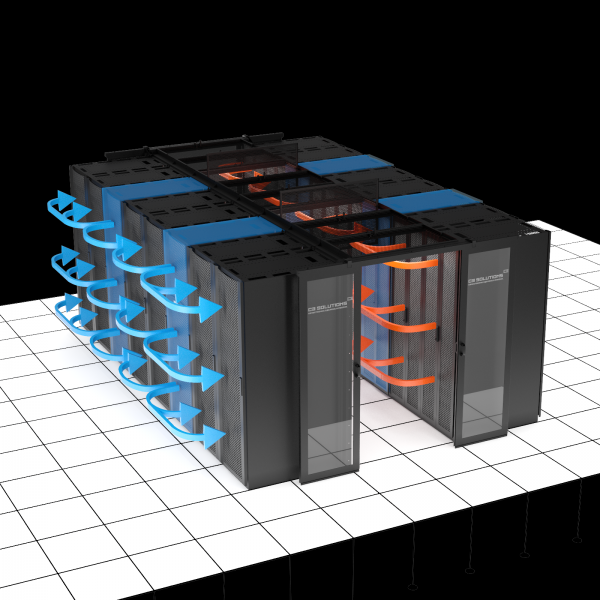
Rack installation: cabinets are arranged in rows, with their backs facing each other. In this arrangement, air conditioners are installed in a single line with the cabinets to minimize airflow length, thereby improving the cooling system's efficiency. Hot air is expelled into a closed container and then returned to the air conditioner.
Pros:
- A reliable, high-performance solution that can be used with heavily loaded racks and in rooms with low ceilings, as its installation does not require either a raised floor or an upper plenum.
- Easy scalability due to each corridor being independent.
- Comfortable working conditions for personnel in the room.
Cons:
- Cost: this option requires more air conditioners, with each container necessitating its own backup air conditioner.
- Inter-row air conditioners occupy space that could be used for server racks.
- Scaling difficulties: adding air conditioners is only possible if additional connection points were anticipated beforehand.
Structural Features:
- The room does not require additional height clearance.
- The container is insulated along the external perimeter of the corridor.
- Cabinets require insulation on the front side and a base plug, as well as insulation for all cabinet tops.
- For end cabinets in the corridor, insulation is needed on the sides and base around the external perimeter.
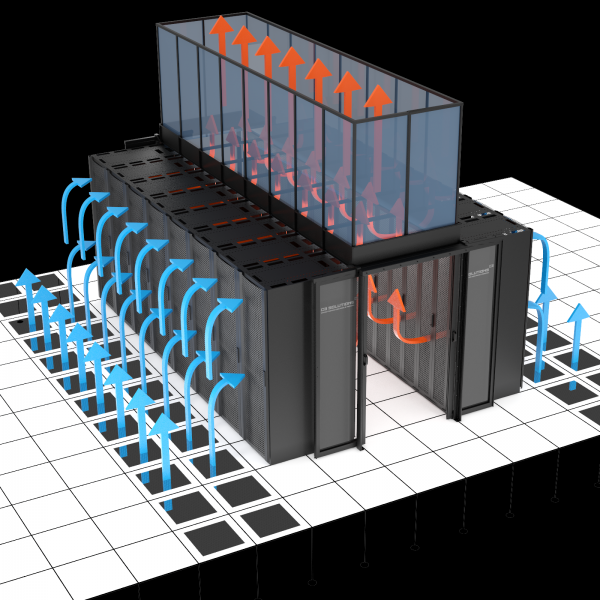
Suitable for small to medium server rooms with high loads (up to 10 kW per rack).
Special case: containerized systems with a closed cooling circuit.
Operating principle: air conditioners are installed next to or inside the cabinets, creating unified closed hot and cold zones. Air exchange occurs inside the cabinet (or a small group of cabinets).
Pros:
- A high-performance solution used with loaded racks or in areas not designed for IT equipment (the container also serves as a protective shell for IT equipment).
- Can be used in rooms with low ceilings.
Cons:
- The high cost of the solution excludes the possibility of mass deployment of cabinets.
- Limited scalability: Each set requires a separate air conditioner to ensure redundancy.
- Increased complexity of the fire suppression system: Each enclosed cabinet becomes a separate compartment that requires its own set of monitoring sensors and a localized fire suppression system.
Structural Features:
- The room does not require additional height clearance.
- The cabinet design includes a fully enclosed contour, including the option for IP protection.
Who it is suitable for: Those who need to host high-load computing complexes (up to 20 kW per rack).
Source: habr.com
