

Recently, our company introduced a new product – . This is a versatile platform designed for performance, ensuring multidimensional scaling, continuous data reduction (compression and deduplication), and support for next-generation media. PowerStore utilizes a microservices architecture, cutting-edge storage technologies, and integrated machine learning.
This is the device we want to tell you about in detail – information is still limited, and we hope that receiving it first-hand will be both enjoyable and useful. In today's post, we'll cover the key features and characteristics of the solution, and in the following ones, we'll delve deeper into technical details and development questions.
Advantages of the new storage systems:
- Modern microservices architecture. The system is based on container architecture, where separate components of the OS are allocated into individual microservices. Microservices architecture ensures portability of functions and rapid deployment of new features. This architecture allows for quick adaptation of previously written functionality to a new platform since microservices are autonomous and don’t affect each other, which provides higher reliability for the entire system compared to monolithic architecture. For instance, updates to microcode often affect only specific modules, rather than the whole system (or its core), resulting in smoother transitions.
- Utilization of advanced data storage technologies. Support for Intel Optane Storage Class Memory (SCM) and NVMe All-Flash eliminates bottlenecks in the system, significantly enhancing performance and reducing system response time.
- Continuous on-the-fly data reduction. Always-on data compression and deduplication mechanisms allow for a reduction in the volumes occupied by data within the system and optimize storage. This helps to cut costs on system acquisition and operation and boosts operational efficiency.
- Flexible scalability of the solution. The architecture of Dell EMC PowerStore solutions supports both vertical and horizontal scaling, allowing you to efficiently plan infrastructure expansion by increasing capacity or compute resources independently.
- Built-in Data Protection Mechanisms. PowerStore systems have a wide range of built-in data protection mechanisms—from snapshotting and replication to data encryption and integration with antivirus programs. The system also integrates extensively with external solutions, both from Dell Technologies and other vendors.
- AppsON. With the integrated VMware ESX hypervisor, customers can run custom virtual machines directly within the system.
- Integration with VMware. PowerStore is designed for deep integration with VMware vSphere. The integration includes support for VAAI and VASA, event notifications, snapshot management, vVols, as well as the discovery and monitoring of virtual machines in PowerStore Manager.
- Unified Data Access. PowerStore enables the storage of application data in various formats, from physical and virtual volumes to containers and traditional files, thanks to its ability to operate across multiple protocols—block, file, and VMware vSphere Virtual Volumes (vVols). This capability provides high flexibility for the system and allows IT departments to simplify and consolidate infrastructure.
- Simple, Modern Management Interface. The management interface of the system—PowerStore Manager—was developed based on customer requirements for ease of management. It is a web interface that runs on the PowerStore system controllers. Accessible via HTML5 protocol, it does not require the installation of additional plugins.
- Programmable Infrastructure. It simplifies application development and reduces deployment times from several days to just seconds, thanks to integration with VMware and support for leading management and orchestration environments, including Kubernetes, Ansible, and VMware vRealize Orchestrator.
- Intelligent Automation. Built-in machine learning algorithms automate labor-intensive workflows: such as initial provisioning and placement of volumes, data migration, load balancing, and issue resolution.
- Analytical Information about the InfrastructureDell EMC CloudIQ software for monitoring and analyzing storage combines the advantages of machine learning and human intelligence to analyze system performance and capacity in real-time, as well as to store historical data, providing a unified view of Dell EMC infrastructure. Dell Technologies plans to integrate CloudIQ with its full portfolio of solutions for even deeper analytics.
The platform is represented by two types of systems:
- – serves as a traditional storage array.
- – acts as a hyper-converged solution, allowing customers to run virtual machines alongside dedicated, traditional storage.
Thanks to integrated VMware ESXi capabilities, PowerStore X models allow applications with intensive input-output to be hosted directly within the PowerStore system. Using built-in VMware mechanisms (vMotion), applications can be moved between the PowerStore storage system and external solutions. The integrated VMware ESXi hypervisor runs customer applications alongside the PowerStore operating system as VMware virtual machines. This innovative design is perfect for storage-intensive applications, providing additional compute and high-performance storage for existing environments or any scenario where density, performance, and availability are key factors.
Clear examples where AppsON perfectly addresses our customers' needs include:
- Dedicated infrastructure for a single application. For example, for a database that requires a dedicated server, storage array, and some additional components, such as backup solutions. In this case, you can purchase a single PowerStore system that will meet all these needs, as the application and backup server can be deployed within the PowerStore node without the need for additional infrastructure.
- ROBO (remote branches and offices). Many clients face the challenge of replicating some form of the primary data center infrastructure at the edge to ensure the operation of their company's remote branches. Previously, this required purchasing separate servers, storage systems, and switches for connectivity, as well as figuring out how to secure the infrastructure and – most importantly – the data. We suggest, as in the previous example, taking the path of consolidating infrastructure within a single solution – Dell EMC PowerStore. You will receive a fully ready infrastructure within a 2U chassis, consisting of a pair of fault-tolerant servers connected to high-speed storage.
Both types of systems are presented as a line of models with different technical specifications:
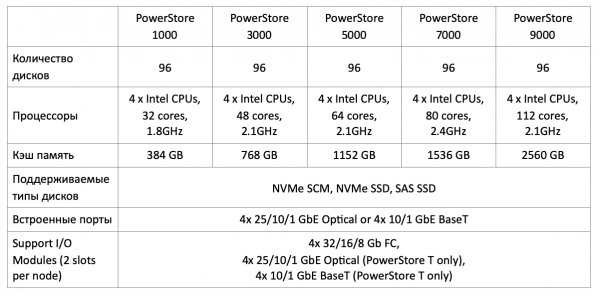
An important feature of PowerStore systems is the ability to upgrade an already purchased system in the future. Here’s how this can be done.
- Traditional upgrade of lower models to higher ones allows you to avoid unnecessary investments at the purchasing stage: there is no need to buy an expensive solution immediately, the potential of which will only be fully realized after several years. The upgrade procedure involves a standard replacement of one controller with another and is performed without interrupting access to data.
- Thanks to the properly selected architecture, the system can be upgraded to a new generation, which will keep it up to date and extend its lifespan.
- There is a way to build in the capability for system upgrades at the purchasing stage. For this purpose, there is a special option , which allows either to upgrade the system to a new generation or to upgrade the system to a higher and more powerful model.
Licensing
Dell EMC PowerStore is licensed on an 'All-Inclusive' model. The entire available functionality is provided to the customer along with the system without additional investments. As new functionality for the array is released, it will also become available to customers after the firmware upgrade.
Optimization of physical data volume
Dell EMC PowerStore includes several methods to improve data storage efficiency by reducing the physical space used by the data:
- fine space allocation;
- compression – has hardware implementation and is performed using a separate physical chip, which means the process does not affect system performance;
- data deduplication – allows storing only unique data, without duplicates.
Dynamic pools
The Dell EMC PowerStore is equipped with a RAID system based on extents for handling disk failures. A large number of RAID elements form a single logical space, creating a pool that the end user works with.
The dynamic RAID architecture provides 5 main advantages:
- reduces recovery time after a disk failure through parallel recovery from multiple disks;
- evenly distributes write requests across all disks;
- allows mixing disks of different capacities within a single pool;
- enables expanding system capacity by adding one or more disks;
- the ability to eliminate the need for a physically designated hot spare disk allows the system to rearrange data blocks using all functional disks.
High availability
NAS is fully protected against failures and includes a range of methods to ensure high availability. These methods are designed to counteract component failures in the system and the external infrastructure, such as network outages or power failures. In the event of a single component failure, the storage system continues to serve data. The system can also withstand multiple failures if they occur in separate components. After the administrator is notified of the failure, they can order and replace the faulty component without consequences.
NVMe SCM
Storage Class Memory (SCM) is high-performance non-volatile storage developed using Intel Optane technology. NVMe SCM drives have lower latency and improved performance compared to other SSDs. NVMe is a protocol that allows for direct access via the PCIe bus, designed with low-latency high-performance storage in mind. NVMe SCM drives serve as a storage layer for PowerStore, used for user data or metadata. Currently, capacities of 375 GB and 750 GB are available.
NVMe NVRAM
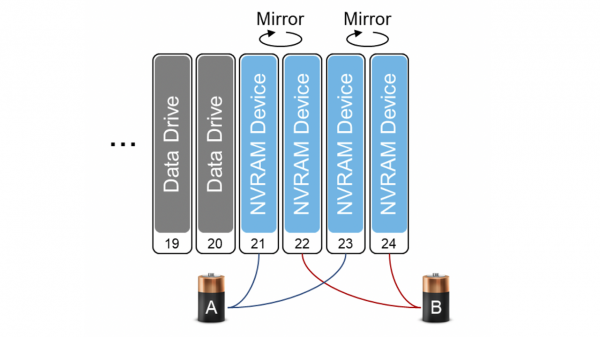
NVMe NVRAM is a high-performance storage solution used to enhance the caching system of PowerStore. They are available from both controllers of the system and enable easy caching of incoming records. The drives operate at DRAM speeds over PCIe, providing exceptional performance. Their design allows them to function as non-volatile storage, and PowerStore can quickly store incoming records and confirm operations to the host without notifying the second controller. Data storage is set up in pairs to mirror data between them in case of hardware failure.
This approach has significantly accelerated the operation of the storage system:
- first, the controllers do not need to waste CPU cycles synchronizing cache memory data with each other;
- second, all writes to the drives occur in 2 MB blocks, as the system accumulates this amount of data before writing it to the disks. Thus, random writes turn into sequential ones. As you can understand, this approach significantly reduces the load on the storage systems and the controllers themselves.
Clustering
Each Dell EMC PowerStore device is deployed as one of the nodes in a cluster, as clustering is part of the architecture of this platform. Currently, a single cluster can combine no more than four PowerStore nodes. When deploying a cluster with multiple devices, this task can be accomplished during the initial setup process, or devices can be added to an existing cluster in the future. A PowerStore cluster can be reduced by removing devices from the existing cluster, effectively splitting one large cluster into two smaller ones.
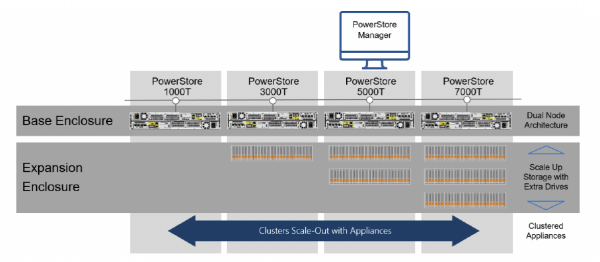
Clustering of Dell EMC PowerStore devices offers many advantages.
- Scale-Out scaling to increase the system's resources by adding additional compute nodes – CPU, memory, capacity, and host connection interfaces.
- Independent scaling of storage resources or compute resources.
- Centralized management of a multi-node cluster.
- Automatic load balancing between cluster nodes.
- Increased reliability and fault tolerance.
PowerStore Manager
PowerStore Manager provides storage administrators with a simple and intuitive interface for configuring and managing the cluster. It is based on HTML5, requires no additional client software installation, and helps perform the following tasks:
- Initial setup of a new PowerStore node.
- Adding or removing nodes from an existing cluster.
- Managing cluster resources.
The capacity of the cluster is the aggregation of the capacities of the individual nodes in the cluster. Statistics on savings are available for the entire cluster as a whole.
A load balancer is provided for balancing the load between the nodes in the cluster, which monitors the utilization of individual components of the cluster and assists in the automatic or manual migration of data between the nodes. The migration procedure is transparent to servers and is performed in hardware, without involving server resources.
In conclusion
Here is a brief overview of We are wrapping up. In this article, we covered the key aspects related to the technology and economics that need to be understood when planning the purchase of PowerStore systems – from clustering to licensing and planning future upgrades. Many technical details remain unaddressed, and we are pleased to share them with you either in upcoming articles or during discussions with our sales department specialists.
In conclusion, it is worth noting that the first sold systems have already been deployed in the data centers of our customers, distributors, and partners have purchased demo systems and are ready to showcase them to you. If the system has caught your interest, feel free to reach out to our partners and representatives to discuss your projects.
Source: habr.com
