

Today, we focus not only on Huawei's product line for building data center networks but also on how to create advanced integrated solutions based on these products. We will start with scenarios, move on to specific functions, supported hardware, and conclude with a review of specific devices that can serve as the foundation for modern data centers with a high level of automation for network processes.

No matter how impressive the specifications of network equipment may be, the capabilities of application architectural solutions built on it depend on how effectively the interconnected hardware, software, virtual, and other technologies can integrate with each other. In striving to keep up with the times, we aim to promptly offer our clients modern and promising opportunities that often exceed the boldest concepts of other vendors.
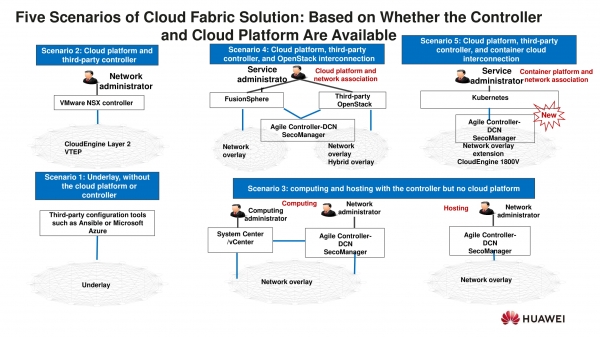
Solutions based on Cloud Fabric include the data center network, an SDN controller, and other necessary components for the specific project, including those from other manufacturers.
The first and simplest scenario involves using a minimal number of components: the network is built on Huawei hardware and third-party tools for automating network management processes and monitoring. For instance, tools like Ansible or Microsoft Azure.
The second scenario assumes that the customer is already using a virtualization system and SDN for data centers, such as NSX, and wants to employ Huawei equipment as a hardware VTEP (Virtual Tunnel Endpoint) within the existing VMware solution. On this company's site, of Huawei equipment that has been tested and can be used as VTEP. After all, it is no secret that, no matter how successful VXLAN (Virtual Extensible LAN) software solutions are on virtual switches, hardware implementations are more efficient in terms of performance.
The third scenario involves the construction of hosting & computing class systems that include a controller but lack any higher-level platform for integration. One option for implementing this scenario involves having a separate SDN controller, Agile Controller-DCN. System administrators can use this architecture for daily network management tasks. A more advanced version of the third scenario is based on the interaction between Agile Controller-DCN and VMware vCenter, connected through a certain business process, again without a higher-level administration system.
The fourth scenario is noteworthy—integration with a higher-level platform based on OpenStack or our virtualization product, FusionSphere. We are receiving numerous requests for such architectural solutions, with OpenStack (CentOS, Red Hat, etc.) being the most popular. It all depends on which orchestration and resource management platform is used in the data center.
The fifth scenario is entirely new. In addition to widely known hardware switches, it includes the distributed virtual switch CloudEngine 1800V (CE1800V), which can only be operated with KVM (Kernel-based Virtual Machine). This architecture implies combining Agile Controller-DCN with the Kubernetes containerization platform using the CNI plugin. Thus, Huawei is moving forward with the world. from host virtualization to operating system virtualization..
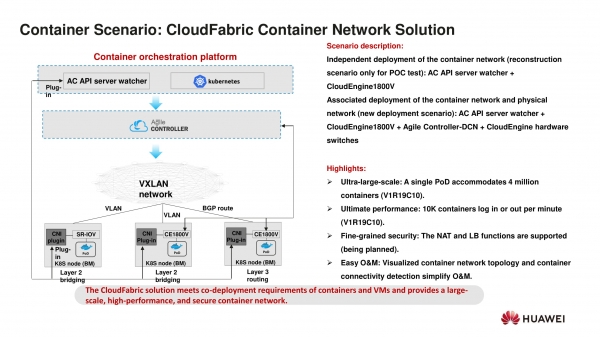
More about containerization.
We previously mentioned the virtual switch CE1800V, deployed using Agile Controller-DCN. In combination with Huawei hardware switches, they form a kind of 'hybrid overlay.' Soon, Huawei's container scenarios will gain support for NAT and load balancing features.
A limitation of the architecture is the inability to use CE1800V independently of Agile Controller-DCN. It should also be noted that a single Kubernetes PoD can contain no more than 4 million containers.
Connecting to the VXLAN network of the data center occurs via VLAN (Virtual Local Area Network), but there is an option where the CE1800V acts as a VTEP with BGP (Border Gateway Protocol) processing. This allows for the exchange of BGP routes with the backbone network without the need for separate hardware switches.
Intent-Driven Networks: networks that analyze intentions
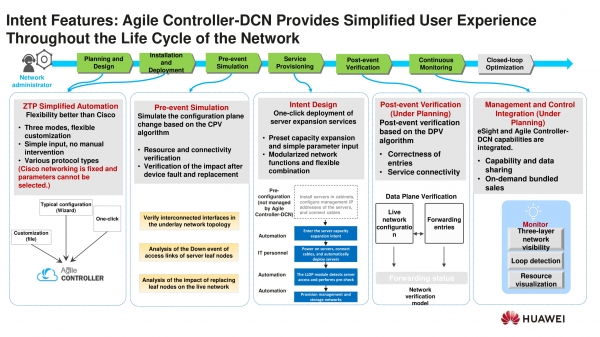
The concept of Intent-Driven Network (IDN) by Huawei emerged back in 2018. Since then, the company has continued to work on networks that use cloud computing technology, big data, and artificial intelligence to analyze users' goals and intentions.
Essentially, we are talking about a shift from automation to autonomy. The intention expressed by the user is returned in the form of recommendations for network products on how to realize that intention. This functionality is based on the capabilities of the Agile Controller-DCN, which will be integrated into the product to support the implementation of the IDN ideology.
In the future, with the implementation of IDN, it will be possible to deploy network services with a single click, implying the highest degree of automation. The modular architecture of network functions and the ability to combine these functions will allow the administrator to simply specify which services need to be made available in a particular network segment.
To achieve such a level of manageability, the ZTP (Zero Touch Provisioning) process is crucial. Huawei has made significant progress in this area, offering the capability for complete network deployment "out of the box."
The subsequent installation and deployment process necessarily includes a procedure to check the network connectivity between resources and assess changes in network performance based on its operational modes. This stage involves conducting a simulation before actual operation begins.
The next step is configuring services to meet client needs (service provisioning) and their verification, performed using Huawei's built-in tools. All that remains is to monitor the results.
Completing the entire described process can now be achieved using a single comprehensive mechanism based on the iMaster NCE platform, which includes the Agile Controller-DCN and the Element Management System (EMS) eSight.
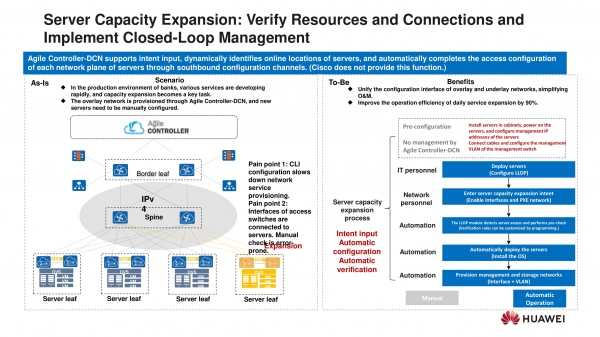
Currently, the Agile Controller-DCN can monitor resource availability and connection status and proactively respond to network issues after administrator approval. The addition of necessary services is currently done manually, but in the future, Huawei plans to automate this and other operations, such as server deployment and network configuration for storage systems.
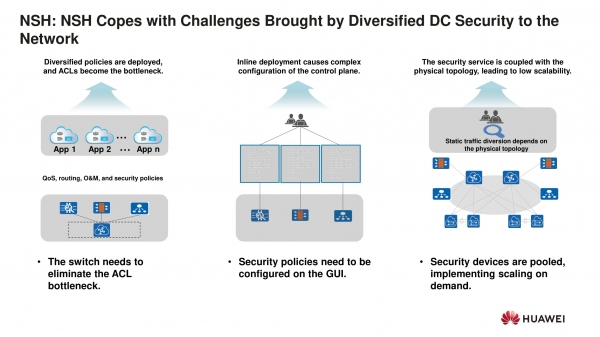
Service Chains and Microsegmentation
The Agile Controller-DCN can process Net Service Headers (NSH) contained in VXLAN packets. This is useful for creating service chains. For example, if you intend to send packets of a certain type along a path different from that offered by standard routing protocols, they must pass through a device (such as a firewall) before leaving the network. This can be achieved by configuring a service chain with the necessary rules. This mechanism can be used to configure security policies, among other applications.
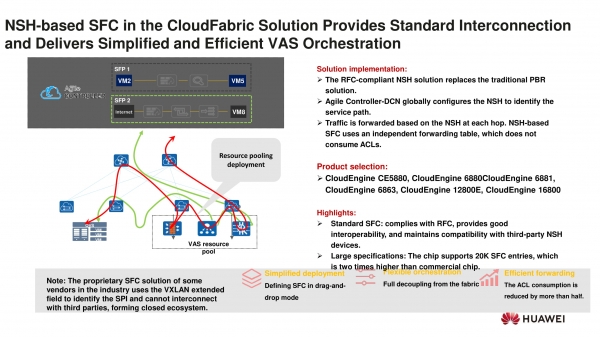
The diagram clearly illustrates the operation of RFC-compliant service chains based on NSH, along with a list of hardware switches that support them.
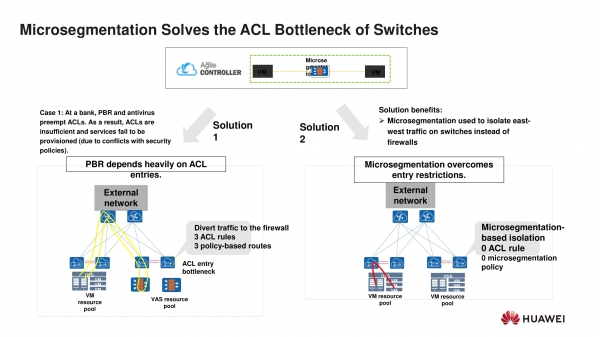
Huawei's solutions for creating service chains are complemented by microsegmentation tools—a network security method that involves isolating security segments down to individual workload elements. The absence of the need to manually configure a large number of Access Control Lists (ACLs) helps to overcome the 'bottleneck' of ACL management.
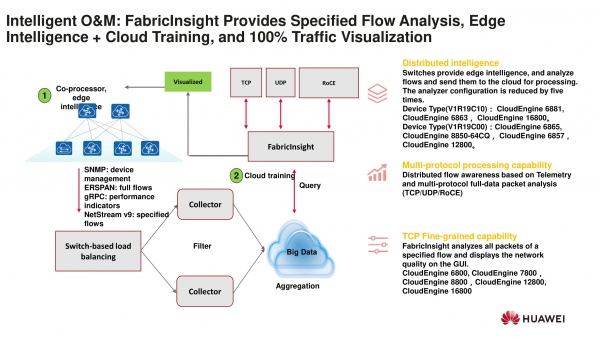
Intelligent Operations
Turning to the issue of network operation, we cannot overlook another component of the iMaster NCE umbrella brand — the intelligent network analyzer FabricInsight. It offers extensive capabilities for collecting telemetry and information about data flows within the network. Telemetry is gathered using gRPC and accumulates data on transmitted, buffered, and lost packets. The second significant data set is aggregated via ERSPAN (Encapsulated Remote Switch Port Analyzer) and provides insight into data flows in the data center. Essentially, this involves the collection of TCP headers and the volume of information transmitted during each TCP session. This can be accomplished using various Huawei devices — the list is presented in the diagram.
SNMP and NetStream are also included, so Huawei employs both old and new mechanisms to shift from a network viewed as a 'black box' to one from which we know practically everything.
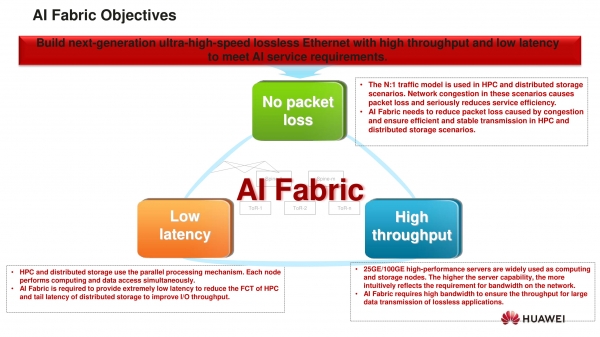
AI Fabric: smart networks without losses
The functions of AI Fabric, supported by our equipment, are designed to transform Ethernet into a high-performance network with low latency and no packet loss. This is essential for deploying key application scenarios in the data center network.
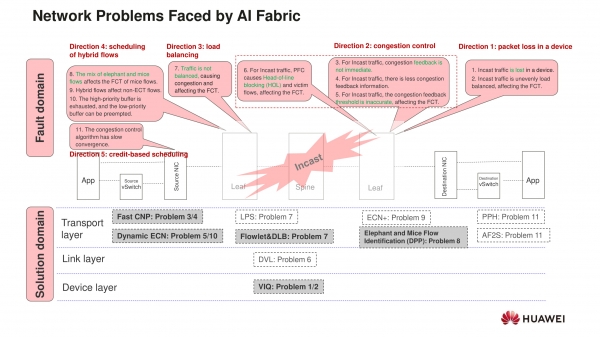
In the diagram above, we see the issues that pose a risk during network operation:
- packet loss;
- buffer overflow;
- the issue of optimal network loading when using parallel links.
Huawei equipment implements mechanisms to address all these problems. For example, at the chip level, a technology of virtual incoming queues is integrated, which also prevents head-of-line (HOL) blocking at the input.
At the protocol level, the Dynamic ECN mechanism — dynamic buffer size adjustment — operates, along with Fast CNP — rapid notification to the source of network issues.
Equalizing stream rights and is supported by the Dynamic Packet Prioritization (DPP) technology, which involves placing short data fragments from different streams into a separate high-priority queue. Thus, shorter packets have a better chance of 'surviving' in the presence of longer, heavier flows.
To clarify, for the above mechanisms to function effectively, they must be directly supported by the equipment.
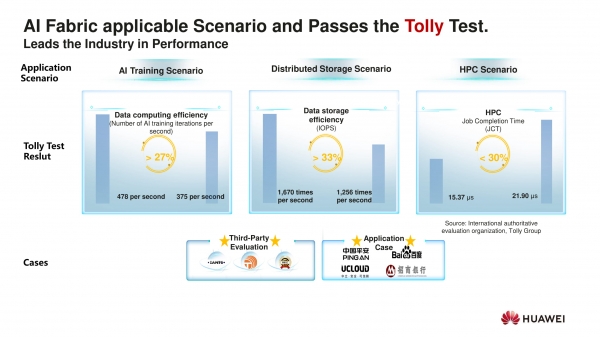
All these functions are applied in one of the three usage scenarios of Huawei equipment:
- when building artificial intelligence systems based on distributed applications;
- when creating distributed data storage systems;
- when developing systems for high-performance computing (HPC).
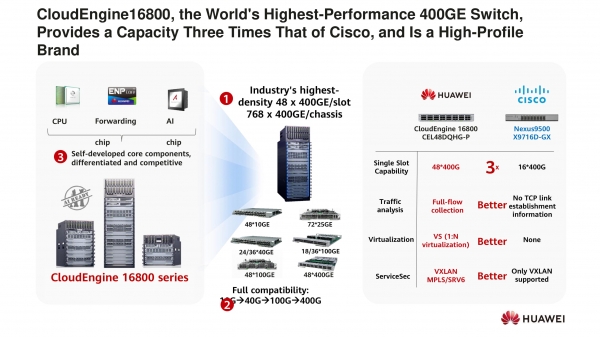
Ideas embodied in the 'hardware'
Having discussed typical usage scenarios for Huawei solutions and listed their main capabilities, let's move on to the hardware.
CloudEngine 16800 is a platform that supports operation via 400 Gbps interfaces. Its distinctive feature is the presence of a dedicated forwarding chip and an AI processor, which are necessary for implementing AI Fabric capabilities.
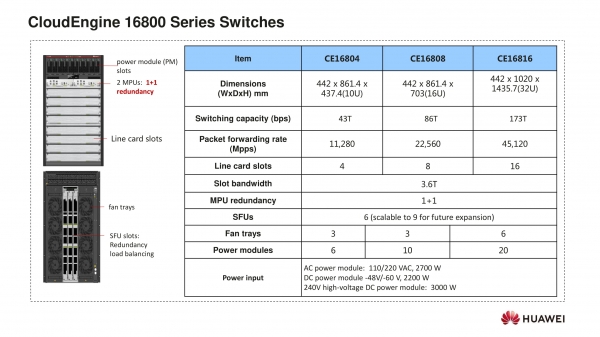
The platform is designed with a classic orthogonal architecture featuring a front-to-back cooling system and is available with one of three chassis types — 4 (10U), 8 (16U), or 16 (32U) slots.
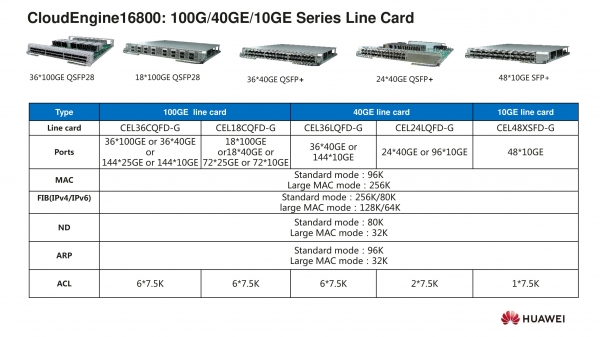
CloudEngine 16800 can use several types of line cards. These include traditional 10 gigabit, as well as 40 and 100 gigabit, including the very latest ones. Upcoming releases will feature cards with 25 and 400 Gbps interfaces.
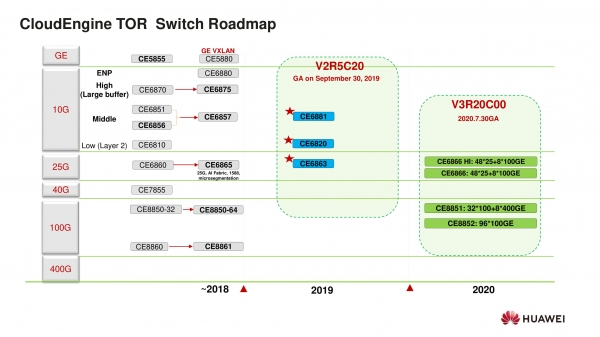
Regarding ToR (Top of Rack) switches, their current models are marked on the timeline above. The most interest is generated by the new 25-gigabit models, 100-gigabit switches with 400-gigabit uplinks, and high-density 100-gigabit switches with 96 ports.
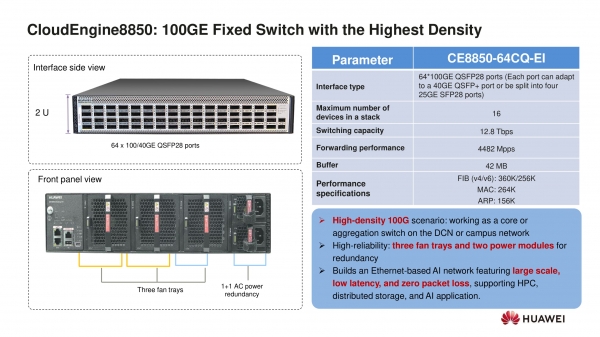
Currently, the main fixed-configuration switch from Huawei is the CloudEngine 8850. It is expected to be replaced by the 8851 model with 32 100 Gbps interfaces and eight 400 Gbps interfaces, as well as the option to split them into 50, 100, or 200 Gbps.
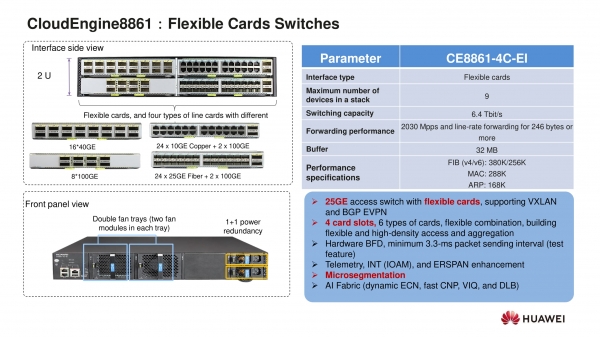
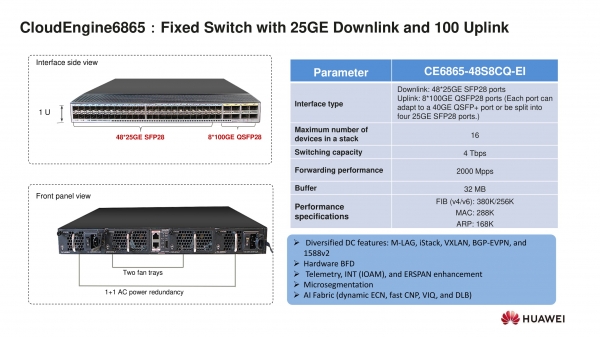
Another fixed-configuration switch, CloudEngine 6865, remains in Huawei's current product lineup. This well-established 'workhorse' offers access at 10 / 25 Gbps and eight 100-gigabit uplinks. Additionally, it supports AI Fabric.
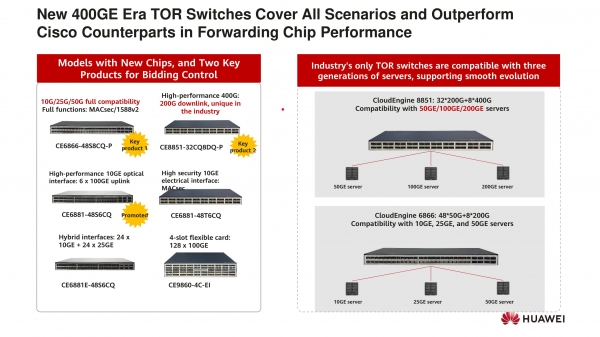
The diagram shows the characteristics of all the new switch models we anticipate in the coming months, if not weeks. Some delays in their release are related to the coronavirus situation. Moreover, the ongoing issues surrounding sanctions against Huawei may affect only the timing of their premiere.
You can easily get more information about Huawei solutions and their applications by signing up for our webinars or contacting company representatives directly.
***
We would like to remind you that our experts regularly conduct webinars on Huawei products and the technologies used in them. A list of upcoming webinars is available at .
Source: habr.com
