

Nokia Corporation a new network operating system (SR Linux), for use in the network infrastructure of data centers and cloud environments. SR Linux is considered a key component of Nokia's Data Center Fabric solutions and will be installed on the Nokia 7250 IXR and 7220 IXR router series. The SR Linux-based solution is already undergoing testing at Apple’s new data center in Denmark.
Unlike other network operating systems based on the Linux kernel, SR Linux retains access to the underlying Linux environment, which is not obscured by specialized APIs and interfaces. Users have access to the unmodified Linux kernel and basic system applications (bash, cron, Python, etc.), while specific applications are created using the NetOps Toolkit, which is not tied to specific programming languages. Applications based on the NetOps Toolkit, such as routing protocol implementations, gain access to various network APIs but operate as independent components.
This approach allows for the management of applications separately from the operating system, meaning you can update an application without making system changes or update the operating system without rebuilding applications. In addition to standard applications like routing protocol implementations, the execution of arbitrary third-party programs is allowed. The use of an unmodified Linux kernel significantly simplifies the maintenance of patches for vulnerability fixes and the creation of extensions. Access to Linux utilities, patches, and packages is declared, along with support for running in isolated containers.
Checkpointing is supported to roll back changes in case of problems.
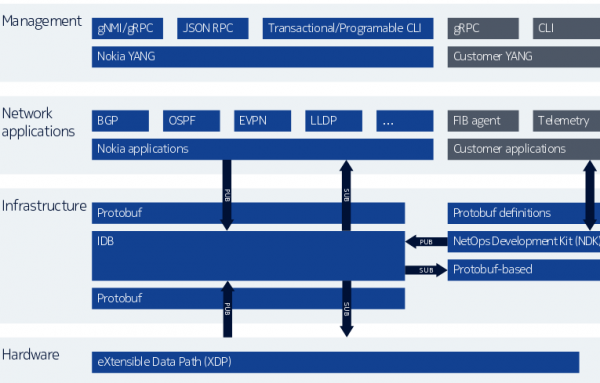
Management can be performed via (gRPC Network Management Interface), command line interface, Python plugins, and JSON-RPC based API.
To access the functionality of services running in the system, it is recommended to use gRPC and the Protocol Buffers data exchange protocol. SR Linux applications can exchange state information using a "publish/subscribe" (pub/sub) architecture, which also employs gRPC and Protocol Buffers, and IDB (Nokia Impart Database) is used as the guaranteed delivery mechanism.
Data models YANG (Yet Another Next Generation) are used to structure information about the application's state and the configuration in use. ).
The implementations of network protocols, including Multiprotocol Border Gateway Protocol (MP-BGP), Ethernet VPN (EVPN), and Virtual Extensible LAN (VXLAN), are based on the proven SR OS (Nokia Service Router Operating System) protocol stack, already in use on over a million Nokia routers. To abstract from hardware components, the subsystem is employed. (eXtensible Data Path).
To automate the operations of creating, deploying, and configuring the network infrastructure of data centers, as well as collecting and analyzing telemetry, the Nokia Fabric Services Platform (FSP) is suggested. FSP also provides tools for software network simulation to simplify the planning, designing, testing, and debugging of data center networks. Network components are simulated using container isolation based on the Kubernetes platform, allowing individual instances of SR Linux to run in their isolated environments.
Essentially, FSP allows for the programmatic creation of a virtual copy of the real network and the use of the same software (SR Linux in containers) in this simulated network as that used on actual routers and switches. Moreover, the same configuration is used in both the real and simulated networks, allowing the software-simulated network to serve as the first link for making and testing changes. Based on the simulated environment, FSP can generate all the information needed for deploying the real network.
Source: opennet.ru
