

The main aim of this article is to introduce those interested in lighting equipment to the technical solutions used by unscrupulous manufacturers from China for producing counterfeit products that mimic reputable brands. Here, I will express my subjective opinion as someone who has experienced this type of equipment firsthand. This article should not be considered a guide; therefore, no links to suppliers or sellers will be included. Everyone has access to the internet, and finding information through searches should not be a challenge.
The high cost of original solutions is obviously due to the manufacturer's desire to compensate for the labor costs involved in developing and producing narrowly specialized devices that are not aimed at a wide audience of users. This article will discuss how reasonable it is for users who need a functional device but cannot afford the high price to seek alternatives in the form of cheaper copies of the original device.
To begin with, I would like to discuss the basic principles of stage lighting complexes.
Those familiar with DMX512, ArtNet, sACN, etc., can skip this part of the article.
Basics
Thus, the foundation of the entire lighting control system is the DMX512 protocol.
The DMX512 data transmission protocol was developed in 1986 as a means of controlling intelligent lighting fixtures from various control panels (consoles) through a single interface, allowing different control devices to be combined with various end devices (dimmers, projectors, strobe lights, smoke machines, etc.) from different manufacturers. It is based on the standard industrial interface RS-485, which is used for computer control of industrial controllers, robots, and automated machines. Data is transmitted using a cable with two twisted wires within a common shield.
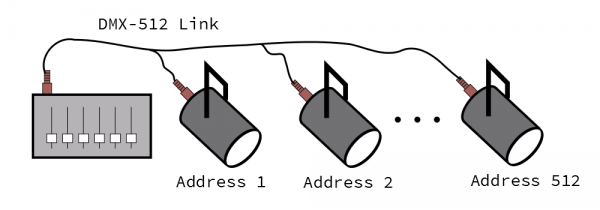
The DMX512 standard allows the control of 512 channels simultaneously over a single communication line (one device may use several dozens of channels). Multiple devices operating simultaneously and supporting DMX512 enable the creation of lighting scenes and design elements of varying complexity, both indoors and outdoors. One parameter of the device is transmitted over one channel, such as what color to set the beam, which pattern (gobo) to choose, or at what angle to tilt the mirror horizontally at that moment, i.e., where the beam will hit. Each device has a certain number of parameters that can be controlled, occupying the corresponding number of channels in the DMX512 space. Each parameter can take values from 0 to 255 (8 bits or 1 byte).
The next image reflects the standard wiring diagram for devices:
More about the principles of the protocol can be read in the article provided below in the sources.
The DMX512 protocol has several advantages and disadvantages, but it is currently the main standard for most lighting systems.
Before the advent of a unified digital protocol, control was done through separate wires with a control voltage sent to each device or through various digital and analog connections.
For example, the analog interface "0-10 volts" gained wide popularity, where one cable was run to each device. The system successfully worked with a small number of devices, but became too cumbersome and inconvenient as the number of devices increased, both in setup and in management and troubleshooting. This and other analog systems were excessively complicated, expensive, and lacked a unified standard.
They required special adapters, as well as amplifiers and voltage inverters, to connect lighting fixtures from one manufacturer to control consoles from another.
Digital systems also lacked universality; they were incompatible with each other, and often the interfaces used were hidden by developers. This was a clear problem for users of such systems, as choosing one system limited them to the hardware offered by that same manufacturer, in accordance with the same standard.
The drawbacks of the DMX512 protocol are:
- Poor resistance to interference.
The operation of devices in conditions of strong radio wave interference created by mobile communication terminals (i.e., mobile phones), nearby television centers, etc., as well as electrical and lighting equipment: elevators, advertising signs, theatrical lighting, daylight lamps, or simply improper laying of DMX cables, can be accompanied by chaotic 'twitching' against the normal operation of devices. This problem can be solved with the help of specialized devices (amplifiers, splitters, etc.). The downside of this solution is the increased cost of installation due to the use of additional devices.
- Attenuation and signal reflection over long line lengths.
The standard does not recommend connecting more than 32 devices to one DMX 512 line. If the line laid between the devices is sufficiently long or if more than ten devices are connected in one chain, there is a high probability that the devices will malfunction, one of the main reasons being the self-induction of the DMX signal along the line. Simply put, the signal, after passing through all devices, is 'reflected' and packets can bounce back and forth along the DMX line. For such cases, a simple device called a DMX Terminator is used. A DMX line terminator consists of a resistor with a rating of approximately 120 ohms.
- Low fault tolerance.
Since the devices are connected in series using a single line, damage to this line will result in the inability to control the devices located after the damaged section.
The problem can be mitigated with devices that allow branching and enhance fault tolerance.
Below is an image of a splitter that helps branch the signal into several independent lines:
- Weak protection against high voltage.
Gas discharge lamps are used in many lighting devices, providing a high-intensity light output from a relatively small light source. To operate these lamps, electronic circuits known as drivers or ignition units are employed (similar to those used for xenon lamps in cars). These circuits operate at high voltages (several hundred volts). Poor quality lighting devices or mechanical failures may cause short circuits in the electronic circuits to the metal housing of the device, as well as a high voltage entering the control line. In this case, physical outputs on the control panel and even USB interfaces can fail if the panel is connected to a laptop or computer, resulting in costly repairs. This problem can be avoided by using splitters, which typically incorporate optical isolators in their design.
There are also wireless DMX signal transmitters. One transmitter can broadcast 512 channels, which is the same as one wired line. In theory, an unlimited number of receivers can be programmed to receive the signal from a single transmitter. Wireless devices transmit signals on frequencies similar to Wi-Fi in the 2.4GHz range. They are still in the early stages of development due to their limited range and numerous complaints about unstable performance (possibly due to the congestion of the 2.4GHz radio channel), which has led to their adoption mainly in smaller installations used by DJs.
Art-Net Protocol
The further development of the protocol involved integrating DMX512 into the Art-Net network protocol.
Art-Net is a simple implementation of the DMX512 protocol over UDP, where control channel information is sent in IP packets, typically over a local area network (LAN) using Ethernet technology. Art-Net is a feedback protocol. Devices operating under Art-Net generally have a function to respond to received data. For example, a device receives data and can send back a confirmation that it has been received.
ArtNet can transmit absolutely everything, including files. Initially, ArtNet can send values and positions of faders, device coordinates, as well as transmit timecode (address timecode — digital data about time, recorded and transmitted along with image or sound. It is used for synchronizing various media systems — audio, video, light, etc.).
ArtNet devices use what are known as Nodes for communication with each other. Nodes can consist of Art-Net to physical DMX512 converters, or lighting fixtures or equipment that already have a built-in Art-Net interface. Nodes can subscribe (listen) to a server. At the same time, the server can distribute packets to all ArtNet nodes or to selected ones. Nodes resemble a social network in some way; they can subscribe to a server, while the server can ignore certain nodes. A computer with lighting software or a lighting console can serve as an Art-Net server. The simplest way to implement the protocol is via Broadcast, which works on the principle of a radio station. It broadcasts to all listeners, and listeners can either accept or reject the signal.
Each space of 512 DMX channels in the Art-Net protocol is called a Universe. Each node (device) can support a maximum of 1024 DMX channels (2 Universes) on one IP address. Every 16 Universes are combined into a subnet (Subnet — do not confuse with subnet mask). A group of 16 subnets (256 Universes) forms a network (Net). The maximum number of networks is 128. In total, the Art-Net protocol can support up to 32,768 nodes (256 Universes x 128 Nets), each with 512 DMX channels.
ArtNet addresses are typically used within the 2.0.0.0/8 range, but they also work without issues in regular local networks like 192.168.1.0/255.
Advantages of ArtNet:
- The ability to transmit signals over existing local network lines, as well as significantly increase transmission range using inexpensive networking equipment and distances up to 100m over unshielded twisted pair category 5.
- An Art-Net line can transmit thousands of times more data than a physical DMX512 line.
- The Ethernet network has a 'star' topology. This increases the reliability of the system compared to the 'ring' or 'pass-through' wiring used with DMX512.
- The capability to use wireless networking equipment, such as Wi-Fi routers, access points, etc.
Among the disadvantages, the following can be noted:
- The maximum length of a cable run is approximately 100 meters compared to 300 meters for the DMX512 system. However, considering the lower cost of Ethernet switches compared to DMX512 splitters, this issue can be overlooked.
- Implementing a 'star' topology for the Ethernet network requires more cabling. However, due to the low cost of twisted pair cables and because Ethernet can transmit much more data than DMX512, savings are still realized. Additionally, 'star' wiring for Ethernet will be more complex when laying cables across the truss. The best solution is to bring Ethernet from the console to the truss, then convert it to DMX512.
A visual diagram of device connections using nodes:
Most major manufacturers of software for controlling lighting fixtures support the Art-Net protocol, allowing the use of Ethernet instead of physical DMX512 lines.
Now let's move directly to the topic of the article — control panels, consoles, and controls for lighting fixtures produced by Chinese manufacturers.
Let's familiarize ourselves with some basic terminology:
- Interface — a device that does not have its own control elements and allows for outputting control signals from software running on a personal computer.
- Lighting console — either a stationary device capable of outputting control signals or a controller connected to a computer or laptop and working in conjunction with software. Control elements include faders, buttons, encoders, etc., which can be assigned to change specific parameters of the lighting fixtures, trigger recorded scenes.
- Console — a device that essentially combines a PC with software and a controller with control elements and output signals in one case. It typically includes a touchscreen(s) and input/output ports found on most PC motherboards.
Sunlite and Daslight
I included these interfaces in the list as I was directly involved in their distribution.
These interfaces do not relate to controllers or consoles, as they have limited functionality and a different logic of interface organization and controls.
The Daslight interface from Nicolaude in its maximum configuration allows the use of 3072 DMX channels, with 1536 channels outputted through physical outputs on the interface itself. The other half can be outputted via the art-net interface.
It operates on Windows and Mac. Currently, the latest official version dates back to 13.01.2020.
The Sunlite Suite 2 FC+ interface allows outputting 1536 channels through physical outputs and up to 60 Universes via art-net.
It works only on Windows. Currently, it has officially been discontinued and replaced by the Sunlite Suite 3 interface. The last version of Sunlite Suite 2 software was released in 2019.
Regarding prices, counterfeits are 7-8 times cheaper than the original. Considering the high cost of original interfaces, copies are quite a profitable purchase.
Among the downsides of copies, it can be noted: the inability to update the software (this is already impossible for Sunlite), to purchase additional useful features such as extra art-net universes, channels for standalone mode, etc.
Software installation is performed from the included disc; software downloaded from the official site will not work.
When attempting to update the software, problems may arise in the form of the computer failing to recognize the interface, so it's better to limit internet access for the software to avoid issues. From several dozen sold interfaces, there were a couple of complaints from buyers who tried to use the original software. One time there was an interface with a factory defect, but it was replaced by the seller without problems.
Interface T1
It mimics the T2 interface from Avolites. Externally, it resembles the Sunlite Suite 2 and Daslight. The seller claims that the interface performs the same functions as the original T2, allowing the output of two DMX streams and full use of midi commands and LTC timecode.
It also comes with Titan software on a flash drive, version 11. Up to 32 T1 interfaces can be used simultaneously.
Starting with version 12, a special avokey key will be required for software usage, so we shouldn't expect updates from the Chinese in the near future.
The price is on average 3 times lower than the original.
Titan Mobile, Fader Wing, Quartz, Tiger Touch controllers and consoles
The consoles are assembled in a rather makeshift manner. The basis is a standard PC motherboard, to which various devices like controllers, displays, etc., are connected in a rather crude fashion.
It's unclear why they opted for standard USB extenders and VGA cables, glued to the connectors with thermal glue on both sides.
In the original consoles, everything is assembled and secured in a more civilized manner.
Reviews vary; some have these copies working reliably for years, while others have experienced constant key failures. Overall, it’s hit or miss.
If you do decide to purchase, do so from reliable suppliers based on recommendations from acquaintances.
Prices differ by 3 to 5 times.
Regarding the assembly of the Mobile and Fader Wing controllers, there are no complaints, but a downside is that cheaper components like faders and encoders are used, leading to a shorter lifespan compared to the original.
Just like with the T1, updating the software to version 12 and above won't be possible due to the use of the avokey key.
Grand MA2 consoles and controllers
The consoles are copies of MA2 Ultralite, Full models, etc.
Here, the assembly resembles that of the Titan. The same USB extenders and thermal glue are used.
Interestingly, the Chinese produce unique devices that are not found in the original manufacturer's lineup.
This includes the USB DMX expander interface, which connects to a computer via USB and allows the use of 4096 DMX parameters.
Several requests for testing with the latest version of the original software have been successfully confirmed. Additionally, there have been no complaints from at least a small number of buyers so far.
Another interesting device is the Boss console.
There are various models differing in functionality, appearance, and hardware specifications.
Despite the drawbacks, this device offers an impressive balance of mobility and functionality, which original consoles cannot boast of. For example, it allows output of 3072+512 parameters, including via physical outputs.
As previously mentioned, there were issues with one specific unit, such as the touchscreen disconnecting, etc. Overall, stability leaves much to be desired.
There are also counterfeit Command Wing, Fader Wing, and various Net Nodes on the market. In terms of assembly and stability, the titan consoles perform better. There is experience with the successful use of the Command Wing.
The cryptographic protection of Grand MA devices and software is still significantly lower than that of competitors, allowing Chinese manufacturers to release clones that work fully with the official software.
In conclusion, I would like to express that the use of clones in Russia is possible for those whose finances do not allow them to purchase original lighting control devices. As far as I know, the use of counterfeit products (not including sales) is not regulated in our country, unlike in Europe or the West, where it can be equated to profiting from someone else's intellectual property and lead to large fines.
Sources:
Source: habr.com
