

Development of the topic and for a detailed response to
The strategy used implies the concept of 'Business Logic in the Database', which was described in more detail here —
The theoretical part is well described in the documentation — . Below is a practical implementation of a specific business task — a role-based data access model.
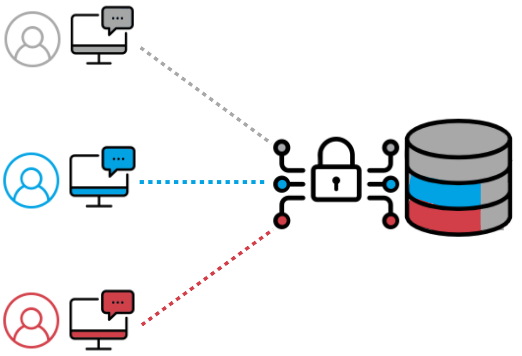
The article contains nothing new, no hidden meanings or secret knowledge. It is simply a sketch about the practical implementation of a theoretical idea. If anyone is interested — read on. If not, don’t waste your time.
Task Definition
It is necessary to restrict access to view/insertion/modification/deletion of a document according to the user's application role. The role refers to an entry in the table roles related by a many-to-many relationship to the table users. The details of the table implementation have been omitted due to their triviality. Specific implementation details related to the subject area have also been omitted.
Implementation
Creating roles, schemas, and the table
Creating database objects
CREATE ROLE store;
CREATE SCHEMA store AUTHORIZATION store;
CREATE TABLE store.docs
(
  id integer ,         -- document id
  man_id integer , -- document manager id
  stat_id integer ,  -- document status id
  ...
  is_del BOOLEAN DEFAULT FALSE
);
ALTER TABLE store.docs ADD CONSTRAINT doc_pk PRIMARY KEY (id);
ALTER TABLE store.docs OWNER TO store ;
Creating functions for implementing RLS
Checking the ability to execute SELECT on the row
check_select
CREATE OR REPLACE FUNCTION store.check_select ( current_id store.docs.id%TYPE ) RETURNS boolean AS $$
DECLARE
  result boolean ;
  curr_pid integer ;
  curr_stat_id integer ;
  doc_man_id integer ;
BEGIN
  -- DBA has access to all documents
  IF SESSION_USER = 'curr_dba'
  THEN
    RETURN TRUE ;
  END IF ;
  --------------------------------

  --If the document is marked as 'deleted' - do not show in the selection
  SELECT
    is_del
  INTO
    result
  FROM
    store.docs
  WHERE
    id = current_id ;
 IF result = TRUE
 THEN
   RETURN FALSE ;
 END IF ;
 --------------------------------

 --Get the current user id
 SELECT
   service_function.get_curr_pid ()
 INTO
   curr_pid ;
 --------------------------------

 --Get the document manager id
 SELECT
   man_id
 INTO
   doc_man_id
 FROM
   store.docs
 WHERE
   id = current_id ;
 --------------------------------

 --If the document manager is not the current user or no manager is assigned
 --add the document to the selection
 IF doc_man_id != curr_pid OR doc_man_id IS NULL
 THEN
   RETURN TRUE  ;
 ELSE
   --Get the current status of the document
   SELECT
     stat_id
   INTO
     curr_statid
   FROM
     store.docs
   WHERE
     id = current_id ;

   --If the status allows viewing the document - add the document to the selection
   IF curr_statid = 4 OR curr_statid = 9
   THEN
     RETURN TRUE ;
   ELSE
   --Otherwise - exclude the document from the selection
     RETURN FALSE ;
    END IF ;
  END IF ;
  --------------------------------

 RETURN FALSE ;
END
$$ LANGUAGE plpgsql SECURITY DEFINER;
ALTER FUNCTION store.check_select( store.docs.id%TYPE  ) OWNER TO store ;
REVOKE EXECUTE ON FUNCTION store.check_select( store.docs.id%TYPE  ) FROM public;
GRANT EXECUTE ON FUNCTION store.check_select( store.docs.id%TYPE  ) TO service_functions;
Check the possibility to perform INSERT on the row
check_insert
CREATE OR REPLACE FUNCTION store.check_insert ( current_id store.docs.id%TYPE ) RETURNS boolean AS $$
DECLARE
  curr_role_id integer ;
BEGIN
  --DBA can add a row in any case
  IF SESSION_USER = 'curr_dba'
  THEN
    RETURN TRUE ;
  END IF ;
  --------------------------------

 --Get the current user's role id
 SELECT
   service_functions.current_rid()
  INTO
    curr_role_id ;
 --------------------------------

--If the role allows the creation of a new document
--permit
IF curr_role_id = 3 OR curr_role_id = 5
THEN
  RETURN TRUE ;
END IF ;
--------------------------------
RETURN FALSE  ;
END
$$ LANGUAGE plpgsql SECURITY DEFINER;
ALTER FUNCTION store.check_insert( store.docs.id%TYPE  ) OWNER TO store ;
REVOKE EXECUTE ON FUNCTION store.check_insert( store.docs.id%TYPE  ) FROM public;
GRANT EXECUTE ON FUNCTION store.check_insert( store.docs.id%TYPE  ) TO service_functions;
Check the possibility to perform DELETE on the row
check_delete
CREATE OR REPLACE FUNCTION store.check_delete ( current_id store.docs.id%TYPE )
RETURNS boolean AS $$
BEGIN
  --Only DBA can delete a row
  IF SESSION_USER = 'curr_dba'
  THEN
    RETURN TRUE ;
  END IF ;
  --------------------------------

  RETURN FALSE ;
END
$$ LANGUAGE plpgsql
SECURITY DEFINER;
ALTER FUNCTION store.check_delete( store.docs.id%TYPE  ) OWNER TO store ;
REVOKE EXECUTE ON FUNCTION store.check_delete( store.docs.id%TYPE  ) FROM public;
Check the possibility to perform UPDATE on the row.
update_using
CREATE OR REPLACE FUNCTION store.update_using ( current_id store.docs.id%TYPE , is_del boolean  )
RETURNS boolean AS $$
BEGIN
   --Documents with 'deleted' status cannot be edited
   IF is_del
   THEN
     RETURN FALSE ;
 ELSE
    RETURN TRUE ;
  END IF ;

END
$$ LANGUAGE plpgsql SECURITY DEFINER;
ALTER FUNCTION store.update_using(  store.docs.id%TYPE ,  boolean  ) OWNER TO store ;
REVOKE EXECUTE ON FUNCTION store.update_using(  store.docs.id%TYPE ,  boolean  ) FROM public;
GRANT EXECUTE ON FUNCTION store.update_using( store.docs.id%TYPE  ) TO service_functions;
update_check
CREATE OR REPLACE FUNCTION store.update_with_check ( current_id store.docs.id%TYPE , is_del boolean )
RETURNS boolean AS $$
DECLARE
  current_rid integer ;
  current_statid integer ;
BEGIN

  --DBA can view the row
  IF SESSION_USER = 'curr_dba'
  THEN
    RETURN TRUE ;
  END IF ;
  --------------------------------

 --Get the current user's role id
 SELECT
   service_functions.current_rid()
  INTO
    curr_role_id ;
 --------------------------------

 --Document deletion - changing the flag
 IF is_deleted
 THEN
   --If the user's role is ***
   IF current_role_id = 3
   THEN
      SELECT
        stat_id
      INTO
        curr_statid
      FROM
        store.docs
      WHERE
        id = current_id ;

      --A document in status *** cannot be deleted
      IF current_status_id = 11
      THEN
         RETURN FALSE ;
      ELSE
      --Document can be deleted in other statuses
        RETURN TRUE ;
      END IF ;

    --Otherwise, if the user's role is ***
    ELSIF current_role_id = 5
    THEN
      --All document statuses
      RETURN TRUE ;
    ELSE
      --Other users cannot delete documents
      RETURN FALSE ;
    END IF ;
 ELSE
   --Document update is allowed
    RETURN TRUE ;
END IF ;

RETURN FALSE ;
END
$$ LANGUAGE plpgsql SECURITY DEFINER;
ALTER FUNCTION store.update_with_check( storg.docs.id%TYPE ,  boolean   ) OWNER TO store ;
REVOKE EXECUTE ON FUNCTION store.update_with_check( storg.docs.id%TYPE ,  boolean   )  FROM public;
GRANT EXECUTE ON FUNCTION store.update_with_check( store.docs.id%TYPE  ) TO service_functions;
Enabling Row Level Security policy for the table.
ENABLE ROW LEVEL SECURITY
ALTER TABLE store.docs ENABLE ROW LEVEL SECURITY ;

CREATE POLICY doc_select ON store.docs FOR SELECT TO service_functions USING ( (SELECT store.check_select(id)) );
CREATE POLICY doc_insert ON store.docs FOR INSERT TO service_functions WITH CHECK ( (SELECT store.check_insert(id)) );
CREATE POLICY docs_delete ON store.docs FOR DELETE TO service_functions USING ( (SELECT store.check_delete(id)) );

CREATE POLICY doc_update_using ON store.docs FOR UPDATE TO service_functions USING ( (SELECT store.update_using(id , is_del )) );
CREATE POLICY doc_update_check ON store.docs FOR UPDATE TO service_functions  WITH CHECK ( (SELECT store.update_with_check(id , is_del )) );
Summary
It works.
The proposed strategy allowed the implementation of the role model to be transferred from the business function level to the data storage level.
Functions can be used as a template for implementing more sophisticated data masking models if business requirements necessitate.
Source: habr.com
