

Probably everyone involved in implementing IPv6 or at least interested in this set of protocols knows about . Similar data is collected by and , but for some reason, Google's data is the benchmark (although, for example, there is no visibility from China).
The chart experiences noticeable fluctuations — readings are higher on weekends and significantly lower on weekdays, with the current difference exceeding 4 percentage points.
I became curious about what would happen if we removed this noise and whether interesting information could be seen by clearing the data of weekly fluctuations.
I downloaded and calculated the moving average. I excluded the results for February 29, as I couldn't figure out how to smooth them, and it seems it doesn’t affect anything.
Here are the results:
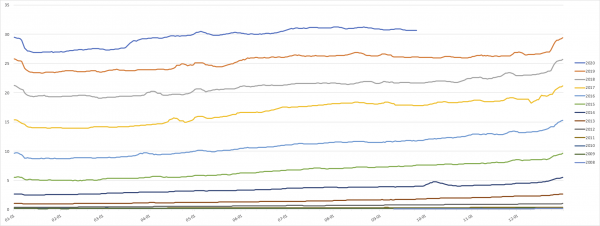
Here .
Some interesting observations:
- the graph from 2020 clearly shows the point where mass quarantines began — the third week of March;
- the first week of May is accompanied by a spike of a couple of percentage points; apparently, it's not only in Russia that people tend not to work during this time.
- the nature of the preceding spike, which occurred in the third week of April in 2017, in the fourth week of March in 2016 and 2018, and in the fourth week of April in 2019 is unclear. I think it’s some holiday related to the lunar calendar, but I don’t know which one?
Orthodox Easter? A national holiday in India? I'd appreciate ideas.
- the spike at the end of November is likely related to Thanksgiving in the USA.
- after spikes at the end of August, there’s usually one and a half months of stagnation or even regression, and the further, the more noticeable it becomes. By mid-October, this effect disappears. I believe it's related to the start of the academic year; university campuses do not adequately support IPv6. Then other forces compensate for this decline.
- and, of course, the end of the year shows the biggest spike.
Quarantines worldwide continue, so we probably won’t see the cancellation effect — the decline will be spread over months.
What other non-obvious things have you noticed?
Source: habr.com
