

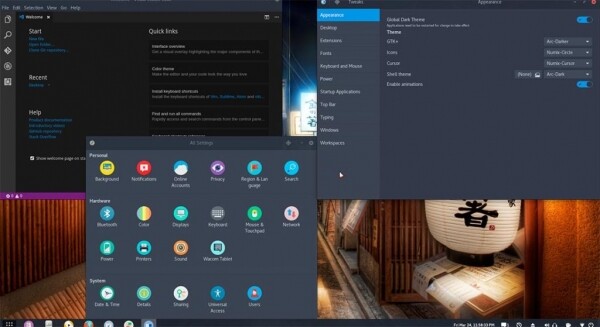
Screenshot of the desktop version of Fedora Linux
Linux and the entire open source industry continue to develop actively. Just recently, open-source evangelist Eric Raymond that in the near future, in his opinion, Windows will switch to the Linux kernel. Well, now for smartphones.
A group called Fedora Mobility is working on this project. Interestingly, they had not shown much activity for 10 years, but now and started working actively. As for the browser, it is currently only intended for installation on the PinePhone, a smartphone created by the Pine64 community. Soon the group promises to present a version of the browser for other smartphones, including the Librem 5 and OnePlus 5/5T.
Currently, the Fedora 33 (rawhide) repository has a set of packages for mobile devices with the Phosh user interface, which is controlled by a touchscreen. It is developed by Purism for the Librem 5 phone. It includes a compositing server called Phoc, which runs on top of Wayland. It is based on GNOME technologies (GTK, Gsettings, Dbus).
Developers have opened the possibility to use the KDE Plasma Wayland environment. However, corresponding packages are currently not available in the repository. As for the applications and components that are already available, here is the list:
- oFono — a stack for accessing telephony.
- chatty — a messenger based on libpurple.
- carbons — an XMPP plugin for libpurple.
- pidgin — an enhanced version of the instant messaging program pidgin, which uses the libpurple library for chatty.
- purple-mm-sms — a plugin for libpurple for working with SMS, integrated with ModemManager.
- purple-matrix — a Matrix network plugin for libpurple.
- purple-telegram — a Telegram plugin for libpurple.
- calls — an interface for dialing numbers and receiving calls.
- feedbackd — a background process integrated with Phosh for physical feedback (vibration signals, LED indicators, sound signals).
- rtl8723cs-firmware — firmware for the Bluetooth chip used in the PinePhone.
- squeekboard — an on-screen keyboard with Wayland support.
- pinephone-helpers — scripts for initializing the modem and switching audio streams during a phone call.
- gnome-terminal — a terminal emulator.
- gnome-contacts — an address book.
A little about the PinePhone smartphone
This is a mobile device released by Pine64 in July of this year. Its main advantage is the ability to use the device as a desktop PC. Of course, this system isn't suitable as a media station, but it works perfectly well for tasks. Specifically, this desktop is ideal as a portable workstation for data center engineers, system administrators, and similar roles.
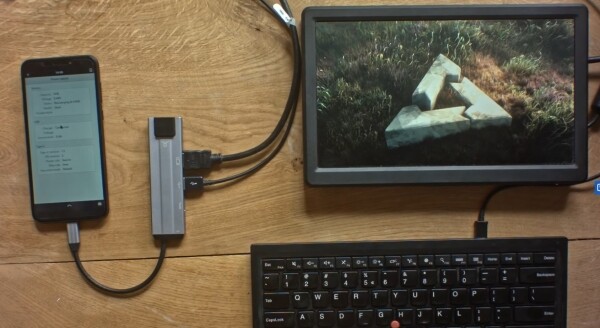
PinePhone Specifications:
- Quad-core ARM Allwinner A64 SoC.
- Mali 400 MP2 GPU.
- 2 or 3 GB RAM.
- 5.95-inch screen (1440×720 IPS).
- Micro SD (with support for booting from an SD card).
- 16 or 32 GB eMMC.
- USB-C port with USB Host and combined video output for connecting a monitor.
- 3.5 mm mini-jack.
- Wi-Fi 802.11 b/g/n, Bluetooth 4.0 (A2DP), GPS, GPS-A, GLONASS.
- Two cameras (2 and 5Mpx).
- Removable 3000mAh battery.
- Hardware-disableable modules for LTE/GNSS, WiFi, microphone, and speakers.
You can set up a complete workspace anywhere and anytime. The device is quite affordable — only $200.
OS — postmarketOS, based on Alpine Linux, which is a Linux distribution designed for mobile devices.
Source: habr.com
