

We regularly conduct market research, compiling tables with prices and numerous parameters from dozens of data centers. It occurred to me that it wouldn't be a waste to share the data. Some may find the information useful, while others can use the structure as a basis. feature data from 2016. However, there were too few tables, so we created additional graphs and , and supplemented it with public data from the tax authorities regarding revenues, taxes, and employees, data from RIPE (LIR status, subnets, and total IPv4 count), and information from the ping-admin ranking (Uptime and outages).
Sample Selection
The September 2020 table includes all companies that are in the TOP-20 on Yandex and Google, are also present in advertising spots, and have prices listed on their website. If a company is not available online or does not provide prices upon request, it is definitely not competitive in the open market. Such a company may still have solid orders, for instance, government contracts, but that represents a separate opportunity — one can even be a leader there, but it doesn't relate to market competition.
If some prices are hidden, the data is not displayed in that range. For instance, if it's stated that the plan includes 350W or 100Mbps or 1 IP address and there are no prices below for additional power, bandwidth expansion, or extra IPv4 addresses.
Pricing Challenges
In colocation service pricing, clients were most frustrated by hidden fees. This was a huge issue in the early 2000s due to traffic. No one knew in advance what their traffic would be, and everyone feared going over budget. However, at the same time, wonders do not happen. The cost of 100Mbps was around 50,000 rubles then. Now, gigabit traffic is cheaper. Time passes, yet pricing remains very murky for many, and providers' websites lack comprehensive price lists. Pricing is structured differently; at specific parameters, one supplier might be more economical, but as parameters increase, another may offer better value.
And of course, one should not forget that price is far from the only indicator. It is necessary to consider other parameters as well, though they are more difficult to compare. For some reason, 'ihor' made it into our table. I didn't even want to add it to the database. But then I thought that it would serve as a negative example, a company with one employee, 22 thousand in taxes, and 43 thousand in contributions, is quite illustrative. And after all, 'people consume'.
General Trends and Issues in the Market
The graphs visually depict the overall market trend.
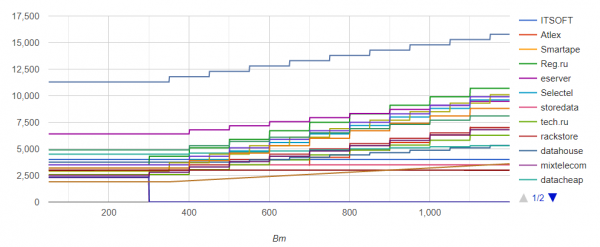
The first graph shows the dependence of cost on capacity, assuming all other parameters are equal. Capacity is a sensitive topic for both clients and data centers. Electricity is currently one of the main components of monthly expenses for data centers, and the government consistently raises rates. Although cheap electricity ultimately leads to production, jobs, and taxes. While we seem to be an energy superpower, it's hard to say that we have highly competitive prices compared to Western data centers.
On one hand, money is being charged for nominal capacity, rather than actual consumption, which is a bit of a rip-off. It’s difficult and expensive to measure actual consumption for a single server, requiring a meter for each outlet. However, potentially, a server can almost operate at the full capacity of its power supply. Additionally, it is necessary to account for 30% more for cooling, 10% for industrial UPS systems, and another 10% for lighting and office needs. But here’s a secret: on average, a single server consumes 100W, as 5kW is brought to the rack, which is usually sufficient.
The majority of hosts charge for capacity. However, there are those in the market who do not. Naturally, the outlet has its limitations. You cannot obtain a megawatt at the price of placing a single unit.
Some of those who do not charge for capacity have caveats on their websites, stating that GPU servers, blades, and other high-demand setups are billed at separate rates.
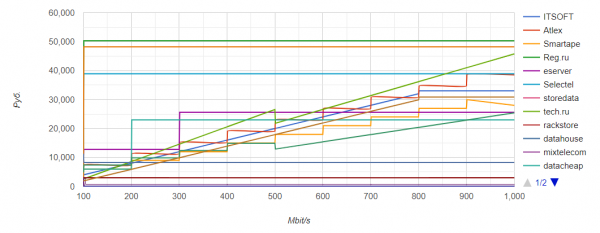
The second graph shows the dependence of cost on port speed. The speed of channels is an even more complex issue than electricity. Electricity has no concept of quality; it may flicker, but that’s what UPS and backup generators are for. However, two gigabit channels can vary significantly in quality. One might be delivering everything to an exchange, have poor visibility, high latencies, and restrictions on international traffic. And there’s no UPS or backup generator for such situations. Therefore, comparing prices for channels is practically a futile endeavor.
When we conducted market research on the cost of a gigabit in Moscow, we were asked questions like: "What kind of traffic will it be?" and "What are the peaks?".
There is also chaos with prices at the inter-carrier level. The channels vary significantly in cost and quality.
What to pay attention to
It's important to understand that there can't be a single correct opinion here; it all depends on the task at hand, and even in such tasks, everyone ultimately decides for themselves what risks they are willing to take and which ones they are not.
In our opinion, certification according to Tier III matters. This is not just our view, as advertising is saturated with Tier III. You can search on Yandex for 'server placement in a data center,' hit Ctrl+F, and count how many times the word Tier appears.
However, with this certification and positioning as Tier III, many have fallen into a trap. A proper Tier III data center should have three certifications: for the design, capabilities, and operation, with the last one needing to be renewed every two years. Many don't even have a certificate for the design.
The turnover shows both large and small companies. For some reason, there are no medium-sized ones. The pros and cons of large and small are clear. Interestingly, some large companies do not engage in retail at all. They focus on large clients and only sell colocation services by the rack. And this is correct. When we were at BST, they were always overwhelmed by our marketing. They simply couldn't provide good retail service. This is a different business with different services. You can't drive nails into shoes with a sledgehammer. From my perspective, I would also say that, all else being equal, support small businesses for the sake of diversity and competition.
Conclusion
Not everyone has been added to the database. Therefore, feel free to send the details of those we should include. However, those interested should have prices listed on their websites.
If you know of any other data sources that should be included, please let us know, and we'll try to add them.
Source: habr.com
