

These two trendy words associated with Data Science often confuse many people. Data Mining is frequently misunderstood as the extraction and retrieval of data, but in reality, it is much more complex. In this post, let's clarify the meaning of Mining and explore the difference between Data Mining and Data Extraction.
What is Data Mining?
Data mining, also known as Knowledge Discovery in Databases (KDD), is a method often used to analyze large datasets using statistical and mathematical techniques to find hidden patterns or trends and extract value from them.
What can be achieved with Data Mining?
By automating the process, can sift through databases and effectively identify hidden patterns. For businesses, data mining is frequently used to uncover patterns and relationships within data, assisting in making optimal business decisions.
Application examples
Since data mining gained widespread popularity in the 1990s, companies across a wide range of industries, including retail, finance, healthcare, transportation, telecommunications, e-commerce, etc., have begun employing data mining methods to derive insights from data. Data mining can help segment customers, detect fraud, forecast sales, and much more.
- Customer Segmentation
Through analyzing customer data and identifying traits of target customers, companies can group them together and provide tailored offers that meet their needs. - Market Basket Analysis
This methodology is based on the theory that if you purchase a certain group of items, you are likely to buy another group of items. A well-known example: when fathers buy diapers for their babies, they tend to buy beer alongside the diapers. - Sales Forecasting
This may seem similar to market basket analysis, but this time, data analysis is used to predict when a customer will repurchase a product in the future. For example, a coach buys a tub of protein that should last for 9 months. The store selling this protein plans to release a new one in 9 months, anticipating that the coach will buy it again. - Fraud Detection
Data mining helps in building models for fraud detection. By collecting samples of fraudulent and legitimate reports, businesses can identify which operations are suspicious. - Pattern detection in production
In the manufacturing industry, data mining is used to aid in system design by identifying relationships between product architecture, customer profiles, and needs. Data mining can also predict product development timelines and costs.
And these are just a few use cases of data mining.
Stages of Data Mining
Data mining is a comprehensive process of collecting, selecting, cleaning, transforming, and extracting data to evaluate patterns and ultimately extract value.
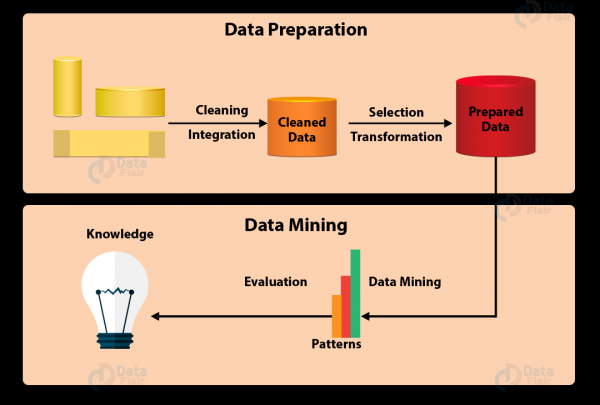
Generally, the entire data mining process can be summarized into 7 stages:
- Data Cleaning
In the real world, data is not always clean and structured. It is often noisy, incomplete, and may contain errors. To ensure that the results of data mining are accurate, the data must first be cleaned. Some cleaning methods include filling in missing values, automated and manual checks, etc. - Data Integration
This is the stage where data from different sources is extracted, combined, and integrated. Sources can include databases, text files, spreadsheets, documents, multidimensional data arrays, the internet, and so on. - Data Sampling
Usually, not all integrated data is needed in data mining. Data sampling is the stage where only useful data is selected and extracted from a large database. - Data Transformation
After data selection, it is transformed into forms suitable for mining. This process involves normalization, aggregation, generalization, etc. - Data Analysis
Here comes the most critical part of data mining — using intelligent methods to discover patterns within the data. The process includes regression, classification, forecasting, clustering, association rules, and much more. - Model Evaluation
This stage focuses on identifying potentially useful, easily understandable patterns, as well as patterns that validate hypotheses. - Knowledge Representation
In the final stage, the obtained information is presented attractively using knowledge representation methods and visualization techniques.
Drawbacks of Data Mining
- Significant investments of time and effort
Since data mining is a lengthy and complex process, it requires extensive work from skilled and productive individuals. Data analytics specialists can leverage powerful data mining tools; however, they need experts for data preparation and result interpretation. Consequently, processing all the information may take a considerable amount of time. - Privacy and Data Security
As data mining collects customer information using market methods, it can violate user privacy. Additionally, hackers may obtain data stored in data mining systems. This poses a threat to customer data security. If stolen data is misused, it can easily harm others.
The above is a brief introduction to data mining. As I mentioned earlier, data mining involves the process of data collection and integration, which includes data extraction. In this case, it can be confidently said that data extraction can be part of the lengthy data mining process.
What is Data Extraction?
Also known as 'web data extraction' and 'web scraping', this process involves extracting data from typically unstructured or poorly structured data sources to centralized locations for storage or further processing. Specifically, unstructured data sources include web pages, emails, documents, PDF files, scanned text, mainframe reports, tape files, advertisements, etc. Centralized storage can be local, cloud-based, or hybrid. It's important to note that data extraction does not include processing or other analysis that may occur later.
What can be done with Data Extraction?
Generally, the purposes of data extraction fall into three categories.
- Archiving
Data extraction can convert data from physical formats such as books, newspapers, and invoices into digital formats like databases for storage or backup. - Data format change
When you want to transfer data from your current website to a new one in development, you can gather data from your own site by extracting it. - Data analysis
Additional analysis of the extracted data is common to gain insights. This may seem similar to data mining, but note that data analysis is the goal of extraction, not a part of it. Moreover, data is analyzed differently. One example: online store owners extract product information from e-commerce sites like Amazon to monitor competitor strategies in real-time. Like data mining, data extraction is an automated process with many benefits. Previously, people copied and pasted data manually from one location to another, which was very time-consuming. Data extraction speeds up collection and significantly increases the accuracy of the extracted data.
Some examples of Data Extraction applications
Similar to data mining, data extraction is widely used across various industries. Besides price monitoring in e-commerce, data extraction can assist in personal research, news aggregation, marketing, real estate, travel and tourism, consulting, finance, and much more.
- Lead generation
Companies can extract data from directories such as Yelp, Crunchbase, and Yellowpages to generate leads for business development. You can watch the video below to learn how to extract data from Yellowpages using . - Content and news aggregation
Content aggregation websites can receive regular data streams from multiple sources to keep their sites up-to-date. - Sentiment analysis
After extracting reviews, comments, and feedback from social media platforms like Instagram and Twitter, specialists can analyze the underlying sentiments and gain insights into how the brand, product, or phenomenon is perceived.
Steps in Data Extraction
Data extraction is the first stage of ETL (Extract, Transform, Load) and ELT (Extract, Load, Transform). ETL and ELT are part of a comprehensive data integration strategy. In other words, data extraction can be part of their mining.
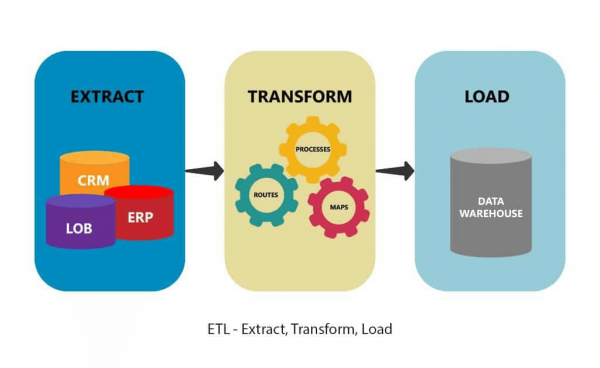
Extract, Transform, Load
While data mining is about obtaining insights from large datasets, data extraction is a much shorter and simpler process. It can be boiled down to three stages:
- Choosing a Data Source
Select the source from which you want to extract data, such as a website. - Data Collection
Send a 'GET' request to the site and analyze the resulting HTML document using programming languages like Python, PHP, R, Ruby, and others. - Data Storage
Store the data in your local database or in cloud storage for future use. If you are an experienced programmer looking to extract data, the above steps may seem simple. However, if you do not code, there is a shortcut — using data extraction tools such as . Data extraction tools, like data mining tools, are designed to save effort and make data processing simple for everyone. These tools are not only cost-effective but also user-friendly for beginners. They allow users to collect data within minutes, store it in the cloud, and export it in various formats: Excel, CSV, HTML, JSON, or to databases on the website via API.
Drawbacks of Data Extraction
- Server Failure
When extracting data on a large scale, the website's server may become overloaded, which can lead to server crashes. This can harm the interests of the website owner. - IP Ban
When a person scrapes data too frequently, websites may block their IP address. The resource may completely ban the IP or restrict access, resulting in incomplete data. To extract data and avoid getting blocked, it is important to do so at a moderate speed and apply some anti-blocking methods. - Legal Issues
Web data extraction falls into a gray area when it comes to legality. Major sites like LinkedIn and Facebook clearly state in their terms of use that any automated data extraction is prohibited. There have been numerous lawsuits between companies over bot activities.
Key Differences Between Data Mining and Data Extraction
- Data mining is also referred to as knowledge discovery in databases, knowledge extraction, data analysis/patterns, and information gathering. Data extraction is used interchangeably with web data extraction, web scraping, data collection, and so on.
- Data mining research primarily focuses on structured data, whereas data extraction typically pulls from unstructured or poorly structured sources.
- The goal of data mining is to make data more useful for analysis. Data extraction involves gathering data into one location where it can be stored or processed.
- Analysis in data mining is based on mathematical methods for identifying patterns or trends. Data extraction relies on programming languages or data extraction tools to navigate sources.
- The aim of data mining is to uncover facts that were previously unknown or overlooked, while data extraction deals with existing information.
- Data mining is more complex and requires greater investment in training personnel. Data extraction, when using the right tool, can be extremely simple and cost-effective.
We help beginners navigate Data. Specifically for Hubrarians, we have created a promo code HABR, providing an additional 10% discount on the discount indicated on the banner.
More Courses
Recommended Articles
Source: habr.com
