


Developers have discussed the benefits of blockchain technology for many years. They have argued this with vague "use cases" alongside unclear definitions of how the technology works, what it is actually needed for, and how the platforms using it differ from each other. It's no wonder that this has caused confusion and distrust towards blockchain technology.
In this article, I want to outline a set of mental models that will help understand how potential use cases lead to technical compromises that each platform has to make. These mental models are based on the progress that blockchain technology has made over the last 10 years, having gone through 3 generations: open money, open finance, and finally, the open internet.
My goal is to help you form a clear understanding of what blockchain is, comprehend the necessity of different platforms, and envision the future of the open internet.
A Brief Introduction to Blockchain
A bit of basics. Blockchain is essentially just a database that is managed by a group of different operators, rather than a single enterprise (like Amazon, Microsoft, or Google). An important distinguishing feature of blockchain from the cloud is that you do not need to trust the "owner" of the database (or their operational security) to store valuable data. When a blockchain is public (and all major blockchains are public), anyone can use it for any purpose.
For such a system to operate on a large number of anonymous devices around the world, it needs to have a digital token that will be used as a means of payment. These tokens will allow users of the chain to pay the system operators. At the same time, the token provides a security guarantee, as defined by the embedded game theory. And although the idea was significantly compromised by the ICO scam boom in 2017, the concept of tokens and tokenization as a whole—which entails that an individual digital asset can be uniquely identified and sent—holds incredible potential.
It's also important to separate the part of the database that stores data from the part that alters data (the virtual machine).
Different characteristics of a blockchain can be optimized. For example, security (in Bitcoin), speed, cost, or scalability. Additionally, the logic of modification can also be optimized in various ways: it can be a simple calculator for addition and subtraction (like in Bitcoin), or a Turing-complete virtual machine (like in Ethereum and NEAR).
Thus, two platforms on the blockchain can 'tune' their blockchain and virtual machine to perform entirely different functions, and they may never compete with each other in the market. For instance, Bitcoin compared to Ethereum or NEAR is a completely different world, while Ethereum and NEAR, in turn, have nothing in common with Ripple and Stellar — despite the fact that they all operate on 'blockchain technology.'
Three generations of blockchain
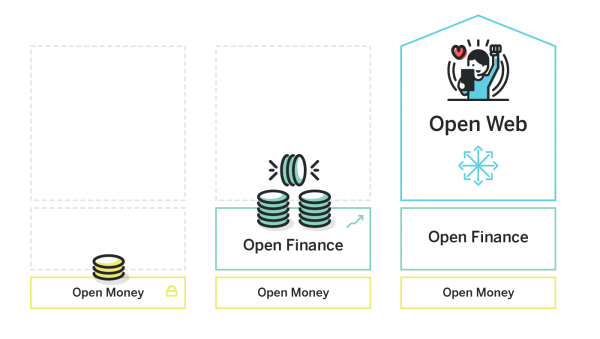
Technological advancements and specific solutions in system design have expanded the functionality of blockchain over 3 generations of development in the last 10 years. These generations can be categorized as follows:
- Open Money: Providing everyone access to digital cash.
- Open Finance: Making digital money programmable and broadening the possibilities of its use.
- Open Internet: Extending open finance to include valuable information of any kind and making it accessible for mass use.
Let's start with open money.
First generation: open money
Money is the foundation of capitalism. The first stage allowed anyone from anywhere to access funds.
One of the most important types of data that can be stored in a database is money itself. This is where Bitcoin shines: having a simple distributed ledger that allows everyone to agree that Joe has 30 Bitcoins and has just sent Jill 1.5 Bitcoins. Bitcoin is designed to prioritize security over all other parameters. Consensus in Bitcoin is incredibly costly, time-consuming, and operates on a 'bottleneck' principle, and in terms of modification level, it is essentially a regular calculator for addition and subtraction that enables transactions and performs some other very limited operations.
Bitcoin is a great example that illustrates the main advantages of storing data on the blockchain: it doesn't rely on any intermediaries and is accessible to everyone. This means that anyone with bitcoins can make a p2p transfer without needing anyone's help.
Due to the simplicity and power of what Bitcoin promised, 'money' became one of the earliest and most successful use cases for blockchain. However, the 'too slow, too expensive, and too secure' Bitcoin system works well for storing assets—similar to gold—but doesn't serve daily needs for services like online payments or international transfers.
Configurable open money
For such use cases, different chains with other configurations were created:
- Transfers: for millions of people to send arbitrary amounts around the world every day, you need something much more efficient and less costly than Bitcoin. At the same time, your system still must provide a sufficient level of security. Ripple and Stellar are projects that have optimized their chains to achieve this goal.
- Fast transactions: for billions of people to use digital money just like they use credit cards, the chain needs to scale well, have high performance, and remain inexpensive. This can be accomplished in two ways, albeit at the cost of security. The first is to build a faster 'second layer' on top of Bitcoin that optimizes the network for high performance, and once the transaction is complete, moves the assets back to Bitcoin's 'storage.' An example of such a solution is the Lightning Network. The second way is to create a new blockchain that provides the maximum level of security while allowing fast, low-cost transactions, like Libra.
- Private transactions: to maintain complete confidentiality during a transaction, an additional layer of anonymization needs to be added. This reduces performance and increases cost, as seen in Zcash and Monero.
Since such money is tokens representing a fully digital asset, they can also be programmed at the base level of the system. For example, the total amount of Bitcoin that will ever be produced is programmed into the Bitcoin core system. By creating a good computational system on top of the base layer, it can be taken to a completely new level.
This is where open finance comes into play.
Second Generation: Open Finance
With open finance, money ceases to be just a means of savings or a tool for transactions — now it can generate profit, increasing its potential.
The properties that allow people to make Bitcoin transactions publicly also enable developers to write programs that do the same. From this perspective, let's assume that digital money has its own independent API, which does not require obtaining an API key or user agreement from any company.
This is what 'open finance' promises, also known as 'decentralized finance' (DeFi).
ETHEREUM
As mentioned earlier, the Bitcoin API is quite simple and not very productive. It suffices to deploy scripts on the Bitcoin network that allow it to function. To do something more interesting, one needs to transfer Bitcoin onto another blockchain platform, which is not a trivial task.
Other platforms have worked on combining a high level of security required for dealing with digital money with a more complex modification level. Ethereum was the first to launch this. Instead of a 'calculator' like Bitcoin that operates on addition and subtraction, Ethereum created a whole virtual machine on top of the storage layer, allowing developers to write full-fledged programs and run them directly on the chain.
The importance lies in the fact that the security of a digital asset (such as money) stored on the chain is as critical as the security and reliability of the programs that can natively alter the state of this chain. Ethereum smart contract programs are essentially serverless scripts that run on the chain just as a typical Bitcoin transaction like 'send Jill 23 tokens' does. The native Ethereum token is Ether, or ETH.
Blockchain components as a pipeline
Because the API on top of ETH is public (like in Bitcoin) but infinitely programmable, a series of building blocks has been created that transfer Ether to one another to perform useful work for the end user.
In the 'traditional world', this would require, for example, a large bank to negotiate contract terms and API access with each individual provider. However, on the blockchain, each of these blocks was independently created by developers and quickly scaled to handle capacities of millions of dollars and store value of over $1 billion as of early 2020.
For example, let's start with Dharma, a wallet that allows users to store digital tokens and earn interest on them. This is a foundational principle of using the traditional banking system. The Dharma developers offer an interest rate to their users by connecting numerous components built on top of Ethereum. For instance, users' dollars are converted to DAI, an Ethereum-based stablecoin pegged to the US dollar. This stablecoin is then 'piped' into Compound, a protocol that lends these funds out for interest, thereby instantly earning interest for users.
The application of open finance
The main takeaway is that the final product reaching the user was created using many components, each developed by a separate team, and there was no need to obtain permission or an API key to utilize these components. Currently, billions of dollars circulate within this system. It's almost like open-source software, but while open-source software requires downloading a copy of a specific library for each implementation, open components are deployed only once, allowing each user to send requests to a specific component to access its shared state.
Each of the teams that created these components is not responsible for any excessive EC2 charges due to abuse of their API. The measurement and billing for the use of these components essentially occur automatically within the chain.
Performance and Configuration
Ethereum operates with the same parameters as Bitcoin, but blocks are transmitted to the network about 30 times faster and cheaper — with transaction costs of $0.10 instead of around $0.50 in Bitcoin. This provides a sufficient level of security for applications managing financial assets without requiring high bandwidth.
The Ethereum network, being a first-generation technology, struggled with a high volume of requests and suffered from a throughput of 15 transactions per second. This performance shortfall led to open finance being stuck in a proof-of-concept state. The overloaded network functioned like the global financial system during the era of analog devices with paper checks and telephone confirmations because Ethereum's computing power is less than that of from 1990.
Ethereum demonstrated the potential for combining components for financial usage models and opened up access to a broader range of applications, referred to as the open internet.
Third Generation: The Open Internet
Now, everything that has value can become money, connecting the internet with open finance and thereby creating an internet of values and the open internet.

As previously noted, the concept of open money encompasses many application options. It has also been described how the next-generation technology, Ethereum, has made open money more useful by creating opportunities for combining components of open finance. Now let’s examine how another generation of technologies expands the possibilities of open finance and reveals the true potential of blockchain.
Initially, all the "money" mentioned refers simply to types of data stored on the blockchain with their own open API. However, a database can store anything.
Due to its structure, blockchain is best suited for data that possesses significant value. The definition of "significant value" is highly flexible. Any data that potentially holds value for people can be tokenized. Tokenization in this context is the process by which an existing asset (not created from scratch like Bitcoin) is transferred to the blockchain and gains a public API similar to that of Bitcoin or Ethereum. Just like Bitcoin, this allows for the creation of scarcity (whether it be 21 million tokens or just one).
Consider the example of Reddit, where users earn online reputation in the form of "karma." And take a project like Sofi, which uses multiple criteria to assess the creditworthiness of an individual. In today’s world, if the hackathon team developing a new Sofi wanted to incorporate Reddit karma ratings into their lending algorithm, they would need to enter into a bilateral agreement with the Reddit team to gain certified access to the API. If "karma" were tokenized, that team would have all the necessary tools to integrate with "karma," and Reddit wouldn't even know. Reddit would simply benefit from even more users wanting to improve their karma because now it's valuable not just within Reddit, but across the globe.
If we go a step further, 100 different teams at the next hackathon may come up with new applications for this and other assets to create a new set of public, reusable components or build new consumer applications. This is the idea of an open internet.
Ethereum has made it easy to transfer large sums via a 'pipeline' through public components, similarly allowing the transfer of any asset that can be tokenized, as well as to spend, exchange, collateralize, modify, or interact with it in other ways, as outlined in its open API.
Configuration for the open internet
The open internet is fundamentally no different from open finance: it is simply a layer built on top of it. To expand the use cases of the open internet, a significant leap in performance and the ability to attract new users is required.
To support the open internet, the platform needs the following properties:
- High bandwidth, increased speed, and cheaper transactions. Since the chain is no longer simply transmitting slow asset management solutions, it needs to scale to support more complex data types and use cases.
- Usability. As use cases transition into user applications, it is very important that the components built by developers, or applications created with them, deliver a good experience for the end user. For example, when they create an account or link an existing one to various assets and platforms while keeping data control in the hands of users.
Such characteristics were not present in any platform before due to their complexity. It took years of research to reach the point where new consensus mechanisms merge with new execution environments and new scaling methods—while maintaining the performance and security levels necessary for monetary assets.
The open internet platform
Dozens of blockchain projects entering the market this year have configured their platforms to apply to various use cases within the realms of open money and open finance. Given the current technological limitations, it has been beneficial for them to optimize their platform for a specific niche.
NEAR is the only chain that consciously refined its technology and optimized its performance characteristics to fully meet the needs of the open internet.
NEAR combines scaling approaches from the world of high-performance databases with runtime improvements and years of usability enhancements. Like Ethereum, NEAR features a full virtual machine built atop its blockchain, but to keep pace with demand, the underlying chain balances the throughput of the virtual machine by breaking computations into parallel processes (sharding). It also maintains the level of security necessary for reliable data storage.
This means that NEAR can support all possible use cases: fiat-backed coins that provide everyone with access to stable currency, open finance mechanisms that scale up to complex financial instruments and back down again for everyday use by ordinary people, and finally, open internet applications that encompass all this for daily trading and interaction.
Conclusion
The story of the open internet is just beginning, as we have only just developed the necessary technologies for it to reach its true scale. Now that this significant step has been taken, the future will be built on innovations that can be created based on these new technologies, as well as the technological capabilities of developers and entrepreneurs who are at the forefront of this new reality.
To understand the potential impact of the open internet, recall the "Cambrian explosion" that occurred during the creation of the early internet protocols necessary for users to finally spend money online in the late 1990s. For the next 25 years, online commerce grew, generating volumes exceeding $2 trillion each year.
Similarly, the open internet expands the scope and reach of financial primitives from open finance and allows their integration into business and consumer-oriented applications in ways that we can guess but, of course, cannot predict.
Let's build the open internet together!
A small list of resources for those who want to dive deeper right now:
1. You can see how development looks for NEAR and experiment in an online IDE .
2. For developers looking to join the ecosystem .
3. Extensive documentation for developers is available in English .
4. Follow all news in Russian on , and on
5. If you have ideas for community-driven services and want to work on them, join our entrepreneur support.
Source: habr.com
