

Collabora has introduced Monado 21.0.0, the open implementation of the OpenXR standard. The OpenXR standard has been prepared by the Khronos consortium and defines a universal API for creating virtual and augmented reality applications, along with a set of middleware for interacting with hardware, abstracting the specifics of individual devices. Monado provides a runtime fully compliant with the OpenXR requirements that can be used to facilitate virtual and augmented reality experiences on smartphones, tablets, PCs, and any other devices. The project code is written in C and distributed under the Boost Software License 1.0, which is compatible with GPL.
Monado 21.0.0 is the first release officially compatible with the OpenXR 1.0 standard. The Khronos consortium conducted compatibility testing and added Monado to the list of officially compatible OpenXR implementations. The tests were performed using both OpenGL and Vulkan graphics APIs with a desktop build in virtual reality device simulation mode. Initially, the version was planned to be numbered 1.0, but the developers decided to adopt year-based versioning, similar to Mesa's version numbering.
Another significant innovation was the preparation of a driver for the SteamVR platform with state tracking implementation, as well as a plugin generator for SteamVR, allowing any drivers for head-mounted displays (HMDs) and controllers made for Monado to be used in SteamVR. For example, Monado provides drivers for the OpenHMD virtual reality headset, Panotools (PSVR), and Vive/Vive Pro/Valve Index.
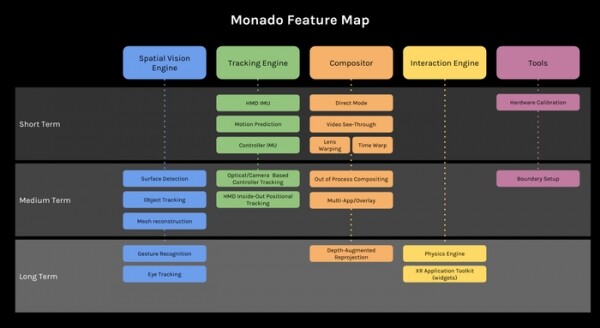
Platform Composition:
- Spatial awareness engine (object tracking, surface detection, mesh reconstruction, gesture recognition, eye tracking);
- Character tracking engine (gyrostabilizer, movement prediction, controllers, optical motion tracking via camera, position tracking based on data from the VR headset);
- Composite server (direct output mode, video passthrough, lens adjustment, compositing, creating a workspace for simultaneous use of multiple applications);
- Interaction engine (simulation of physical processes, a set of widgets, and a toolkit for virtual reality applications);
- Toolset (equipment calibration, setting movement boundaries).
Main Features:
- Driver for the HDK (OSVR Hacker Developer Kit) and PlayStation VR HMD, as well as for Vive Wand, Valve Index, PlayStation Move, and Razor Hydra controllers.
- Ability to use hardware supported by the OpenHMD project.
- Driver for the North Star augmented reality glasses.
- Driver for the Intel RealSense T265 position tracking system.
- Set of udev rules for configuring access to virtual reality devices without root privileges.
- Motion tracking components with a framework for filtering and streaming video.
- Character tracking system with six degrees of freedom (6DoF, forward/backward, up/down, left/right, yaw, pitch, roll) for PSVR and PS Move controllers.
- Modules for integration with graphic APIs Vulkan and OpenGL.
- Headless mode.
- Spatial interaction and viewpoint control.
- Basic support for frame synchronization and information (action) input.
- Ready composite server supporting direct output to the device, bypassing the system X server. Shaders for Vive and Panotools are provided. Support for projection layers is available.
Source: opennet.ru
