

The release of the Ubuntu 21.04 "Hirsute Hippo" distribution is now available, classified as an interim release with updates provided for 9 months (support will continue until January 2022). Installation images have been created for Ubuntu, Ubuntu Server, Lubuntu, Kubuntu, Ubuntu Mate, Ubuntu Budgie, Ubuntu Studio, Xubuntu, and Ubuntu Kylin (the edition for China).
Key Changes:
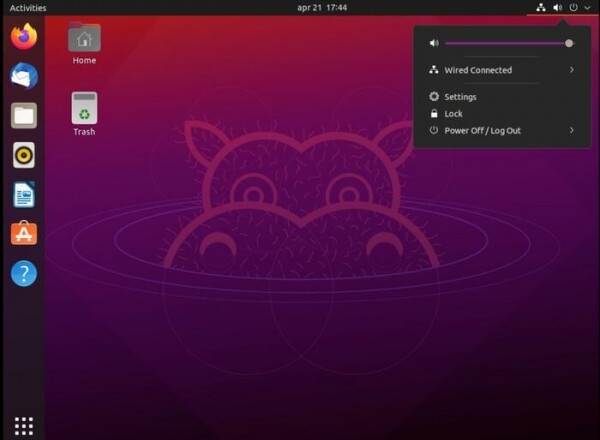
- As for the desktop environment, GNOME Shell 3.38 is continued to be supplied, built using GTK3, but GNOME applications are mainly synchronized with GNOME 40 (the transition of the desktop to GTK 4 and GNOME 40 is considered premature).
- By default, a session based on the Wayland protocol is enabled. When using proprietary NVIDIA drivers, the session based on the X server is still offered by default, but for other configurations, this session has been relegated to the options. It is noted that many limitations of the GNOME session based on Wayland, which were previously considered to be blockers for transitioning to Wayland, have been resolved. For example, the capability to share the desktop has been added using the Pipewire multimedia server. The first attempt to transition Ubuntu to Wayland by default was made in 2017 with Ubuntu 17.10, but due to unresolved issues, the traditional graphics stack based on X.Org Server was restored in Ubuntu 18.04.
- A new dark theme named Yaru has been introduced, along with updated icons for file type identification.

- Added multimedia support server Pipewire enables screen content recording, improves sound support in isolated applications, provides capabilities for professional sound processing, eliminates fragmentation, and unifies the sound infrastructure for various applications.
- Support for authentication using smart cards (via pam_sss 7) has been added.
- The desktop now includes the ability to move resources from applications using the drag and drop method.
- The settings now include the option to change the power consumption profile.
- The installer now supports the creation of backup keys for recovering access to encrypted partitions, which can be used for decryption in case of password loss.
- Integration with Active Directory has been improved, allowing user authentication in Active Directory with GPO (Group Policy Objects) support immediately after Ubuntu installation. Administrators can manage Ubuntu workstations by placing settings on the Active Directory controller. domain Active Directory, including desktop settings and the set of offered applications. GPO can be used to enforce security policies for all connected clients, including defining user access parameters and password policy rules.
- The model for accessing user home directories in the system has changed — home directories are now created with permissions 750 (drwxr-x—), which provide access to the directory only for the owner and group members. Historically, user home directories in Ubuntu were created with permissions 755 (drwxr-xr-x), allowing one user to view another's directory contents.
- The Linux kernel has been updated to version 5.11, which includes support for Intel SGX enclaves, a new syscall interception mechanism, an auxiliary bus, a prohibition on building modules without MODULE_LICENSE(), a fast syscall filtering mode in seccomp, the end of support for the ia64 architecture, the migration of WiMAX technology to the 'staging' branch, and the ability to encapsulate SCTP in UDP.
- By default, the nftables packet filter is in use. To maintain backward compatibility, the iptables-nft package is available, providing utilities with the same command line syntax as iptables, but translates the received rules into nf_tables bytecode.
- On x86_64 (amd64) and AArch64 (arm64) systems, improved support for the UEFI SecureBoot mode has been introduced. The layer for organizing verified boot has transitioned to using the SBAT (UEFI Secure Boot Advanced Targeting) mechanism, which addresses certificate revocation issues. SBAT support has been added to the grub2, shim, and fwupd packages. SBAT involves adding new metadata that is signed digitally and can further be included in lists of allowed or disallowed components for UEFI Secure Boot. This metadata allows for version number manipulation of components upon revocation without the need to regenerate keys for Secure Boot or create new signatures for the kernel, shim, grub2, and fwupd.
- System components and programming languages have been updated, including GCC 10.3.0, binutils 2.36.1, glibc 2.33, Python 3.9.4, Perl 5.32.1, LLVM 12, Go 1.16, Rust 1.50, OpenJDK 16, Ruby 2.7.2, Rails 6.
- Versions of applications and subsystems have been updated, including Mesa 21.0, PulseAudio 14, BlueZ 5.56, NetworkManager 1.30, Firefox 87, LibreOffice 7.1.2, Thunderbird 78.8.1, Darktable 3.4.1, Inkscape 1.0.2, Scribus 1.5.6.1, OBS 26.1.2, KDEnlive 20.12.3, Blender 2.83.5, Krita 4.4.3, GIMP 2.10.22.
- Components for server systems have been updated, including PostgreSQL 13.2, Samba 4.13.3, QEMU 5.2, SSSD 2.40, Net-SNMP 5.9, DPDK 20.11.1, Strongswan 5.9.1, Open vSwitch 2.15, Chrony 4.0, OpenVPN 2.5.1, Virt-manager 3.2.0, Libvirt 7.0, Rsyslog 8.2102.0, Docker 20.10.2, OpenStack Wallaby.
- Support for Wayland has been implemented in builds for Raspberry Pi. GPIO support has been added (via libgpiod and liblgpio). For the Compute Module 4 platform, Wi-Fi and Bluetooth support has been implemented.
- Builds for HiFive SiFive Unleashed and HiFive SiFive Unmatched boards based on the RISC-V architecture have been added.
- For iSCSI, the targetcli-fb toolkit has been used instead of tgt, offering higher performance, additional features, and support for SCSI 3 clustering.
- The needrestart package has been included in Ubuntu Server, which runs at the end of each APT transaction, detects changes requiring a reboot, and informs the administrator.
- Support for the Lua module for nginx has been discontinued as it is not compatible with new versions of nginx (instead of a separate module, the project now develops OpenResty, a special edition of Nginx with integrated LuaJIT support).
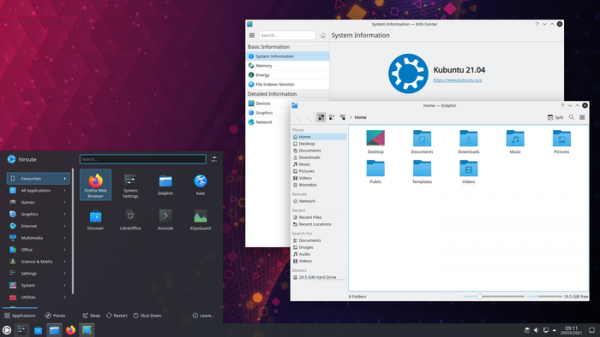
- Kubuntu features the KDE Plasma 5.21 desktop and KDE Applications 20.12.3 suite. The Qt framework has been updated to version 5.15.2. The Elisa 20.12.3 music player is enabled by default. Versions of Krita 4.4.3 and Kdevelop 5.6.2 have been updated. A Wayland session is available but not enabled by default (to activate at the login screen, select 'Plasma (Wayland)').

- Xubuntu has updated the Xfce desktop to version 4.16. Applications Hexchat and Synaptic have been included in the base set. The desktop now disables application menu display on right-click by default and hides shortcuts for file systems and external drives.
- Ubuntu MATE continues the delivery of the MATE 1.24 desktop release.
- Ubuntu Studio now uses the new Agordejo music session manager by default, with updated versions of Studio Controls 2.1.4, Ardour 6.6, RaySession 0.10.1, Hydrogen 1.0.1, Carla 2.3-rc2, jack-mixer 15-1, and lsp-plugins 1.1.29.
- Lubuntu offers the LXQt 0.16.0 desktop environment.
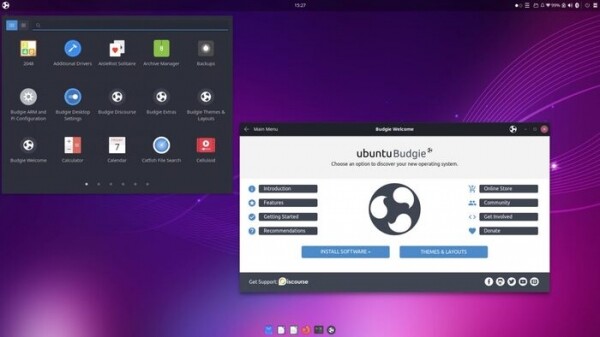
- Ubuntu Budgie features a new release of the Budgie desktop 10.5.2. Builds for Raspberry Pi 4 have been added. An optional macOS-style theme has been introduced. Shuffler, the interface for quickly navigating open windows and grouping them in a grid, now includes the Layouts interface for grouping and launching multiple applications at once. Additionally, it allows for the pinning of the position and size of application windows. New applets have been proposed: budgie-clipboard-applet (clipboard manager) and budgie-analogue-applet (analog clock). The desktop appearance has been updated, with a dark theme set as default. Budgie Welcome now features a tab-based interface for navigating themes.
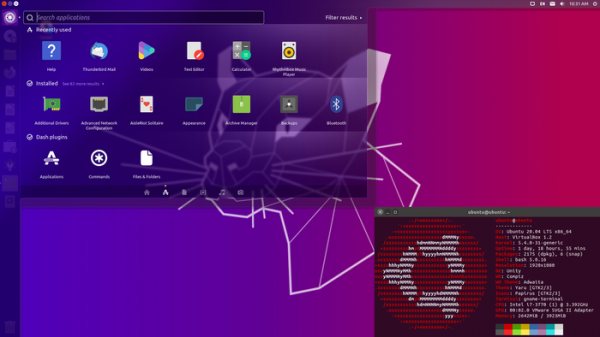
Additionally, the community has proposed two unofficial variants of Ubuntu 21.04: Ubuntu Cinnamon Remix 21.04 with the Cinnamon desktop and Ubuntu Unity Remix 21.04 with the Unity desktop.
Source: opennet.ru
