


Will 4K become the television standard, or will it remain a privilege available to only a few? What awaits providers launching UHD services? In the report from the analysts of the magazine you will find answers to these and other questions.
At first glance, it may seem that the quality of the television picture directly depends on quantity: the more pixels per square inch, the better. To confirm this, one need look no further than the enthusiasm with which viewers embraced HD and FullHD formats.
However, opinions are divided when it comes to 4K: some consider it just a marketing ploy that scarcely improves the user experience; others boldly call it an evolution in the media industry.
The attempt by manufacturers to keep up with the growing demand for ultra-high-definition TVs has already led to not only an influx of a wide range of 4K set-top boxes and televisions into the market but also the emergence of new standards for compression and data transmission, as well as technologies for producing and storing 4K content.
Is 4K destined to become a new technological breakthrough, or will it simply settle in the minds of consumers as an attempt to push viewers into buying more expensive televisions? Let’s see what the facts and figures say about this.
4K Televisions: A Hit in the Coming Years
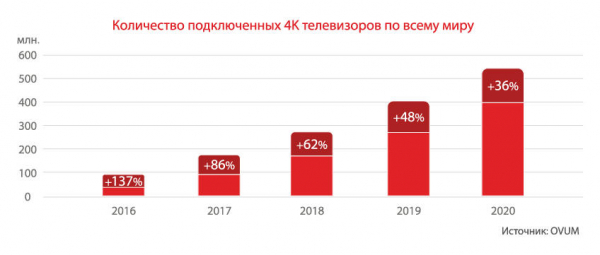
4K televisions are undoubtedly the brightest star in the 4K sky. They garner the most interest from users and the press. According to OVUM forecasts, the popularity of UHD TVs will only increase. By 2020, the number of ultra-high-definition televisions worldwide will exceed 540 million — nearly a tenfold increase compared to 2015.
IHS and Strategy Analytics predict that this year the overwhelming majority of large-screen displays (50 inches and above) will support 4K. A little later, the format will also take hold in smaller devices.
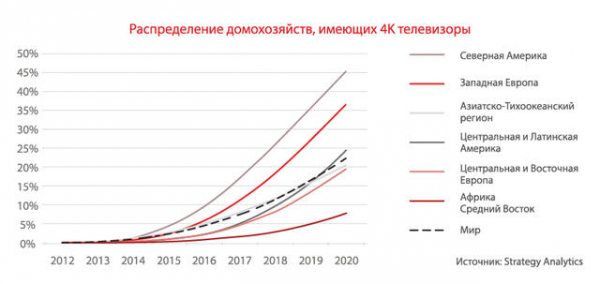
This will result in one in four families worldwide owning a brand-new UHD television by 2020. North America will lead the world, with 4K penetration exceeding 45%. Western Europe will come in second, while the African and Middle Eastern markets will lag behind in this race.
When it comes to individual countries, Japan is the fastest to embrace 4K TVs. According to the Mitsubishi Research Institute, by 2020, UHD televisions will be found in half of Japanese households.
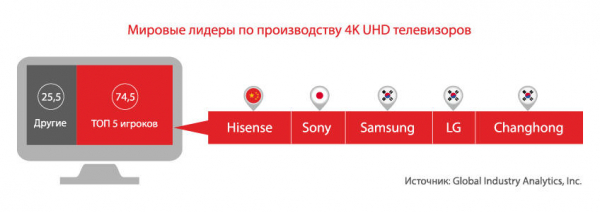
The heavyweight players in the 4K television market will be China and South Korea. The largest factories for producing UHD displays operate in these countries. South Korea will be the main exporter in this pair, as Chinese manufacturers sell a large portion of their products domestically.
4K-capable TV boxes: a significant market share
The market for set-top boxes is expected to quadruple. By 2020, they will account for a quarter of all sold 4K devices.
Sales of UHD boxes are growing by 10 million units per year, and it is projected that more than 50 million of these devices will be sold by 2020.
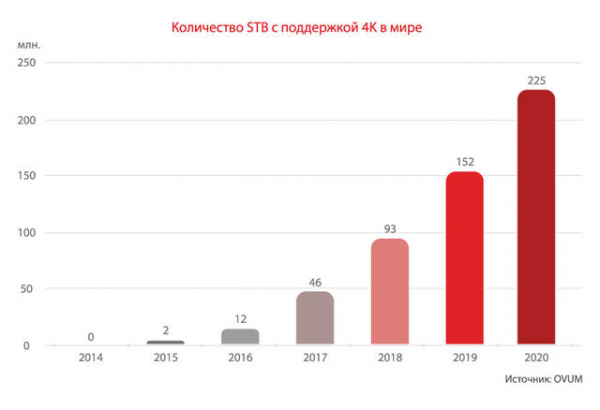
According to OVUM, by 2020, 4K boxes will be installed in more than 225 million homes around the globe. UHD content will be consumed through these boxes by 80 million viewers from North America and 65 million viewers from Europe and Asia.
Service market: catching up
Sales of 4K televisions and boxes are steadily increasing. However, their owners have already faced a significant problem: there’s nothing to watch. This is due to several reasons:
● Technological: producing 4K content is complex and expensive, while FullHD content remains popular and profitable.
● Logistical: not all homes have high-speed internet.
● Economic: users are reluctant to purchase subscriptions because they are quite expensive and the content selection is limited.
Despite all the difficulties, this issue will be resolved in the near future. The media industry has faced a similar situation with the emergence of the FullHD format. Owners of the then-new devices had to wait several years before they had enough content to watch.
The growing selection of UHD videos, decreasing prices for televisions, 4K set-top boxes, and subscriptions will steadily lead to explosive growth in the number of users. Most of them will be from the middle and upper classes living in North America, the Pacific region, and Western Europe.
In 2021, a greater number of subscribers will be attracted to cable, satellite, and IPTV services. Broadcast TV, with few exceptions, will not be able to offer viewers UHD resolution.
Internet television in 4K
4K-IPTV
Despite IPTV services still having fewer subscribers compared to their cable and satellite competitors, IPTV providers will be able to earn more from each viewer individually. The main reason for the profit disparity is that IPTV providers are quicker to implement new popular features in their services, which attracts the most affluent users.
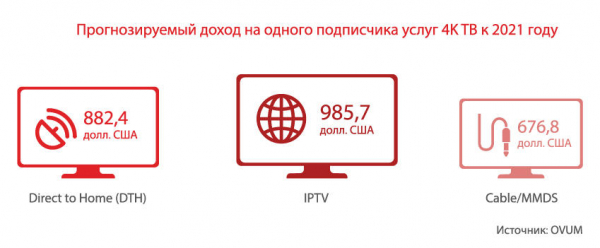
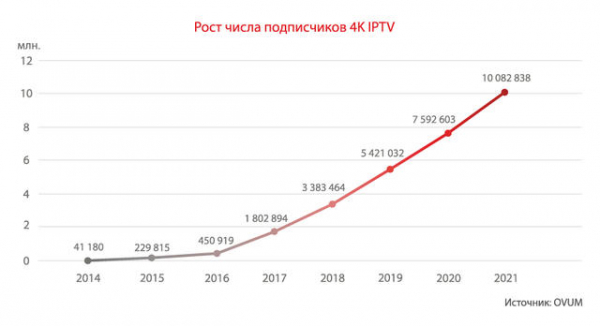
According to OVUM forecasts, by 2021, the number of IPTV service subscribers with 4K will exceed 10 million. This is more than a 20-fold increase compared to 450,000 in 2017. Viewers from Western Europe will be the most active in subscribing to such services: in 2021, the number of subscribers in this region will exceed 3 million. They will bring operators $1.2 billion in revenue, which is almost half of the global income.
4K-OTT
According to Juniper Research, in the next 5 years, OTT services providing access to 4K content will gain significant popularity. It is projected that by 2021, the number of unique consumers of 'over the top' content in 4K will reach 190 million, and the revenues of these services will surpass $5 billion.
The main user device for viewing 4K-OTT content will remain televisions; however, the widespread adoption of multi-screen technology will make UHD content accessible on smartphones, tablets, and desktops.
In summary

It is safe to say that 4K content will not take long to arrive, and its popularity will only continue to grow. But let’s consider the main factors influencing the speed of technology adoption:
Growth Factors
● Demand for high-end electronics.
● The emergence of new UHD channels and services.
● Decreasing prices of 4K equipment.
● Development of compression algorithms and data transmission technologies.
Restraining Factors
● Currently, UHD equipment is still unaffordable for most of the population.
● As the market is just forming, not all investors are willing to take risks in funding it.
● Creating 4K content costs several times more than producing FullHD.
● The network infrastructure necessary for transmitting 4K video is underdeveloped.
● Residents of remote or small areas do not have access to high-speed internet, making 4K content inaccessible to them for a long time.
Operators now face a difficult choice: to create their own 4K service while competition is low and demand is steadily rising; or to focus on Full HD until their viewers' networks are ready for 4K broadcasting.
A high-quality image alone is not enough to win users' hearts. The content must be engaging. This is confirmed by shows filmed on smartphone cameras that have managed to attract millions of viewers.
Source: habr.com
