

Following the recent release we have already prepared the first update, 3CX V16 Update 1 Beta. It introduces new corporate chat capabilities and an updated Call Flow Service, which, together with the Call Flow Designer (CFD) development environment, allows for the creation of complex voice applications in C#.
Updated corporate chat
The communication widget is actively being developed. In Update 1, the widget remains open regardless of page and tab transitions. Now visitors can navigate your site while keeping the chat window accessible for immediate communication.
Exciting features have also emerged in the 3CX corporate chat service.
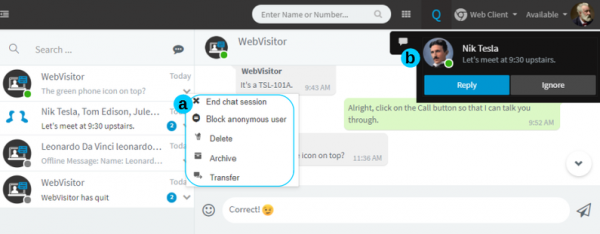
Now the following actions are available for messages (a):
- End chat session — end the chat with the 3CX user (or site visitor).
- Block anonymous user — block user (IP address) from incoming messages and calls.
- Delete — delete the chat.
- Archive — archive the chat (move it to the Archive folder) and remove it from the web client interface. More features related to chat archiving will be introduced in the future.
- Transfer — select the 3CX extension number (of another user) and transfer further communication to them. This is convenient when chatting with site visitors and it's necessary to hand off an ongoing conversation to another specialist.
Additionally, when an incoming chat occurs, a notification pops up for the user, allowing for a quick response to the message (b).
If a message comes from the site via the 3CX Live Chat & Talk widget, a range of new capabilities is now available.
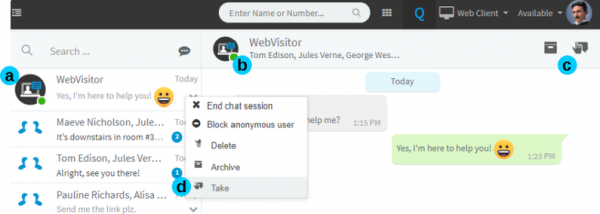
- The incoming message appears in the 3CX web client interface as from the WebVisitor user for quick identification.
- If a message arrives in the Operators Queue, a chat group is automatically created, adding all operators from that Queue. Operators see the conversation with the client and can collectively respond until one of them takes over the communication with the client individually. From the site visitor's perspective, this chat appears as a conversation with a single operator named Sender name, specified in the widget's configuration.
- In the top right menu, quick action icons, previously described — Archive, Forward, Take — are available.
- The Take action allows one of the Queue operators to 'claim' a group chat with the website visitor and continue personalized communication. If the widget is set up for calls, the visitor will see a Call button, which they can click to continue the conversation via voice or video.
The chat also includes intuitive discussion icons. These allow for quick differentiation between chats with website visitors and colleagues (users of the PBX). Another convenient feature is the ability to reply to an email. The operator can click on the visitor's email and respond after the chat is finished. The visitor's address can be obtained online or through the offline form.
A demonstration of all these features is presented in this video.

Call Flow Service and Call Flow Designer development environment
3CX v16 Update 1 Beta includes the new 3CX Call Flow Apps Service. It supports new voice applications for 3CX written in C#. Existing applications can be downward API support (simultaneously with this in . The application server works equally well on 3CX v16 for Debian/Raspbian Linux and Windows. A full REST API for managing calls and corresponding documentation will be added soon.
You can learn more about converting existing 3CX applications in this video.

in 3CX v16 Update 1 Beta.
Updating the installation
The update installation is done through the 3CX Management Interface in the Updates section. Please note — after the update is installed, the conversion of the existing chats database takes place. During this time, the chat is unavailable in the 3CX applications.
You can also download the complete 3CX v16 Update 1 Beta distribution for Windows or Linux:
- Windows:
- Linux: – on the 3CX Update Channel screen, select Beta.
- Manual installation on Debian & Raspbian – follow the installation guides for and .
Source: habr.com
