

Well, not entirely. That was a small, dirty clickbait. But at the RIPE NCC Days conference held on September 24-25 in Kyiv, the imminent end of the allocation of /22 subnets to new LIRs was announced. The issue of IPv4 address space exhaustion has been discussed for a long time. For about 7 years now, since the last /8 blocks were allocated to regional registries. Despite all the restraining and limiting measures, the inevitable could not be avoided. What awaits us in this regard is discussed below.
Historical Overview
When all these internets were just being created, people thought that 32 bits for addressing would be more than enough. 2^32 gives approximately 4.2 billion addresses for network devices. Could the first few organizations that came together in the network back in the 80s have imagined someone needing more? Back then, the first registry of addresses was managed by a guy named Jon Postel manually, almost in an ordinary notebook. And requesting a new block could be done over the phone. Periodically, the current allocated addressing was published in the form of an RFC document. For example, in , published in September 1981, the familiar 32-bit notation of IP addresses was mentioned for the first time.
But the concept caught on, and the global network began to develop rapidly. This led to the emergence of the first electronic registries, but the situation didn't feel urgent just yet. If there was justification, one could easily obtain a /8 block (over 16 million addresses) in one hand. It’s not to say that the justification was strictly checked back then.
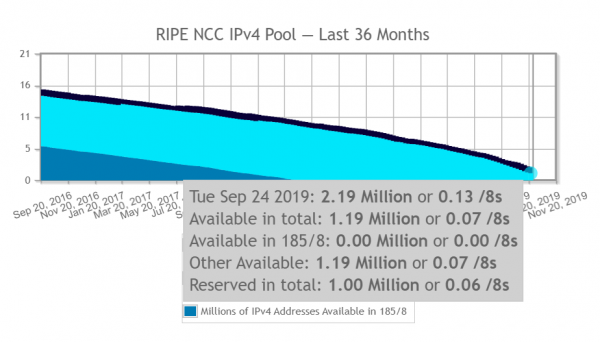
We all understand that if you actively consume a resource, sooner or later it will run out (may the mammoths rest in peace). In 2011, IANA, which allocated address blocks globally, handed out the last /8 to regional registries. On September 15, 2012, RIPE NCC announced the exhaustion of IPv4 and began distributing no more than /22 (1024 addresses) per LIR (however, it allowed opening several LIRs for one company). On April 17, 2018, the last block 185/8 was exhausted, and since then, new LIRs have been surviving on breadcrumbs and forage – blocks returned to the pool for various reasons. Now they are running out too. Observing this process in real time can be done at .
The train has left
At the time of the conference report, approximately 1200 continuous blocks /22 were still available. There is also quite a significant pool of unprocessed applications for allocation. Simply put, if you are not an LIR yet, the last /22 block is not in your future. If you are already an LIR but have not applied for the last /22, there is still a chance. However, it would have been better to have submitted the application yesterday.
In addition to the continuous /22, there is also a chance to receive a combined allocation - a combination of /23 and/or /24. However, according to current estimates, these opportunities will be exhausted within weeks. By the end of this year, you can forget about /22 for sure.
A bit of reserves
Naturally, addresses are not cleaned up to zero. A certain address space has been left by RIPE for various needs:
- /13 для временных назначений. Адреса могут быть выделены по запросу для реализации каких-то ограниченных во времени задач (например, тестирование, проведение конференций и т.п.). После реализации задачи блок адресов отберут.
- /16 для точек обмена (IXP). По оценкам точкам обмена этого должно хватить ещё лет на 5.
- /16 для непредвиденных обстоятельств. Их не предвидеть.
- /13 – адреса из карантина (про него чуть ниже).
- A separate category is what is known as IPv4 dust - scattered blocks smaller than /24, which cannot be announced or routed according to current standards. Thus, they will remain unused until an adjacent block is freed and a /24 is formed.
How are blocks returned?
Addresses are not only allocated but can also sometimes return to the pool of available ones. This can happen for a number of reasons: voluntary return due to lack of need, closure of an LIR due to bankruptcy, non-payment of membership fees, violation of RIPE rules, and so on.
However, addresses do not immediately go back into the general pool. For 6 months, they are placed in quarantine so that they can be 'forgotten' (mostly referring to various blacklists, spam databases, etc.). Of course, far fewer addresses return to the pool than are issued, but in 2019 alone, it was possible to return 1703 blocks /24. Such returned blocks will become the only opportunity for future LIRs to obtain at least some IPv4 block.
A bit of cybercrime
Resource scarcity increases its value and desire to own it. And how can one not desire it?.. Address blocks are sold for a price of 15-25 dollars each depending on the size of the block. Given the growing shortage, prices are likely to rise even higher. At the same time, gaining unauthorized access to an LIR account can easily lead to resources being redirected to another account, and retrieving them back will not be easy. RIPE NCC certainly assists in resolving various disputes like this, but does not take on the role of police or court.
There are many ways to lose your addresses: from ordinary negligence and password leaks to improper dismissals of individuals with access without revoking their rights, and even completely detective-like stories. For instance, at a conference, a representative of one company recounted how they almost lost their resources. Some crafty individuals re-registered the company in their name in the business registry using fake documents. Essentially, this was a hostile takeover aimed purely at seizing IP blocks. Subsequently, becoming the de jure legal representatives of the company, the fraudsters contacted RIPE NCC to reset access to the managing accounts and initiated the transfer of addresses. Fortunately, the process was noticed, and the address operations were frozen "pending clarification." However, the legal proceedings to return the company to its original owners took over a year. One conference participant mentioned that to avoid such situations, his company had long ago transferred its addresses to a jurisdiction where the law works better. I remind you that not long ago we ourselves .
What's next?
During the discussion of the report, one of the RIPE representatives recalled an old Native American proverb:

It can be considered a profound answer to the question, "How can I get a bit more IPv4?" The draft standard for IPv6, which addresses the shortage of addresses, was published back in 1998, and almost all network devices and operating systems released since the mid-2000s support this protocol. So why aren’t we there yet? "Sometimes a decisive step forward is the result of a push from behind." In other words, providers are simply too lazy. The Belarusian leadership took an original approach to their laziness, mandating the legislative support of IPv6 in the country.
What will happen with IPv4 allocation? A new policy has already been adopted and approved, allowing new LIRs to receive /24 blocks as they become available after the exhaustion of /22 blocks. If there are no blocks available at the time of application, the LIR will be put on a waiting list and will receive (or not receive) a block when one becomes available. However, the lack of an available block does not exempt one from paying the joining and membership fees. There will still be the possibility to purchase addresses on the secondary market and transfer them to one’s account. However, RIPE NCC avoids using the word "buy" in its rhetoric, trying to abstract from the monetary aspect of what was originally not conceived as a trade object.
As a responsible provider, we encourage you to actively implement IPv6 into your life. And as an LIR, we are ready to assist our clients in every possible way.
Don't forget to subscribe to our blog; we plan to publish some other interesting things overheard at the conference.
Thank you for staying with us. Do you enjoy our articles? Would you like to see more interesting materials? Support us by placing an order or recommending us to your friends. 30% discount for Habr users on a unique entry-level server designed by us for you: (options available with RAID1 and RAID10, up to 24 cores and up to 40GB DDR4).
Dell R730xd for half the price? Only with us in the Netherlands! Dell R420 — 2x E5-2430 2.2GHz 6C 128GB DDR3 2x960GB SSD 1Gbps 100TB — from $99! Read about how
Source: habr.com
