

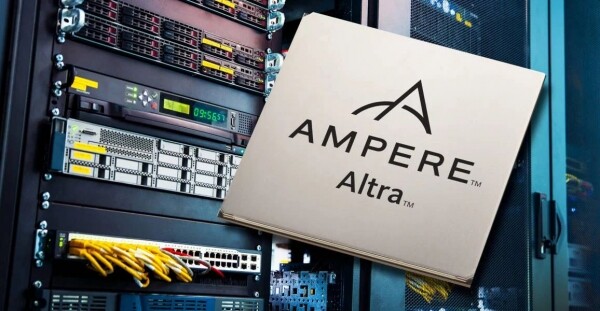
California company introduced the industry's first 80-core ARM server processor based on 64-bit architecture .
For several years, experts have been predicting that the ARM platform will compete with x86 in data centers, but this does not happen. At the end of 2019 there , AMD has 4,5%.
However, the new ARM processor in the SPECrate 2017 integer benchmark shows better performance than the fastest 64-core AMD EPYC or the top 28-core Xeon of the Cascade Lake family. This is already a serious claim (although the benchmark results are a bit “twisted”, see below).
The main advantage of ARM is energy efficiency, which, by definition, cannot be compared with x86 processors due to the architecture. The 80-core Ampere Altra has a TDP of 45-210W and a clock speed of 3GHz.
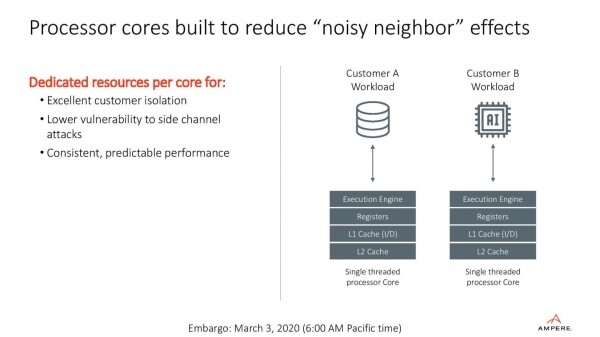
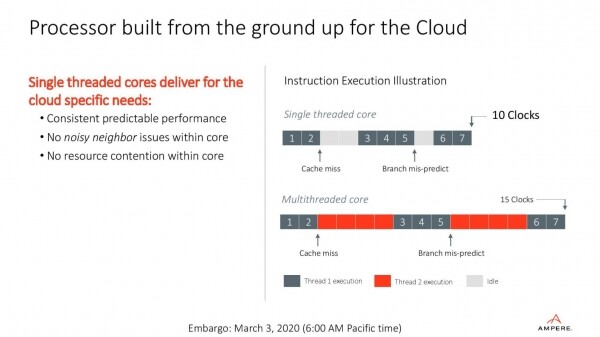
Ampere believes that one thread per core instead of two contributes to higher security, since this design better protects individual cores from side-channel attacks such as Meltdown and Specter.
The processor is designed for server applications such as data analytics, artificial intelligence, databases, storage, telecom stacks, edge computing, web hosting, and cloud applications. Especially for machine learning applications, the hardware supports the FP16 (half-precision) and INT8 (single-byte integer) data formats. There is also hardware accelerated AES and SHA-256 hashing.
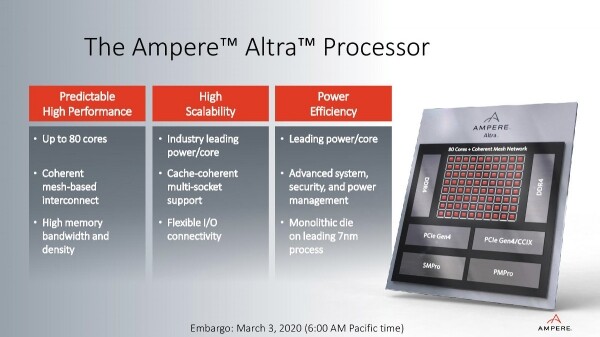
The chips are manufactured at TSMC's 7nm process. The first CPU samples have already been sent to potential customers, and mass production is scheduled to begin in mid-2020.
 Ampere CEO and former Intel president Renée James founded Ampere Computing in October 2017 from the bankrupt Applied Micro Circuits Corporation (1979-2017), which also designed ARM server processors. In particular, in 2011 it introduced the 64-bit X-Gene platform based on ARMv8-A.
James now combines his positions as CEO and Chairman of the Board of Directors of Ampere Computing with the position of Vice Chairman of the National Security Telecommunications Advisory Committee, which advises the President of the United States.
I wonder how successful the new attempt to bring ARM processors to the server market will be.
“We released the processor with the highest number of cores on the market,” James. “Now we've sent it [for testing] to some of the biggest cloud providers in the industry… I think people will be surprised. [To replace previous technologies] there is always something new. And if not from an existing company, then from a new one. It's very exciting to work on what I see as the next step in the industry."
There was a lot of talk about 64-bit ARM server chips in past years, when AMD and the aforementioned Applied Micro tried to produce similar processors. But these companies failed. AMD shut down its ARM project, while Applied Micro's assets Macom company. In 2017, the Carlyle Group bought the ARM processor division from it. The deal closed at the end of 2019, and James took over as CEO of the new company, leaving her position as COO at the Carlyle Group.
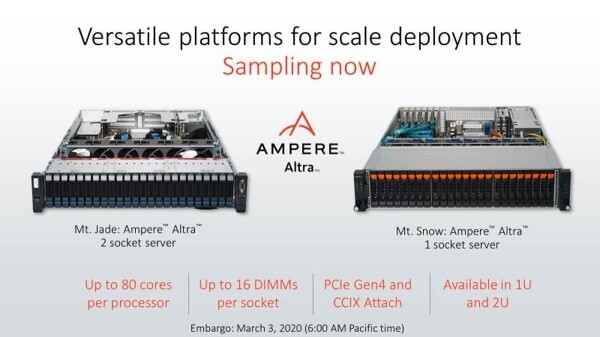
Two Ampere server platforms: Mt. Jade and Mt. Snow
Single-threaded Ampere Altra cores and the "dense energy-efficient servers" that can be built on such CPUs will allow customers to "maximize the number of services they can deploy in the cloud," the company said.
The Ampere Altra processor is based on the platform . Positive feedback on the new servers comes from Microsoft Azure, Oracle, Canonical, VMware, Kinvolk, Packet, Lenovo, Gigabyte, Wiwynn and Micron engineers, all of whom are cited in the press release.
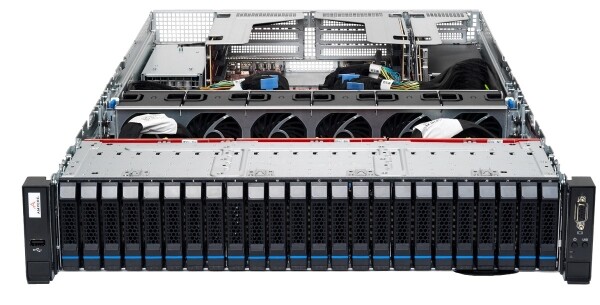
Server Mt. Jade on two processors (160 cores): data analytics, database, web
The company says the software is ready to work with the Ampere Altra: “The most important thing now is that if you look at all the layers, the OS layer, everything from Linux before BSD and Windows "Everyone supports ARM," says Jeff Wittich, senior vice president of products at Ampere. "In terms of virtualization, we support Kubernetes, Docker, VMware, and KBM. They all support it. At the application level, everything that runs in the cloud today already runs on our platform."
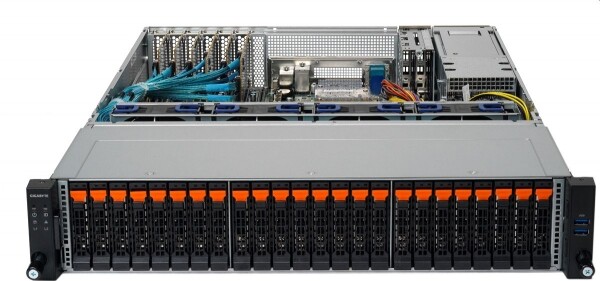
Server Mt. Snow per processor: edge computing, telecom services, web, storage
Specifications
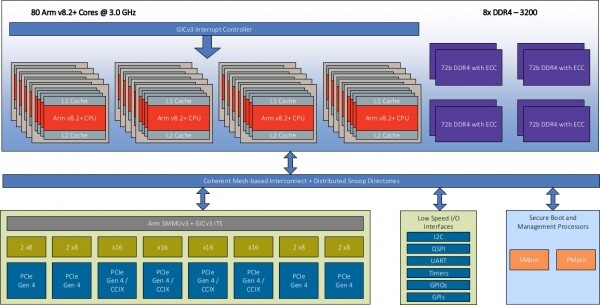
- Processor Subsystem
- 80 ARM v8.2+ 64-bit cores up to 3,0 GHz with Sustained Turbo, added some improvements from ARM v8.3 and v8.4
- 1 KB L64 I-cache, 1 KB L64 D-cache per core, 2 MB L1 cache per core, 32 MB shared system-level cache (SLC)
- Stream of SIMD (Single Instruction, Multiple Data) double-width short instructions (128 bits)
- Coherent interconnections in a mesh network
- System memory
- 8x 72-bit DDR4-3200 channels
- ECC, Symbol-based ECC, DDR4 RAS
- Up to 16 DIMMs and 4 TB per socket
- System resources
- Full interrupt virtualization (GICv3)
- Full I/O Virtualization (SMMUv3)
- Reliability RAS (Reliability, Availability, Serviceability) of an enterprise server class
- Network
- 128 PCIe Gen4 lanes
- 8 x8 PCIe + 4 x16 PCIe/CCIX with Extended Speed Mode (ESM) support for data transfer at 20/25 GT/s (gigatransactions per second)
- 48 controllers to support up to 32 x2 connections
- 192 lines in 2P configuration
- Multiple socket support
- 4 lines x16 CCIX
- 128 PCIe Gen4 lanes
- Temperature Range – from 0°C to +90°C
- Food
- CPU: 0,80V, DDR4: 1,2V
- I/O: 3,3V/1,8V, SerDes PLL: 1,8V
- Power management – Dynamic evaluation, Turbo Gen2, voltage drop protection
- Chassis – 4926-pin FCLGA
- Production – 7nm FinFET technology
Benchmarks
Jeff Wittich says that in tests, the Ampere processor performs 4% better than AMD's fastest EPYC processor and consumes 14% less power. This is a 64-core EPYC processor.
7742 with a TDP of 225W and a cost of $6950. This is the most powerful in the EPYC 2 processor family based on the Zen 2 microarchitecture. The family was introduced in August 2019.
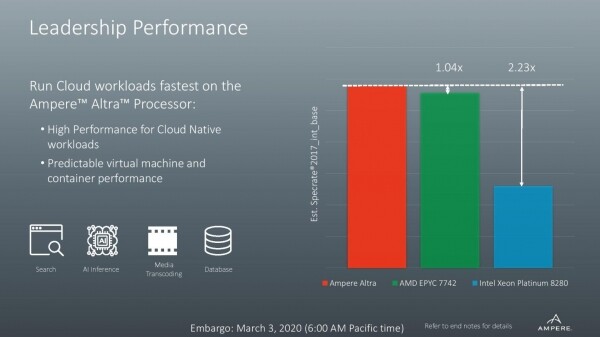
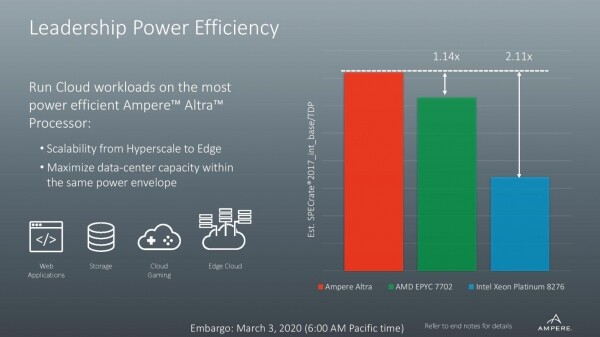
Wittich also gave a comparison with the 28-core Xeon processor of the Cascade Lake family. The Ampere Altra processor outperformed it "by 2,23 times in performance and 2,11 times in energy efficiency". Here, the figures were compared with the 28-core Xeon Platinum 8280 (205 W), and the energy efficiency was calculated based on one core.
In the SPECrate 2017 integer benchmark, the Ampere Altra processor reportedly scores over 259. this is inferior to the peak performance of ASUS RS720A-E9(KNPP-D32) Server System (2.20 GHz, AMD EPYC 7601) and ASUS RS500A-E10(KRPA-U16) Server System 2.25 GHz, AMD EPYC 7742.
However, in the performance comparison, Ampere applied a factor of 0,85 to the AMD results due to the use of the AMD64 compiler package to compile the benchmark code compared to GCC 8.2, which it used itself, since the AMD C/C++ compiler produces more optimized code than GCC for ARM.
Despite such benchmark tweaks, the Ampere Altra looks very impressive in terms of performance and energy efficiency. A typical 42U server rack with 12,5kW of power can pack about 3500 processor cores into a watt-per-core savings.
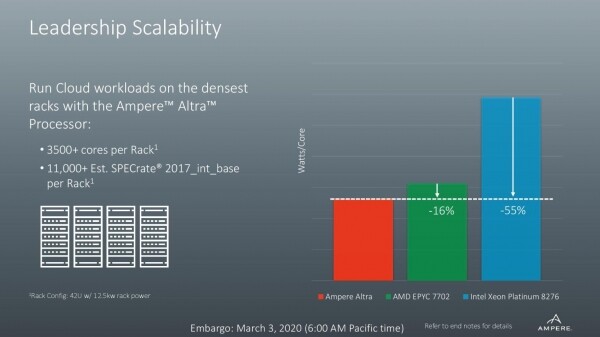
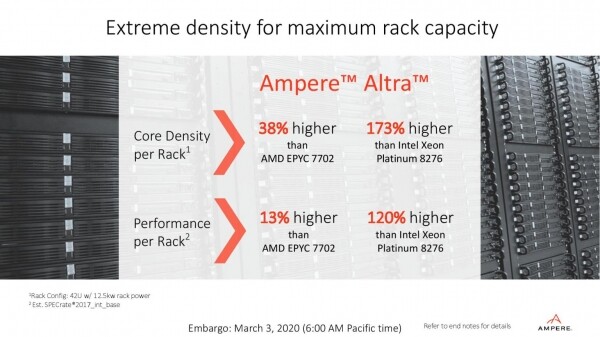
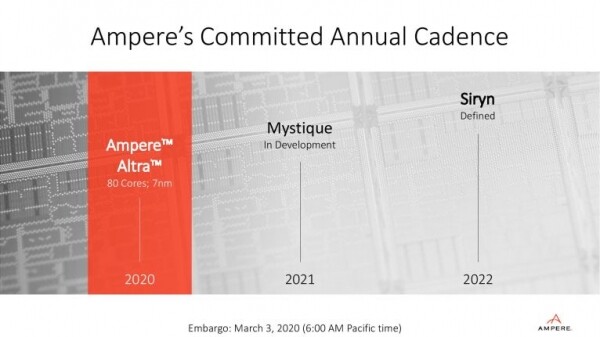
And this is just the beginning. Jeff Wittich said that another product, codenamed Mystique, will hit the market in a year, with Ampere further increasing the number of cores.
Mystique will support the same connector, so there is no need to change motherboards. The next generation Siryn SoC is scheduled for 2022.
In recent years, we have seen several attempts to release ARM server processors from various companies: Broadcom/Cavium/Marvell, Calxeda, Huawei, Fujitsu, Phytium, Annapurna/Amazon and AppliedMicro/Ampere. Most of these attempts were unsuccessful. But there are signs that the situation is changing. In December 2019 Amazon servers with 64-core ARM processors is a system-on-a-chip on the same core as the ARM Neoverse N1 core. In some tests, ARM instances (M6g and M6gd) performed better, and sometimes much better, than x86.
In November 2019, it was reported that the American startup Nuvia . The startup was founded by three lead engineers who were involved in the creation of processors at Apple and Google. They also promise to develop server processors that will compete with Intel and AMD. By , Nuvia has designed a processor core from the ground up that can be built "on top" of the ARM architecture, but without obtaining an ARM license.
All this indicates that RISC processors can find application not only in mobile devices, but also in servers, as well as in desktop computers and laptops. By the way, there are rumors that .
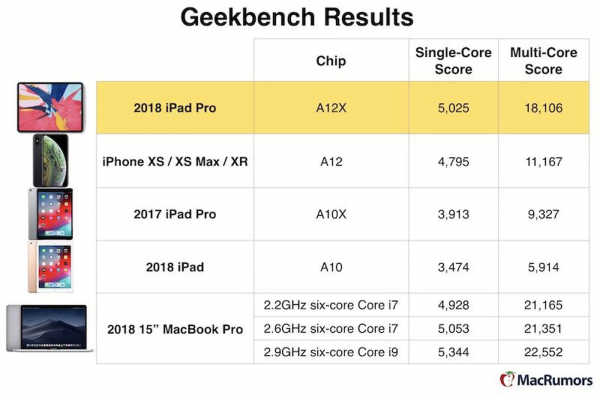
In fact, the latest iPad Pro models with ARM-based A12X processors are almost on par with the performance of the 15-inch MacBook Pro with Core i7 and Core i9 processors, so such an upgrade would be quite logical.
Source: habr.com

