

Service engineers can be found at gas stations and spaceports, in IT companies and car factories, at AvtoVAZ and Space X, in small businesses and international giants. And all of them, absolutely всех, have at some point heard the classic phrases like "it just worked," "I wrapped it with duct tape and it worked, then it exploded," "I didn't touch anything," "I definitely didn't change it," etc. Our world is full of legends, myths, funny comics, and sad stories. We've gathered the best of them, translated them for you, and added a few paragraphs about the most important thing — how to make a service department truly impressive. In short, there's fun below, but not just for fun.
Service engineers have their own name 🙂
What do clients not want?
If you are a service company, you have technical support, and you have engineers who fix problems on the client side, you need to focus primarily on overcoming the most irritating factors for clients. And it's not just the upbeat music your clients listen to while they learn that their call is important to you.
- Let's start with the long wait from the company. We live in an era of advanced IVR technologies, chatbots, rented call centers, and other ways to entertain the client in those 30 seconds it takes for an engineer to review the client’s call map and answer. Seriously, in these times, the world is so fast, and there's so little time, that during the wait for an answer, a client can Google a competitor's site and price list and start chatting with them — simply because it's quicker. Don’t be dial-up, it's awful. Reduce response times to client inquiries across any channel to a minimum, and the client will be yours.
- Unprofessionalism is something that should not exist at all, but it does happen. If your engineer does not know how to handle a task, is unfamiliar with the equipment, and doesn't even make an effort to read the instructions, that is a clear indicator that it's time to let them go. Hours and even minutes of client equipment downtime result in financial losses, and the client should not have to pay for unprofessional service staff. Therefore, build a knowledge base, train employees, and actively adapt them to new client interaction conditions. Otherwise, you risk facing a lawsuit for breach of contract.
- Under no circumstances should you deceive the client. Be honest about deadlines, quality, and payment terms. Do not try to hide behind force majeure circumstances or excuses such as "the supplier didn't deliver the injectors in time."
- Clients do not tolerate a conveyor-belt approach — it is best if you can demonstrate 100% personalization: addressing them by name (CRM), relationship history (CRM), and detailed history of problems and incidents regarding the object or equipment (). Attention to the client and constant relationship maintenance is a powerful weapon against your competitors.
- Inconsistency in service quality is a sign of problems in the business, ranging from staffing issues to resource challenges. The client will not understand if their issue is resolved perfectly in half an hour the first time, but then a trainee shows up and struggles for a day without completing anything. Another mistake is assigning VIP status to a client, providing priority service, and then downgrading them to regular client status. Remember: VIP status granted for free must remain so throughout the client's lifetime with your company. Not ready for that? Okay, don't throw around statuses and make priority service a paid feature. At the very least, it's honest.
- Clients do not tolerate mistrust towards themselves and their employees. If they report an incident and receive a response like "That can't be true!", it looks disgraceful — essentially, you are calling your client a fool. If you value your expertise and reputation, and are confident in your correctness, go onsite or connect remotely and prove it correctly and practically. What if the automatic fuel dispenser at the gas station is indeed under-delivering, but not because of your settings, but due to the engineer/hacker talent of the station attendant?
All events are not fictional, any coincidences are not accidental.
Naturally, the top situations disliked by clients did not arise from nowhere — dissatisfaction has occurred across various companies repeatedly due to systemic issues that exist worldwide. It is no coincidence that our team came up with , to make equipment maintenance convenient and transparent. Here’s what one (!) employee, who joined us from the service department, has to say.
I managed to work at a company where there was no organized service department and witnessed obvious problems.
- In order for service specialists to close requests, they had to stay on the phone for up to 45 minutes, resulting in employee downtime and reduced responsiveness, leading to low SLA and lost revenue.
- Requests could mistakenly be assigned by dispatchers to service specialists from another region, at a gas station with a similar number, resulting in unnecessary trips.
- Requests could be assigned to the wrong executor, wasting the time allocated for completing the request and consequently incurring penalties from the Client.
- Communication with gas stations was carried out through dispatch, which increased the costs for this dispatch service.
- It was impossible to assess the actual workload of the executors, leading to an excess number of staff.
- Requests could 'disappear.' A request was assigned to an executor, but they forgot about it, resulting in either lost revenue or penalties for late completion of the request.
- Loss of service sheets for completed requests. The service specialist might not deliver the SL to the office, lose it, which meant that part of the work was not billed to the Client and revenue was lost.
 I managed to work at a company where there was no organized service department and witnessed obvious problems.
As you can see, this is the experience of one person, but how many banal and frustrating reasons there are for profit loss. However, a business without proper automation of equipment servicing processes (for both external and internal clients) is doomed to certain losses.
If they laugh about a problem, it means it exists.
Comic 1. A simple picture with profound meaning.
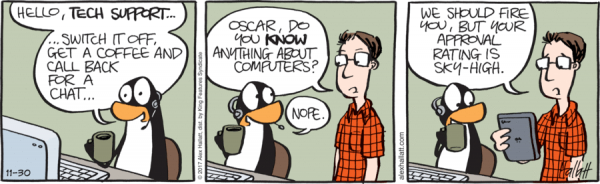
— Hello, tech support…
— Turn it off, pour some coffee, and you can call back…
— Oscar, do you even know anything about computers?
— Nope.
— Actually, we should fire you, but your customer approval rating is simply sky-high.
Of course, it's very unfortunate when your employee has a weak understanding of the equipment. However, soft skills are also important, meaning communication skills—whether you're servicing hotels, refrigeration units, or auto centers. Every employee is part of the company's image, and today's competitive atmosphere doesn't allow for being a harsh engineer who berates those who have increased the voltage on a machine, disrupted power in a data center, or overloaded weighing equipment.
Here’s a list of basic skills for a service engineer in the 21st century.
- Extensive knowledge of the product and the company's business — it’s this combination that matters. An engineer must not only master their field but also understand that their undoubtedly brilliant work is linked to business processes, and they are part of the company. Therefore, in addition to excellent work, there must be competent support: documentation, action tracking, invoicing, and recording all work details. No one enjoys this routine, but it’s the foundation of the company’s income. By the way, the mobile version makes part of the routine automated and pleasant—just think of the access to the equipment passport via QR code.
- Confident problem-solving skills — employees involved in equipment servicing must not only be able to make the mechanism operational but also ensure that the problem, if possible, does not recur, pass knowledge to other relevant staff, and explain causes and consequences to the customer. Only then can the issue be considered resolved.
- Adaptability — this is a trait that every modern employee should possess, from secretaries to CEOs. The types of equipment change rapidly, updates come in, configurations and integration elements shift—the technological environment is more dynamic than ever. Thus, adaptability can only be ensured through training, both in terms of initial mastering of new developments and nuances, as well as establishing a unified knowledge base (by the way, here the HubEx platform can again facilitate the accumulation of experience from tickets. But any knowledge management system, from a corporate Wiki and CRM to a hierarchy of folders on a server, will work).
- The ability to communicate clearly An engineer must respond strictly and factually, without emotions or negativity, to find out what happened and explain how it will work. Moreover, a restrained person inspires more trust and confidence in their professionalism. Work like an emergency doctor: less emotion, more action, and calculated steps. This is genuinely impressive.
Returning to the comic, a little empathy never hurts. There is a grain of truth in every joke.
Comic 2. The client does nothing; it always happens on its own. Someone is behind the 'on its own'.
Get used to the idea that the client will always tinker with the equipment themselves before calling you. Neither a seal on the case nor a service sticker (no matter how skillfully it's glued!) nor a supplier's stamp will stop this. Simply because there will always be an employee who claims to understand the issue and will do it quickly and for free. In reality, this often results from Googling. Meanwhile, such behavior from the client brings problems that service engineers must address:
- damage to related nodes and modules due to a misunderstanding of technical connections;
- using inappropriate tools (manicure scissors, a screwdriver, and a paper knife — a weak but incredibly resilient device are often used);
- violating software shells — especially if keys are pressed based on the logic of ordinary application software;
- reset settings — partially or completely.
The task of superhero engineers is not only to fix the issues but also to firmly explain that such interventions are not only harmful but also incur additional costs.
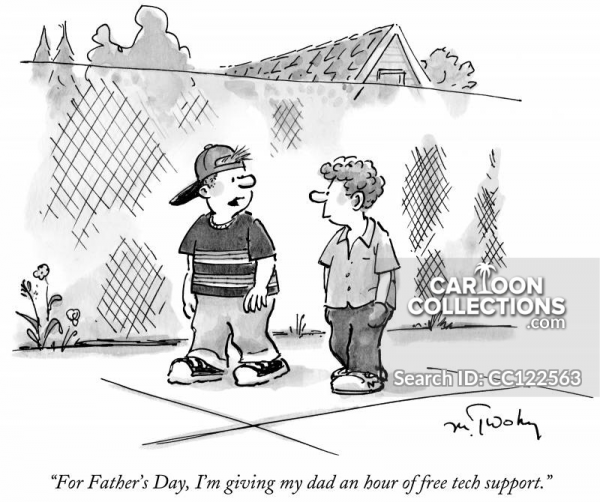
I will gift my father an hour of free technical support for the holiday.
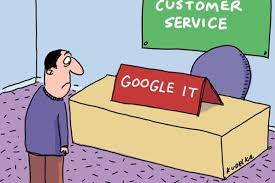
Just Google it. They go and Google.
Comic 3. The customer is always right; the customer is always scared.
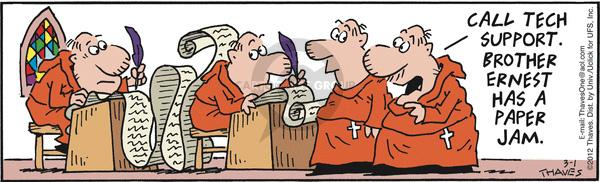
Call support. Ernest's brother has a paper jam.
There can also be the opposite situation, which is no less time-consuming for the contractor: the client gets scared of every little thing and submits requests for any reason, even fearing to dust the equipment, let alone restart or reconfigure it. Of course, this is a burden for engineers, with trips for every little complaint, costs for travel, gasoline, etc. One can try to fight this with two main approaches:
- Charge a fee for each visit based not only on the complexity of the task but also on the parameters of the trip and the specialist's time (for example, this is how metrologists and gas station engineers operate: they write down the distance, cost per kilometer, urgency surcharge, etc., directly in the report) — the client will think twice about whether the problem can be solved over the phone;
- Conduct a comprehensive knowledge update: create and provide instructions regarding basic details, limit the scope of permissible interference with equipment operations (for instance — one can independently change the lighting element of the equipment, but one cannot go in and change fuses and circuits).
 By the way, our employees' all-time favorite request, quoted verbatim: "Something is beeping with my UPS, it seems to be dying."
Comic 4. Hidden knowledge should become evident
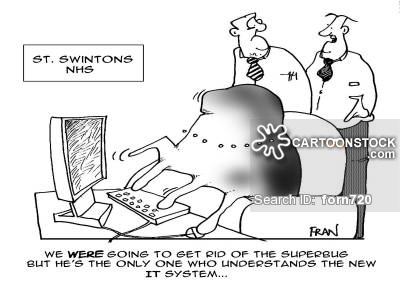
We were going to get rid of this super-monster, but he is the only one who understands this new IT system...
It's really cool when you have a true guru in your support service, equipment maintenance, or outsourcing — he can figure out any issue, resolve any accident, and tackle the most complex incident. But such specialists not only cost a lot, they are usually also in high demand in the job market — which means they will be lured away by any means available. Therefore, the manager's task is not only to work on retention but also to make the company relatively independent of key specialists. The business should not collapse with their departure. Thus, there are several effective tips:
- encourage such specialists;
- motivate them to share knowledge, and the others — to learn;
- automate the tracking of clients, incidents, and their resolutions — the database of clients and tickets should belong to the company, not to individual specialists.
Your jedis must be a force for good and not turn to the dark side for cookies.
Comic 5. Costs must be justified
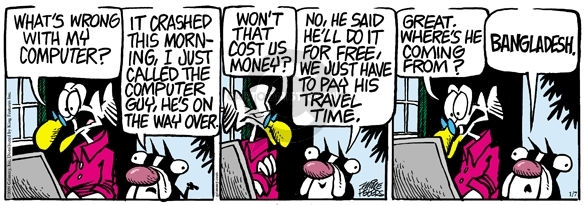
— Something broke?
— Yes, the computer crashed this morning, I called the technician, he's on his way.
— Is this going to cost us money?
— No, he says he is doing it for free, we only have to pay for the travel time.
— Excellent. And where is he coming from?
— From Bangladesh.
If you do not manage the service and it is not automated, you risk incurring additional costs due to improperly processed requests, dispatcher errors, unnecessary equipment purchases, and needless spare parts. Therefore, use a small checklist to avoid unpleasant issues:
- create service sheets;
- keep accounting in automated systems;
- create route maps and monitor employee movements along the route;
- maintain strict records of serviced equipment and associated incidents;
- collect maximum information about the incident, have a customer request form/template that accounts for all significant parameters affecting load and cost.
Comic 6. Calm down, just, @#!#$!!, stay calm!
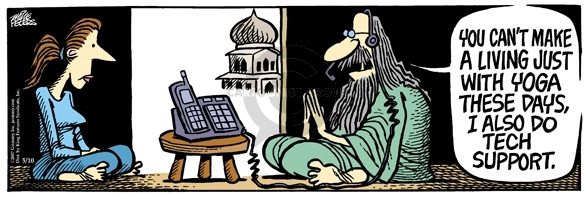
Nowadays, yoga alone is not enough to survive; one has to work part-time in tech support.
Take care of your nerves! The work of a service engineer is inherently linked to incredible psychological stress, mental activity, and strain. Each individual finds their own way to cope with these issues, but relieving part of the routine and stressful minutiae through software is quite simple. As we declare: there are no trivial matters, and controlled details are the key to calmness and success.
Comic 7. No one believes in the service department
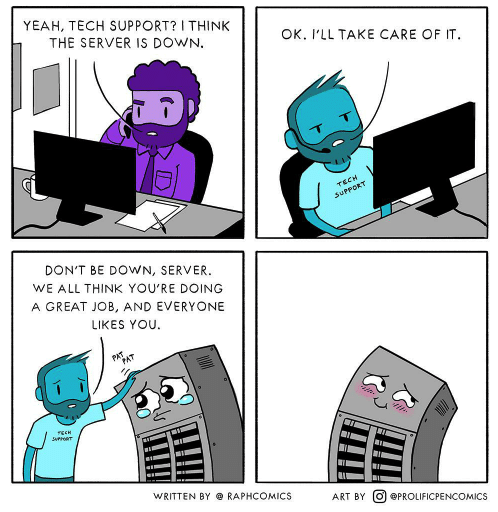
"Service department? I think the server is down."
"Okay, I'll take care of it."
In the server room:
"Don't fail, little server, we all believe you're doing an excellent job; everyone loves you."
This is how some users envision the work of an engineer. This perception especially affects those who pay: accountants, top managers, and commercial departments of your clients. They are ready to accuse you of laziness, wasting work time, charging too high fees, and unprofessionalism just to pay a little less. The problem is easily resolved: the cost and scope of work are clearly defined, everything is implemented strictly according to the technical specifications, request, act, or contract. Any deviation must also be justified and documented. This way, you will rid yourself of most headaches related to calculations.
— And you call yourself a professional! You're taking so long; I won't see my documents today!
— Hmm. Will you pay me the same amount if I open it quickly?
— Yes, all according to the invoice.
A minute later, the safe was opened, and in 15 minutes, it was functioning again. The guy signed the documents and explained:
— Often, when I finish a job in three minutes, they refuse to pay the invoice. It’s not about the time — it's about the work done. Sometimes I have to fake it.
 In 1995, a construction company experienced a safe malfunction. The chief accountant called in a specialist for breaking complex locks and safe doors. The guy worked for half an hour, an hour, an hour and a half. The accountant irritably exclaimed:
Comic 8. The Client is Always Angry
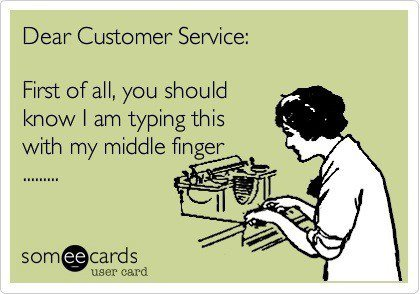
Dear service team! First and foremost, you should know that I'm typing this message with my middle finger.
Yes, clients can often be angry, and it's hard to get a request or clear information from them. That's why it's better to provide them with a chance to reach out through an app with smart, customizable forms, because electronics can handle anything, and an aggressive manager will have a chance to focus.
By the way, the client’s anger is understandable: during breakdowns, failures, downtimes, and equipment failures, the client incurs direct losses, and the speed of the service team's response often determines how serious those losses are and how quickly they will be covered. Do you see now that waiting 45 minutes for a response on the line is a disaster?
Comic 9. The Problem Has Big Eyes
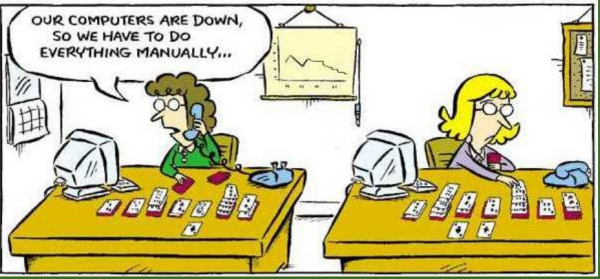
Our computers have broken down, and we have to do everything manually!
For the same reasons mentioned above, clients often exaggerate the scale of the breakdown: they report that everything is broken (when in fact, a plug has simply come loose), nothing works (actually, just one module has failed), all devices are malfunctioning (a stuck button is flickering), we're incurring massive losses (a spout is spilling 2 ml per liter), staff have joined a criminal syndicate and are raiding the business (a spout is short by 4 ml per liter). In any case, there is a reason for a request, and your task is to help the client fill out the application as realistically as possible. Once again, the application creation forms and the client's personal account (or even a personal mobile app, like the one from ). It's especially important to give the client a chance to track the status changes of their application.
Comic 10. Working in the service department is fun. But first — it's all about professionalism.
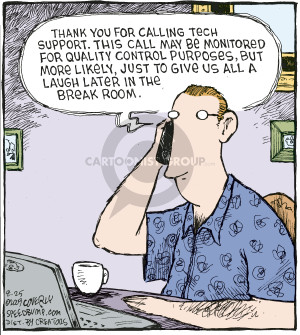
Thank you for contacting support. For quality control purposes, the call may be recorded, but most likely, it'll just give us a reason to laugh later in the break room.
Yes, there are indeed many funny moments in the lives of service engineers, here are a few quotes from different staff members:
"Your specialists came with a vacuum cleaner and poked it at the computers; we called not for cleaners." // сотрудница нефтеперерабатывающей компании ИТ-аутсорсеру (кулеры собрали пыль всего мира)
"It goes beep, then gurgle-gurgle, and the light blinks." // полетел насос у ТРК на АЗС
"There are noises, crackling, and squeaking in the fuel dispenser." // приехали, открыли крышку старой Ливны, а там птичка-трясогузка гнездо свила и уже вывела птенцов; тихо закрыли и не потревожили их
"There are snot in the barrel, almost half a meter deep." // в топливном резервуаре АЗС осадок от очень качественного российского топлива, чистили с дежурной скорой, чтобы предупредить отравление рабочих
"The gun is jammed; we can't clean it. Management is coming tomorrow; they need to work." // о пистолете шланга колонки на АЗС
"The server is down? No, it's not down; it's standing by the wall!" // в ответ на уточнение заявки на проблему со скоростью работы внутреннего сервера
"The printer chewed everything up." // constant paper jam
 "Your cell tower is making the flowers wilt, you should cut it down." // обращение в справку оператора связи
But you shouldn't get carried away: service, support, and equipment maintenance are very serious matters.
The key to successful customer service is establishing a solid service management structure and a well-tuned business process for handling customer complaints.
You must forget forever about:
- Long chains of communication.
- Long wait times for service.
- Forgotten customer stories — each breakdown is perceived as a complete story that has to be retold every time.
How to work?
- The first rule is to maintain the history of the customer and their equipment that you are servicing. There is nothing worse than repeatedly explaining the equipment problem — as many times as you were transferred to different specialists. allows recording all relationship details, saving incidents, creating equipment passports — in other words, maintaining a database in such a way that any service engineer can immediately see the customer's history and either respond promptly or refer the inquiry to the right specialist.
- There is also another important aspect of service department management. If a company is unable to provide engineers with tools that make their work efficient and measurable, it should not employ KPIs. Otherwise, it ends up with ratios set without monitoring their real execution, which leads to overall employee demotivation.
- You will learn more about your product and the services offered. You will accumulate feedback, requests, incidents, and based on this data, understand what customers expect from your product. This information will enrich your backlog and help you find the right development direction.
A good service department with quality automation is an additional revenue stream for the company. Of course, there is a strong temptation not to create a service department and to utilize existing staff, as establishing a service department involves costs. However, these costs will quickly pay off because:
- You will increase sales and customer lifespan—no customer is willing to spend money on poorly supported services and products.
- A service department saves money for both your business and your clients, as having specialized staff helps resolve problems before they arise. Customers do not harm your reputation since all incidents are handled professionally and promptly.
- Your users remain your beta testers and key advisors in business development—saving on research, staff costs, and missteps in product development.
Having a service department, technical support, being outsourced, or addressing all problems in-house for internal clients means taking responsibility for someone else's profitability, quality, and work speed, effectively ensuring the functionality and continuity of processes. Plus, the humorous side of support activities is just the tip of the iceberg of the challenges that departments face daily. So, smile and get to work!
Taking this opportunity, our team congratulates everyone on the recently celebrated System Administrator's Day, as well as on the upcoming August 1st Support Worker’s Day! And for true professionals—it's work like a celebration 🙂
And here we have the nature of Karelia
Source: habr.com
