

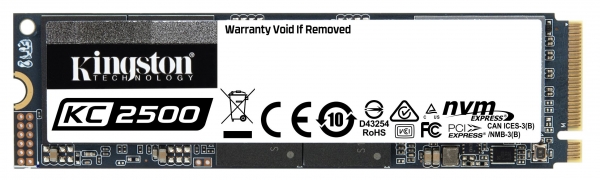
The rapid development of SSD and NAND controller technology requires manufacturers to keep pace with progress. Therefore, Kingston has announced the release of the new with read speeds of up to 3.5 GB/sec and write speeds of up to 2.9 GB/sec.
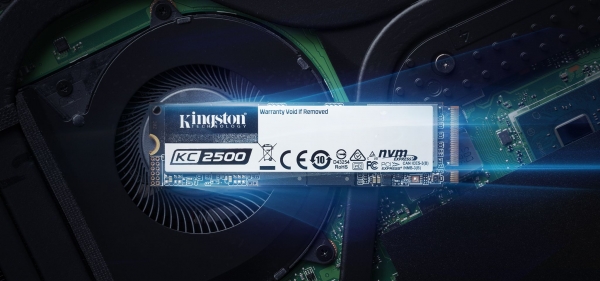
The new products are available in four sizes ranging from 250 GB to 2 TB, all in the M.2 2280 form factor, equipped with PCI Express 3.0 x4 interface with NVMe 1.3 protocol, and support end-to-end data protection using 256-bit hardware AES encryption. This encryption is applicable in enterprise environments, considering support for TCG Opal 2.0 and Microsoft eDrive. The performance characteristics depend on the size of the SSD:
- 250 GB – read up to 3500 MB/s, write up to 1200 MB/s;
- 500 GB — read up to 3500 MB/s, write up to 2900 MB/s;
- 1 TB — read up to 3500 MB/s, write up to 2900 MB/s;
- 2 TB — read up to 3500 MB/s, write up to 2900 MB/s.
The claimed warranty period is 5 years.
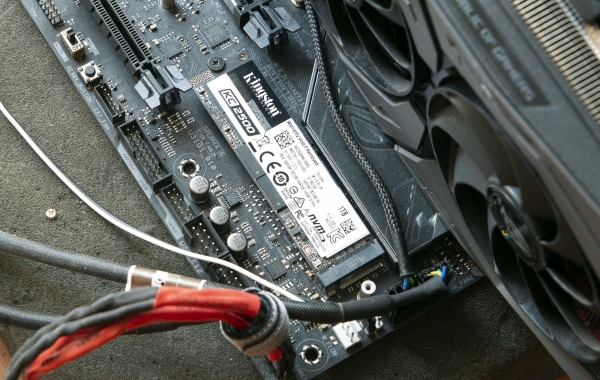
The core of any NVMe drive is the controller, and Kingston continues to use the well-known Silicon Motion SM2262ENG processor. Naturally, all 8 available channels of the controller are utilized. The main difference from the KC2000 is the improved firmware, which allows for the full potential of the NAND memory to be realized. Moreover, there are overclocked NAND memory chips.
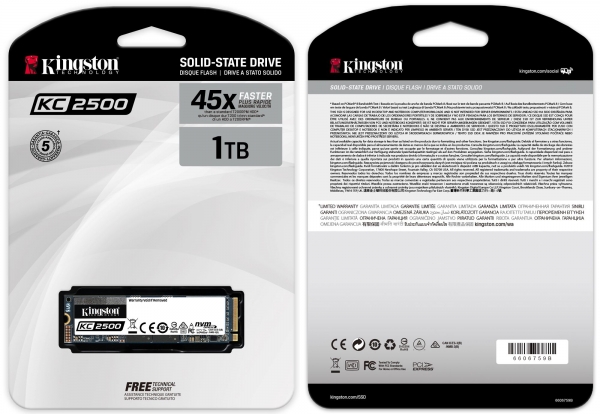
The package includes the SSD KC 2500 itself and a key to activate Acronis True Image HD software. This makes it easier to migrate to the new drive by creating an image of your old disk. The drive is designed in the common M.2 2280 form factor and is suitable for installation in PCs and laptops. The standard formatting in Windows leaves 931 gigabytes of free space for the user. The NAND memory layout is dual-sided, and the SSD allows for additional cooling to be installed, although, as will be revealed later, this is not a mandatory condition.
Testing methodology
The topology of SSD drives involves the use of read and write buffers, as well as multithreading. The size of the DRAM cache is typically either static or dynamic. In modern typical SSDs that use Silicon Motion controllers, a 'clever' dynamic DRAM cache is often employed, managed by firmware. The main trick lies in the controller and firmware. The better and more progressive the controller and the more adaptive the firmware is to various usage scenarios, the faster the SSD operates, assuming high-speed NAND memory is present.
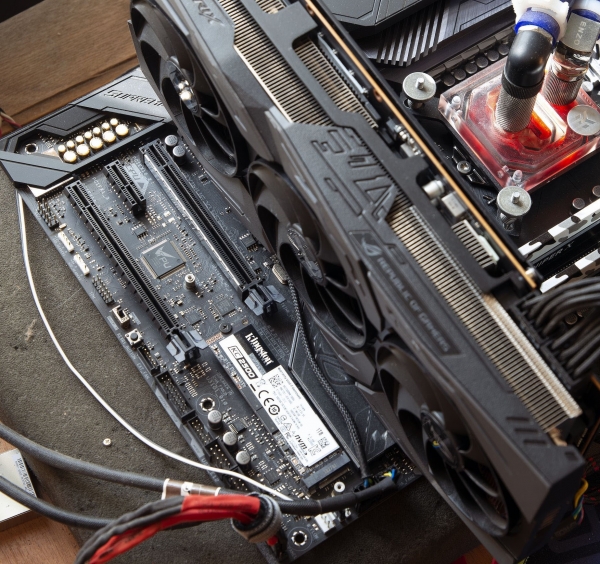
The test stand included an Intel platform with an ASUS ROG Maximus XI Hero (Wi-Fi) motherboard, an Intel Core i7 9900K processor, an ASUS Radeon RX 5700 graphics card, 16 GB of DDR4-4000 memory, and the Windows 10 X64 (build 19041) operating system.
Test Results
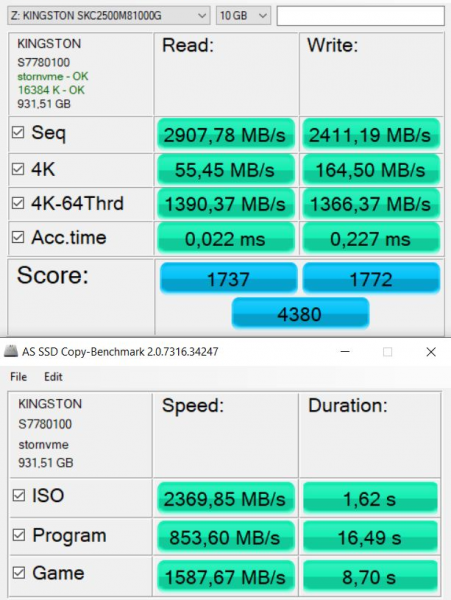
AS SSD Benchmark
- The testing was conducted with a data volume of 10 GB;
- Sequential read/write test;
- Random read/write test for 4 KB blocks;
- Random read/write test for 4 KB blocks (Queue Depth 64);
- Test measuring read/write access time;
- Final result in conditional units;
- Copy Benchmark evaluates the speed and time taken for copying different groups of files (ISO image, folder with programs, folder with games).
CrystalDiskMark
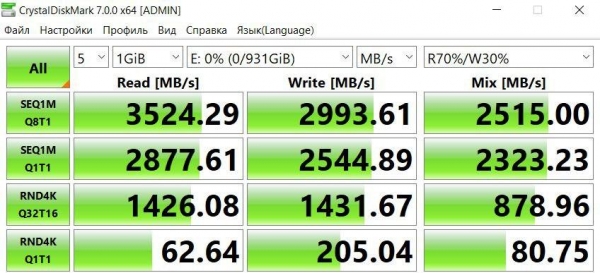
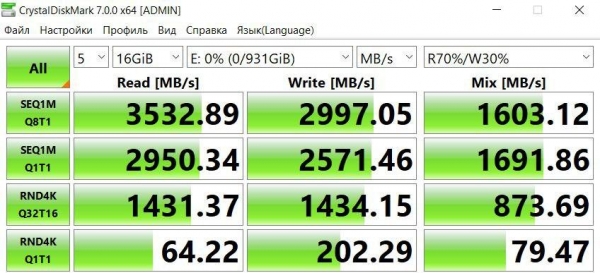
- Testing was conducted with 5 repetitions, each of 16 GB and 1 GB.
- Sequential read/write with a depth of 8.
- Sequential read/write with a depth of 1.
- Random read/write in 4 KB blocks with depth 32 and 16 threads.
- Random read/write in 4 KB blocks with depth 1.
HD Tune Pro 5.75
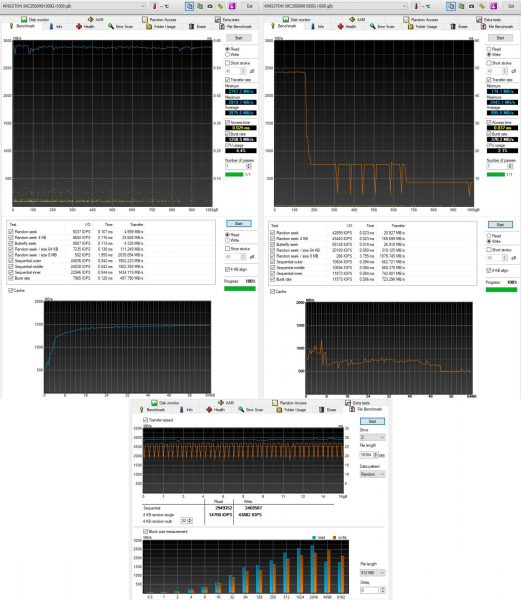
- Linear read and write speed with 64 KB blocks.
- Access times.
- Extended read and write tests
- Tests with various block sizes, as well as real speed on a 16 GB file.
PCMark 10 Storage
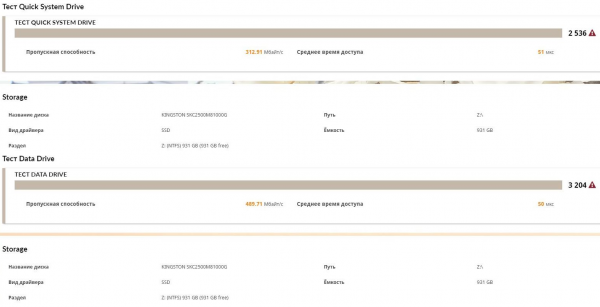
- Quick System Drive Benchmark: a short test that simulates light load on the storage system. Test sets replicate real actions of the system and programs with the drive;
- Data Drive Benchmark: replicates the load on the storage system in the form of test sets for NAS (storing and using files of various types).
Heating during sequential write
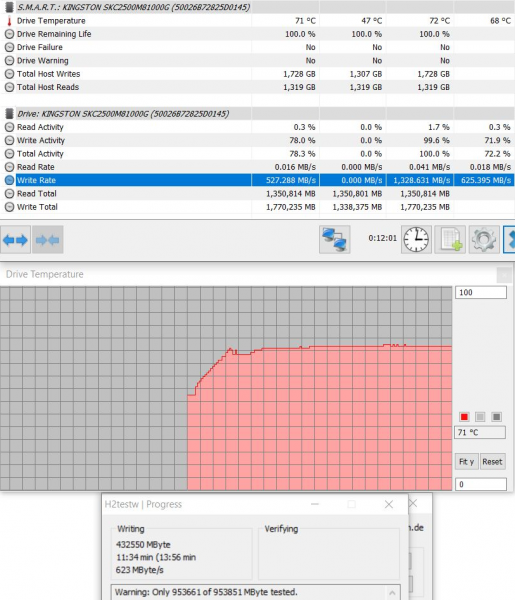
The standard procedure for writing on the KC2500 SSD allows for assessing the device's temperature without active cooling. You probably won't be surprised if we tell you that overheating high-performance SSDs is a critical issue. Engineers are working hard to avoid entering critical states with SSDs. The simplest approach involves installing a heatsink (either purchased separately or using the motherboard's cooling system) or introducing a write queue bypass mode to relieve the controller. In this case, performance decreases, but the SSD does not overheat. A similar scheme is used in processors, where they skip cycles when overheating occurs. However, in the case of a processor, these skips are less noticeable to the user than with an SSD. If the SSD heats up beyond the temperature specified by the designers, it will skip too many cycles, leading to
Dynamic cache
Traditionally, any storage review includes a test for filling the DRAM cache with subsequent announcement of its size, but this is fundamentally incorrect. The fast buffer is allocated dynamically, not only as a percentage of the free space but also depending on the type of data being written.
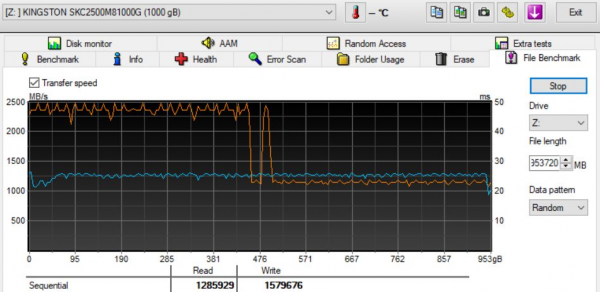
As an example, let's fill the entire disk with a file of random data. This file contains compressible and non-compressible data in various blocks. Theoretically, the fast buffer should be sufficient for 100-200 GB; however, as you can see, the result turned out differently. A significant drop in linear writing appeared only at the 400+ GB mark, indicating a complex recording management algorithm by the firmware. At this stage, it's clear where the man-hours were spent during the creation of KC2500. Thus, the SLC cache on the KC2500 drive indeed has dynamic allocation and depends on many factors, but it is certainly not limited to 150-160 GB.
Types of Accesses to SSD in Windows 10
The second common mistake is failing to make the reader understand what accesses are being sent to the disk if you are using it as a system drive. Here, again, the correct approach to evaluation is essential. I will attempt to perform typical operations in the operating system as a user. For this, we will delete something in the recycle bin, open a dozen files in Photoshop, simultaneously run a disk cleanup, export from Excel after opening several tables, and continue writing this text. The parallel installation of updates is missing, but let's initiate the updates from Steam.
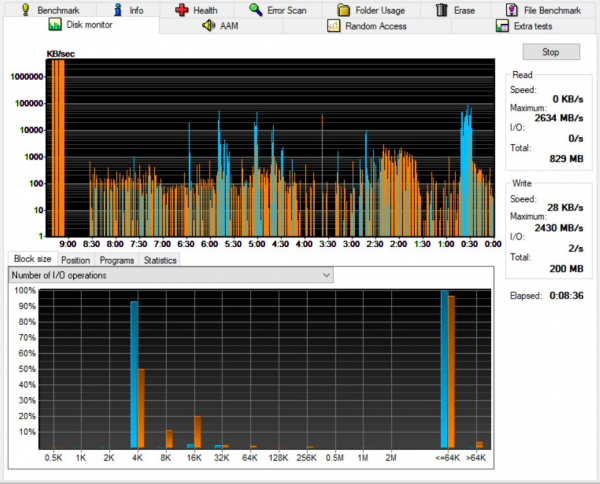
In nearly 10 minutes of work, over 90% of accesses were related to reading files in 4K blocks, and almost half of the writes were in the same blocks. I should note that the swap file in the Windows environment was at the discretion of the system. Overall, the picture shows that for operation, response time in small block operations is more important than speed. Moreover, the volume of these operations is not that large. Naturally, it is worth considering acquiring a fast SSD for gaming (the loading of the games themselves and the speed of writing updates are also important). As an additional note, it is pleasant to achieve high speeds in linear reading/writing when it comes to frequent copying or writing of data.
Conclusions
This is the continuation of the popular KC2000 series, utilizing high-speed memory with firmware optimized for desktop computers. Improvements have been made regarding both sequential read and write speeds. The approach to the SLC cache has been revised to offer more degrees of freedom and adjustments for various scenarios. As a bonus, Kingston continues to provide customers with a 5-year warranty and support for 256-bit XTS-AES encryption.
For more information about Kingston Technology products, please visit of the company.
Source: habr.com
