

Traditionally, enterprise IT systems were designed to automate and support specific systems such as ERP. Today, organizations face different challenges—those of digitization and digital transformation. Achieving this with the old IT architecture is difficult. Digital transformation is a serious challenge.
What should the program for transforming IT systems for the purpose of digital business transformation be based on?

The right IT infrastructure is key to success.
As modern solutions for data center infrastructure, vendors offer various traditional, converged, and hyper-converged systems, as well as cloud platforms. They help companies maintain competitiveness, better leverage the potential of collected data, and bring new products and services to market faster.
The change in the IT landscape is also driven by the implementation of artificial intelligence and machine learning technologies, the Internet of Things, big data, and cloud services.
Survey results indicate that within the next two years, 72% of organizations will implement digital transformation strategies. The number of devices will increase by 40% by 2020, reaching 50 billion. A 53% growth in the adoption of artificial intelligence and cognitive technologies is expected, and 56% of companies will use blockchain by 2020.
According to IDC analysts, by 2020, at least 55% of organizations will be focused on digital transformations, reshaping markets, and changing the future by creating new business models and digital components for products and services.
By 2020, 80% of organizations will establish data management and monetization capabilities, thereby expanding their potential, strengthening competitiveness, and creating new revenue streams.
By 2021, leading intra-industry value chains will expand their digital platforms across the entire multichannel ecosystem through the implementation of blockchain, thereby reducing transaction costs by 35%.
At the same time, 49% of organizations are strictly limited in budgets, 52% need more productive technological platforms, and 39% want to work with more reliable partners (The Wall Street Journal, CIO Blog).
One of the key drivers of digital transformation is blockchain technology. In particular, according to IDC's forecast, by 2021 around 30% of manufacturers and retailers worldwide will establish digital trust based on blockchain services, enabling collaborative and allowing consumers to learn about the history of product creation.
Since all participants in the chain are verified and identified, blockchain is well-suited for environments with high security requirements, such as banks. Some of them have already integrated blockchain into their digital transformation strategies. For example, Lenovo is working on creating a digital identification system that will be used by government entities and commercial banks and is implementing new blockchain platforms.
From hype to reality
Blockchain is transitioning today from hype to a real business tool. The transparency of business processes increases the trust of their participants, which impacts business efficiency. It is no coincidence that the largest companies in the world are adopting blockchain. For instance, Amazon Web Services offers blockchain tools for companies that want to use distributed systems but do not wish to develop them on their own. Among their clients are Change Healthcare, managing payments between hospitals, insurance companies, and patients, software provider Workday, and clearing company DTCC.
Microsoft Azure launched Azure Blockchain Workbench last year — a tool for developing blockchain applications. Among the users are Insurwave, Webjet, Xbox, Bühler, Interswitch, 3M, and Nasdaq.
Nestle has tested blockchain in more than ten projects. The most promising joint project is with IBM Food Trust, where blockchain is used to trace the origin of ingredients for several products, including Gerber baby food. The service is expected to be available in Europe by the end of this year.
BP invests in blockchain to enhance the efficiency of commodity trading. The oil company is one of the founders of Vakt, a blockchain platform aimed at digitizing contract creation and invoicing. BP has invested over $20 million in blockchain projects.
BBVA, the second largest bank in Spain, announced its first blockchain-based loan in a deal with the power grid operator Red Eléctrica Corporación. Citigroup has invested in several startups (Digital Asset Holdings, Axoni, SETL, Cobalt DL, R3, and Symbiont) focused on developing blockchain and distributed ledger technologies for securities settlements, credit swaps, and insurance payouts. Last year, Citi entered into an agreement with Barclays and software infrastructure provider CLS to launch LedgerConnect — an app store where companies can purchase blockchain tools.
The ambitious project of Swiss bank UBS — Utility Settlement Coin (USC) — will allow central banks to use digital money instead of their own currencies to transfer funds among themselves. UBS's partners on the USC include BNY Mellon, Deutsche Bank, and Santander.
And these are just a few examples illustrating the growing interest in blockchain. However, pioneers face challenging tasks.
Smart Transformation
Changing business models requires serious expertise, designing, and implementing a platform that not only digitizes everything but also ensures the effective interaction of deployed solutions. A process of digital transformation initially set 'on the wrong tracks' is very difficult to realign later. This leads to failures and disappointments in the implementation of certain digitization projects.
Over the past few decades, data centers have noticeably evolved, becoming software-defined (SDDC), yet many companies continue to operate legacy data centers, complicating the digitization of such organizations.
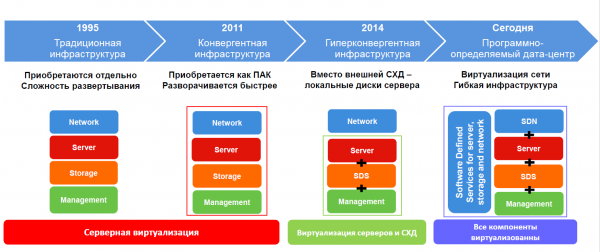
Data Center Transformation: Virtualization and Transition to SDDC.
Lenovo has been producing server equipment and systems for data centers since 2014, inheriting this business from IBM. Today, the company ships 100 servers per hour and ranks among the top four manufacturers of this product globally. It has already released over 20 million servers. Having its own manufacturing capacities helps control product quality and ensure high server reliability (according to the ITIC reliability rating for x86 servers over the past 6 years).
The project discussed below is one example of successful digital transformation. It was implemented using Lenovo equipment at the Central Bank of Azerbaijan. A similar project is being carried out at the Central Bank of Russia, which the use of blockchain in the development of Russia's financial system.
At the Central Bank of Azerbaijan, blockchain technologies were implemented alongside the deployment of a new software-defined IT platform based on Lenovo products.
The first blockchain ecosystem in Azerbaijan
In this project, the regulator intended to build a complete blockchain ecosystem; however, in terms of digital transformation, many banks are not leaders but rather conservatives, accustomed to working in the old ways. The project's complexity was further compounded by the need to create not only a technological foundation for using blockchain but also to amend the legislative and regulatory framework.
Finally, the scale of the project, named 'Personal Identification Systems'. This includes the 'one-stop shop' (public services) service implemented by a special agency, commercial banks checking their clients against various lists, and the Central Bank as the regulator. All this needed to be integrated using blockchain technology with a distributed ledger. Similar projects have already been implemented or are underway in different countries around the world.
At this stage, the pilot phase of the project is concluding. It is planned to launch by the end of 2019. The technological partners are Lenovo and Nutanix, IBM, and Intel. Lenovo developed the software and hardware component. Lenovo and Nutanix, a well-known developer of hyper-converged and cloud platforms, have already gained experience in collaborating on projects in Russia and the CIS.
This solution will be used by various government bodies, such as the Ministry of Justice, the Ministry of Taxes, and others, as well as commercial banks. Today, for example, a client needs to undergo identification in each bank to open accounts in several of them. Now, a digital signature stored on the blockchain will be used, and the organization requesting the document from the individual or legal entity will receive it during the electronic transaction. To open an account, the bank client will not even need to leave their home.
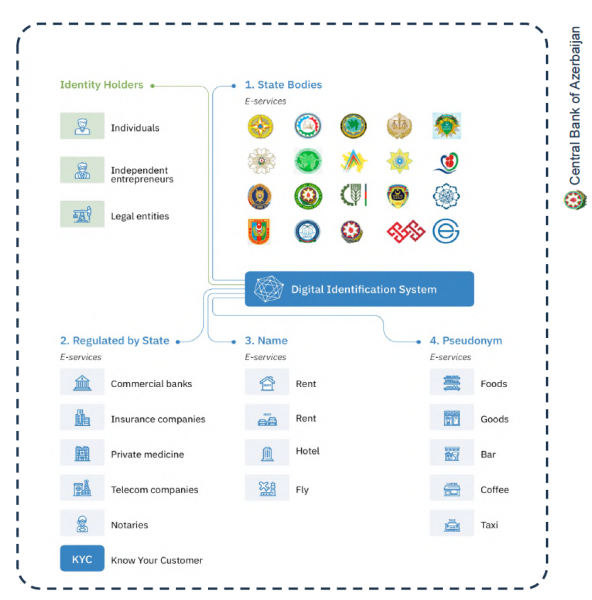
Ecosystem participants using the digital identification system.
In the future, the project is planned to expand, particularly by connecting video identification services, integrating various financial platforms and international databases into public services.
"This project effectively covers the entire range of public services in the country," says Rasim Bakshi, business development manager for hyper-converged infrastructure solutions at Lenovo in the CIS countries. "Its software-hardware platform consists of four-processor servers from Lenovo with Nutanix software. These cutting-edge solutions debuted in this project during their announcement at the SAP conference in 2018. Given the tight deadlines for project implementation and client requests, they were put into production three months ahead of schedule."
Three such high-performance servers in one rack can handle the growth of load over the next five years.
Nutanix has already been involved in similar large-scale projects; for example, its software was used in the well-known Russian transport flow control system "Platon." It allows for effective hardware platform utilization and replaces traditional storage systems, while computational resources are divided into separate server blocks.
As a result, a high-performance and compact solution is obtained, taking up little space in the data center, significantly increasing the return on investment.
Expected Results
The project envisions developing blockchain infrastructure among financial institutions, creating a digital transformation plan, and establishing a digital identification system based on .
This project aims to implement the following digital services on the blockchain:
- Opening bank accounts for individuals and legal entities.
- Submitting loan applications.
- Signing digital contracts between clients and the bank.
- Client video identification service.
- Other banking and insurance services.
The identification process will closely follow W3C standards and the principles of decentralized identification by W3C, comply with GDPR requirements, and ensure data protection against fraud and forgery.
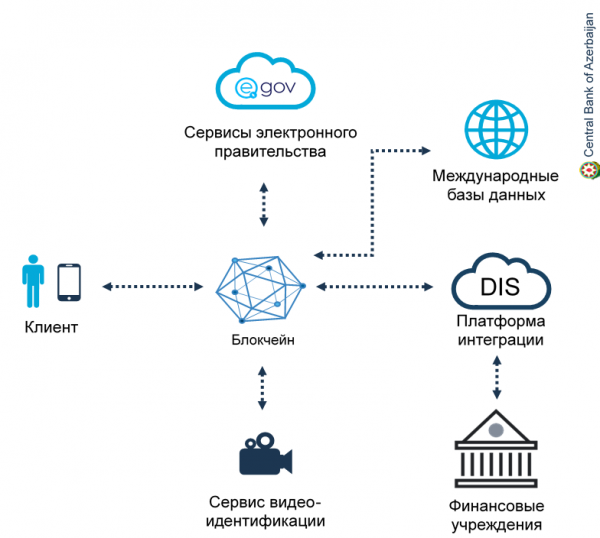
The digital identification system — trusted identity under control.
The project also envisions integration with current identification services used by the Central Bank of Azerbaijan, such as video identification, fingerprint scanning, next-generation personal ID cards, and integration with banking systems and e-government services. Future integration with new technologies and systems is planned.
Solution Architecture
The solution utilizes the Lenovo ThinkAgile HX7820 Appliance hardware-software complex powered by Intel Xeon (Skylake) processors, with Acropolis from Nutanix selected as the virtualization platform.
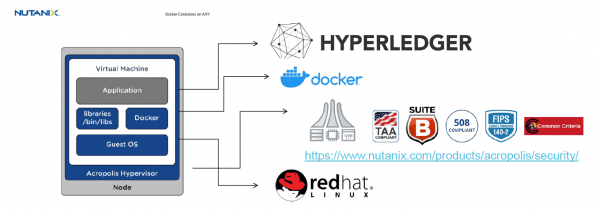
The hardware and software architectures of the project.
The solution is based on primary and backup facilities. The primary facility features a three-node cluster of Lenovo hx7820 servers with Nutanix AOS ULT/AHV/Prism PRO+, Red Hat OS Docker, Hyperledger Fabric, and applications from IBM and independent developers. It also includes a NE2572 RackSwitch G7028 network switch and UPS.
The backup facilities use two-node clusters based on Lenovo ROBO hx1320 hardware and Nutanix AOS ULT/AHV/Prism PRO software, along with Red Hat OS and applications from IBM and independent developers. It also includes a NE2572 RackSwitch G7028 network switch and UPS.
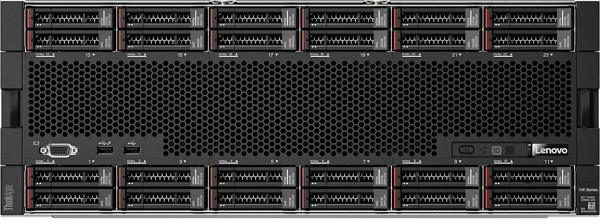
Lenovo ThinkAgile HX7820 platforms with pre-installed hyper-converged software Nutanix Acropolis are a scalable complex proven in industrial environments with simplified management and support from ThinkAgile Advantage Single Point. The first four-processor Lenovo HX7820 platforms were delivered for the blockchain project at the Central Bank of Azerbaijan.
A blockchain project based on Nutanix Acropolis in Baku for the 'Personal Identification System' integrates multiple banking registries, enabling financial organizations to create scalable distributed solutions based on Lenovo-Nutanix infrastructure for real-time operations management, such as online account opening, etc. This platform is also planned to be used for providing cloud services Blockchain-as-a-Service.
Such a platform accelerates deployment by 85%, occupies one-third less space in the data center compared to traditional systems, and reduces administrative overhead by 57% due to simpler and unified management (ESG data).
It is noteworthy that Lenovo is applying blockchain technology in its own business processes. Specifically, the company will use the technology to monitor the supply chains of hardware and software used in its data centers.
Blockchain technology will also be one of the components that IBM will integrate into Lenovo's customer systems under an agreement with the vendor, including a Virtual Assistant for technical support, an enhanced Client Insight Portal personalization tool, and augmented reality technology.
In February 2018, Lenovo filed a patent application with the U.S. Patent and Trademark Office for a physical document integrity verification system using 'security blockchain'.
Lenovo is also collaborating with Intel to create solutions based on Intel Select Solutions for Blockchain: Hyperledger Fabric. This blockchain solution will be based on Lenovo's portfolio of server, networking, and software products for data centers.
Blockchain is the key technology for the financial market in the 21st century. Business leaders and politicians in Russia and around the world refer to it as the 'new internet' due to its universal and much more convenient way of storing information and executing transactions. Additionally, it offers significant resource savings and increased reliability. The course taken by several countries, including the Russian government, towards the 'fourth industrial revolution' implies the adaptation and development of key technologies. Choosing the right technological foundation is crucial for the success of such initiatives.
Source: habr.com
