

Companies often face the need to install new, more powerful equipment in existing facilities. Sometimes, solving this task can be challenging, but there are standard approaches that can help. Today, we will discuss these using the example of the Mediatek data center.
MediaTek, a globally renowned microelectronics manufacturer, decided to build a new data center at its headquarters. As usual, the project needed to be completed quickly, while also ensuring compatibility with all existing equipment. Additionally, the power and cooling systems had to be initially adapted to the conditions of the building where the new data center was to begin operations.
The CIO of the company requested automation and monitoring technologies for the data center, and the client welcomed the introduction of energy-efficient solutions in cooling and power supply. This meant that an additional budget was allocated for these technologies, which allowed for the creation of a truly high-performance data center under the specified conditions.
High Load
Before starting the project, it was important to study the features of the equipment being deployed, which was indeed powerful. The new data center was planned to accommodate 80 racks, with some expected to handle loads of 25 kW.
Simulation of load placement and analysis of possible cooling schemes were conducted, after which it was decided to divide the data center into functional zones. The high-load zone, where the most powerful equipment was located, was separated, and it was decided to install the most powerful and technologically advanced systems, including RowCool in-row cooling systems, for cooling and power supply.
The medium-density zone, which mainly contained network switching equipment, storage systems, and auxiliary servers, was also located separately. Given the lower power output of the racks, it was possible to create a longer 'hot aisle' here, thus saving usable space.
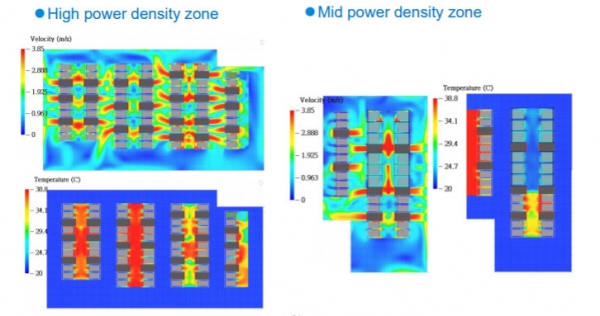
We simulated air movement and assessed the allowable temperature parameters for both zones, calculated the equipment power requirements, and determined the acceptable dimensions for corridors, as well as the equipment placement parameters in the racks.
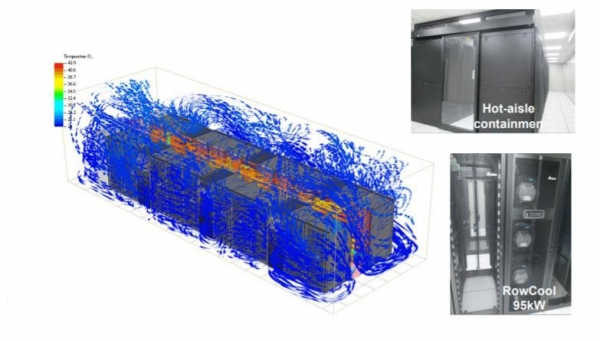
The air movement simulation helped identify optimal points for placing the RowCool in-row air conditioners, ensuring that the combined use of active cooling and hot and cold aisle containment maximized effectiveness.
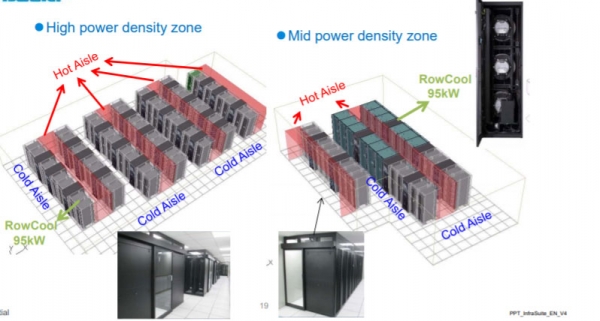
Modular load distribution systems were designed and installed for both zones. As a result, the high-load zone received shorter corridors and a greater number of RowCool air conditioners compared to the medium-load zone.
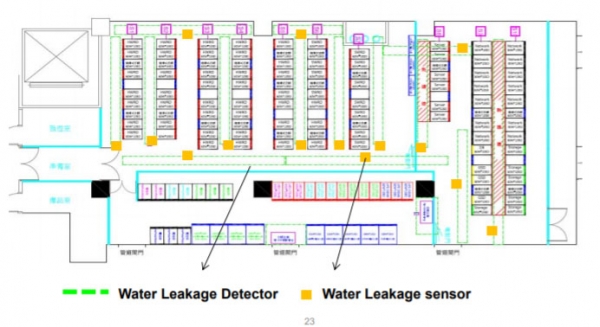
RowCool air conditioners were connected to chillers using a water cooling system. To ensure the safety of this system, dozens of sensors were installed in the data center, and leakage detection areas were defined. If even a single drop of water appears, the system immediately issues a notification and helps rectify the situation.
Furthermore, RowCool air conditioners located in the high-load zone are grouped, with autonomous interaction configured between them. This is done so that if one air conditioner fails, the others can increase their operation to provide sufficient cooling, taking into account the operation of the cold aisle while the faulty unit is being repaired or replaced. For this purpose, the in-row air conditioners are also configured in an N+1 arrangement.
UPS and power distribution
Drawing on proven practices, we placed backup batteries and UPS systems in a separate zone to prevent airflow mixing and to ensure that cooling systems do not lose capacity under loads that do not require additional cooling.
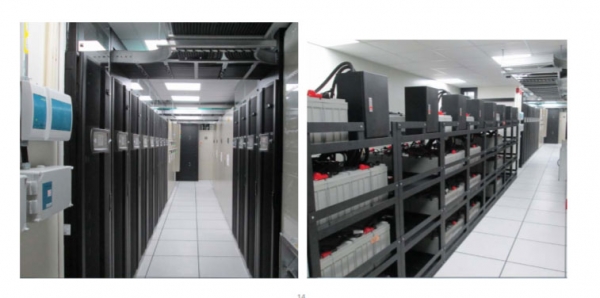
Considering that the total power of the data center exceeds 1500 kW, the power infrastructure and UPS area had to be designed with special care. Modular UPS units were installed with N+1 redundancy, and each rack was supplied with ring power—meaning at least two power cables. The monitoring system simultaneously tracked energy consumption, voltage, and current to instantly catch any abnormal changes.
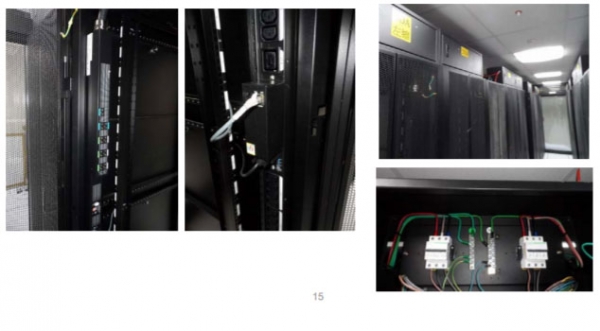
In the high-load area, power distribution units (PDUs) were installed at the back of the Delta racks, with additional 60A distribution modules placed above them.
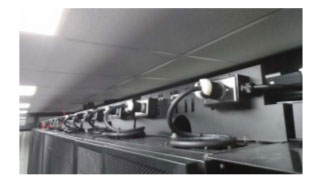
In the medium-load area, it was possible to use distribution units installed above the racks. This approach allowed cost savings without compromising quality.
Management and DCIM
In the new data center, equipment operation management systems were implemented. Through the DCIM InfraSuite system, all equipment and its location in the data center can be tracked, along with all power parameters for each individual rack.
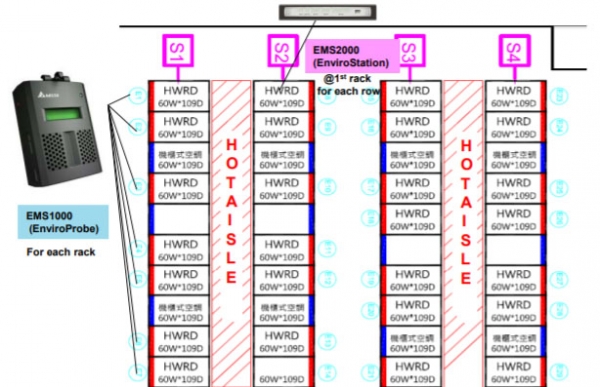
Each rack was also fitted with an EnviroProbe sensor, with data collected at EnviroStation hubs for each row and sent to the central management server. This enables data center operators to continuously monitor air temperature and humidity parameters in each rack.
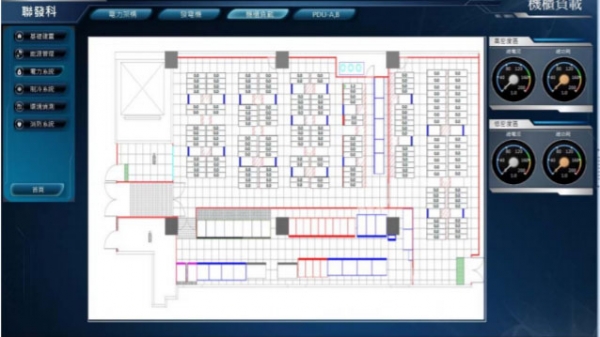
In addition to monitoring power, the InfraSuite system also allows for data center capacity planning since it contains data on the number and power of installed equipment. Engineers can plan for the installation of new servers or switching systems while redistributing power through intelligent PDU cabinets.
Conclusion
The practice of building a data center for MediaTek was interesting because we had to accommodate a lot of high-performance loads in a relatively small area. Instead of distributing it throughout the room, it turned out to be more effective to allocate high-powered servers to a separate zone and establish more powerful and technologically advanced cooling there.
The comprehensive monitoring and management system allows for constant oversight of energy consumption in high-power servers, while redundant cooling and power supply elements help prevent downtime, even in case of equipment failure. Such data centers are essential for the critical business processes of modern companies.
Only registered users can participate in the survey. , please.
Do you use redundancy in your data center?
Yes, we also use N+1 air conditioners.
We also have N+1 UPS systems.
We've even implemented stronger redundancy measures.
No, we do not use redundancy.
9 users voted. 6 users abstained.
Source: habr.com
