

Reading MongoDB licenses might seem harmless to change, unless you are a 'big and cool cloud solutions provider.'
However, I must disappoint you: the consequences for you will be much more serious and worse than you might think.
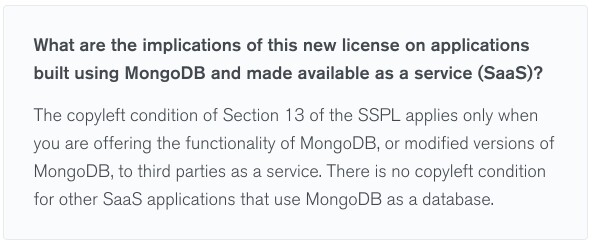
Image translation
What is the impact of the new license on applications built using MongoDB and offered as a service (SaaS)?
The copyleft condition in Section 13 of the SSPL applies only when you offer MongoDB functionality or modified versions of MongoDB to third parties as a service. For other SaaS applications using MongoDB as a database, there is no copyleft condition.
MongoDB has always been an 'uncompromising open source company.' While the world (GPL) to permissive licenses (MIT, BSD, Apache), MongoDB chose AGPL for its MongoDB Server Software—a version of GPL that is even more restrictive.
After reading MongoDB used to apply for its IPO, you will see that the focus is on the freemium model. This is achieved by mutilating the Community Server version rather than supporting the values of the open-source developer community.
In his 2019 interview, MongoDB CEO Dev Ittycheria confirmed that MongoDB Inc. does not intend to collaborate with the open-source developer community to improve MongoDB, as they focus on their freemium strategy:
"MongoDB was created by MongoDB. There were no pre-existing solutions. We did not open-source it to get help; we opened it as part of our freemium strategy,"
– Dev Ittycheria, CEO of MongoDB.
In October 2018, MongoDB changed its license to SSPL (Server Side Public License). This was done suddenly and unfriendly towards the open-source developer community, where upcoming license changes are announced in advance to allow those who cannot use the new license for any reason to plan and transition to other software.
What is SSPL really, and why might it affect you?
The SSPL license terms require anyone offering MongoDB as a DBaaS to either release all surrounding infrastructure under the SSPL or obtain a commercial license from MongoDB. For cloud solution providers, the former is impractical, as direct licensing of MongoDB allows MongoDB Inc. to exert significant control over pricing for end users, leading to a lack of real competition.
As DBaaS becomes the dominant form of database software usage, such reliance on the provider poses a serious concern!
You might think: "It's not a big deal: MongoDB Atlas isn't that expensive." Indeed, it may be so… but only for now.
MongoDB is NOT yet profitable, as it reported losses exceeding $175 million last year. Currently, MongoDB is heavily investing in growth. This means, among other things, maintaining reasonably low prices. However, global companies must eventually become profitable, and in the absence of competition, you'll have to pay for it.
Concerns go beyond profitability. The overall scenario of "winner takes all," which entails capturing a dominant market share at any cost, suggests price increases until it is no longer feasible (and even beyond!).
In the database world, this game was successfully played years ago by Oracle, which saved people from being tied to the hardware of the "blue giant" (IBM). Oracle's software was available on various hardware and was initially offered at a reasonable price… then it became a curse for IT directors and CFOs worldwide.
Today, MongoDB is playing the same game, only at an accelerated pace. My friend and colleague Matt Yonkovit recently asked: "Is MongoDB the new Oracle?" and I am quite certain, at least from this perspective, that it is.
In conclusion, I want to emphasize that the SSPL does not only affect a handful of cloud vendors who cannot directly compete with MongoDB in the DBaaS space. The SSPL impacts all MongoDB users by imposing vendor lock-in and the risk of excessively high prices in the future.
Source: habr.com
