

Hello Habr.
It's already the 21st century, and it seems that data can be transmitted in HD quality even to Mars. However, there are still many interesting devices operating in the radio spectrum, and one can hear quite a few fascinating signals.
It’s not possible to review all of them, of course, so we will try to select the most interesting ones, which can be received and decoded independently using a computer. For receiving signals, we will use a Dutch online receiver , the MultiPSK decoder, and the Virtual Audio Cable program.
For convenience, we will present the signals in increasing frequency order. I won't consider broadcasting stations; that's boring and trivial, and anyone interested can listen to Radio China in AM by themselves. Instead, we will move on to more intriguing signals.
Time signals
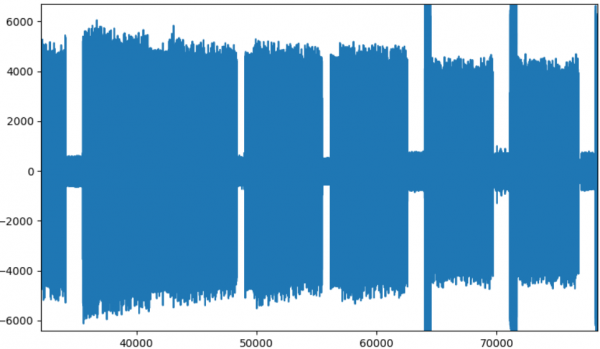
At a frequency of 77.5 kHz (longwave band), precise time signals are transmitted by the German station DCF77. There has already been information on this , so I can only briefly repeat that this is a simple amplitude-modulated signal where '1's and '0's are encoded with varying durations; as a result, a 58-bit code is received in one minute.
130-140 kHz - telemetry of electric networks
At these frequencies, if we believe , control signals of the electric networks in Germany are transmitted.
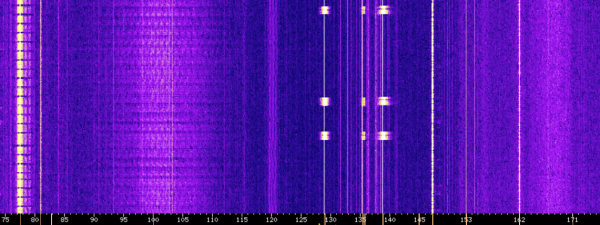
The signal is strong enough, and according to reports, it can even be received in Australia. It can be decoded in MultiPSK if the parameters are set as shown in the screenshot.
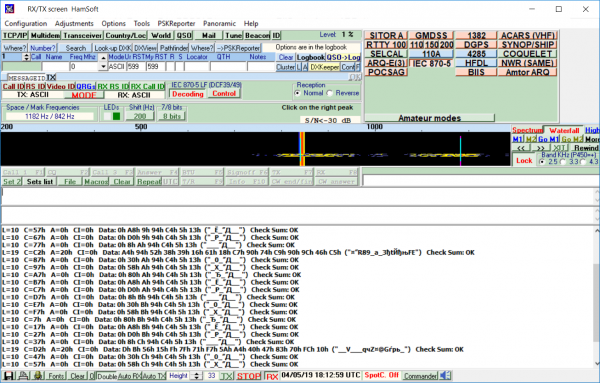
At the output, we will receive data packets; their structure is, of course, unknown, and those interested can experiment and analyze it in their spare time. Technically, the signal itself is very simple; the method is known as FSK (Frequency Shift Keying) and involves forming a bit sequence by changing the transmission frequency. The same signal, in the form of a spectrum — the bits can even be counted manually.

Weather teletype
In the spectrum above, quite close by, at a frequency of 147 kHz, another signal is visible. This is from the (also German) station DWD (Deutscher Wetterdienst), which transmits weather updates for ships. In addition to this frequency, signals are also transmitted at 11039 and 14467 kHz.
The decoding result is shown in the screenshot.
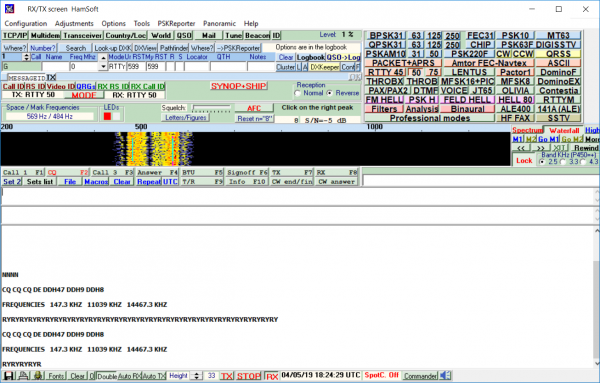
The telegraph encoding principle is the same, FSK, with an interesting aspect being the text encoding. It is 5-bit, using the , and has an almost 100-year history.
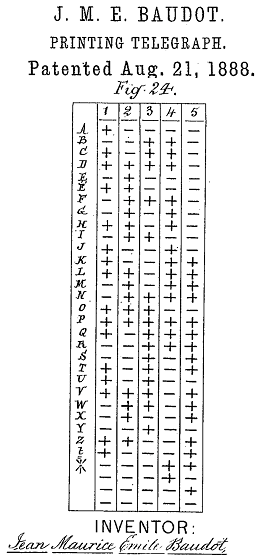
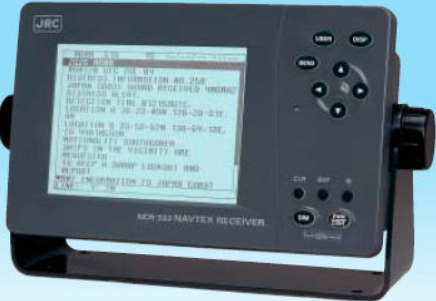
It seems that a similar code was also used in perforated tapes, while teletype messages have been sent since the 1960s and, as we can see, still work to this day. Of course, on a real ship, signals are not decoded using a computer—there are special receivers that record the signal and display it on the screen.
In general, even with satellite communications and the Internet, transmitting data this way remains a simple, reliable, and inexpensive method. Although one can assume that someday these systems will also fade into history and be replaced completely by digital services. Therefore, those wishing to receive such signals shouldn't delay too much.
Meteor Fax
Another legacy signal with a similarly long history. In this signal, images are transmitted in analog format at a speed of 120 lines per minute (other values exist, such as 60 or 240 LPM). Frequency modulation is used to encode brightness—each point's brightness is proportional to the change in frequency. This simple scheme allowed images to be transmitted back when few had ever heard of 'digital signals.'
Popular in the European region and convenient for reception is the previously mentioned German station DWD (Deutsche Wetterdienst), transmitting messages at frequencies of 3855, 7880, and 13882 kHz. Another organization whose faxes are easy to receive is the British Joint Operational Meteorology and Oceanography Centre, transmitting signals at frequencies of 2618, 4610, 6834, 8040, 11086, 12390, and 18261 kHz.
To receive HF Fax signals, you need to use the USB receiver mode, and for decoding, you can use MultiPSK. The reception result via a websdr receiver is shown in the image:
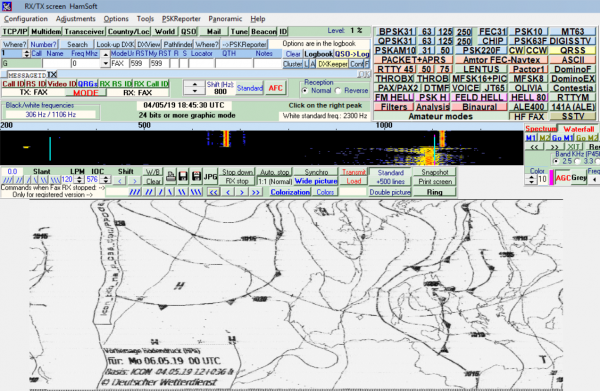
This image was received while writing the text. It’s worth noting that the vertical lines have shifted—the protocol is analog, and synchronization accuracy is critical; even slight audio delays cause image shifts. Using a 'real' receiver will not cause such an effect.
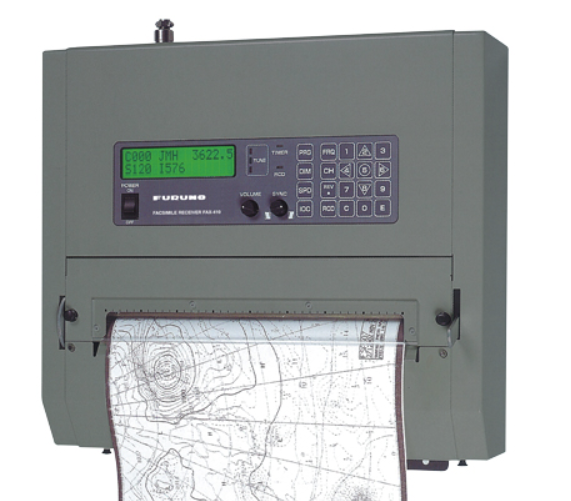
Of course, as with the meteor teletype, no one on ships decodes faxes using a computer—there are specialized receivers (an example image from the beginning of the article) that handle all the work automatically.
STANAG 4285
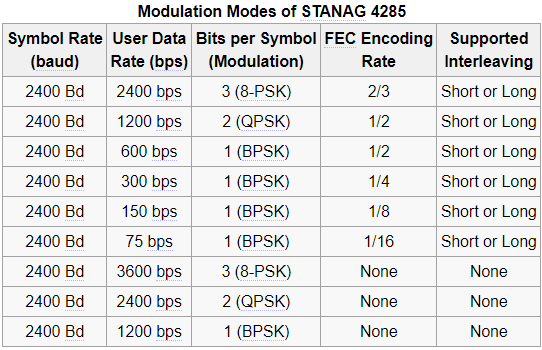
Now let's consider a more modern data transmission standard for short waves — the Stanag 4285 modem. This format was developed for NATO and exists in various versions. It is based on phase modulation, and the signal parameters can vary; as seen in the table, the speed can range from 75 to 2400 bits/s. This may seem low, but considering the transmission environment — short waves, with their fading and interference — it is quite a good result.
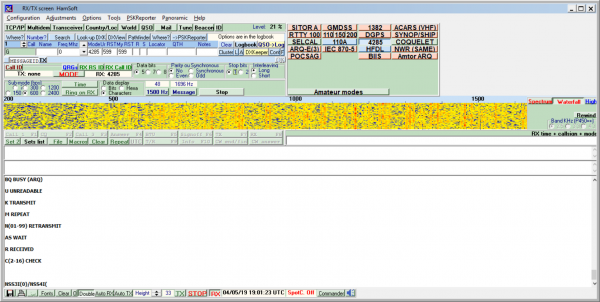
The MultiPSK program can decode STANAG, but in 95% of cases, the result of decoding will be just 'garbage' — the format provides only a bit-level lower-level protocol, and the actual data may be encrypted or have its own format. Some signals, however, can be decoded; for example, the recording below at a frequency of 8453 kHz. I was unable to decode any signal through the websdr receiver, apparently, online transmission disrupts the data structure. Those interested can download a file from a real receiver via the link . The decoding results in MultiPSK are shown in the screenshot below. As you can see, the speed for this recording is 600 bps, and the content appears to be a text file.
Interestingly, as can be seen on the panorama, there are actually a lot of such signals in the air:
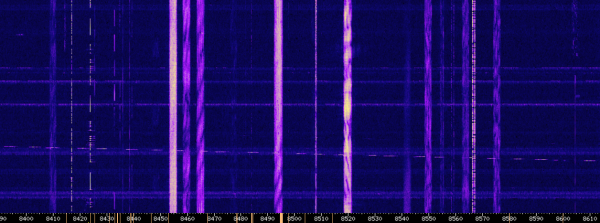
Of course, not all of them may belong to STANAG — similar principles exist for other protocols. For example, let's analyze the signal .
As with the other signals discussed, specialized devices are used for actual reception and transmission. For example, for the modem shown in the photo a speed of 75 to 9600 bps is claimed with a signal bandwidth of 3 kHz.
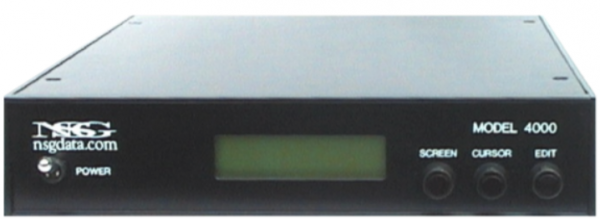
A speed of 9600, of course, is not very impressive, but considering that signals can be transmitted even from jungles or from a ship in the ocean, and without paying traffic fees to the communication operator, it’s not so bad.
By the way, let's take a closer look at the panorama above. On the left, we see... that's right, the old good Morse code. So, let's move on to the next signal.
Morse Code (CW)
At a frequency of 8423 kHz, we are hearing it. The art of listening to Morse code is nearly lost, so we will use MultiPSK (though it decodes somewhat poorly, the CW Skimmer performs much better).
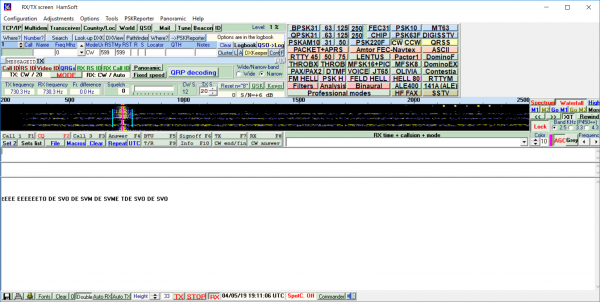
As can be seen, a repeating text DE SVO is transmitted, if we are to believe , the station is located in Greece.
Of course, there are few such signals now, but they still exist. For example, there is a long-operating station at 4331 kHz sending repeating signals “VVV DE E4X4XZ”. As Google suggests, the station belongs to the Israeli Navy. Is anything else transmitted at this frequency? The answer is unknown; those interested can listen and check for themselves.
The Buzzer (UVB-76)
Completing our top is probably the most well-known signal — recognized both in Russia and beyond, the signal at a frequency of 4625 kHz.
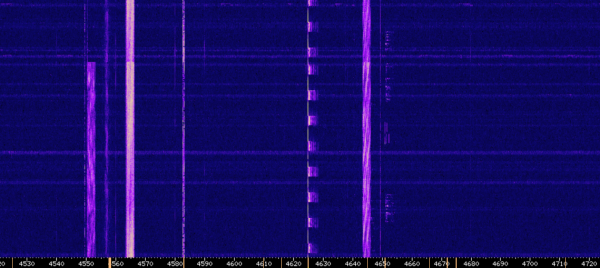
The signal is used to alert troops and consists of repeated beeps, between which coded phrases from a code notebook are sometimes transmitted (abstract words like “KROLIST” or “BRAMIRKA”). Some claim to have seen such receivers in military enlistment offices, while others say it is part of the ‘dead hand’ system; in general, the signal is a mecca for fans of Stalker, conspiracy theories, the ‘Cold War,’ and so on. Interested parties can search for ‘UVB-76’, and I am sure an engaging read for the evening is guaranteed (although one shouldn’t take everything written too seriously). At the same time, the system is quite interesting, if only because it has been operational since the ‘Cold War,’ though whether anyone needs it now is hard to say.
Completion
This list is far from complete. With a radio receiver, one can hear (or rather see) signals for communication with submarines, over-the-horizon radars, rapidly changing frequency hopping signals, and much more.
Here is, for example, an image taken right now at a frequency of 8 MHz, on which you can count at least 5 signals of different types.
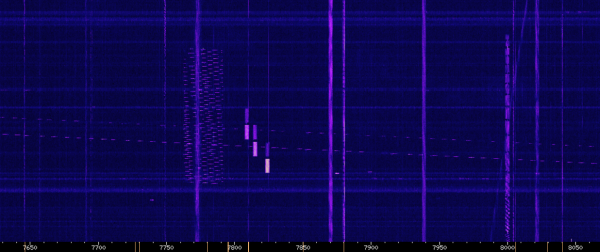
What they represent is often unknown; at least in open sources, it’s far from possible to find everything (although there are websites like and Exploring such signals is quite interesting from the perspectives of mathematics, programming, and CSS, as well as simply as a way to learn something new about the surrounding world.
It's also interesting that despite the development of the Internet and communications, radio not only maintains its position but perhaps even strengthens it—the ability to transmit data directly from sender to receiver, without censorship, traffic control, or packet tracking, could become (though let's hope it doesn't) relevant once again...
Source: habr.com
