

Content
In this article, I want to talk about the fundamental factors in building a quality wireless bridge, as many "network builders" believe that it is enough to buy quality networking equipment, install it, and get 100% performance from it — which, in the end, not everyone achieves.
CCQ — what is it?
CCQ (Client Connection Quality) translates from English as "the quality of client connection" — which basically shows the percentage ratio of theoretically possible to the currently available bandwidth of the channel, in other words, the percentage of achieved bandwidth compared to the maximum possible on specific equipment.
For example, if you are using equipment with a maximum possible bandwidth of 200 Mbps, but the current channel is 100 Mbps — in this case, CCQ equals 50%.
In networking equipment and there are two separate indicators
Tx. CCQ (Transmit CCQ) — data transmission rate.
Rx. CCQ (Receive CCQ) — data reception rate.
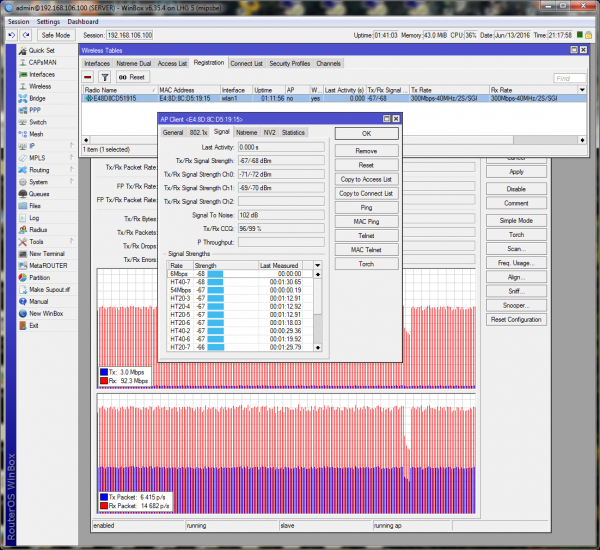
Three main factors affecting the quality of CCQ
1. Alignment of the two antennas. When speaking of a "point-to-point" wireless bridge, it is clear that the antennas must be aimed at each other as accurately as possible, "eye to eye."
If a Wi-Fi bridge is needed for "point-to-multipoint" — you must initially plan the entire architecture from the provider's sector antenna to the client antennas so that they intersect as accurately as possible.
2. Presence of noise in the channel. Before deciding on the frequency of the Wi-Fi bridge, you must check each frequency for noise, and based on this check, choose a less crowded frequency.
3. Fresnel zone.
Fresnel zone — what is it?
The Fresnel zone is the volume of the radio-wave channel between the two antennas.
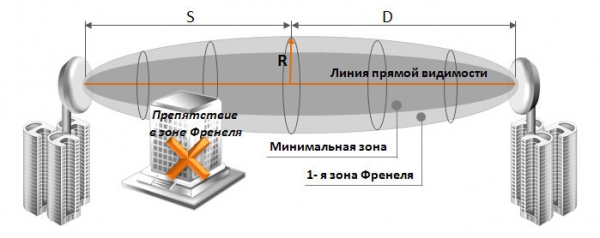
The maximum volume of the channel is located at the central point between the two antennas.
To achieve the best signal quality, you need to select the cleanest zone, free from physical obstacles as well as radio-wave interference (as mentioned in the second point).
How to calculate the Fresnel zone?
The formula for calculating the Fresnel zone at its central point:

D — distance (km)
f — frequency (GHz)
The formula for calculating the Fresnel zone at any point, for example at the location of an obstacle:
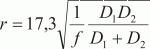
f — frequency (GHz)
D1 — the distance to your desired calculation point from the first antenna (km)
D2 — the distance to your desired calculation point from the second antenna (km)
By carefully considering these three factors, you will ultimately achieve a stable wireless bridge with the highest possible data transmission speed.
Source: habr.com
