

At its annual Microsoft made several quite significant presentations. We selected two of them.
First: in the summer 19H2 build, Windows 10 will feature a full Linux kernel based on for its own 'Windows Subsystem for Linux' (WSL).
Second: in future enterprise builds of the Chromium reincarnation of the defunct Edge browser, an IE core will be integrated.
The first news is important and useful for developers; the second sounds like a bad joke.

We integrated the IE engine into your Chromium browser so you won't forget that it's Edge.
Linux Kernel in Windows 10
Adding a full Linux kernel to Windows 10 is a logical step that continues Microsoft's methodical work with the community. Previously, Windows only offered Linux kernel emulation. Alongside the Linux kernel, the company announced the release of a new application for Windows for centralized access to PowerShell, Cmd, and, of course, the Linux kernel itself within the WSL package.
Company representatives assure that 4.19 is not the last version of the kernel for their subsystem. In the future, WSL will be updated and keep pace with stable Linux kernel releases, which is also important. Furthermore, the integration of a full kernel eliminates the need for emulation, which directly increases performance and comfort for developers working under Windows. Additionally, WSL is based on open source, meaning any developer can make necessary modifications to the subsystem and fork the kernel.
This is not the first major step towards the developer community. Previously, the company which can be considered a significant step for the rather conservative Microsoft.
Microsoft's actions are surprising but no longer shocking: under Satya Nadella's management, the company has effectively penetrated the open-source community and is increasingly focusing on working directly with developers and the enterprise segment, as evidenced by Microsoft's actions over the past 3-4 years.
The Microsoft beast or why the Internet Explorer kernel is in Chromium Edge.
Everyone remembers Internet Explorer with dread, and the old developers still weep over it. When Microsoft announced Spartan and the retirement of IE, people around the world popped champagne, but reality turned out to be harsher than we hoped. There are still solutions, portals, and websites created to work exclusively with old versions of IE. Most of these solutions exist in closed enterprise environments. Microsoft once faced a choice: force companies worldwide to update their internal products and solutions due to the complete abandonment of IE, or fight a losing battle. Since the total abandonment of IE threatened Microsoft with billions in losses and reputational damage, the giant had to drag the compatibility of its browser with pages adapted for Internet Explorer year after year.
Even after the loud abandonment of the EdgeHTML engine and the transition of the development of the 'default browser' for Windows 10 to the Chromium engine, Microsoft cannot escape its dreadful legacy of Internet Explorer.
Therefore, specifically for Enterprise builds of Windows 10, the company will supply a version of Chromium Edge with a 'surprise' – a built-in IE engine within Edge itself. This strange solution will ensure the new browser's compatibility with old corporate solutions that were once recklessly nailed to Internet Explorer.
When opening any page adapted for Internet Explorer in the new Chromium Edge, the browser will automatically activate 'IE compatibility mode' and switch to a display corresponding to that of Internet Explorer 11. You can tell that a page is running in compatibility mode by a special IE icon next to the address bar in the browser window.
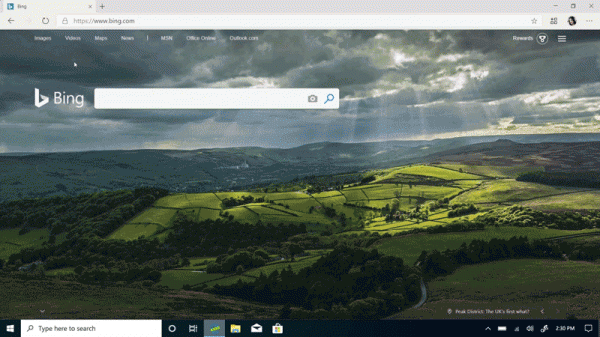
Microsoft itself insists that companies using outdated web portals should switch to the new Chromium Edge and completely abandon the practice of using the combination of IE + any other browser. Of course, any technical expert would say that integrating an outdated engine into a new product is redundant, but in fact, Microsoft is trying to save face and engage in a bit of charity. The question is whether the giant will ever be able to tell businesses 'no' and finally put the 'donkey' to rest. So far, that seems unlikely.
The conference started yesterday, May 6, and will last until the 8th, so Microsoft has at least one more day to impress us even more.
Source: habr.com
