

We continue to introduce you to the hyper-converged system Cisco HyperFlex.
In April 2019, Cisco will once again hold a series of demonstrations of the new hyper-converged solution Cisco HyperFlex in regions of Russia and Kazakhstan. You can register for the demonstration through the feedback form by following the link. Join us!
Previously, we published an article about load tests conducted by the independent laboratory ESG Lab in 2017. In 2018, the specifications of the Cisco HyperFlex solution (version HX 3.0) have significantly improved. Additionally, competitive solutions continue to evolve. That is why we are publishing a new, more recent version of comparative load tests from ESG.
In the summer of 2018, the ESG laboratory conducted a re-comparison of Cisco HyperFlex with its competitors. Considering the modern trend of using software-defined solutions, manufacturers of such platforms were also included in the comparative analysis.
Test Configurations
During testing, HyperFlex was compared with two completely software-based hyper-converged systems, which are installed on standard x86 servers, as well as with one hardware-software solution. The testing was conducted using standard software for hyper-converged systems – HCIBench, which utilizes the Oracle Vdbench tool and automates the testing process. In particular, HCIBench automatically creates virtual machines, coordinates the load between them, and generates convenient and comprehensible reports.
140 virtual machines were created on the cluster (35 per cluster node). Each virtual machine used 4 vCPU and 4 GB of RAM. The local disk of the VM was 16 GB and an additional disk of 40 GB.
The following cluster configurations participated in the testing:
- A cluster of four Cisco HyperFlex 220C nodes with 1 x 400 GB SSD for caching and 6 x 1.2 TB SAS HDD for data;
- A competitor Vendor A cluster of four nodes with 2 x 400 GB SSD for caching and 4 x 1 TB SATA HDD for data;
- A competitor Vendor B cluster of four nodes with 2 x 400 GB SSD for caching and 12 x 1.2 TB SAS HDD for data;
- A competitor Vendor C cluster of four nodes with 4 x 480 GB SSD for caching and 12 x 900 GB SAS HDD for data.
Processors and RAM for all solutions were identical.
Virtual machine count test
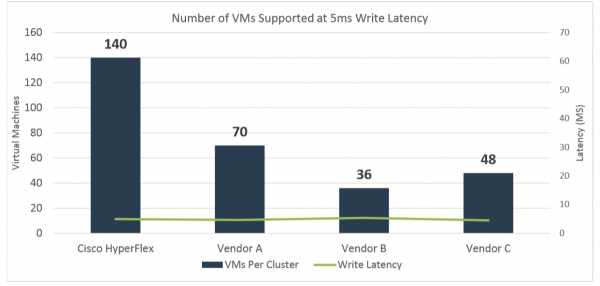
The testing began with a workload designed to emulate a standard OLTP test: a read/write (RW) ratio of 70%/30%, 100% FullRandom, aiming for 800 IOPS per virtual machine (VM). The test was conducted on 140 VMs in each cluster over three to four hours. The goal of the test was to maintain write latencies at a maximum of 5 milliseconds or below across the highest number of VMs.
As a result of the test (see the chart below), HyperFlex was the only platform that completed this test with the initial 140 VMs while maintaining latencies below 5 ms (4.95 ms). For each of the other clusters, the test was restarted to iteratively adjust the number of VMs to meet the targeted latency of 5 ms.
Vendor A successfully managed 70 VMs with an average response time of 4.65 ms.
Vendor B achieved the required latency of 5.37 ms with only 36 VMs.
Vendor C was able to handle 48 virtual machines with a response time of 5.02 ms.
SQL Server Load Emulation
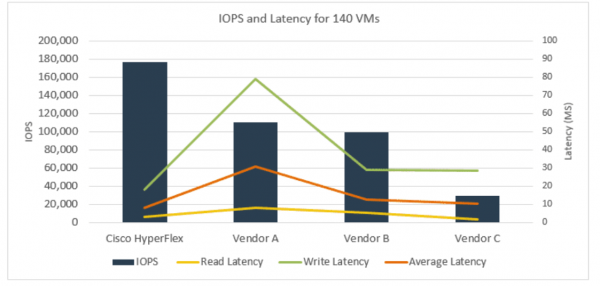
Next, ESG Lab emulated a SQL Server workload. The test used various block sizes and read/write ratios. The test was also run on 140 virtual machines.
As shown in the figure below, the Cisco HyperFlex cluster nearly doubled the IOPS of Vendor A and B, and exceeded Vendor C by more than five times. The average response time for Cisco HyperFlex was 8.2 ms. In comparison, Vendor A's average response time was 30.6 ms, Vendor B's was 12.8 ms, and Vendor C's was 10.33 ms.
An interesting observation was made during all tests. Vendor B exhibited significant variability in average IOPS performance across different VMs. This means that the load was distributed extremely unevenly, with some VMs operating at an average of 1000 IOPS+, while others were at 64 IOPS. In this case, Cisco HyperFlex appeared significantly more stable, with all 140 VMs averaging 600 IOPS from the storage subsystem, indicating that the load among the virtual machines was distributed very evenly.
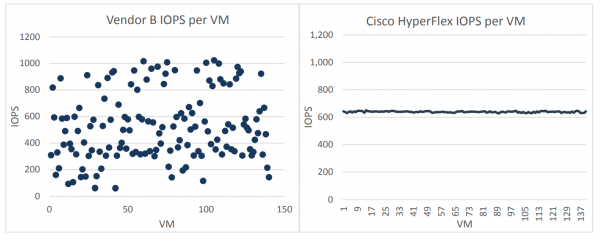
It is important to note that this uneven distribution of IOPS across virtual machines from Vendor B was observed in every iteration of the testing.
In real production, such system behavior can be a significant problem for administrators, as individual virtual machines may start to 'freeze' randomly, and there is practically no way to control this process. The only somewhat effective method for load balancing when using the vendor B solution is the implementation of some form of QoS or load balancing.
Output
Let's consider what having 140 virtual machines on Cisco HyperFlex on one physical node means compared to 70 or fewer on other solutions. For businesses, this means maintaining the same number of applications on Hyperflex requires half the nodes compared to competitor solutions, resulting in a significantly cheaper overall system. When we add the level of automation for all network, server, and HX Data Platform storage operations, it becomes clear why Cisco HyperFlex solutions are rapidly gaining popularity in the market.
Overall, ESG lab confirmed that hybrid Cisco HyperFlex version HX 3.0 delivers higher and more stable performance than other similar solutions.
Moreover, HyperFlex hybrid clusters also outperformed competitors in IOPS and Latency metrics. Importantly, the performance of HyperFlex was achieved with well-distributed load across the entire storage.
Let us remind you that you can see the Cisco Hyperflex solution and verify its capabilities right now. The system is available for demonstration to all interested parties:
Source: habr.com
