

RAID algorithms were introduced to the public back in 1987. To this day, they remain the most sought-after technology for protecting and speeding up data access in the field of information storage. However, the age of this IT technology, which has surpassed the 30-year mark, is not maturity but rather old age. This is due to progress, relentlessly bringing with it new possibilities. In times when there were practically no other storage media besides HDDs, RAID algorithms effectively utilized available storage resources. However, with the emergence of SSDs, the situation has fundamentally changed. Currently, RAID with solid-state drives acts as a 'noose' on their performance. Therefore, to unlock the full potential of SSD speed characteristics, a completely different approach to working with them is essential.

In addition to the obvious differences between HDDs and SSDs in their operating principles, there is another important characteristic of these types of media: any hard drive can overwrite any data with a granularity of one block (most often 4KB today). For SSDs, however, the process of overwriting is a much more complex procedure:
- Modified data is copied to a new location. The granularity is still the same block, but it consists of several pages and is sized between 256KB and 4MB. That is, when changing the same 4KB, it is necessary to also copy all neighboring pages that form a single block.
- 'Old' blocks are marked as unused so they can later be erased by the garbage collector.
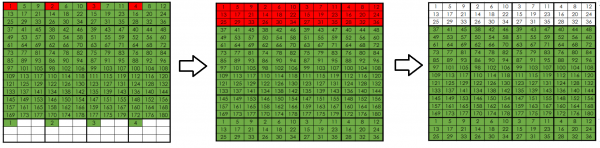
Sequential writing/re-writing on SSDs
In the case of sequential writing/re-writing, this characteristic of SSD operation does not play a significant role in terms of performance, as the blocks are located close to one another and the garbage collector can easily handle its job in the background. However, in real life, especially in the Enterprise segment, SSDs are most often used for random data access. And this data is written to arbitrary locations on the drives.
The more data is written to an SSD, the harder it is for the garbage collector to work, as fragmentation significantly increases. As a result, there comes a time when the cleanup process ceases to be 'background': the performance of the SSD drops significantly, as a noticeable part of it is taken up by the Garbage Collector.
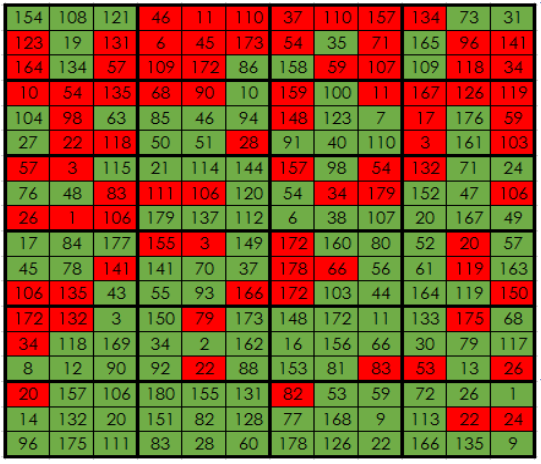
The actual location of data on the SSD during everyday use
To illustrate the effect of the garbage collector's operation depending on the writing mode to the drive, simple tests can be conducted: sequential and random writing in 4KB blocks to a 100GB drive. (Source - company )
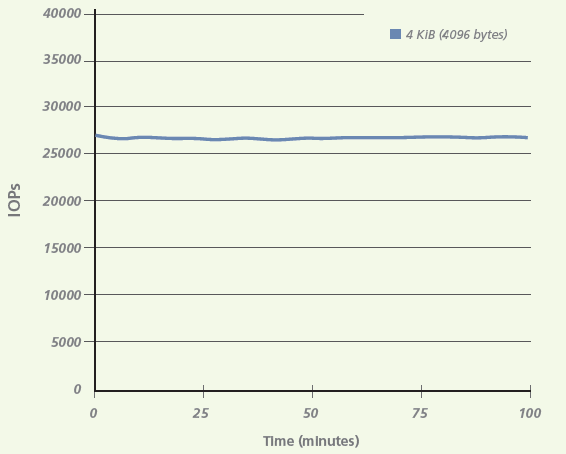
Performance during sequential writing
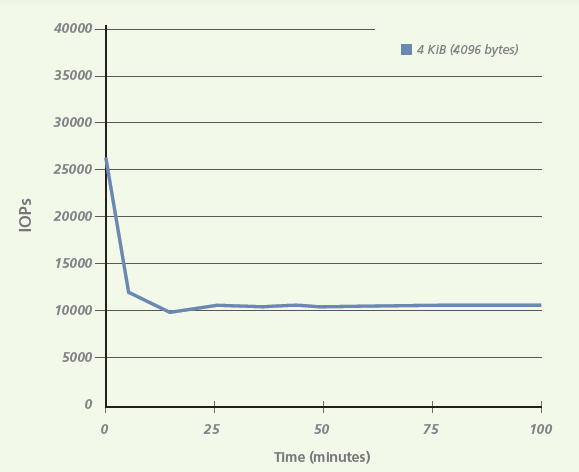
Performance during random writing
As seen from the tests, the performance drop can exceed two times. And this is just a single drive. In the case of using SSDs in a RAID group, the number of write operations greatly increases due to working with parity.
In general, due to these SSD operational features, there is a parameter known as write amplification. This is the ratio of the amount of data written to the drive to the amount of data actually sent by the host. For the most popular RAID5, this ratio is about ~3.5.
As a result, systems with classic RAID at their core utilize SSDs at only about ~10% of their actual speed and scale poorly in performance when the number of drives exceeds a dozen.
It is also noteworthy that excessive write operations not only reduce SSD performance but also diminish its not unlimited resource, thereby shortening the lifespan of the drive.
, which is at the core of all AccelStor products, has been developed as an alternative to traditional RAID algorithms when working with SSDs. The innovativeness of the technology has been recognized through various patents and awards (including at Flash Memory Summit 2016), as well as the results of independent tests (e.g., SPC1).
Essence consists of transforming all incoming write requests, primarily of the random type, into a set of blocks that closely resembles sequential write mode from the storage perspective. As a result, writing on SSDs occurs in the most comfortable mode for them, and the final performance exceeds that of any traditional RAID systems.
All SSDs in AccelStor systems are divided into two symmetric groups, FlexiRemap®. The size of the group depends on the model and ranges from 5 to 11 drives. For redundancy within the group, parity similar to RAID5 is applied. Both groups are used together to form a common storage space. Therefore, the overall fault tolerance will be analogous to a RAID50 array consisting of two groups: the system can withstand the failure of up to two SSDs, but not more than one in each FlexiRemap® group.
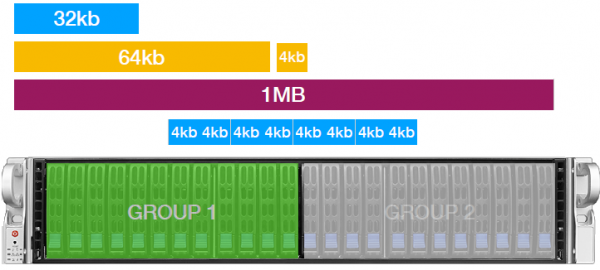
All incoming write requests are split into 4KB blocks, which are written to both FlexiRemap® groups in a round-robin mode. The system continually keeps track of the demand for the written blocks, trying to write similar blocks as closely together as possible when they are modified. This results in a virtual equivalent of tiering, in terms of storage systems. In this case, the garbage collector's job is significantly easier: unused blocks will always be located next to each other.
It should be noted that unlike competitors' products, do not utilize caching functionality for incoming requests in the controller's RAM. All incoming data blocks are immediately written to SSDs. The host receives confirmation of successful write only after the data is physically placed on the drives. Only the block placement tables on SSDs are stored in RAM to speed up access and determine where to write the next data block. Naturally, for reliability, copies of these tables are also located on the drives themselves. As a result, AccelStor systems do not require any cache protection in the form of a battery or capacitor (however, there is an option to connect to an UPS for a 'soft' shutdown in case of power issues).
Thanks to this approach to organizing records, the 'garbage collector' can operate in the background without significantly affecting the speed of storage devices, ultimately allowing the system to utilize up to 90% of SSD performance. This is where the high IOPS ratings in AccelStor systems come from compared to All Flash systems based on RAID algorithms.
Another important feature of FlexiRemap® technology is the significant reduction of unnecessary write operations on SSDs. The write amplification factor for AccelStor systems is only 1.3, which translates to the industry standard as extending the lifespan of storage devices by more than 2.5 times compared to RAID5!
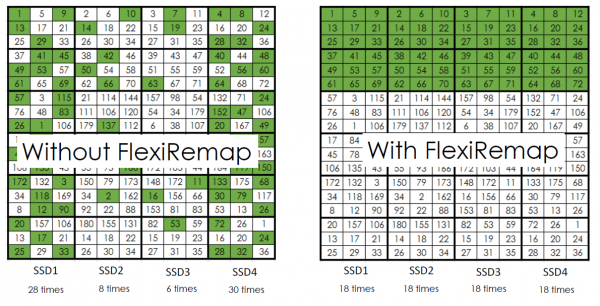
Thanks to the constant monitoring of data placement policies on SSDs by the system, all storage devices wear out uniformly. This approach allows for forecasting their lifespan and sending early warnings to the administrator about reaching write resource limits.
It's clear that SSDs can fail. In such cases, the system will immediately start a rebuild onto one of the hot spare disks. Meanwhile, the FlexiRemap® group, in a degraded state, switches to 'read-only' mode, and all write requests are directed to the second group. This protection mechanism is designed to expedite the rebuild operation and reduce the likelihood of another storage device failing within the same group. It is well-known that during a rebuild, all disks in the group experience increased load due to the interference of read, write, and recovery operations on the hot spare. Consequently, the risk of another disk failure increases. The greater the number of write operations, the longer the rebuild will take.
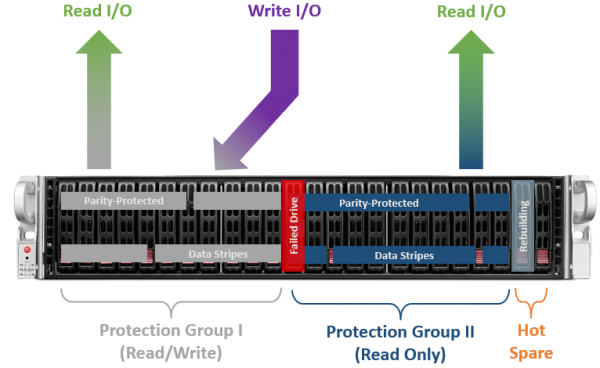
After the recovery process is complete and the FlexiRemap® group returns to normal status, there will be a slight imbalance in write resources between the two groups. Therefore, to balance it out, subsequent write operations will more frequently target the recovered group (of course, ensuring that the overall system performance does not suffer significantly).
Increasing the performance of All Flash systems based on RAID algorithms beyond certain values (~280K IOPS@4K random write) is not possible even with complex caching systems. The FlexiRemap® technology, with its fundamentally different approach to storage organization, not only easily overcomes this barrier but also significantly increases the lifespan of SSDs. Hence, systems have serious advantages among All Flash arrays on many fronts (IOPS/ $, GB/ $, TCO, ROI), making them ideal candidates for key positions in customer data centers to solve resource-intensive tasks.
Source: habr.com
