

In this series of articles, we aim to address the questions people have when working with hosting providers and dedicated servers in particular. Most of the discussions were held on English-language forums, where we tried to help users primarily with advice rather than self-promotion, providing detailed and unbiased answers. After all, our experience in the field spans over 14 years, with hundreds of successful implementations and thousands of satisfied clients. However, our responses should not be taken as the only correct answers; they may contain inaccuracies and even mistakes—no one is perfect. We would appreciate it if you could supplement or correct them in the comments.

Why is the cost of a server with a traffic limit of 100 TB and a 1 Gbps channel much lower than that of a server with a 1 Gbps channel without a traffic limit? After all, if you rent 2-3 servers with a 1 Gbps channel and a 100 TB limit, you can use exactly as much as a server with 1 Gbps Unmetered, or even more during peaks, while the provider essentially offers more hardware, more connections, and a lower price?
The thing is that providers offering servers with a relatively large traffic limit or even "unlimited" for a low price consider the average consumption profiles of their clients. It turns out that most customers who purchase such channels do not fully utilize the connectivity they are provided. This makes such an offer possible.
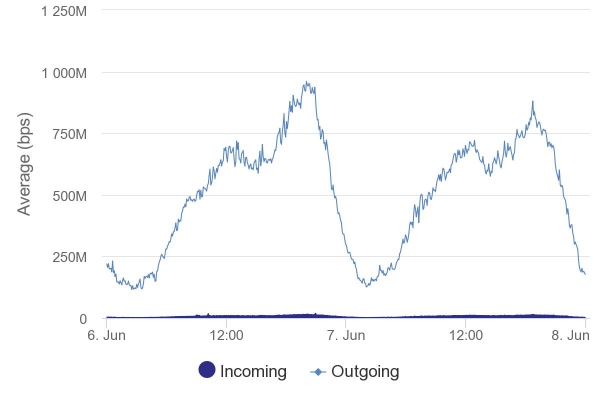
100 TB of traffic is quite a large limit. This is more than 100 Mbps Unmetered. With a 100 Mbps connection, if considering unmetered, you can transfer a maximum of 100 (speed in megabits) * 86400 (number of seconds in a day) * 30 (days) / 8 (bits in bytes) / 1000 (megabytes in gigabytes, if calculated by 1000 instead of 1024, as 1024 is bits in kibibits) = 32,400 GB per month in each direction at a constant 100% channel load. However, as we know, servers do not consume traffic constantly, and often daily consumption curves can look like this:
Some users may peak at maximum bandwidth and require a true 1 Gbps at those moments. Nevertheless, the overall monthly traffic limit may hardly be exceeded:
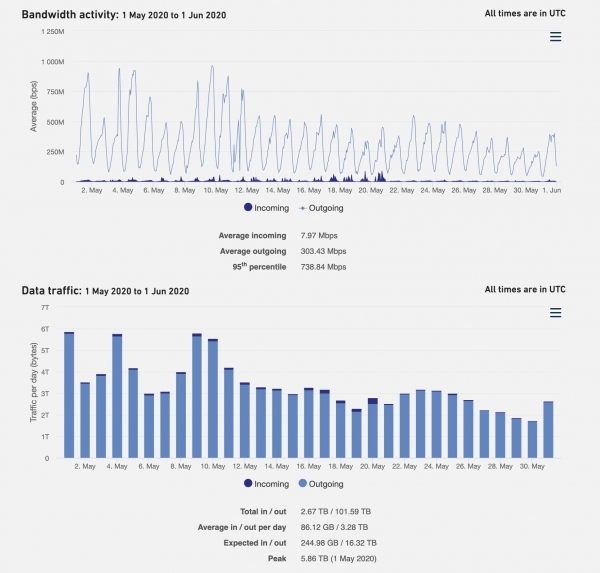
Such clients are certainly not very profitable for providers, and therefore the provider seeks to transition them to Unmetered, because if they serve clients from a single region, it is likely that the consumption peaks will coincide, and this "true" gigabit can only be sold to 1.2 clients. If the provider has clients from different regions, it is quite possible that the channel can be sold to two or more subscribers simultaneously, as the consumption peaks of the audiences will occur at different times. In reality, far from every client consumes their limit of 100 TB, making it very profitable to provide servers with a limit of 100 TB of traffic.
Moreover, by connecting 10 gigabit channels to the racks, we can effectively distribute traffic among all of them. We manage to split a 10 Gbps channel on average among 5 racks filled with servers limited to 100 TB. This is about 150 servers. Since one rack with a height of 47 units can accommodate either 41 one-unit servers or 21 two-unit servers.
As a result, the overall channel consumption looks like this:
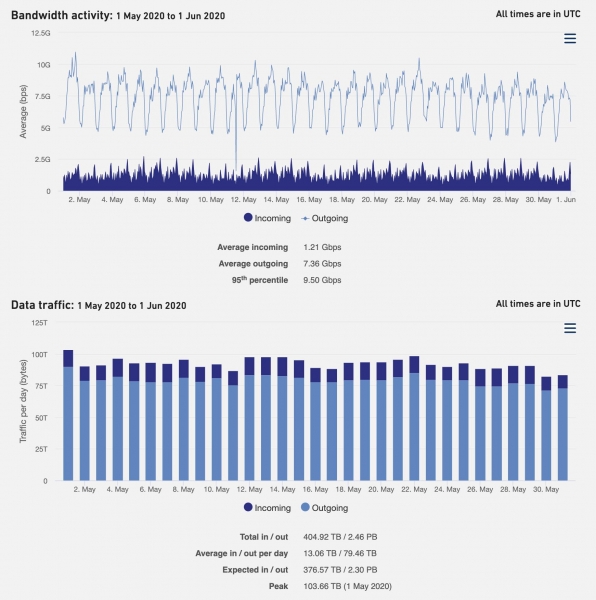
If we refuse service to clients who generate a lot of traffic (the main contribution to the channel load comes from fewer than 10 servers out of 150 present on this port), we can increase the number of servers to 300 or more. Everyone will be satisfied, and there will be enough traffic for all.
However, there are other ways to save and not disappoint subscribers - connect a cheaper transit uplink or send traffic to an exchange point or peer for free if you are a large traffic generator.
This all allows us to maintain low prices while providing service to subscribers, paying transit providers between 1500 and 6000 euros for every 10G, depending on the quality of the transit provider, and selling connectivity below cost with a certain oversell ratio, where each subscriber has their own allocated fair channel without interfering with each other.
It's immediately clear why the price for 1Gbps Unmetered is significantly higher, as not every client with 100 terabyte servers consumes their limit, but a client ordering 1Gbps Unmetered will certainly use a large portion of the channel. Although we have seen the exception mentioned above where nearly 1 Gbps of traffic can be generated during peaks while remaining within the 100 terabyte limit, this is an exception rather than a typical pattern.
My administrator installed the vnstatd program on the server, and traffic is monitored from the interface every 5 minutes. Does it count everything? It shows that 87 TB has been used, while the provider claims 96 TB has been used and that traffic is almost finished. I trust my system administrator; he is an excellent specialist. And if he says that the provider is inflating usage, then it is indeed the case. Moreover, this is evidenced by the fact that different values for traffic for the same period were given during the discussion. We are still awaiting an answer to the question, 'How is this possible?'
The thing is that some traffic accounting programs measure in TiB rather than TB. In tebibytes, not terabytes. This means accounting is done in a binary system rather than a decimal one, based on the fact that a kibibyte — precisely 1024 bytes — instead of 1000.
It is worth noting that to prevent this distinction from being used for marketing purposes, ISO (International Organization for Standardization) has long introduced the prefixes 'bi' for binary bytes, meaning kibibytes, mebibytes, gibibytes, and tebibytes. However, marketing has indeed taken place, and while storage manufacturers manage to indicate smaller capacities using decimal bytes, the situation is reversed when measuring and accounting for traffic. A hosting provider offering 100 TB of traffic actually provides less than it may seem when calculated using the binary system.
It may seem like the difference is small, just 24 bytes per 1000, leading to an error of only 2.4%, but why is there such a significant discrepancy, around 10%? Could it be that some traffic was indeed not accounted for?
The fact is that we should not forget that the 'error' accumulates, specifically:
There are 1024 bytes in a kibibyte (according to ISO standards), in a mebibyte it is 1024*1024 = 1,048,576 bytes, in a gibibyte — 1024*1024*1024 = 1,073,741,824, and in a tebibyte — 1024*1024*1024*1024 = 1,099,511,627,776.
An unexpected twist? Yes?
When measuring traffic in terabytes, the difference between the units of measurement is precisely 10%!

Moreover, the difference in data observed from a switch port and from a server port may be caused by a DDoS attack, which does not reach the client and can be mitigated at the 'router' level, yet traffic consumption is still occurring.
Additionally, it should be remembered that sometimes the program counts traffic not across all ports, and some traffic may 'slip' past monitoring.
It is also important to note that when a limited traffic allowance is provided, it often includes a total of incoming + outgoing, and if you have, say, a VPN service, the ratio will be 1 to 1, and your clients will be able to consume a total of no more than 50 TB of traffic with a limit of 100.
To be continued…
A little advertisement 🙂
Thank you for staying with us. Do you enjoy our articles? Want to see more interesting content? Support us by placing an order or recommending us to your friends, , a unique entry-level server alternative that we have created for you: (options available with RAID1 and RAID10, up to 24 cores and up to 40GB DDR4).
Dell R730xd at half the price in the Equinix Tier IV data center in Amsterdam? Only with us in the Netherlands! Dell R420 — 2x E5-2430 2.2GHz 6C 128GB DDR3 2x960GB SSD 1Gbps 100TB — from $99! Read about how
Source: habr.com
