


An SLA, or "service-level agreement," is a guarantee between the client and the service provider regarding what the client can expect in terms of service. It also outlines compensation in the event of downtime caused by the provider, among other things. Essentially, an SLA serves as a letter of assurance with which a data center or hosting provider convinces prospective clients that they will receive exceptional care. However, the issue is that an SLA can state almost anything, and the events described in the document do not occur very often. An SLA is far from a reliable criterion when choosing a data center, and one certainly should not rely on it.
We are all accustomed to signing contracts that impose certain obligations. This includes SLAs, which are often the most disconnected documents imaginable. Probably the only thing more useless is an NDA in jurisdictions where the concept of "trade secret" is not really recognized. The problem is that SLAs do not assist the client in making the right choice of provider but are merely smoke and mirrors.
What do hosting providers most often include in the public version of their SLA that they show to the public? The first point usually involves the term "reliability" of the host, which typically ranges from 98% to 99.999%. In reality, these numbers are just a pretty fabrication by marketers. Back when hosting was young and expensive, and clouds were just dreams for specialists (just like broadband access for everyone), the uptime metric was extremely important. Nowadays, with all providers using roughly the same equipment, relying on the same backbone networks, and offering similar service packages, downtime metrics have become completely irrelevant.
Is there such a thing as a "correct" SLA?
Certainly, there are ideal versions of SLAs, but they are all atypical documents crafted and finalized manually between the client and the provider. Moreover, this type of SLA often pertains more to specific contractual work than to services.
What should be included in a good SLA? To summarize, a good SLA is a document that governs the relationship between two parties, providing one party (the customer) maximum control over the process. This means that in reality, there is a document that outlines the global interaction processes and governs the parties' relationships. It establishes boundaries, rules, and serves as a lever that both parties can use to the fullest extent. Thus, with the right SLA, the customer can compel the provider to operate as agreed, while the provider is protected from unreasonable demands from an overly assertive client. It looks like this: 'Our SLA states this and that, go away, we do everything as agreed.'
So, 'a correct SLA' = 'an adequate service contract' that provides control over the situation. This is only possible when working 'on equal terms.'
What is written on the website and what is expected in reality are two different things.
In fact, everything we will discuss further are typical marketing ploys and a test of attentiveness.
If we take popular domestic hosting providers, each offer is more enticing than the last: support 25/8, server uptime 99.9999999% of the time, a multitude of their data centers at least throughout Russia. Please remember the point about data centers, we will return to it shortly.. For now, let's talk about ideal redundancy statistics and what a person faces when their server happens to fall into the '0.0000001% downtime.'
With metrics of 98% and higher, any downtime is an event on the edge of statistical error. Working equipment and connectivity are either available or they are not. You can use a host with a 'reliability' rating of 50% (according to their own SLA) for years without a single issue, or you can 'go down' for a couple of days each month with a provider that claims 99.99%.
When the moment of downtime finally arrives (and, as a reminder, everyone eventually experiences downtime), the client faces the internal corporate machine known as 'support,' and the service contract and SLA come to light. What does this mean:
- Most likely, you won't be able to make any claims during the first four hours of downtime, although some hosts start counting tariff adjustments (compensation payouts) from the moment of the outage.
- If the server is down for a longer period, you may be able to submit a claim for a tariff adjustment.
- This is provided that the issue arose due to the provider's fault.
- If your problem is caused by a third party (on the highway), it seems that ‘no one is to blame’, and when the issue will be resolved is a question of your luck.
It is important to understand that you never get direct access to the engineering team; more often than not, the first support line stops you, while real engineers attempt to fix the situation. Does that sound familiar?
Many people rely on the SLA, which is supposed to protect you from such situations. However, in reality, companies rarely go beyond their own documentation or manage to twist the situation to minimize their costs. The primary goal of the SLA is to lull vigilance and convince you that even in unforeseen circumstances, ‘everything will be fine’. The second goal of the SLA is to discuss the main critical points and give the service provider room for maneuver, meaning the possibility to attribute the failure to something for which the provider ‘is not responsible’.
In fact, large clients don’t care much about compensation under the SLA. ‘Compensation under the SLA’ means a refund proportional to the equipment downtime, which never covers even 1% of the potential financial and reputational losses. In this case, it is much more important for the client that the issues are resolved promptly rather than any ‘tariff adjustment’.
‘Many data centers around the world’ is a cause for concern.
We have categorized the situation with a large number of data centers at the service provider separately, as, besides the obvious communication problems mentioned above, there are also less apparent issues. For example, your service provider may not have access to ‘their’ data centers.
In our previous article , the essence of which lies in reselling others' resources under its own name. The vast majority of modern hosts that claim to have their own data centers in multiple regions are resellers operating on a White Label model. In other words, they have no physical connection to a hypothetical data center in Switzerland, Germany, or the Netherlands.
This creates extremely interesting conflicts. Your SLA with the service provider is still valid and applicable, but the provider is fundamentally unable to significantly impact the situation in the event of an incident. They are also dependent on their own supplier—the data center from which they purchased the rack capacities for resale.
Therefore, if you value not only the nice wording in the contract and SLA regarding reliability and service but also the ability of the service provider to promptly resolve issues, you should work directly with the owners of the resources. In fact, this implies direct interaction with the data center.
Why don’t we consider options where multiple data centers might actually belong to one company? Well, there are very few such companies. One, two, or three small data centers or one large one is feasible. But a dozen data centers, half of which are located in Russia and the other half in Europe, is practically impossible. This means that the number of reseller companies is much greater than one might imagine. Here’s a simple example:
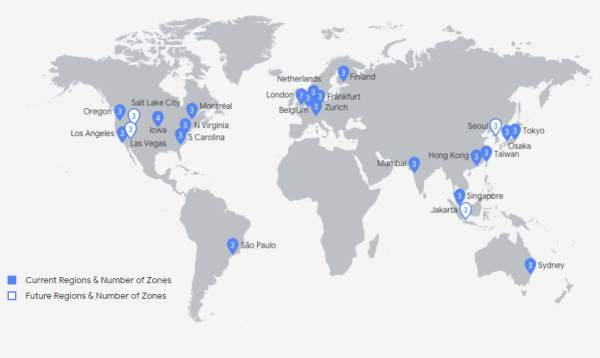
Consider the number of data centers for the Google Cloud service. In Europe, there are only six: in London, Amsterdam, Brussels, Helsinki, Frankfurt, and Zurich. These are all the major hub points. Because a data center is an expensive, complex, and very large project. Now, recall hosting companies from somewhere in Moscow claiming to have 'dozens of data centers across Russia and Europe.'
No, of course, there are good providers with partners in the White Label program, and they offer top-notch services. They allow you to rent capacities in the EU and Russia simultaneously through the same browser window, accept payments in rubles instead of foreign currency, and so on. However, in the event of situations described in the SLA, they become just as much hostages in the situation as you are.
This serves as a reminder that an SLA is useless if you have no understanding of the structure of the organization and the capabilities of the provider.
What we have in the end
A server outage is always an unpleasant event and can happen to anyone, anywhere. The question is what level of control you desire over the situation. Currently, there aren't many direct capacity providers in the market, and when it comes to major players, they typically only own one data center somewhere in Moscow out of many across Europe that you can access.
Every client must decide for themselves: do I choose immediate comfort or do I spend time and effort looking for a data center at a suitable location in Russia or Europe where I can host my equipment or purchase capacity? In the first case, standard solutions available in the market will suffice. In the latter, it will require more effort.
First and foremost, it's essential to determine whether the service provider is the direct owner of the capacities/data center. Many resellers operating under a White Label model go to great lengths to mask their status, and in such cases, indirect signs should be examined. For instance, if their 'European data centers' have specific names and logos that differ from the provider's company name. Or if the word 'partners' appears somewhere. Partners = White Label in 95% of cases.
Next, it is necessary to familiarize yourself with the company's structure, and it’s even better to see the equipment in person. Among data centers, it is not uncommon to have tours or at least informational articles on their own website or blog (we've written such articles, and ), where they discuss their data center with photos and detailed descriptions.
Many data centers can arrange for a personal visit to the office and a mini-tour of the data center itself. There, you can assess the degree of order, and perhaps speak to one of the engineers. Of course, no one will organize a tour of the production for you if you need just one server for 300 RUB/month, but if you require substantial capacity, the sales department may be willing to accommodate you. For example, we conduct such tours.
In any case, you should rely on common sense and the needs of your business. For instance, when a distributed infrastructure is needed (some servers in Russia, others in the EU), it would be simpler and more advantageous to use the services of hosts that have partnerships with European data centers on a White Label model. However, if your entire infrastructure is concentrated in one location, meaning in a single data center, you should spend some time searching for a supplier.
Because a standard SLA will likely not help you. Working directly with the owner of the resources, rather than a reseller, will significantly speed up the resolution of potential issues.
Source: habr.com
