

Before the Web could do anything, HyperCard did it all
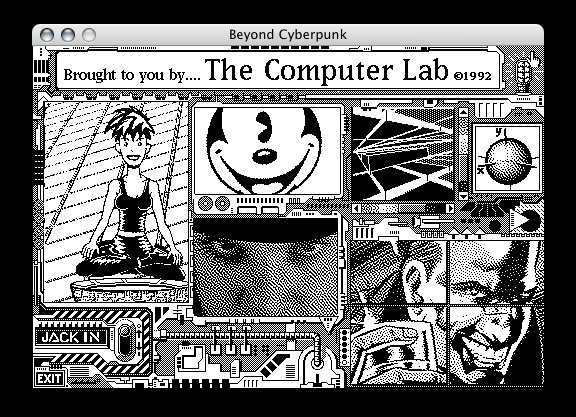
Around 1988, my landlord made a deal with me. She would buy a Macintosh computer, I would buy an external hard drive, and we would leave this system in the living room to use it alternately. For the most part, she used the computer, as I was calculating on an IBM 286 and just wanted to track Apple's progress. However, after we set up the Mac, one evening I noticed a program in the applications menu. 'HyperCard?' I thought. 'What is this?'
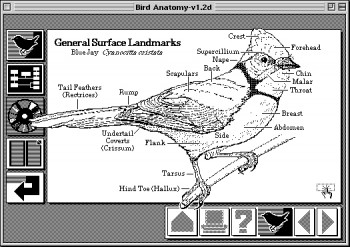
I opened the program and read the instructions. It allowed users to create 'stacks' of cards, or visual pages on the Mac screen. You could insert 'fields' that displayed text, tables, or even images. You could place 'buttons' that linked cards in the stack to one another, playing different sounds when clicked – one rattling sound particularly stuck with me to this day. You could also turn images into buttons.
Five cool HyperCard stacks
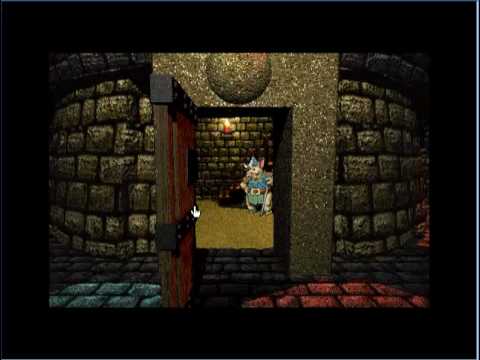
1. The most famous project in HyperCard history is likely . The company Cyan released the game in 1993, but it took the founders, Rand and Ryan Miller, two years to build the intricate landscapes that captivated a generation. The disk contained 40 minutes of music, 2500 images, and an hour of QuickTime video.
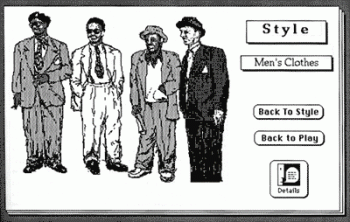
2. Before Myst, the Miller brothers made waves with their game The Manhole (1987), specifically designed for children. Before its release on CD, the program required working with a handful of floppy disks that housed 600 interconnected screens. You can watch a video of the game on YouTube.
3. The team from heard about HyperCard even before the program was released to the market in 1987. 'The scale of the catalog and its natural division into cards made it the perfect way to test the program's capabilities from Apple's perspective,' later Kevin Kelly, so Apple 'sponsored us to tell them everything we learned while converting the catalog into HyperCard format.' Whole Earth Hyperlog contained 9742 pages and cost $150.4. An almanac was published in HyperCard format [Time Table of History]. It primarily discussed science and technology and was released on CD for Macintosh in 1991. It contained over 6000 hypercards and was sold for $150.
5. It's also worth mentioning the interactive book catalog from . In the late 1980s and early 1990s, the company released an impressive series of interactive CDs, including the electronic version of Art Spiegelman's Maus comics, "The Companion to Beethoven's 9th Symphony," and the popular Beatles film "A Hard Day's Night" in a "book-and-film" format. The choice of HyperCard was described as "logical" in the series description. HyperCard, which "models a stack of cards, is akin to a book".
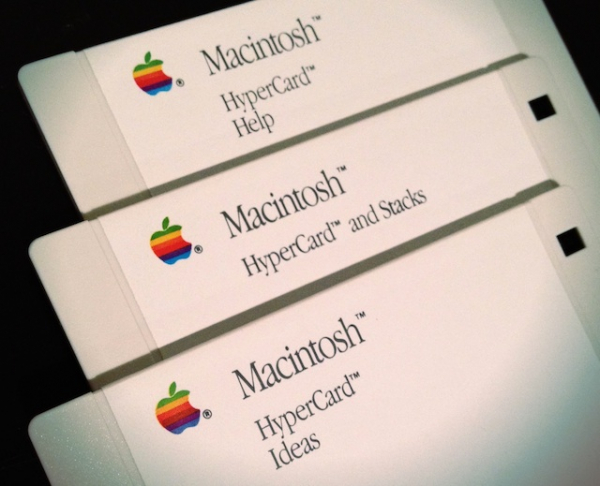
Additionally, HyperCard included a scripting language , which even a non-programmer like myself could learn. It allowed developers to insert commands like "go to," "play sound," or "fade away" into the elements of the HyperCard stack.
I became intrigued and started creating stacks. None of them turned into anything more than just a collection of hastily created images, sounds, and aphorisms, but at one point, I looked at the clock and realized it was already 4 AM. I was astonished and exhausted, and lay down to sleep while visual components of the stacks danced in my head.
Looking back at our historical timeline, HyperCard will turn 32 in August 2019. What happened to this program? I searched and found a eulogy for the program from entrepreneur and programmer Tim Oren, dated 2004, written in the week Apple removed this program from the market. He argued that the issue with HyperCard was that Apple never figured out what the purpose of this program was.
"What was it?" Oren wrote. "A tool for programming and designing user interfaces? A lightweight database and hypertext document management system? An environment for creating multimedia files? Apple never answered that question."
Thus, the Cupertino company relegated this program to its Claris division, where it was lost among more interesting projects like FileMaker and the office suite . "With the tacit agreement of Apple after it reacquired Claris, the most devoted fans, especially from the educational community, kept the life of this program alive," continued Oren's epitaph.
But even before the development ceased, the inventor of HyperCard foresaw its end. In a 2002 interview filled with concern, Bill Atkinson referred to it as his "terrible mistake." If he had realized that stacks could be linked in hyperspace rather than just installed on specific computers, everything would have been different.
"With HyperCard, I missed the mark," Atkinson lamented. "I grew up in a culture restricted by Apple’s limits. If I had grown up in a network culture like Sun, HyperCard could have been the first web browser. My blind spot at Apple prevented me from turning HyperCard into the first web browser."
Perhaps HyperCard didn’t become the first web client, but I believe it deserves a more prominent place in internet history.
Computer Library
The year HyperCard was released, the San Francisco television show "" aired about this program. The hosts of the episode quickly defined its foundation.
"HyperCard is based on hypertext," Gary Kildall told Stewart Cheifet. "This concept was invented by Ted Nelson and Doug Engelbart in the 60s. The core idea is: when we are researching any topic, materials about it exist in many different places. These can be books, magazines, recordings, Compuserve [the first major commercial internet provider in the US / trans. note.] — and it would be great to somehow link all of this electronically, so that, for instance, we could click on Beethoven and jump from one page to another… That was the essence of hypertext."
proposed the concept of hypertext back in the 60s and attempted to implement it in the unfinished project Without losing enthusiasm, Nelson transformed into an expressive advocate for this idea. In his 1974 book, Computer Lib/Dream Machines, he defined hypertext as "a form of writing that branches or acts on request; it is best expressed on a computer display." By simplifying the distribution and access to information, hypertext and hypermedia could free society from what Nelson deemed an overly professionalized elite of digital information.
"As it has been said, war is too important to be left to the generals," Nelson wrote. "Control over computers can no longer be left to the clergy."
However, the 'clergy' itself was not doing too badly in unleashing technologies in the 1970s. Three years before the book was published, architects – the Defense Department's internet prototype – of their project at a public event in Washington, D.C. Meanwhile, two engineers from Bell Labs at AT&T were diligently working on UNIX, the operating system that would become the backbone of the network. Fearing government antitrust action, AT&T opted not to stay in the software sales market and offered UNIX to colleges and universities at reduced prices. With financial support from the National Science Foundation, these schools created hundreds, then thousands of ARPANET "nodes" in the 1980s.
Then came 1989, when a programmer at CERN, the massive Swiss physics laboratory, proposed the use of a hypertext network there. "Most of today's systems use a single database," . "And this allows access to many users through a distributed file system. Few products have literally embraced Ted Nelson's idea of a 'docuverse,' allowing cross-references between nodes in different databases."
However, Berners-Lee was determined to create one.
On the path to the web,
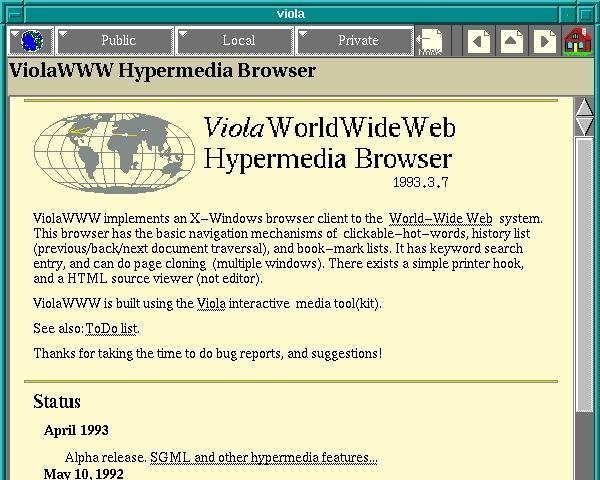
the ViolaWWW hypermedia browser, inspired by HyperCard
About two years later, Berners-Lee created his own web browser and then published the library of this project so that programmers could develop their own versions. Soon, a group of Finnish students developed the Erwise browser. Unfortunately, at that time the country was in a prolonged recession, which severely limited Erwise's capabilities.
"At that time, it was impossible to build a business around Erwise in Finland," said one member of the team. " But other developers were also downloading Berners-Lee's code. Among them was Pei-Yuan Wei, who worked on the X terminal for UNIX at the Experimental Computing Facility at the University of California, Berkeley. Where did Wei draw inspiration for his browser ViolaWWW? He was thinking about a program he really liked, even though he didn't have his own Mac.
"At that time, HyperCard looked very appealing, graphically, with those hyperlinks," Wei recalled later. "I got the manual for HyperCard, studied it, and simply implemented all the concepts in X-windows," the visual component of UNIX. The final Viola browser included HyperCard components: bookmarks, history, tables, graphics. And it, like HyperCard, could run programs.
This was in 1992. By that time, a web client for Mac was already in development—made by Nicola Pellow and Robert Cailliau Samba, also influenced by HyperCard. And through all this activity, a young developer watched with enthusiasm. from the National Center for Supercomputing Applications at the University of Illinois. Andreessen's team launched the Mosaic browser in January 1993; it was the first browser to work on PC, Mac, and UNIX simultaneously. A year later, Mosaic evolved into Mosaic Netscape.
Shortly after that, I downloaded Netscape on my Dell PC. "Wow," I thought, as I was browsing different sites. "This is very similar to HyperCard."
The Legacy of HyperCard
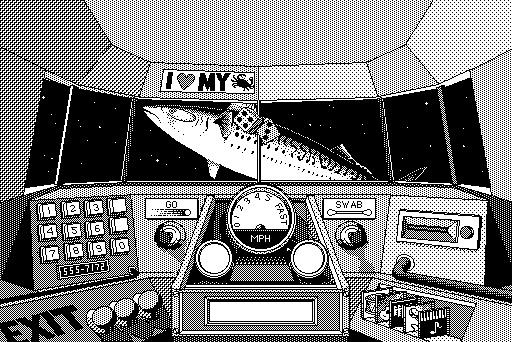
The HyperCard game "Cosmic Osmo" is still
What place does HyperCard hold in the history of innovation? Of course, there’s a temptation to dismiss the program by comparing it, for example, to , a largely forgotten precursor to ; or with the mechanical television , the predecessor of electronic TV; or with experiments downloading music over a cable connection or from William Meister's satellites—unsuccessful but inspired the emergence of America Online.
However, all these projects failed. HyperCard was incredibly popular worldwide. The Melbourne Museum of Victoria, which describes Australia's scientific and cultural history, published a list of ways teachers in Melbourne used this program:
- A stack of exam questions with multiple-choice answers.
- Collection, storage, and use of educational materials, including Excel charts.
- Presentations in the style of KeyNote and handouts for students.
- A calculator with numerous mathematical functions and graphing capabilities.
- Interactive instructions on scientific subjects with animation and sound.
- Fractals.
- Training material on Geographic Information Systems.
- Modeling oil spills.
- Literacy development.
- Road safety.
- Interface to the Oracle database.
- Database on toxicology.
- Selection and playback of video disc tracks.
- Interactive educational presentation of jobs in the wool industry.
- Interactive educational games 'Crystal Flowers' and 'Grandma's Garden'.
- 'Beach Tracks' – studying local shores and shells.
- TTAPS – a typing education program for schools.
Even in August 2002, there were for HyperCard. Three years after the broadcast, the program 'Computer Chronicles' produced a sequel telling about the development of HyperCard. They discovered software for HyperCard developed for managing a TV studio. MIT produced an interactive video magazine based on the program. A seventh-grader wrote a timeline of Russian history for HyperCard, while even preschoolers played with the application.
It’s no surprise that the programmers from Cyan originally wrote their incredibly popular adventure puzzle game Myst as a stack of HyperCard. This explains the beautiful graphics and animation quality of the game, interspersed with background sounds or sudden video inserts. But even in 1987, when the Mac was black-and-white, HyperCard developers and artists produced slim and stunning products rarely seen on today’s web.
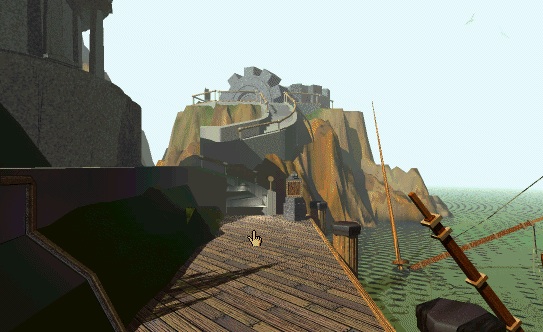
The adventurous puzzle Myst – possibly the pinnacle of HyperCard evolution.
How did its creator Bill Atkinson define HyperCard? "Simply put, HyperCard is a software toolkit that allows people without programming skills to assemble interactive information in one place," he said in 1987 in the Computer Chronicles.
When Tim Berners-Lee's innovation finally gained popularity in the mid-1990s, HyperCard had already prepared a generation of developers who understood the purpose of Netscape. This is why the most fitting historical analogy for HyperCard would not be some failed and forgotten innovation, but a rephrasing of the famous about Elvis Presley. Before the Web could do anything, HyperCard was already doing it.
Source: habr.com
