

My name is Leonid, I am a website developer , so due to my work, I am interested in the stories of the formation and development of various companies in the hosting industry. Today, I would like to present an interview with Danil and Dmitry — the founders of the hosting service . They will talk about the infrastructure setup, organization of work, and their experience in developing a virtual server provider in Russia.
Please tell us a few words about yourself. How did you come to hosting? What did you do before that?
Until 2016, both Dmitry and I worked in the enterprise sector, including companies like Dell, HP, and EMC. Analyzing the cloud market in Russia, we realized that it is growing rapidly and decided that we could offer something interesting to the market. A team of people who had already worked together on other projects came together, and we started developing our own virtualization platform aimed at large businesses with their specific needs. Since 2018, we have also launched cloud hosting 'for everyone', dedicating a team of five people to the project. a team of five people.
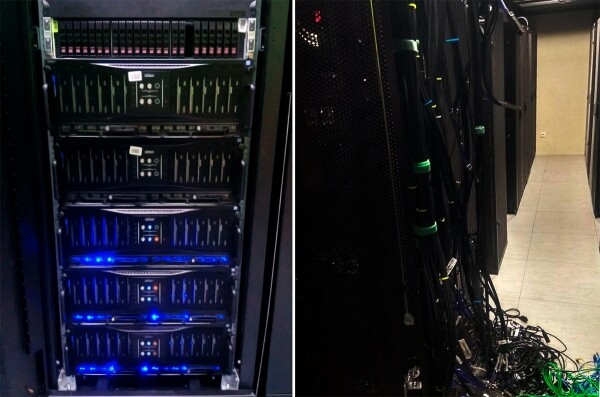
Storage and preparation rack before launch
Is this business project already operational or still in development?
Yes, it is operational alongside — there is already a larger team, and the focus is more on software-hardware solutions for IT infrastructure, not on hosting.
You currently offer quite a few services. When you started, was the list shorter or the same? However, all these services essentially represent a typical virtual server, but there is some division.
We started with classic IaaS: providing 'bare' virtual servers with closed ports and virtual networks for them so that the user could create a complete infrastructure for themselves. However, after launching, it turned out that most users did not understand why they needed such capabilities, and we decided to introduce a new product for us — standard VDS/VPS, which the market was already familiar with. For us, it was essentially a stripped-down version of the product, but users immediately understood what it was, and we began to get our first clients. Apparently, our experience with large companies prompted us to develop a more complex and customized solution right away, while the mass market wants simplicity. And further on the basis of VPS, we began to develop new services based on what clients most frequently request. And we are still developing them.
Where do you host your equipment? Is it your own or do you rent it? How did you choose your data center for hosting? Have there been any relocation cases?
All the equipment is ours; we only rent space in two data centers. We started with three data centers: we wanted to achieve tri-fold fault tolerance, but the demand for it was too small at the time to invest in it, so we dismissed the third data center. We had one relocation: we moved from the third data center to one of the other two. We chose based on the principle that the data centers should be well known in the market, reliable (Tier III), and that both should be located in Moscow, in remote areas from each other.
Which data centers are you currently using, and which one did you abandon?
We are currently located in DataSpace and 3Data. We abandoned one of the data centers of 3Data.
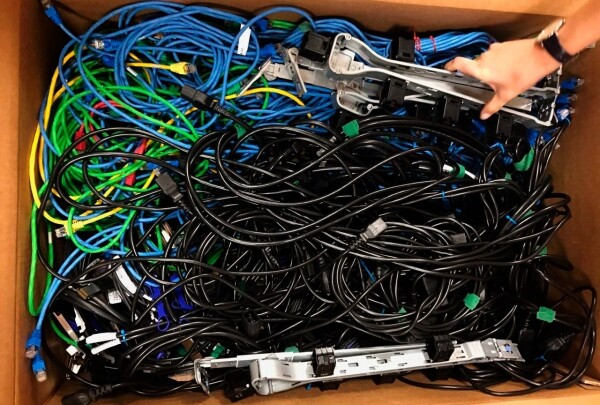
We are leaving the third data center.
Do you rent or buy IP addresses?
We rent them.
What is the reason for choosing this approach rather than purchasing?
Basically, to grow quickly. We provide clients with virtual infrastructure that does not require immediate capital expenditures, allowing costs to be broken down monthly. We adhere to the same philosophy as our clients — we aim for expansion and rapid scaling.
What are your thoughts on IPv6?
So far, we have not noticed significant demand, so we have not added it, but the architecture for implementation is developed, and we are ready to 'roll it out' in a short time as soon as we understand there are requests.
You are using KVM virtualization. Why did you choose it? How does it perform in practice?
That's correct, but we don't use 'bare' KVM; we have a fully developed virtualization system based on KVM, created by our 'big brother,' which includes a storage system (SDS) and software-defined networking (SDN). We chose this to build a highly fault-tolerant product without single points of failure. It has been performing well, with no major problems in production. During the alpha-testing phase in the market, when we offered services to our first clients as bonus points, we encountered some unpleasant moments while testing the technology, but over the past two years, we have learned and resolved many issues.
Do you use overselling? How do you monitor server load?
We only use overselling on processors, but never on RAM. Even with physical processors, we do not allow their usage to exceed 75%. Regarding disk capacity, we work with 'thin' provisioning. We have centralized monitoring of the entire environment, allowing us to control the load. Two engineers are responsible for supporting the entire infrastructure, so we strive to automate as much as possible and gather all sorts of information about the system. Any deviations from normal operation are immediately visible, and we periodically assess and rebalance the load within the infrastructure. The rebalancing always occurs online, seamlessly for customers.
How many physical servers do you currently have? How often do you add new ones? What servers do you use?
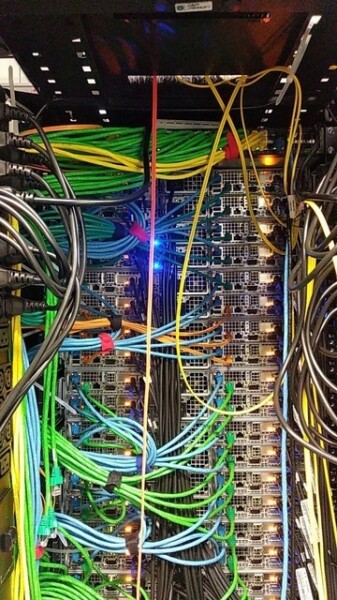
Currently, there are 76 servers, and we add new ones approximately every four to five months. We use QCT, Intel, and Supermicro.
Have there been cases where a client came and occupied all remaining free resources, necessitating urgent server additions?
We haven't experienced that with resources. So far, we are growing relatively evenly. However, there was a case where a user requested 50 IPs, each in a separate block. Of course, we don’t have that available yet 🙂
What are your most popular payment methods? Which are the least used?
The most popular methods are bank cards and QIWI. The least used is payment via bank transfer under an offer for legal entities, but these transfers are the most substantial (companies typically pay for significant resources for several months). PayPal is also lagging behind: at the start, we didn't expect international users, but they began to appear.
At Boodet.online, we have a custom billing system. Why did you choose to use such a solution? What are the pros and cons? Was it difficult to develop?
Our entire system is custom-developed. Existing platforms did not seem very convenient in terms of UX, so we decided to create and develop our own. Billing is just one of the microservices that make up the system. It turned out to be more challenging to develop than we initially thought. At one point, we even had to postpone the project launch to prepare a working product that wouldn’t be embarrassing during alpha testing. Over time, we gained competence in long-term development methodologies and product management. Now, it's easier to add new functionality and products to the system.
How many people worked on this development? What technologies were used?
There are five people working on the entire project, including two developers (frontend and backend). The backend is written in RoR/Python. The frontend is in JS.
How is user support organized? Is it available 24/7 or only during business hours? How many support lines are there? What do users ask most often?
We have three entry points: chat, phone, and a ticketing system from the personal account. There are two support lines: if the on-call engineer cannot resolve the issue, the technical director or development team gets involved. If the problem is with the main platform, which happens much less frequently, the technical director contacts the support of the 'big brother.' At night, we respond only to calls from clients who purchase separate technical support or report platform failures through a specially created bot in Telegram.
The most common questions:
- Are our IPs available in Turkmenistan? (This is the most popular question — apparently, there is a strict blocking policy in the country.)
- How to install certain software.
- How to gain root access (there is even a special note in the interface when creating machines, but it doesn’t always help).
Do you perform customer verification? Do spammers and other undesirable individuals often appear?
Verification via email and phone (if the user enables 2FA). Spammers and other abusers appear periodically. We have to respond with a temporary block of compromised servers, as we do not want IPs to be blacklisted. However, we always inform the user beforehand that a complaint has been received against them and ask them to contact us to discuss the issue. If the user does not respond, or if repeated complaints arise, we will block the account entirely and delete the servers.
How often do DDoS attacks occur against customers? What do you do in such cases? Have there been attacks specifically against you, your website, or infrastructure?
Customers are attacked quite rarely. However, we often experience attacks on our own site and personal account. Sometimes the network is targeted through various IP addresses. We are not in a position to judge who is behind it and why, as there can be several scenarios. There have even been attempts to attack us from within. Previously, during phone verification, we offered a bonus of one hundred rubles so that legitimate users could test any configurations. But one day, a user arrived with a 'bundle of SIM cards' and started creating dozens of accounts from a single IP, receiving bonuses on them. Therefore, we had to remove the automatic accrual of test credits. Now, users must submit a request to tech support for testing, and each case is reviewed individually.
How is the work organized? Is there an office, or does everyone work remotely?
We have an office, but with the onset of restrictions due to the coronavirus, everyone has moved to work from home/their dachas/their hometown.
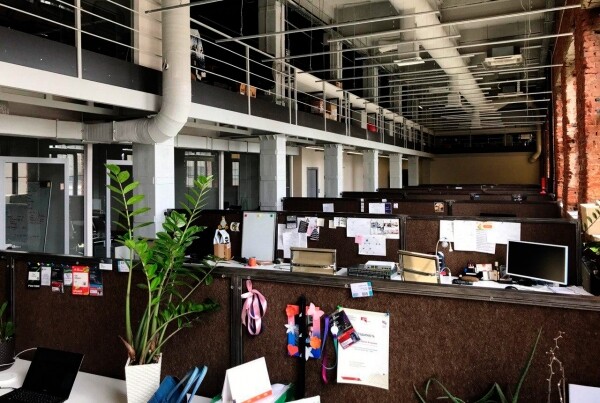
Our office
What is your current company development rate?
We are working towards adding new services. We have an extensive roadmap, we do not stop development, and every two weeks we release a new version of the personal account. We are adding functionalities and services that are in demand by colleagues, and incorporating requests from clients.
How do you find clients? Is there a large influx and outflow of clients per year? What is the average 'lifespan' of a client?
The channels for acquiring clients in our field are what keeps the entire business afloat, provided there is a good working product. Therefore, we are not ready to share.
Churn rate, LTV, and lifecycle are also quite important metrics that we use solely for internal analytics, not for disclosure.
Could you provide readers with any tips for choosing hosting? What should they pay attention to before making a purchase?
The most important thing is to choose a hosting service that starts with the letter 'B.'
But seriously, there are several factors to consider:
- To understand quality, you can take an average configuration and try to solve your practical tasks on it. Choose hosting services that offer hourly rates — you'll be able to test the servers without losing much money if the quality doesn't meet your expectations.
- Look at the data centers where the host's physical servers are located. They can give you a rough idea of the quality of services.
- We do not recommend focusing on prices: there are both super-cheap solutions that perform well, and super-expensive ones that are not particularly different.
Share some of the most memorable work moments.
Project launch. For the first one and a half months, we worked around the clock: observing how registrations were going, whether anything was breaking in the personal account interface, how users were behaving, and whether it was convenient for them to order services. We had to solve many issues on the fly, even replacing some products with others. Changes were made directly in production, bypassing testing environments. It was a tense period, but we managed to survive and not abandon the project.
Users who came looking for vulnerabilities in logic. It was interesting to catch and close these vulnerabilities. For instance, when we were still working without payment, issuing bonuses so users could order servers, a link to us was posted on one of the hacker forums with the comment: 'They are giving away free servers worth 500 rubles.' Of course, we were immediately flooded with miners eager for freebies.
Could you provide a brief chronology of the company's history?
- The first half of 2017 — we began developing the platform, website, and personal account for Boodet.online.
- 2018 — we entered alpha testing, providing clients with resources for free in exchange for detailed feedback and testing results.
- Mid-2018 — we launched the beta version with financial features. The first hundreds of clients tested our support services.
- 2019 — we began attracting legal entities as clients and working on custom solutions.
- 2020 — as everyone went into self-isolation, the demand for virtualization surged. We felt this firsthand with a client increase, enabling us to expand our additional services.
Source: habr.com
