

The impetus for writing this article was the official support from Qsan for connecting third-party expansion shelf storage systems. This fact significantly distinguishes them from other vendors and even somewhat disrupts the established norm in the storage market. However, it seemed less interesting to simply write about the combination of Qsan's storage system and a 'foreign' JBOD than to partially touch on the somewhat controversial topic of using components from third-party manufacturers.

The rivalry between storage vendors (as, indeed, other enterprise equipment) and their users, who wish to use third-party components, will be everlasting. After all, at the core of this rivalry is money. And often, these amounts are quite substantial. Each side has very convincing arguments in favor of its point of view and frequently takes certain actions to ensure that viewpoint is the only valid one. We will try to figure out if there is a possibility for compromise so that both sides remain satisfied.
Typical arguments from the storage vendor, insisting on the mandatory use of their branded components, are usually as follows:
- ‘Their’ components are 100% compatible with the storage system. There will be no surprises. And if any do arise, the vendor will resolve them in the shortest possible time;
- Support and warranty with a ‘single window’ for the entire solution.
All of this results in the fact that the cost of branded components often significantly exceeds the price of similar products available on the open market. And users naturally feel the urge to ‘fool the system’ by introducing components that are not officially intended for the storage system. It is noteworthy that such actions have been observed not only from inexperienced individuals but also from quite serious organizations.
The most popular components from third-party manufacturers that users seek to install in storage systems are, without a doubt, drives. This is due to the fact that the prices of branded drives can be easily compared to their retail counterparts. Therefore, in the eyes of users, it is in their price that the vendor's ‘greed’ is hidden.
Storage vendors cannot simply overlook what they consider wrongful actions by users and constantly make things difficult for them. This includes vendor lock on 'their' components and denial of support for devices using illegitimate drives (even if the problem is obvious and unrelated to them).
Is it worth the trouble? Let's consider whether there is a benefit in this situation and at what cost.
100% compatibility

To be honest, there are only a limited number of actual HDD and SSD manufacturers. Each of their model ranges is finite and does not updated at lightning speed. Therefore, it is potentially within the vendor's capability to test, if not all, then at least a significant portion of storage devices. A testament to this fact is the support for third-party drives in their compatibility lists by several popular storage vendors. For example, at .
Support and warranty for the entire solution as a whole

Free cheese, as you know, is found where? Therefore, vendor support (not just warranty) is never free of charge.
When purchasing third-party drives, one must be prepared for the fact that, in case of problems, the user will have to deal with their supplier (storage vendors rarely provide their own support to users). It is quite possible to encounter a situation where a drive is rejected by the storage system during operation, while the supplier deems it functioning. Additionally, the speed of replacing a faulty drive will be regulated by the buyer-seller relationship. And it's unlikely that in no time.
If the user is willing to accept such limitations, they can try to 'prepare a safety net.' For example, purchasing backup drives in advance. Such actions will, of course, require additional investment, but in some cases, they might still remain financially attractive.
In all these discussions about the use of compatible components, it's essential to remember the primary reason for these efforts. Storage Systems (SSDs) are one of the tools of business. And every tool should yield a return on investment of 146%. Any downtime of the SSD, especially data loss on it, is simply an unacceptable luxury and a significant financial loss. Therefore, when deciding to use unvalidated disks for cost-saving purposes, it's crucial to be aware of the serious consequences of such actions.
Undoubtedly, look preferable to 'store-bought' ones in many respects. However, as practice shows, companies of any size experience times when funds for IT infrastructure development are not as abundant as one would like. Thus, the ability to use is a significant advantage. An obvious benefit of storage systems that simultaneously support both proprietary and compatible drives is the flexibility in decision-making and the minimization of own risks during operation.
While support for third-party disks may not surprise anyone (let's be honest: – is not the only vendor allowing this). Support for JBOD expansion shelves among all vendors is always limited to their own models. Yes, in some cases, some of these shelves result from OEM collaboration between the SSD vendor and another manufacturer. However, such JBODs always have their unique firmware version (including for the purpose of vendor lock), are sold through the SSD vendor's channels, and are supported by them. The case with Qsan is unique because it supports exactly 'foreign' shelves. Currently, the following models are considered compatible:
- Seagate Exos E 4U106 – 106 LFF disks in a 4U chassis
- Western Digital Ultrastar Data60 – 60 LFF disks in a 4U chassis
- Western Digital Ultrastar Data102 – 102 LFF disks in a 4U chassis
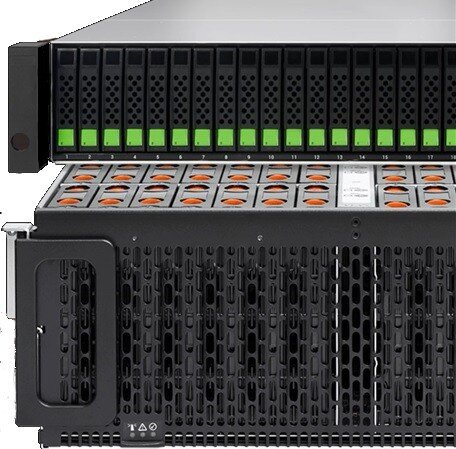
All supported shelves fall into the High Density class. It makes sense: they clearly did not plan to compete with their JBODs of the series However, such shelves, while not needed as frequently as standard form factor JBODs, are still in demand for certain tasks that require a large number of drives.
Just as with disks, users have a choice regarding where and how to purchase compatible JBOD. If support for the entire solution is needed, it is advisable to contact Qsan. If users are willing to handle warranty issues with different vendors, JBOD can be purchased independently. In any case, when planning to use third-party shelves, it is important to thoroughly read the relevant documentation detailing the limitations on possible configurations and the hardware/software requirements for all components.
Again, returning to the 'own/third-party' choice regarding JBOD, it should be noted that collaboration is not prohibited. and third-party manufacturers within a single system. Therefore, during operation, users can flexibly address capacity expansion based on current needs and financial capabilities.
It is rather thoughtless on the part of some customers to purchase a storage system from a specific vendor and then attempt to supplement it with incompatible components for the sake of savings. In doing so, they often lose the entire point of owning such a storage system, as full vendor support will be absent. It would be wiser to choose a storage vendor that does not have such restrictions. is precisely such a vendor, allowing users to decide which components to use and where to purchase them.
Source: habr.com
