

We discuss the statistics of foreign IaaS providers, provide figures for our cloud, and talk about the reasons that have influenced the widespread adoption of open-source operating systems.
Photo - - Unsplash
Market Share Distribution
According to According to IDC, in 2017, 68% of in-house and cloud enterprise servers were running on Linux. Since then, this figure has increased — this trend is observed by many IaaS providers.
In 2015, representatives of Microsoft , that one in four instances in Azure runs on Linux. Two years later, their share reached 40%. This year, the number of Linux machines . The IT company itself has also become an active user of the open-source operating system. For example, software-defined networks (SDN) within the organization are built on its basis.
A similar picture is observed in the clouds of other IaaS providers. For instance, in the 1cloud.ru cloud, 44% of virtual machines run on Linux. In the case of Windows, this figure is 45%.
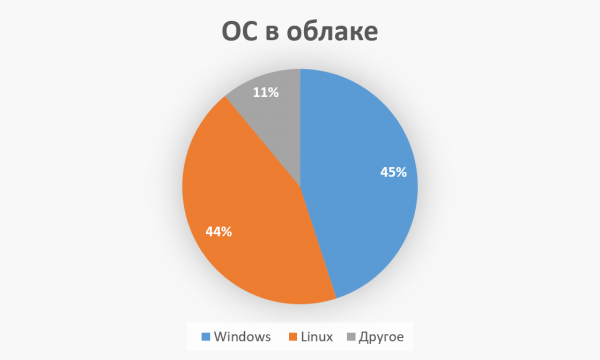
Operating system shares on active servers in the 1cloud cloud
"We expect that very soon Linux could become a leader and surpass other operating systems," comments Sergey Belkin, head of the project development department. — Considering that just a few years ago of the virtual machines deployed in our cloud were running on Windows."
The forecast is confirmed by statistics from other IaaS providers. For example, in the private cloud of one of the largest Western providers, over .
run on Linux. At the same time, the open-source operating system remains the most popular platform for web hosting. According to Alexa rankings). The remaining 30% belong to Windows.
Why Linux
Experts identify at least two factors influencing the spread of the operating system in cloud environments.
Flexibility of architecture. This factor is highlighted by the Linux Foundation as one of the defining ones. Linux is suitable for performing diverse tasks and operates on platforms of various scales: from mobile devices to supercomputers. For example, in 2017, 498 supercomputers from the top 500 list under this open-source operating system. By the end of the same year, however, 100% of the computing machines in the top rankings were already running on Linux.
The most powerful supercomputer today is IBM's Summit — . The first exaflop supercomputer in the U.S., which is scheduled for completion in 2021, will also operate .
An extensive community. The Linux codebase is updated approximately . Since 2005, 15,000 engineers have contributed to the development of the kernel. Among them are employees from 200 major corporations. In 2017 alone, 3% of the changes to the codebase by developers from Google and Samsung. 13% of the changes were 'attributed' to Intel.

Photo - - Unsplash
Major IT companies are actively involved in the development of both Linux itself and open products based on it. Microsoft offers a platform for IoT applications, which is based on the Linux kernel. Intel launched a cloud project , through which engineers are optimizing the open-source OS for their processors. HPE offers for delivery with its hardware. IBM, on the other hand, acquired Red Hat and is now developing one of the most popular distributions on the market.
New open-source products are being actively implemented in cloud environments, positively impacting the spread of Linux.
What's Next
Caution should be exercised when interpreting exact figures regarding the popularity of a particular operating system in the cloud environment. The modern IT infrastructure of cloud providers is complex. Many hypervisors can be described as 'nested', resulting in situations where one operating system operates within another.
But even taking this fact into account, it can be confidently said that Linux is increasingly used in the cloud.
Posts from our blogs and social media:


Source: habr.com
