

Other articles in the series:
- The History of Relays
- The History of Electronic Computers
- The History of the Transistor
- The History of the Internet
As we have seen in , radio and telephone engineers, in search of more powerful amplifiers, opened a new technological field that was quickly dubbed electronics. An electronic amplifier could easily be transformed into a digital switch, operating at much higher speeds than its electromechanical counterpart—the telephone relay. Due to the absence of mechanical parts, the electronic tube could turn on and off in microseconds or even faster, rather than the tens of milliseconds or more required by relays.
From 1939 to 1945, three computers were built based on these new electronic components. The dates of their construction coincidentally align with the period of World War II. This unprecedented conflict in history, which yoked people to the chariot of war, forever changed the relationships both between nations and between science and technology, as well as bringing a plethora of new devices into the world.
The stories of the first three electronic computers are intertwined with the war. The first was dedicated to decoding German messages and remained classified until the 1970s, when it no longer held any interest other than historical. The second, which most readers are likely to have heard of, was ENIAC, a military calculator that was completed too late to aid in the war. But here we will discuss the earliest of these three machines, the brainchild of .
Atanasoff
In 1930, Atanasoff, born in America to an émigré from finally achieved his youthful dream and became a theoretical physicist. However, as with most such aspirations, reality was not as he had hoped. In particular, like most engineering and physics students of the early 20th century, Atanasoff suffered from the torturous burdens of constant calculations. His dissertation at the University of Wisconsin on helium polarization required eight weeks of tedious calculations using a mechanical desk calculator.
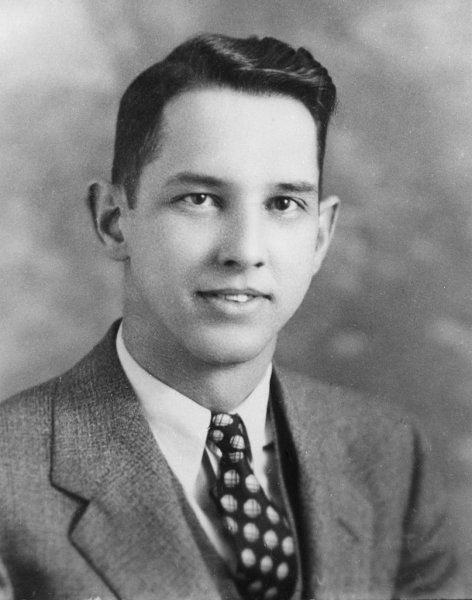
John Atanasoff in his youth
By 1935, already established as a professor at Iowa State University, Atanasoff decided to do something about this burden. He began to consider possible ways to build a new, more powerful computing machine. Rejecting analog methods (such as MIT's differential analyzer) due to their limitations and inaccuracies, he decided to create a digital machine that processed numbers as discrete values rather than continuous measurements. He had been familiar with the binary numbering system since his youth and understood that it fit much better with the on/off structure of a digital switch than conventional decimal numbers. Thus, he resolved to build a binary machine. Ultimately, he concluded that to be the fastest and most flexible, it needed to be electronic, using vacuum tubes for computations.
Atanasoff also needed to determine the problem space — for what specific calculations should his computer be suitable? In the end, he decided it would focus on solving systems of linear equations, reducing them to a single variable (using ) — the same type of calculations that predominated in his dissertation. It would support up to thirty equations, with up to thirty variables each. Such a computer could solve important problems for scientists and engineers, while seemingly not being unimaginably complex.
A work of art
By the mid-1930s, electronic technology had achieved remarkable variety compared to the beginnings that emerged 25 years prior. Two developments were particularly well suited for Atanasoff's project: the relay-trigger and the electronic counter.
Since the 19th century, telegraph and telephone engineers have had at their disposal a convenient device called a switch. A switch is a bistable relay that uses permanent magnets to hold it in the position you left it — open or closed — until it receives an electrical signal to switch states. However, electronic lamps were not capable of this. They did not have a mechanical component, and they could be 'open' or 'closed' while electricity flowed or did not flow through the circuit. In 1918, two British physicists, William Eccles and Frank Jordan, wired two lamps in such a way that they created a 'relay-trigger' — an electronic relay that remains on after being turned on by an initial pulse. Eccles and Jordan developed their system for telecommunication purposes for the British Admiralty at the end of World War I. However, the Eccles-Jordan circuit, later known as the trigger flip-flop, can also be viewed as a device for storing a binary digit — 1 if the signal is transmitted, and 0 otherwise. In this way, through n triggers, a binary number of n bits could be represented.
About ten years after the trigger, a second major breakthrough in electronics occurred, impacting the world of computing: electronic counters. Once again, as often happened in the early history of computing, boredom was the mother of invention. Physicists studying the radiation of subatomic particles had to either listen to clicks or spend hours studying photographic records, counting the number of detections to measure the particle radiation speeds through various substances. Mechanical or electromechanical counters represented an enticing opportunity to ease these tasks, but they moved too slowly: they could not register the many events occurring with millisecond differences.
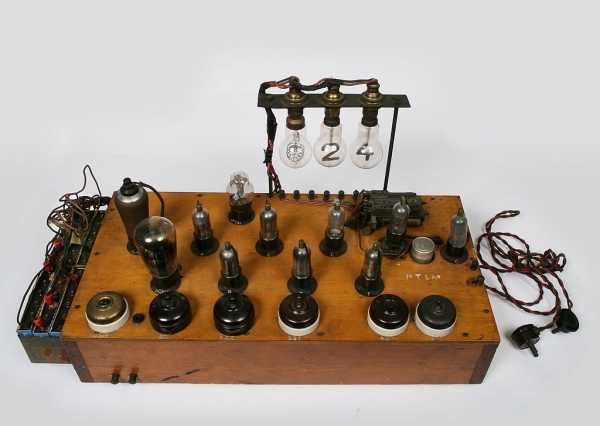
A key figure in solving this problem was , working under Ernest Rutherford at the Cavendish Laboratory in Cambridge. Winn-Williams was adept with electronics and had already utilized valves (or tubes, as they were referred to in Britain) to create amplifiers that allowed for the detection of events involving particles. In the early 1930s, he realized that valves could be used to create a counter, which he termed a "binary scale counter"—that is, a binary counter. Essentially, it was a set of triggers that could transmit switches up the chain (in practice, he used , types of tubes that contained gas rather than a vacuum and could remain in the on position after full ionization of the gas).
The Winn-Williams counter quickly became an essential laboratory device for anyone engaged in particle physics. Physicists built very small counters, often containing three digits (that is, capable of counting up to seven). for a slow mechanical counter, and for recording events occurring faster than could be registered by a counter with slowly moving mechanical parts.
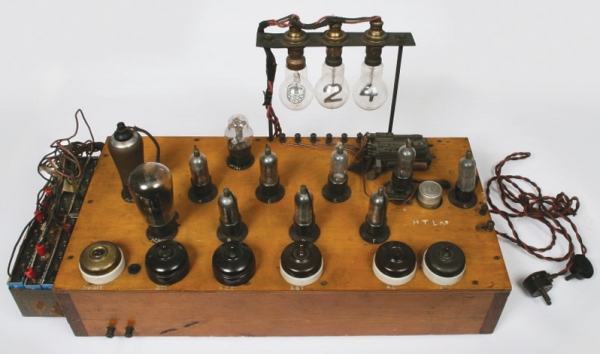
But in theory, such counters could be expanded to numbers of arbitrary size or precision. These were, strictly speaking, the first digital electronic counting machines.
The Atanasoff-Berry Computer
Atanasoff was familiar with this story, which convinced him of the feasibility of building an electronic computer. However, he did not directly employ binary counters or triggers. Initially, for the foundation of his counting system, he attempted to use slightly modified counters—after all, what is addition but a repeated counting? But for some reason, he was unable to make the counting circuits reliable enough, and he had to develop his own addition and multiplication circuits. He could not use triggers for temporarily storing binary numbers, as he had a limited budget and an ambitious goal for simultaneously storing thirty coefficients. As we will soon see, this situation had serious consequences.
By 1939, Atanasoff had completed the design of his computer. Now he needed someone with the right knowledge to build it. He found such a person in a graduate of the engineering department of Iowa State University named Clifford Berry. By the end of the year, Atanasoff and Berry had built a small prototype. The following year, they completed the full version of the computer with thirty coefficients. In the 1960s, a writer who uncovered their story named it the Atanasoff-Berry Computer (ABC), and the name stuck. However, not all shortcomings were resolved. In particular, the ABC produced an error of about one binary digit in 10,000, which would be fatal for any large calculation.
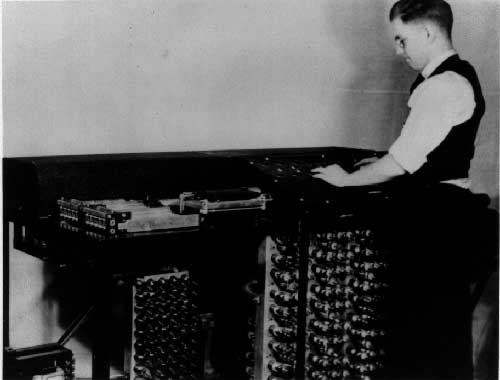
Clifford Berry and ABC in 1942
Nevertheless, in Atanasoff and his ABC, one can find the roots and source of all modern computers. Did he not create (with Berry's skillful assistance) the first binary electronic digital computer? Are these not the fundamental characteristics of billions of devices that shape and manage the economy, society, and culture worldwide?
But let's go back. The adjectives digital and binary are not exclusive to the ABC. For instance, the Bell Complex Number Computer (CNC), developed around the same time, was a digital, binary, electromechanical computer capable of calculations on the complex plane. Also, both ABC and CNC were similar in that they solved problems in a limited domain and could not, unlike modern computers, process arbitrary sequences of instructions.
The term 'electronic' remains. However, while the mathematical internals of the ABC were electronic, it operated at electromechanical speeds. Since Atanasoff and Berry could not afford to use electronic tubes to store thousands of binary digits, they relied on electromechanical components for this purpose. Several hundred triodes performing essential mathematical calculations were surrounded by rotating drums and buzzing perforating machines, where intermediate values of all computational steps were stored.
Atanasoff and Berry did a heroic job of reading and writing data on punch cards at an enormous speed, burning them with electricity instead of mechanically punching holes in them. But this brought its own problems: the device used for burning was responsible for one error in every 10,000 numbers. Moreover, even at their best efforts, the machine could not 'punch' faster than one line per second, meaning the ABC could only perform one calculation per second for each of the thirty arithmetic units. The rest of the time, the vacuum tubes sat idle, impatiently 'drumming their fingers on the table' as all this machinery painfully slowly turned around them. Atanasoff and Berry hitched a thoroughbred stallion to a hay wagon. (The project leader for the re-creation of the ABC in the 1990s estimated the machine's maximum speed, accounting for all time expenditures, including the operator's work in setting up tasks, at five additions or subtractions per second. This is, of course, faster than a human calculator, but it is not the speed we associate with electronic computers.)
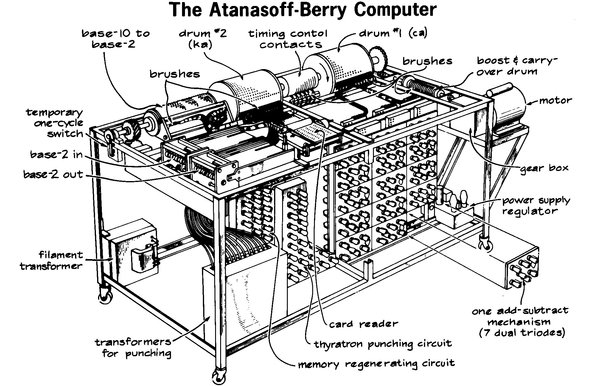
ABC Diagram. The drums stored temporary input and output on capacitors. The thyratron circuit punched cards and the card reader recorded and read the results of a whole step in the algorithm (eliminating one of the variables from the system of equations).
Work on the ABC came to a standstill in mid-1942 when Atanasoff and Berry enlisted in the rapidly expanding U.S. military machine, which needed not just bodies but also brains. Atanasoff was called to the Naval Research Laboratory in Washington to lead a team developing acoustic mines. Berry married Atanasoff's secretary and found a job with a military contractor in California to avoid being drafted into the war. Atanasoff tried for some time to patent his creation in Iowa, but unsuccessfully. After the war, he turned to other pursuits and no longer engaged seriously with computers. The computer itself was sent to the junkyard in 1948 to free up space in the office for a new graduate.
Perhaps Atanasoff simply started working too early. He relied on modest university grants and could only spend a few thousand dollars to create ABC, so frugality overshadowed all other issues in his project. Had he waited until the early 1940s, he might have received a government grant for a full-fledged electronic device. In that state—limited in application, complex to operate, unreliable, and not very fast—ABC did not make a promising case for the utility of electronic computing. The American military machine, despite its computational hunger, let ABC rust away in the small town of Ames, Iowa.
War Computing Machines
World War I created and launched a massive investment pump into science and technology, preparing it for World War II. In just a few years, the practice of warfare on land and at sea transitioned to the use of poison gases, magnetic mines, aerial reconnaissance, and bombing, among others. No political or military leader could overlook such rapid transformations. They were so swift that research initiated early could tilt the scales either way.
The U.S. had ample materials and minds (many of whom fled from Nazi Germany), and they were removed from the immediate struggles for survival and dominance that affected other countries. This allowed the nation to learn this lesson particularly clearly. It manifested in the extensive industrial and intellectual resources thrown into the creation of the first atomic weapon. A lesser-known, but equally important or substantial investment was made in the development of radar technology, centered at MIT's Rad Lab.
Thus, the nascent field of automatic computing received its share of military funding, albeit on a much smaller scale. We have already noted the diversity of electromechanical computing projects spawned by the war. The potential of relay-based computers was, relatively speaking, known, as telephone exchanges with thousands of relays had been operating for many years by that time. Electronic components had yet to prove their operational efficacy at such scales. Most experts believed that an electronic computer would inevitably be unreliable (ABC served as an example), or that building it would take too much time. Despite a sudden influx of government funding, there were few military projects in electronic computing, and they were rare. Only three were initiated, and only two of them led to the creation of operational machines.
In Germany, telecommunications engineer Helmut Schreyer demonstrated to his friend Konrad Zuse the value of the electronic machine over the electromechanical 'V3', which Zuse was building for the aviation industry (later known as Z3). Zuse eventually agreed to collaborate on a second project with Schreyer, and the Aviation Research Institute offered funding for the prototype with 100 tubes at the end of 1941. However, the two men initially engaged in more urgent military work, and then their progress was severely hampered by damage from bombings, resulting in their inability to get their machine to work reliably.
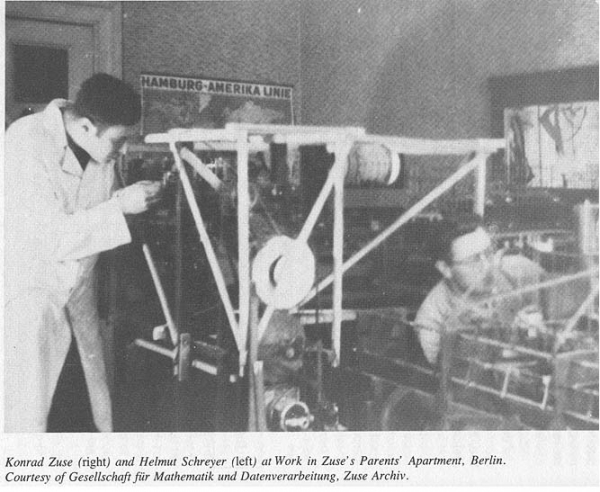
Zuse (right) and Schreyer (left) working on the electromechanical computer in Zuse's parents' Berlin apartment.
The first electronic computer to perform useful work was created in a secret laboratory in Britain, where a telecommunications engineer proposed a new radical approach to cryptoanalysis based on valves. We will reveal this story next time.
What else to read:
• Alice R. Burks and Arthur W. Burks, The First Electronic Computer: The Atansoff Story (1988)
• David Ritchie, The Computer Pioneers (1986)
• Jane Smiley, The Man Who Invented the Computer (2010)
Source: habr.com
