

Other articles in the series:
- The History of Relays
- The History of Electronic Computers
- The History of the Transistor
- The History of the Internet
In 1938, the head of the British Secret Service quietly acquired an estate spanning 24 hectares, 80 miles from London. It was strategically located at the intersection of railways running from London to the north, and from Oxford to the west towards Cambridge in the east, making it an ideal spot for an organization that needed to remain unseen, yet was easily accessible to most of the important centers of knowledge and power in Britain. The estate, known as , became Britain's center for codebreaking during World War II. It is perhaps the only place in the world known for its connection to cryptography.
Tunny
By the summer of 1941, work was in full swing at Bletchley to break the famous Enigma cipher machine used by the German army and navy. If you've seen a movie about British codebreakers, you may have heard of Enigma, but we won't dwell on it here — as shortly after the invasion of the Soviet Union, messages with a new type of encryption were detected at Bletchley.
Cryptanalysts quickly deciphered the general nature of the machine used for transmitting messages, which they named 'Tunny.'
Unlike Enigma, whose messages had to be deciphered manually, Tunny was directly connected to a teleprinter. The teleprinter converted each symbol entered by the operator into a stream of dots and dashes (similar to the dots and dashes of Morse code) in a standard with five symbols per letter. This was plain text. Tunny simultaneously used twelve rotors to create its own parallel stream of dots and dashes: the key. It then added the key to the message, producing the encrypted text transmitted over the air. The addition was performed in binary arithmetic, where dots represented zeros and dashes represented ones:
0 + 0 = 0
0 + 1 = 1
1 + 1 = 0
Another Tanny on the recipient's side with the same settings issued the same key and added it to the encrypted message to produce the original text, which was printed on the recipient's teletype. Suppose we have a message: "dot plus dot dot plus". In digits, this would be 01001. Let's add a random key: 11010. 1 + 0 = 1, 1 + 1 = 0, 0 + 0 = 0, 0 + 1 = 1, 1 + 0 = 1, so we get the encrypted text 10011. By adding the key again, we can restore the original message. Let's check: 1 + 1 = 0, 1 + 0 = 1, 0 + 0 = 0, 1 + 1 = 0, 0 + 1 = 1, giving us 01001.
The analysis of how Tanny worked was facilitated by the fact that in the early months of its use, senders transmitted wheel configurations that needed to be used before sending a message. Later, the Germans released codebooks with predefined wheel settings, and the sender only needed to send the code for the recipient to find the desired wheel setting in the book. As a result, they began to change the codebooks daily, causing Bletchley to have to crack the wheel settings every morning.
Interestingly, cryptanalysts deciphered Tanny's function based on the locations of the sending and receiving stations. It connected the nerve centers of the highest German command with the army and the commanders of army groups across various European battle fronts, from occupied France to the Russian steppes. It was an enticing challenge: cracking Tanny promised direct access to the intentions and capabilities of the enemy at the highest level.
Then, due to a combination of German operators' errors, cunning, and relentless determination, the young mathematician made much further progress than simple deductions about how Tanny operated. Without seeing the machine itself, he fully determined its internal structure. He logically deduced the possible positions of each wheel (each having its own prime number) and how the arrangement of the wheels generated the key. Armed with this information, Bletchley built copies of Tanny that could be used to decrypt messages—right after correctly configuring the wheels.
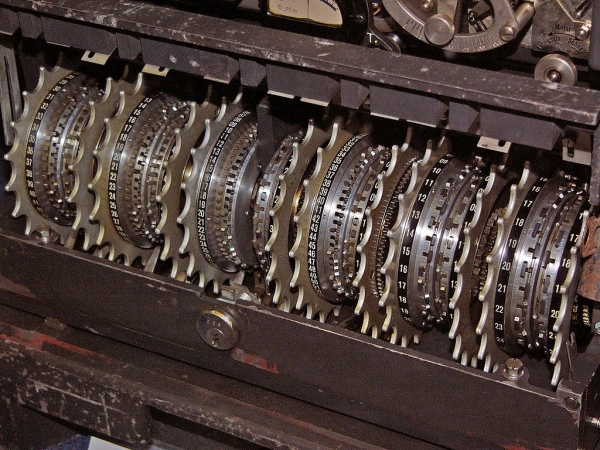
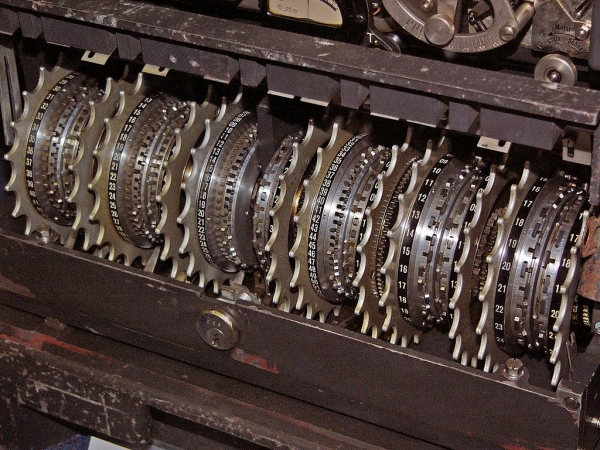
12 wheels of the cipher machine using the Lorenz cipher, known as Tanny
Hugh Robinson
By the end of 1942, Turing continued to attack the Enigma, developing a special strategy for this. It was based on the concept of the delta: the sum modulo 2 of one signal in the message (dots or dashes, 0 or 1) with the next. He realized that due to the intermittent movement of the Enigma's wheels, there was a correlation between the delta of the encrypted text and the delta of the key text: they had to change together. So if you compared the ciphertext with the key text generated on different wheel settings, you could calculate the delta for each and count the number of matches. A match rate significantly exceeding 50% should indicate a potential candidate for the actual message key. In theory, the idea was good, but it was impossible to implement in practice as it required 2400 passes for each message to check all possible settings.
Turing brought this task to another mathematician, Max Newman, who led a department at Bletchley, known to everyone as 'Newmania.' Newman, at first glance, seemed an unlikely candidate to lead a sensitive British intelligence organization, as his father was from Germany. However, it seemed improbable that he would spy for Hitler since his family was Jewish. He was so deeply concerned about Hitler's dominating progress in Europe that he moved his family to safety in New York shortly after the collapse of France in 1940, and for a time, he considered moving to Princeton himself.
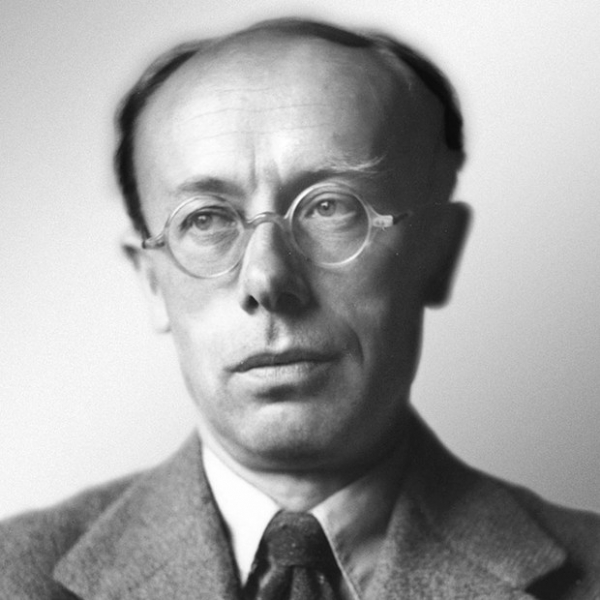
Max Newman
It so happened that Newman had an idea for working on calculations required by Turing's method — through the creation of a machine. At Bletchley, they were already accustomed to using machines for cryptanalysis. That's how Enigma was broken. However, Newman envisioned a specific electronic device for working on the Tani cipher. Before the war, he taught at Cambridge (one of his students was Alan Turing) and was aware of the electronic counters built by Wynn-Williams for counting particles at Cavendish. The idea was as follows: if two closed-loop films, running at high speed, could be synchronized — one containing the key and the other the encrypted message — and each element was counted by a processor tallying the deltas, then the electronic counter could sum the results. By reading the final count at the end of each run, one could determine if the key was potentially valid or not.
It turned out that there was a group of engineers with the right experience. Among them was Wynn-Williams himself. Turing recruited Wynn-Williams from the radar laboratory in Malvern to help create a new rotor for the machine decrypting Enigma, using electronics to count the rotations. He was assisted in this and another project related to Enigma by three engineers from the Post Office Research Station in Dollis Hill: William Chandler, Sidney Broadhurst, and Tommy Flowers (it’s worth noting that the British Post was a high-tech organization, responsible not only for mail but also for telegraphy and telephony). Both projects failed, leaving the men without work. Newman gathered them together. He appointed Flowers as the lead of the team creating the "combining device," which was supposed to count deltas and transmit the results to the counter being developed by Wynn-Williams.
Newman assigned engineers to construct machines, while the Women's Royal Navy Service managed his machines for message processing. The government entrusted high leadership positions only to men, while women effectively served as operators in Bletchley — they handled both message transcription and decoding setups. They seamlessly transitioned from clerical work to managing the machines that automated their tasks. They whimsically named their machine "", the British equivalent of [both were cartoonist illustrators who depicted extremely complex, cumbersome, and convoluted devices that performed very simple functions / translator's note].
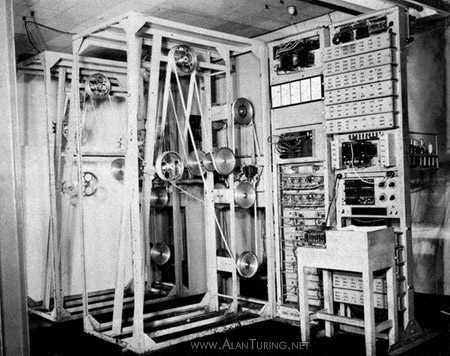
The machine "Old Robinson", very similar to its predecessor, the "Hit Robinson" machine
Indeed, while theoretically reliable, the "Hit Robinson" suffered from serious practical issues. Chief among them was the necessity for perfect synchronization between two films — the encrypted text and the key text. Any stretching or slipping of either film rendered the entire pass useless. To minimize the risk of errors, the machine processed no more than 2000 characters per second, although the belts could operate faster. Flowers, who reluctantly agreed to work on the "Hit Robinson" project, believed there was a better way: a machine almost entirely built from electronic components.
Colossus
Thomas Flowers worked as an engineer in the British post office's research division from 1930, where he initially labored on investigating faulty and unsuccessful connections in new automatic telephone exchanges. This led him to contemplate how to create an improved version of the telephone system, and by 1935 he began advocating for the replacement of electromechanical components in the system, such as relays, with electronic ones. This goal defined the rest of his career.
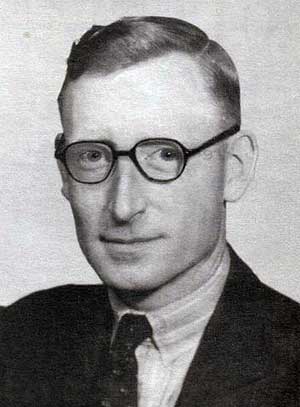
Tommy Flowers, around 1940
Most engineers criticized electronic components for their capriciousness and unreliability when used on a large scale, but Flowers demonstrated that if used continuously and at powers significantly below rated values, electronic tubes actually exhibit remarkably long lifespans. He proved his ideas by replacing all terminals that transmitted a tonal signaling on a switch serving 1000 lines with tubes; there were a total of 3-4 thousand of them. This installation was put into real operation in 1939. During the same period, he experimented with replacing relay registers that stored telephone numbers with electronic relays.
Flowers believed that the 'Hit Robinson' machine, for which he was hired, had serious shortcomings and that he could solve this problem much better by using more tubes and fewer mechanical parts. In February 1943, he presented an alternative machine design to Newman. Flowers cleverly eliminated the key film, resolving the synchronization issue. His machine was supposed to generate the key text on the fly. It was meant to electronically simulate Turing by going through all wheel settings and comparing each one with the encrypted text, recording likely matches. He estimated that such an approach would require about 1500 electronic tubes.
Newman and the rest of the Bletchley leadership viewed this proposal skeptically. Like most of Flowers' contemporaries, they doubted whether electronics could be made to work at such scales. Moreover, even if it could be made to work, they doubted that such a machine could be built in time to be useful in the war.
The head of Flowers at Dollis Hill eventually gave him the green light to gather a team for the creation of this electronic monster—Flowers may not have entirely honestly conveyed to him how much his idea was appreciated at Bletchley (If Andrew Hodges is to be believed, Flowers told his boss, Gordon Radley, that the project was critical work for Bletchley, and Radley had already heard from Churchill that Bletchley's work was absolutely a priority). Besides Flowers, Sydney Broadhurst and William Chandler played significant roles in developing the system, and the entire endeavor employed almost 50 people, half of Dollis Hill's resources. The team was inspired by precedents used in telephony: counters, branching logic, routing and signal translation equipment, and hardware for periodic equipment status measurements. Broadhurst was a master of such electromechanical schemes, while Flowers and Chandler were electronics experts who understood how to transfer concepts from the relay world to the valve world. By early 1944, the team presented a working model at Bletchley. The giant machine was named "Colossus" and quickly proved that it could surpass "Robinson's Hit", reliably processing 5000 characters per second.
Newman and the rest of the management at Bletchley quickly realized they were mistaken in denying Flowers. In February 1944, they ordered another 12 "Colossi", which were to be operational by June 1 — the date set for the invasion of France, although of course, Flowers was unaware of this. Flowers flatly stated that it was impossible, but with heroic efforts, his team managed to deliver the second machine by May 31, into which the new team member, Alan Coombs, made numerous enhancements.
The revised design, known as Mark II, continued the success of the first machine. In addition to the film feeding system, it consisted of 2400 lamps, 12 rotating switches, 800 relays, and an electric typewriter.
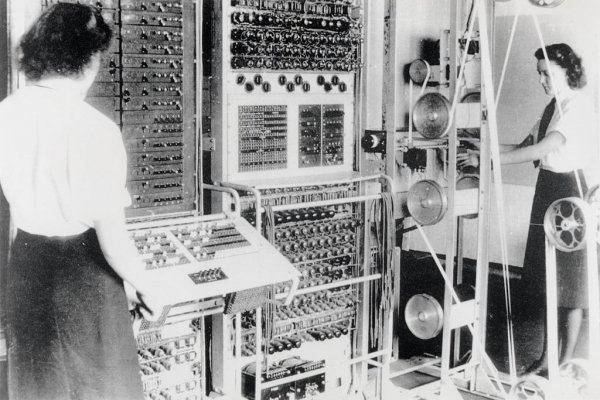
Colossus Mark II
It was customizable and flexible enough to perform various tasks. After installation, each of the female teams configured their "Colossus" to solve specific problems. A control panel, similar to that used by telephone operators, was needed to set up electronic rings that simulated the Turing wheels. A set of switches allowed operators to configure any number of functional devices handling two streams of data: the external tape and the internal signal generated by the rings. By combining a set of different logical elements, the "Colossus" could perform calculations of arbitrary Boolean functions based on the data, meaning functions that would output either 0 or 1. Each unit incremented the "Colossus" counter. A separate control device made branching decisions based on the counter state—for instance, stop and print the output if the counter value exceeded 1000.
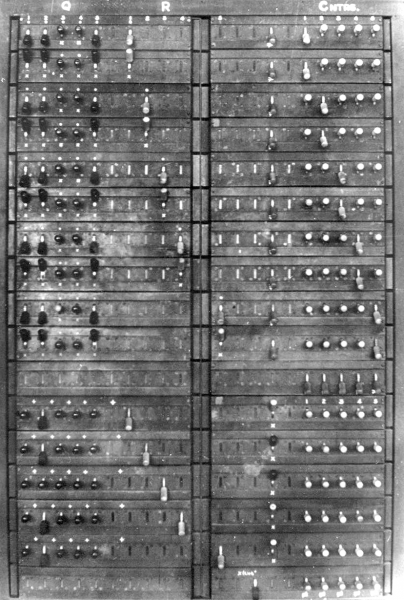
The switch panel for configuring the "Colossus"
Let’s assume that the "Colossus" was a programmable general-purpose computer in the modern sense. It could logically combine two streams of data—one on the tape and one generated by the ring counters—and count the number of encountered units, and that was it. Most of the "programming" of the "Colossus" took place on paper, and operators executed a decision tree prepared by analysts: for example, "if the system output is less than X, set the configuration to B and execute Y, otherwise execute Z."
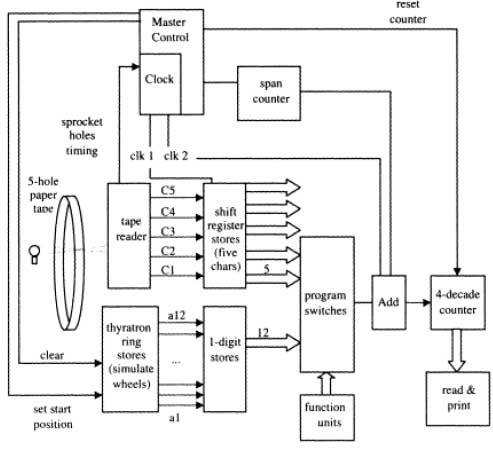
High-level flowchart for the "Colossus"
Nevertheless, the "Colossus" was capable of tackling the task it was given. Unlike the Atanasoff-Berry computer, the "Colossus" was extremely fast—it could process 25,000 characters per second, each of which might require several Boolean operations. Mark II increased the speed fivefold compared to Mark I, reading and processing five different sections of tape simultaneously. It avoided tying the entire system to slow electromechanical I/O devices, using photoelectric cells (taken from anti-aircraft ) for reading incoming tapes and a registry for buffering output to the typewriter. The team leader who restored the 'Colossus' in the 1990s demonstrated that, in his field, he could still easily outperform a computer based on a Pentium processor from 1995.
This powerful word processing machine became the center of the Tanni codebreaking project. By the end of the war, ten more Mark IIs were built, with panels stamped one at a time each month by postal factory workers in Birmingham, who had no idea what they were producing, and then assembled in Bletchley. One irritated official from the Ministry of Supply, upon receiving another request for a thousand special valves, wondered if the postal workers were 'shooting them at the Germans.' Thus, using such an industrial method, rather than handcrafting a customized project, the next computer would not be produced until the 1950s. According to Flowers' instructions for safeguarding the valves, each 'Colossus' operated day and night until the end of the war. They stood, quietly glowing in the dark, warming the damp British winter, patiently awaiting instructions until the day came when they were no longer needed.
The Veil of Silence
Natural enthusiasm for the intriguing drama unfolding in Bletchley led to excessive exaggeration of this organization's wartime achievements. It is terribly absurd to imply, as the film '' suggests, that British civilization would cease to exist without Alan Turing. The 'Colossus' apparently had no impact on the course of the war in Europe. Its most publicized achievement was proving that the deception plan regarding the Normandy landings in 1944 worked. Messages received through Tanni indicated that the Allies successfully convinced Hitler and his command that the true strike would come further east, at Pas-de-Calais. Encouraging information, but it is unlikely that a reduction in cortisol levels in the Allied command helped win the war.
On the other hand, the technological achievements presented by the 'Colossus' were indisputable. But the world would not learn about it anytime soon. Churchill ordered that all existing Colossi at the end of the game be dismantled, and the secrets of their operation sent to the dump along with them. Two machines somehow survived this death sentence and remained part of British intelligence until the 1960s. Yet even then, the British government did not lift the veil of silence regarding operations at Bletchley. It wasn't until the 1970s that its existence became public knowledge.
The decision to permanently ban any discussion of the works conducted at Bletchley Park could be called excessive caution on the part of the British government. But for Flowers, it was a personal tragedy. Deprived of all the merits and prestige of being the inventor of the 'Colossus,' he endured dissatisfaction and disappointment as his constant attempts to replace relays with electronics in the British telephone system were continually blocked. Had he been able to showcase his achievement through the 'Colossus,' he would have had the influence necessary to realize his dream. But by the time his achievements became known, Flowers had long since retired and could not effect any change.
A few scattered enthusiasts of electronic computing around the world suffered from similar problems related to the secrecy surrounding the 'Colossus' and the lack of evidence for the viability of this approach. Electromechanical computing could remain dominant for a while longer. However, there was another project that would pave the way for the rise of electronic computing. Although it too was the result of secret military developments, it was not hidden after the war; on the contrary, it was introduced to the world with great fanfare, under the name ENIAC.
What to Read:
• Jack Copeland, ed. Colossus: The Secrets of Bletchley Park’s Codebreaking Computers (2006)
• Thomas H. Flowers, “The Design of Colossus,” Annals of the History of Computing, July 1983
• Andrew Hodges, Alan Turing: The Enigma (1983)
Source: habr.com
