

Other articles in the series:
- The History of Relays
- The History of Electronic Computers
- The History of the Transistor
- The History of the Internet
Through ARPANET, Robert Taylor and Larry Roberts many different research institutions, each with its own computer for which it bore full responsibility regarding software and hardware. However, the software and hardware of the network itself existed in a vague middle ground and did not belong to any of these places. Between 1967 and 1968, Roberts, head of the network project at the Information Processing Technology Office (IPTO), had to determine who would build and maintain the network and where the boundaries between the network and the institutions should lie.
Skeptics
The problem of structuring the network was at least as much a political issue as it was a technical one. The scientific leaders of the ARPA research centers generally disapproved of the ARPANET concept. Some clearly demonstrated a lack of desire to join the network at any point; few were enthusiastic. Each center would have to make serious efforts to allow others to use their very expensive and rare computers. Providing such access demonstrated clear drawbacks (loss of a valuable resource), while its potential benefits remained uncertain and vague.
The same skepticism toward shared resource access had sunk the network project at the University of California, Los Angeles, a few years earlier. However, in this case, ARPA had significantly more leverage, as it was directly funding all these valuable computing resources and maintained control over all the financial flows associated with their research programs. And although no direct threats were made and no 'or else' was voiced, the situation was abundantly clear – one way or another, ARPA intended to build its network to unite machines that, in practice, still belonged to it.
The moment came during a meeting of scientific leaders in Ann Arbor, Michigan, in the spring of 1967. Roberts presented his plan to create a network connecting various computers at each of the centers. He announced that each leader would equip their local computer with special network software that it would use to call other computers over the telephone network (this was before Roberts learned about the idea). The response was filled with disputes and fears. Among the least inclined to embrace this idea were the largest centers already working on significant projects funded by IPTO, with MIT being the foremost. Researchers at MIT, awash in money gained from developing the Project MAC time-sharing system and the artificial intelligence laboratory, saw no benefits in sharing their hard-earned resources with any riffraff from the West.
And, regardless of their status, each center cherished its own ideas. Each had its unique programs and equipment, and it was difficult to understand how they could even establish the simplest connection with one another, let alone engage in real collaborative work. Just writing and launching network programs for their machine would consume a significant amount of their time and computational resources.
Ironic yet surprisingly fitting was the fact that the solution to these social and technical problems, proposed by Roberts, came from Wes Clark, a person who was disdainful of both time-sharing and networks. Clark, an advocate of the quixotic idea of providing a personal computer to every individual, had no intention of sharing computing resources with anyone and kept his own campus, Washington University in St. Louis, far from the ARPANET for many years. Therefore, it is no surprise that it was he who developed a network project that did not add significant load to the computational resources of each center and did not require them to expend effort on creating special software.
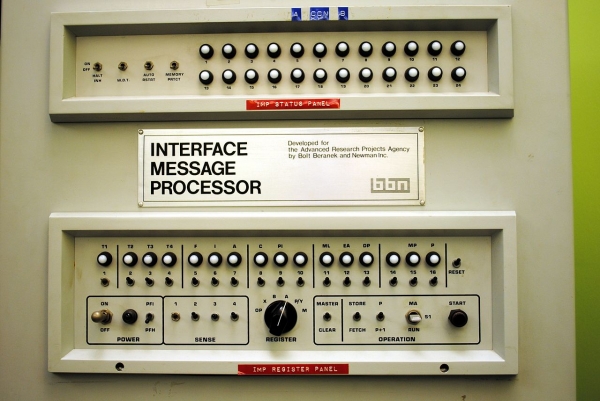
Clark proposed placing a mini-computer in each center to handle all functions directly related to the network. Each center was left to figure out how to connect to its local assistant (later called message interface processors, or ), which would then send messages along the correct route to reach the appropriate IMP at the receiving end. Essentially, he suggested that ARPA distribute additional free computers to each center that would take on most of the network's resource load. At a time when computers were still rare and very expensive, this proposal was bold. However, mini-computers were just beginning to emerge, costing only tens of thousands of dollars instead of several hundred, making the proposal fundamentally feasible (eventually, each IMP cost $45,000, or about $314,000 in today's money).
The approach using IMPs alleviated the concerns of the scientific managers regarding network load on their computational capabilities and also addressed another political issue for ARPA. Unlike other projects of the agency at the time, the network was not limited to a single research center run by one supervisor. Moreover, ARPA did not have the capability to independently create and manage a large-scale technical project. It would have had to hire outside companies for that. The presence of IMPs created a clear division of responsibility between the externally managed network and the locally managed computers. The contractor would control the IMPs and everything in between, while the centers remained responsible for the hardware and software on their own computers.
IMP
After that, Roberts needed to choose this contractor. The old-fashioned approach of Licklider appealing directly to a favored researcher did not apply in this case. The project had to be put out for public auction, just like any other government contract.
It wasn't until July 1968 that Roberts was able to finalize the details of the bidding application. About six months had passed since the last technical piece of the puzzle fell into place when the packet switching system was discussed at the conference in Gatlinburg. The two largest computer manufacturers, Control Data Corporation (CDC) and International Business Machines (IBM), immediately declined to participate, as they did not have affordable mini-computers suitable for the role of IMP.
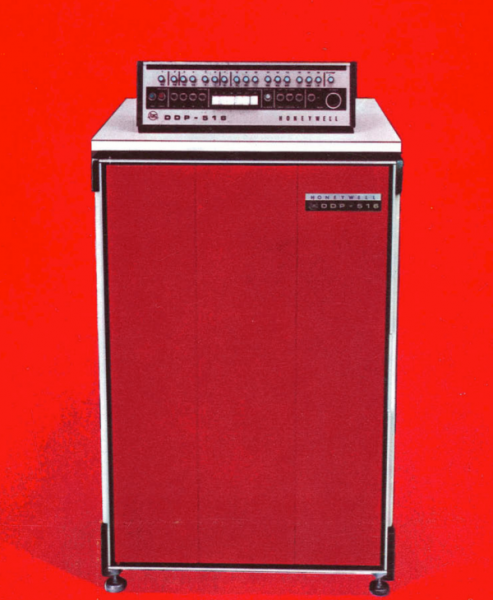
Honeywell DDP-516
Among the remaining participants, most chose the new computer from Honeywell, although some leaned towards . The Honeywell option was particularly attractive as it had an input/output interface specifically designed for real-time systems, for applications such as industrial equipment control. Communication also required appropriate precision – if the computer missed an incoming message while busy with another task, there would be no second chance to catch it.
By the end of the year, seriously contemplating the candidacy of Raytheon, Roberts assigned this task to a burgeoning Cambridge firm founded by Bolt, Beranek, and Newman. The family tree of interactive computing had by then become extraordinarily intertwined, and Roberts could easily be accused of nepotism for choosing BBN. Licklider brought interactive computing to BBN before becoming the first director of IPTO, planting the seeds of his intergalactic network and nurturing individuals like Roberts. Without Lick's influence, ARPA and BBN would neither have been interested in nor capable of supporting the ARPANET project. Moreover, a key part of the team assembled by BBN to create the network based on IMP came directly or indirectly from the Lincoln labs: Frank Hart (team leader), Dave Walden, and Severo Orenstein. It was in the labs that Roberts was in graduate school, and it was there that an accidental encounter between Lick and Wes Clark sparked his interest in interactive computers.
However, although this situation might have appeared to be collusion, the BBN team was just as well adapted for real-time work as Honeywell 516. In Lincoln, they worked on computers connected to radar systems—another example where data cannot wait for the computer to be ready. Hart, for instance, worked on the Whirlwind computer as a student in the 1950s, joined the SAGE project, and spent a total of 15 years in the Lincoln labs. Ornstein worked on the SAGE cross-protocol, transmitting radar tracking data from one computer to another, and later on LINC by Wes Clark, a computer developed to assist scientists right in the lab by working with data in real time. Crowther, now best known as the author of the text game , spent ten years creating real-time systems, including Lincoln's experimental terminal, a mobile satellite communication station with a small computer controlling the antenna and processing incoming signals.
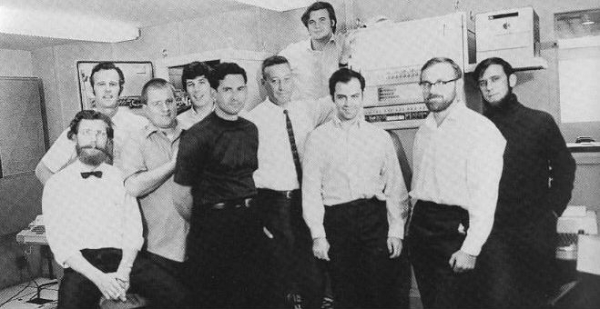
The IMP team at BBN. Frank Hart is the older man in the center. Ornstein is standing on the right side, next to Crowther.
The IMP was responsible for understanding and managing the routing and delivery of messages from one computer to another. A computer could send up to 8,000 bytes at a time to a local IMP, along with the recipient's address. The IMP would then slice the message into smaller packets, which were transmitted independently to the target IMP over lines supporting a speed of 50 kbps, leased from AT&T. The receiving IMP would reassemble the message piece by piece and deliver it to its computer. Each IMP maintained a table that tracked which of its neighbors had the fastest route to any possible destination. This table was dynamically updated based on information received from those neighbors, including info about any neighbor being unavailable (in which case the delay for sending in that direction was considered infinite). To meet the speed and bandwidth requirements set forth by Roberts for all these processing tasks, Hart's team created code that was a work of art. The entire processing program for the IMP took up only 12,000 bytes, with the part that handled routing tables occupying just 300.
The team also took several precautions, considering that assigning a support team to each IMP on-site was impractical.
First, they equipped each computer with devices for remote tracking and management. In addition to automatic rebooting, which started after each power outage, the IMPs were programmed to be able to reboot their neighbors by sending them new versions of the operating software. To assist with debugging and analysis, the IMP could, upon command, start taking snapshots of its current state at regular intervals. Additionally, each packet had tracking information attached, which allowed for more detailed operational logs. With all these capabilities, many problems could be solved directly from the BBN office, which served as a control center where the status of the entire network could be monitored.
Secondly, they requested a military version of the 516 computer from Honeywell, equipped with a thick case to protect it from vibrations and other threats. BBN primarily wanted to signal 'stay away' to curious graduate students, but nothing delineated the boundary between local computers and the subnet managed by BBN as clearly as this armored case.
The first reinforced cabinets, about the size of a refrigerator, arrived at the University of California, Los Angeles (UCLA) on August 30, 1969, just eight months after BBN received its contract.
Hosts
Roberts decided to start the network with four hosts – in addition to UCLA, an IMP would be installed up the coast at the University of California, Santa Barbara (UCSB), another at the Stanford Research Institute (SRI) in Northern California, and the last one at the University of Utah. All were second-tier institutions from the West Coast trying to make a name for themselves in scientific computing. Familial ties remained strong, as two of the faculty advisors, from UCLA and from the University of Utah, were also former colleagues of Roberts at the Lincoln Laboratories.
Roberts assigned additional network-related functions to two hosts. Doug Engelbart from SRI had volunteered in a 1967 leadership meeting to establish a network information center. Using an elaborate information retrieval system at SRI, he planned to create a telephone directory for ARPANET: an organized collection of information about all resources available on various nodes, accessible to all network participants. Given Kleinrock's experience in analyzing network traffic, Roberts designated UCLA as the Network Measurement Center (NMC). For Kleinrock and UCLA, ARPANET was intended to be not only a practical tool but also an experiment from which data could be extracted and generalized to apply the insights gained to improve the network and its successors.
However, more important for the development of ARPANET than these two purposes was a more informal and loosely defined community of graduate students known as the 'Network Working Group' (NWG). The IMP subnet allowed any host on the network to reliably deliver a message to any other; the task of the NWG was to develop a common language or set of languages that hosts could use to communicate. They called them 'host protocols.' The term 'protocol,' borrowed from diplomats, was first applied to networks in 1965 by Roberts and Tom Marill to describe both the format of data and the procedural steps that define how two computers communicate with each other.
Under the informal but effective leadership of Steve Crocker from UCLA, NWG began to meet regularly from the spring of 1969, about six months before the first IMP appeared. Crocker was born and raised in the Los Angeles area, attending Van Nuys High School, being a contemporary of his future NWG colleagues, Vint Cerf and Jon Postel. To document the outcomes of some group meetings, Crocker developed one of the cornerstones of ARPANET culture (and future internet), the 'request for comments' [RFC].His RFC 1, published on April 7, 1969, and distributed to all future ARPANET nodes via traditional mail, gathered the early discussions of the group regarding the design of software for the host protocol. In RFC 3, Crocker continued to outline the process for formalizing all future RFCs, defining it quite loosely.
Comments are better sent on time than perfected. Philosophical opinions without examples or other specifics, certain proposals or implementation technologies without introductory descriptions or contextual clarifications, specific questions without attempts to answer them are accepted. The minimum length for an NWG note is one sentence. We hope to facilitate the exchange of ideas and discussions about informal concepts.
Like a request for quotation [запрос котировок] (RFQ), the standard way to request bids for government contracts, RFC welcomed any response, but unlike RFQ, it also invited dialogue. Anyone from the distributed NWG community could submit an RFC and use this opportunity to discuss, ask questions, or critique previous proposals. Of course, as in any community, some opinions were valued more highly than others, and in the early days, Crocker's views and those of his core group of associates held significant authority. In July 1971, Crocker left UCLA, still a graduate student, to take a position as program manager at IPTO. With key research grants from ARPA at his disposal, he had undeniable influence, willingly or not.
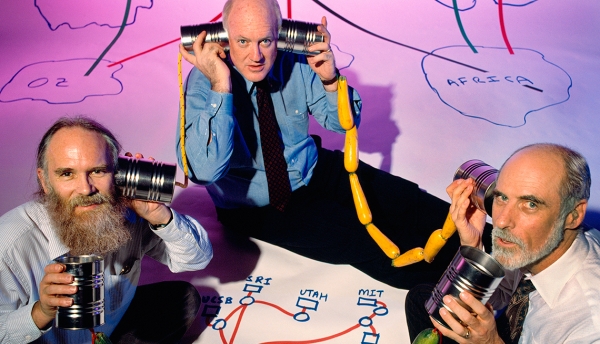
John Postel, Steve Crocker, and Vint Cerf were classmates and colleagues in NWG; later years
The original NWG plan called for the introduction of two protocols. Remote login (telnet) allowed one computer to function as a terminal connected to the operating system of another, spreading an interactive environment of any time-sharing system on ARPANET thousands of miles to any user on the network. The file transfer protocol FTP enabled one computer to transfer a file, for example, a useful program or data set, to or from the storage of another system. However, at Roberts' insistence, NWG added a third basic protocol to support these two, establishing a foundational connection between two hosts. It was called the network control program (NCP). Now the network had three levels of abstraction – a packet subnet managed by IMP at the lowest level, host-to-host communication provided by NCP in the middle, and application protocols (FTP and telnet) at the top.
Failure?
It was not until August 1971 that NCP was fully defined and implemented across the network, which at that time consisted of fifteen nodes. Soon followed implementations of the telnet protocol, and the first stable definition of FTP emerged a year later, in the summer of 1972. Evaluating the state of ARPANET during that period, just a few years after it was first launched, it could be considered a failure compared to the dream of resource sharing envisioned by Licklider and practically realized by his protégé, Robert Taylor.
Initially, it was simply difficult to determine what resources existed on the network that could be utilized. The network's information center used a voluntary participation model—each node had to provide updated information about the availability of its data and programs. While everyone would benefit from such actions, each individual node had little motivation to promote its resources and provide access to them, let alone maintain up-to-date documentation or consultations. Therefore, NIC could not become a network directory. Perhaps its most important function in the early years was to facilitate the electronic publication of the growing set of RFCs.
Even if, say, Alice from UCLA was aware of a useful resource at MIT, a more serious obstacle emerged. Telnet allowed Alice to reach the login screen at MIT, but no further. In order for Alice to actually access a program at MIT, she first needed to negotiate with MIT offline to have them create an account for her on their computer, which typically required filling out paper forms at both institutions and a funding agreement to cover the costs of using MIT's computing resources. Due to incompatibilities between hardware and system software among nodes, file transfers often made little sense, as you could not execute programs from remote computers on your own.
Ironically, the most significant success of resource sharing was not in the realm of interactive time-sharing for which ARPANET was created, but rather in the area of old-fashioned non-interactive data processing. UCLA added its idle IBM 360/91 for batch data processing to the network and provided phone support consultations for remote users, which generated significant revenue for the computer center. The ILLIAC IV supercomputer from the University of Illinois, sponsored by ARPA, and the Datacomputer at Computer Corporation of America in Cambridge also found remote clients via ARPANET.
However, none of these projects came close to fully utilizing the network. In the fall of 1971, with 15 hosts online, the network as a whole transmitted an average of 45 million bits through each node, or 520 bits/s over the leased lines from AT&T with a bandwidth of 50,000 bits/s. Moreover, most of this traffic was test data generated by the network measurement center at UCLA. Aside from the enthusiasm of some early users (for example, Steve Carr, who daily used a PDP-10 located at the University of Utah from Palo Alto), not much was happening on ARPANET. From a modern perspective, perhaps the most interesting event was the launch of the digital library 'Project Gutenberg' in December 1971, organized by Michael Hart, a student at the University of Illinois.
But soon ARPANET was saved from charges of stagnation by a third application protocol – a small thing called email.
Further reading
• Janet Abbate, Inventing the Internet (1999)
• Katie Hafner and Matthew Lyon, Where Wizards Stay Up Late: The Origins of the Internet (1996)
Source: habr.com
