

<< Before this:
From around 1975 to 1995, computers became accessible much faster than computer networks. Initially in the U.S., and later in other wealthy countries, computers became commonplace in affluent households and appeared in nearly all institutions. However, when users of these computers wanted to connect their machines—for exchanging emails, downloading software, or finding communities to discuss their favorite hobbies—they had very few options. Home users could connect to services like CompuServe. However, until the late 1980s when services introduced a fixed monthly fee, connection costs were charged by the hour, making rates unaffordable for many. Some university students and faculty could connect to packet-switched networks, but for most, this was not an option. By 1981, only 280 computers had access to ARPANET. CSNET and BITNET eventually included hundreds of computers, but they only started operating in the early 1980s. At that time, the U.S. had over 3,000 institutions where students received higher education, and nearly all of them had a few computers, from large mainframes to small workstations.
Communities, hobbyists, and academics who lacked access to the network turned to similar technical solutions that allowed them to connect with one another. They hacked the old telephone system, Bell's network, transforming it into something like a telegraph that transmitted digital messages instead of voices, and based on this, messages were sent from computer to computer across the country and around the world.
All articles in the series:
- The History of Relays
- The History of Electronic Computers
- The History of the Transistor
- The History of the Internet
- The Era of Fragmentation
These were among the earliest decentralized [peer-to-peer, p2p] computer networks. Unlike CompuServe and other centralized systems where computers connected to pull information like calves sucking milk, information spread through decentralized networks like ripples on water. It could begin anywhere and go anywhere. Still, heated debates about politics and power arose within them. When the internet captured the community's attention in the 1990s, many believed it would equalize social and economic ties. Allowing everyone to connect with everyone, intermediaries and bureaucrats, who dominated our lives, would be cut off. A new era of direct democracy and open markets was to dawn, where everyone would have an equal voice and equal access. Such prophets might have refrained from such promises had they studied the fates of Usenet and Fidonet of the 1980s. Their technical structure was very flat, but any computer network is just a part of human community. And human communities, no matter how much you spread and roll them out, remain full of clumps.
Usenet
In the summer of 1979, Tom Truscott's life resembled a dream for any young computer enthusiast. He had recently graduated with a degree in computer science from Duke University, was interested in chess, and was interning at Bell Labs in New Jersey. It was there that he had the opportunity to interact with the creators of Unix – the latest craze sweeping the world of scientific computing.
The roots of Unix, like those of the internet itself, lie in the shadows of American telecommunications policy. and In the late 1960s, Bell Labs aimed to create a more flexible and streamlined version of the massive Multics system from MIT, in which they participated as programmers. The new OS quickly became popular in the labs, attracting attention due to its modest hardware requirements (allowing it to run even on inexpensive machines) and high flexibility. However, AT&T was unable to profit from this success. According to an agreement from 1956 with the U.S. Department of Justice, AT&T was required to sell licenses for all non-telephony-related technologies at reasonable prices and was prohibited from engaging in any other business besides providing communications.
As a result, AT&T began selling Unix licenses to universities for scientific use under very favorable terms. The first licensees who gained access to the source code started creating and selling their own versions of Unix, notably the Berkeley Software Distribution (BSD) Unix, developed at the flagship campus of the University of California. The new OS quickly swept through the academic community. Unlike other popular operating systems like DEC TENEX / TOPS-20, it could run on hardware from various manufacturers, many of which were quite affordable. Berkeley distributed the software at a minimal cost, in addition to the modest license fee from AT&T. Unfortunately, I could not find exact figures.
Traskot felt that he was at the source of all things. He spent the summer interning with Ken Thompson, starting each day with a few volleyball matches, then working until noon, sharing pizza dinners with his idols, and staying up late writing code for Unix in C. Upon completing his internship, he didn’t want to lose touch with this world, so as soon as he returned to Duke University in the fall, he figured out how to connect a PDP 11/70 computer from the computer science department to the mothership in Murray Hill using a program written by his former colleague, Mike Lesk. The program was called uucp—Unix to Unix copy—and was part of the set of 'uu' programs included in the recently released Unix version 7. The program allowed one Unix system to connect to another via modem. Specifically, uucp enabled file transfers between two modem-connected computers, allowing Traskot to exchange emails with Thompson and Ritchie.
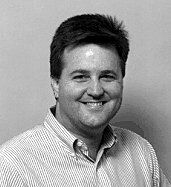
Tom Traskot
Jim Ellis, another graduate student from Traskot's institute, installed the new version of Unix 7 on Duke University's computer. However, the update brought both advantages and disadvantages. A program called USENIX, distributed by the Unix user group for sending news among all users of a specific Unix system, stopped working in the new version. Traskot and Ellis decided to replace it with their own new program compatible with the 7th system, adding more interesting features, and to return the improved version to the user community in exchange for prestige and honor.
At the same time, Traskot used uucp to connect to a Unix machine located at the University of North Carolina, 15 kilometers southwest in Chapel Hill, and communicated with a student there, Steve Belovin.
It is unknown how Traskot and Belovin met, but it’s possible that they bonded over chess. Both participated in the annual chess tournament of the Computer Systems Association, although not at the same time.
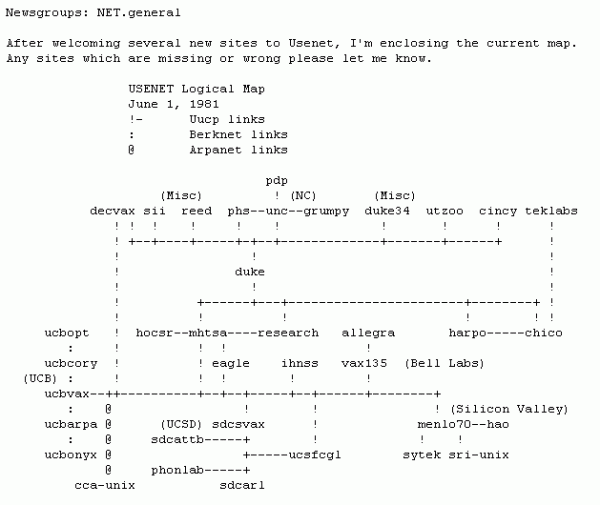
Bélovin also created his own news dissemination program, which interestingly had the concept of news groups categorized by topics to subscribe to—rather than a single channel where all news was aggregated. Bélovin, Traskot, and Ellis decided to join forces to write a network news system with news groups that would use UUCP to distribute news across different computers. They wanted to share Unix-related news with USENIX users, thus naming their system Usenet.
Duke University was meant to serve as the central information and analytics hub, utilizing autodial and UUCP to connect with all nodes in the network at regular intervals, fetching news updates and distributing news from other network members. Bélovin wrote the initial code, but it operated on shell scripts, making it very slow. Then Stephen Daniel, another graduate student from Duke University, rewrote the program in C. Daniel's version became known as A News. Ellis promoted this program in January 1980 at the Usenix conference in Boulder, Colorado, distributing all eighty copies he brought with him. By the next Usenix conference in the summer, the organizers had already included A News in the software package distributed to all participants.
The creators described this system as "ARPANET for the poor." You might not consider Duke University to be second-rate, but at that time it didn't have the kind of influence in the world of computing that would allow it to connect to that premium American computer network. However, access to Usenet required no special permissions—only a Unix system, a modem, and the ability to pay telephone bills for regular news transmission. By the early 1980s, virtually all educational institutions offering higher education could meet these requirements.
Private companies also joined Usenet, which accelerated the spread of the network. Digital Equipment Corporation (DEC) agreed to act as an intermediary between Duke University and the University of California, Berkeley, reducing the costs of long-distance calls and data transfer between the coasts. As a result, Berkeley on the West Coast became the second node of Usenet, connecting the network with the University of California campuses in San Francisco and San Diego, as well as other institutions, including Sytek, one of the first companies engaged in LAN-related business. Berkeley also housed an ARPANET node, allowing for connection between Usenet and ARPANET (after the news exchange program was rewritten again by Mark Horton and Matt Glickman, naming it B News). ARPANET nodes began pulling content from Usenet and vice versa, although ARPA rules technically prohibited interconnection with other networks. The network grew rapidly, from fifteen nodes processing ten posts a day in 1980, to 600 nodes and 120 posts in 1983, and then 5,000 nodes and 1,000 posts in 1987.
Initially, its creators viewed Usenet as a communication method for the Unix user community and for discussing the development of this OS. To this end, they created two groups, net.general and net.v7bugs (the latter discussed issues with the latest version). However, they left the system open for free expansion. Anyone could create a new group in the 'net' hierarchy, and users quickly began adding topics far removed from technical matters, for example, net.jokes. Just as anyone could send anything, recipients could ignore groups at their discretion. For instance, a system could connect to Usenet and request data only from the net.v7bugs group, ignoring the rest of the content. Unlike the meticulously planned ARPANET, Usenet was self-organized and grew in an anarchic manner without top-down oversight.
However, a hierarchical order quickly emerged in this artificially democratic environment. A certain set of nodes with many connections and high traffic came to be regarded as the 'backbone' [backbone] of the system. This process developed organically. As each data transmission from one node to another added latency in communications, every new node connecting to the network wanted to link with a node that already had many connections to minimize the number of 'hops' required to propagate its messages across the network. Among the backbone nodes were both educational and corporate organizations, and usually, every local computer was managed by some quirky individual who voluntarily took on the thankless job of administering everything that passed through the computer. Such were Gary Murakami from Bell Labs in Indian Hills, Illinois, or Gene Spafford from the Georgia Institute of Technology.
The most significant display of power by the administrators of these backbone nodes occurred in 1987 when they pushed through a reorganization of the namespace of newsgroups by introducing seven new top-level sections. There were sections such as comp for computer topics and rec for entertainment. Subsections were hierarchically organized under the 'big seven' – for example, the group comp.lang.c for discussion of the C language and rec.games.board for discussions about board games. A group of rebels, considering this change a coup orchestrated by the 'Backbone Clique', created their own branch from the hierarchy, with the main directory titled alt, and their parallel backbone. This included topics deemed inappropriate for the big seven – for example, sex and soft drugs (alt.sex.pictures), as well as various quirky communities that displeased the admins (for example, alt.gourmand; admins preferred the innocuous group rec.food.recipes).
By that time, software supporting Usenet had expanded beyond the distribution of regular text and introduced support for binary files (named so because they contained arbitrary binary digits). Most commonly among the files were pirated computer games, pornographic images and movies, bootleg concert recordings, and other illegal material. Groups in the alt.binaries hierarchy became some of the most blocked on Usenet servers due to their combination of high cost (images and videos consumed much more bandwidth and storage than text) and controversial legal status.
However, despite all this controversy, by the end of the 1980s, Usenet had become a place where computer enthusiasts could find international communities of like-minded individuals. In just 1991 alone, Tim Berners-Lee announced the creation of the World Wide Web in the alt.hypertext group; Linus Torvalds requested feedback in the comp.os.minix group about his new small project, Linux; Peter Adkison, through a post about his gaming company in the rec.games.design group, met Richard Garfield. Their collaboration led to the creation of the popular card game Magic: The Gathering.
FidoNet
However, even though ARPANET for the masses gradually spread across the globe, hobbyists with far fewer resources than even the most obscure college were largely cut off from electronic communications. The Unix OS, which was considered a cheap and feisty option by academic standards, was inaccessible to owners of computers with 8-bit microprocessors running the decidedly limited CP/M OS, which could do little more than manage storage. However, they soon began their own simple experiment to create a very low-cost decentralized network, and it all started with the creation of bulletin boards.
It is possible that due to the simplicity of the idea and the vast number of computer enthusiasts at the time, (BBS) could have been invented several times. But traditionally, priority is given to the project and from Chicago, which they launched during the Kristensen and Sueess were computer enthusiasts in their 30s, both attending a local computer club. They had long planned to create their own server in the club where members could upload news articles using the file transfer software Kristensen had written for CP/M—the home equivalent of UUCP. However, a snowstorm that kept them stuck at home for a few days provided the necessary motivation to start working on it. Kristensen mainly handled software, while Sueess focused on hardware. In particular, Sueess developed a circuit that automatically restarted the computer into BBS mode whenever it detected an incoming call. This hack was essential to ensure the system was always ready to receive that call—such was the precarious state of home hardware and software at the time. They named their invention CBBS, a computerized bulletin board, but later most system operators (or sysops) dropped the 'C' for brevity and referred to their service simply as BBS. Initially, BBS was also called RCP/M, which stood for Remote CP/M. They detailed their creation in the popular computing magazine Byte, and soon a crowd of imitators followed them.
The flourishing BBS scene was further enhanced by a new device—the Hayes Modem. Dennis Hayes was another computer enthusiast who was eager to connect a modem to his new machine. However, the commercially available models fell into just two categories: devices designed for business buyers, and thus too expensive for home hobbyists, and . To connect with someone via an acoustic modem, you first had to call someone on the phone or answer a call, and then place the receiver on the modem so it could communicate with the modem on the other end. Automating an outgoing or incoming call in this way was not possible. Therefore, in 1977, Hayes developed, created, and began selling his own modem capable of data transmission at a speed of 300 bits per second, which could be inserted into your computer. In their BBS, Christensen and Suyess used one of these early models of Hayes' modem. However, the first groundbreaking product from Hayes was the Smartmodem of 1981, which came in a separate case, featured its own microprocessor, and connected to the computer via a serial port. It was sold at $299, a reasonable price for hobbyists who typically spent several hundred dollars on their home computers.
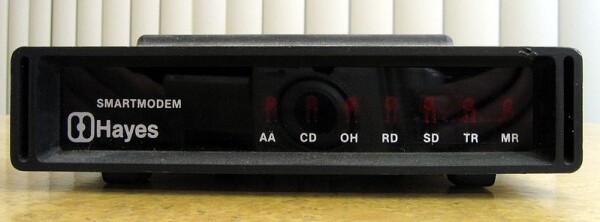
Hayes Smartmodem at 300
One of them was , and he launched a project that became somewhat like Usenet for BBS. He worked as a programmer at Phoenix Software in San Francisco and, in 1983, decided to write his own BBS program, not for CP/M but for the newest and best operating system for microcomputers—Microsoft DOS. He called it Fido [a typical dog name], in honor of the computer he used at work, named so because it was a horrible mix of different components. John Madill, a salesman from ComputerLand in Baltimore, heard about Fido and called Jennings across the country, asking for his help in modifying his program so it could run on his DEC Rainbow 100 computer. This duo began working together on the software, and then another Rainbow enthusiast, Ben Baker from St. Louis, joined them. The trio spent a considerable amount of money on long-distance calls while they logged onto each other's machines at night to chat in their forums.
During all these negotiations on various BBS, Jennings began to conceive an idea – he could create an entire network of BBS that exchanged messages at night, when long-distance charges were low. This idea was not new – many enthusiasts had envisioned such message transmission between BBS since the time of Christensen and Sue's article in Byte. However, they typically assumed that to make this scheme work, a very high density of BBS must first be achieved, along with complex routing rules to keep all calls local, meaning inexpensive, even when transferring messages from one coast to another. However, Jennings quickly calculated and realized that with the rising speeds of modems (amateur modems were already operating at 1200 bits/sec) and decreasing long-distance rates, such tricks were no longer necessary. Even with a significant increase in message traffic, texts could be exchanged between systems for just a few bucks a night.
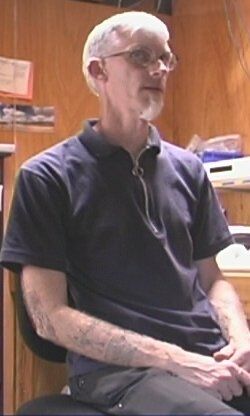
Tom Jennings, a still from the 2002 documentary
Then he added another program to Fido. From one to two in the morning, Fido would close and FidoNet would launch. It would check the outgoing message list in the node list file. Each outgoing message had a node number, and each list item represented a network node – Fido BBS – with the corresponding phone number next to it. If outgoing messages were found, FidoNet would sequentially dial the phones of the corresponding BBS from the node list and transmit them to the FidoNet program waiting for the call on the other end. Suddenly, Madill, Jennings, and Baker had the ability to easily and simply collaborate, albeit at the cost of delayed responses. They did not receive messages during the day; message transmission took place at night.
Before this, enthusiasts rarely connected with other enthusiasts living in different areas, as they primarily called local BBS for free. However, if this BBS was connected to FidoNet, users suddenly gained the ability to exchange emails with others across the country. The scheme quickly became incredibly popular, and the number of FidoNet users began to grow rapidly, reaching 200 within a year. This made it increasingly difficult for Jennings to manage his own node. Therefore, during the first 'FidoCon' meeting held in St. Louis, Jennings and Baker met with Ken Kaplan, another DEC Rainbow fan, who soon took on one of the key roles in managing FidoNet. They devised a new scheme that divided North America into subnetworks, each consisting of local nodes. In each subnetwork, one administrative node took on the responsibility of managing the local list of nodes, received incoming traffic for its subnetwork, and forwarded messages to the appropriate local nodes. Above the subnetworks were zones covering the entire continent. The system still maintained a single global list of nodes containing the phone numbers of all computers connected to FidoNet worldwide, so theoretically any node could directly call any other to deliver messages.
The new architecture allowed the system to continue growing, and by 1986 it had expanded to 1,000 nodes, and by 1989 to 5,000. Each of these nodes (which represented a BBS) had an average of 100 active users. The two most popular applications were the simple mail exchange that Jennings integrated into FidoNet and Echomail, created by Jeff Rush, a sysop of a BBS in Dallas. Echomail was the functional equivalent of Usenet newsgroups and allowed thousands of FidoNet users to engage in public discussions on various topics. The echis, as the individual groups were named, had single titles, unlike the hierarchical Usenet system, ranging from AD&D to MILHISTORY and ZYMURGY (home brewing).
Jennings' philosophical views leaned towards anarchism, and he wanted to create a neutral platform governed solely by technical standards:
I told the users that they can do whatever they want. I have held this view for eight years, and I haven't had any problems with BBS support. The issues arise only with people who have fascist tendencies, seeking to control everything. I believe that if it is clearly stated that the callers monitor compliance with the rules – it’s even uncomfortable for me to say this – if the callers determine the content, they will be able to resist any trolls.
However, as with Usenet, the hierarchical structure of FidoNet allowed some sysops to gain more power than others, leading to rumors of a powerful clique (this time based in St. Louis) wanting to take control of the network from the people. Many feared that Kaplan or others in his circle would try to commercialize the system and start charging for the use of FidoNet. There were particularly strong suspicions regarding the International FidoNet Association (IFNA), a non-profit association that Kaplan founded to cover part of the operational costs of the system (especially long-distance calls). In 1989, it seemed that these suspicions became reality when a group of IFNA leaders pushed for a referendum to make every FidoNet sysop a member of IFNA and to make the association the official organization governing the network, responsible for all its rules and standards. The idea failed, and IFNA disappeared. Of course, the absence of a symbolic governing structure did not mean that there was no real power within the network; administrators of regional node lists implemented their arbitrary rules.
The Shadow of the Internet
From the late 1980s onward, FidoNet and Usenet gradually began to be overshadowed by the shadow of the Internet. By the second half of the following decade, they were completely absorbed by it.
Usenet intertwined with websites on the internet through the creation of the NNTP protocol – the Network News Transfer Protocol – in early 1986. It was conceived by a couple of students from the University of California (one from its San Diego branch, the other from Berkeley). NNTP allowed TCP/IP network nodes on the internet to create news servers compatible with Usenet. Over the years, most of the Usenet traffic was flowing through these nodes rather than through uucp over the old telephone network. The independent uucp network gradually waned, while Usenet became another application operating over TCP/IP. The incredible flexibility of the internet's layered architecture easily allowed it to absorb networks designed for a single application.
Although in the early 1990s there were several gateways between FidoNet and the internet that allowed networks to exchange messages, FidoNet was not the only application, so its traffic did not migrate to the internet as Usenet's did. Instead, when people outside academic circles first began exploring internet access in the late 1990s, BBS gradually either got absorbed by the internet or became obsolete. Commercial BBS fell into the former category. These mini-versions of CompuServe offered access to BBS for a monthly fee to thousands of users, equipped with several modems to handle multiple incoming calls simultaneously. With the emergence of commercial internet access, these businesses connected their BBS to the nearest part of the internet and began providing access to it to their clients through subscriptions. As more websites and services appeared on the burgeoning World Wide Web, fewer users subscribed to the services of individual BBS, leading these commercial BBS to gradually transform into plain internet service providers, ISPs. Most amateur BBS turned into ghost towns as users wanting to connect to the internet switched to local providers and larger organizations like America Online.
All of this is fine, but how did the internet come to dominate so thoroughly? How did a little-known academic system, which spread through elite universities for years while systems like Minitel, CompuServe, and Usenet attracted millions of users, suddenly surge to the forefront and spread like a weed, consuming everything that came before it? How did the internet become the force that ended the era of fragmentation?
What else to read and watch
- Ronda Hauben and Michael Hauben, Netizens: On the History and Impact of Usenet and the Internet, (online 1994, print 1997)
- Howard Rheingold, The Virtual Community (1993)
- Peter H. Salus, Casting the Net (1995)
- Jason Scott, BBS: The Documentary (2005)
Source: habr.com
