

Other articles in the series:
- The History of Relays
- The History of Electronic Computers
- The History of the Transistor
- The History of the Internet
In the first half of the 1970s, the ecology of computer networks diverged from its original ancestor ARPANET and expanded into several different dimensions. Users of ARPANET discovered a new application, email, which became the primary activity on the network. Entrepreneurs launched their own versions of ARPANET to serve commercial users. Researchers worldwide, from Hawaii to Europe, were developing new types of networks to meet needs or fix errors not accounted for by ARPANET.
Almost all participants in this process strayed from the originally defined goal of ARPANET - to provide access to computing machines and programs for a diverse range of research centers, each with its own unique resources. Computer networks became primarily a means of bringing people together either with each other or with remote systems that served as sources or dumps of human-readable information, for example, with databases or printers.
This possibility was foreseen by Licklider and Robert Taylor, although it was not this goal they were trying to achieve by launching the first networking experiments. Their 1968 paper 'The Computer as a Communication Device' lacks the energy and timeless quality of a prophetic milestone in the history of computers that can be found in Vannevar Bush's articles.or Turing's "Computing Machinery and Intelligence." However, it contains a prophetic fragment regarding the fabric of social interaction woven by computer systems. Liklider and Taylor described a near future where:
You will not send letters or telegrams; you will simply identify people whose files need to be linked to yours, and with which parts of the files they should be linked, and possibly determine the urgency factor. You will rarely make phone calls; you will ask the network to connect your consoles.
The network will offer features and services for which you will subscribe, along with other services that you will use as needed. The first group will include investment and tax consulting, information curation from your field of activity, announcements about cultural, sporting, and entertainment events that match your interests, etc.
(Though their article also described how unemployment would disappear on the planet, as ultimately everyone would become programmers servicing the network's needs and engaging in interactive debugging of programs.)
The first and most important component of this computer-managed future—email—spread like a virus across ARPANET in the 1970s, beginning to take over the world.
To understand how email developed in ARPANET, one must first understand the significant changes that took hold of the computing systems across the network in the early 1970s. When ARPANET was first conceived in the mid-1960s, the equipment and operating systems at each point had little in common. Many points focused on specialized, unique systems, for example, Multics at MIT, TX-2 at the Lincoln Laboratory, ILLIAC IV, being built at the University of Illinois.
But by 1973, the landscape of computer systems connected to the network had achieved significant uniformity, due to the explosive success of Digital Equipment Corporation (DEC) and its penetration into the scientific computing market (a venture of Ken Olsen and Harlan Anderson, based on their experience with TX-2 at the Lincoln Laboratory). DEC developed the mainframe , which was released in 1968 and ensured reliable time-sharing for small organizations, providing a full set of tools and programming languages built into it to simplify the system's adaptation to specific needs. This was exactly what scientific centers and research laboratories at that time required.
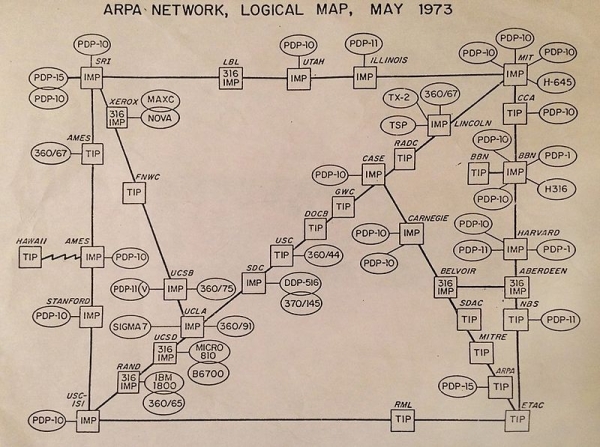
Look at all this PDP!
The company BBN, responsible for supporting ARPANET, made this system even more attractive by creating the Tenex operating system, which added paging virtual memory to the PDP-10. This significantly simplified the management and use of the system since there was no longer a need to adjust the set of running programs to the available memory. BBN provided Tenex free of charge to other ARPA nodes, and soon this OS became dominant on the network.
But how is all this related to email? Users of time-sharing systems were already familiar with electronic messaging, as by the late 1960s, most of these systems provided mailboxes of some kind. They offered a form of internal mail, and messages could only be exchanged among users of the same system. The first person to take advantage of the network for sending mail from one machine to another was Ray Tomlinson, an engineer at BBN and one of the authors of Tenex. He had already written the SNDMSG program to send mail to another user on the same Tenex system, and the CPYNET program to send files over the network. It only took a bit of imagination for him to see how to combine these two programs to create network mail. In previous programs, only the username was needed to specify the recipient, so Tomlinson came up with the idea of combining the local user's name with the host's name (either local or remote) by connecting them with the @ symbol, resulting in a unique email address for the entire network (before this, the @ symbol was rarely used, mainly to indicate prices: 4 pastries @ $2 each).
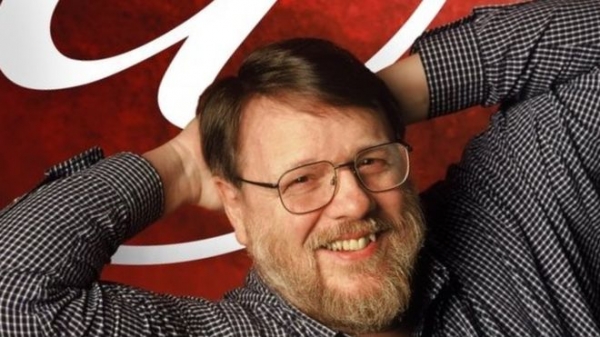
Ray Tomlinson in his later years, with his characteristic sign @
Tomlinson began testing his new program locally in 1971, and in 1972, his network version SNDMSG was included in the new release of Tenex. As a result, Tenex mail was able to break free from a single node and spread across the network. The abundance of machines running Tenex granted access to Tomlinson's hybrid program to a significant portion of ARPANET users, and email quickly became successful. It wasn't long before ARPA executives incorporated email into daily life. Stephen Lukasik, the director of ARPA, was among the first users, as was Larry Roberts, who was still head of the computer science department at the agency. This habit inevitably spread to their subordinates, and soon email became a fundamental aspect of life and culture on ARPANET.
Tomlinson's email program spawned numerous imitations and new developments as users sought ways to enhance its rudimentary functionality. Most of the early innovations focused on addressing the shortcomings of the email reading program. Once email extended beyond a single computer, the volume of messages received by active users began to grow alongside the expansion of the network, and the traditional approach to incoming messages as plain text became ineffective. Larry Roberts himself, overwhelmed by the influx of messages, created his own program for managing the inbox called RD. However, by the mid-1970s, the MSG program written by John Vittal from the University of Southern California was the clear leader in popularity. The ability to automatically fill in the subject and recipient fields of outgoing messages based on incoming ones at the push of a button is something we take for granted. However, it was Vittal's MSG program that first introduced this amazing ability to 'reply' to emails in 1975; it also was part of the software suite for Tenex.
The diversity of these attempts necessitated the introduction of standards. This was the first, but certainly not the last instance when the computer networking community had to develop standards retroactively. Unlike the fundamental protocols of ARPANET, many variations for email already existed in the wild before any official standards were established. Inevitably, conflicts and political frictions arose, focusing on the key documents describing the email standard, RFC 680 and 720. In particular, users of operating systems other than Tenex were frustrated by assumptions made in proposals that were tied to characteristics of Tenex. The conflict never escalated too much – all ARPANET users in the 1970s were still part of one relatively small scientific community, and the disagreements were not that significant. However, it was a precursor to future battles.
The unexpected success of email was the most significant event in the evolution of the network's software layer in the 1970s – the layer most detached from the physical details of the network. At the same time, others were determined to redefine the fundamental 'link' layer, where bits flowed from one machine to another.
ALOHA
In 1968, Norm Abramson arrived at the University of Hawaii from California to take on a combined role as a professor of electrical engineering and computer science. His university had a main campus on Oahu and an additional one in Hilo, along with several community colleges and research centers scattered across the islands of Oahu, Kauai, Maui, and Hawaii. Between them lay hundreds of kilometers of water and mountainous terrain. The main campus hosted a powerful IBM 360/65, but ordering a dedicated line from AT&T to connect a terminal located in one of the community colleges was not as straightforward as it was on the mainland.
Abramson was an expert in radar systems and information theory, and at one time he worked as an engineer at Hughes Aircraft in Los Angeles. His new environment, with all its physical challenges related to wired data transmission, inspired Abramson to come up with a new idea – what if radio was a better way to connect computers than the telephone system, which was ultimately designed for voice transmission rather than data?
To validate his idea and create a system he named ALOHAnet, Abramson received funding from Bob Taylor at ARPA. In its original form, it was not a computer network at all, but rather a medium for connecting remote terminals to a single time-sharing system developed for an IBM computer located on the Oahu campus. Like ARPANET, it had a dedicated mini-computer for processing packets received and sent by the 360/65 machine – Menehune, the Hawaiian equivalent of an IMP. However, ALOHAnet did not complicate itself with routing packets between different points, as was done in ARPANET. Instead, each terminal wishing to send a message simply broadcast it on a designated frequency.
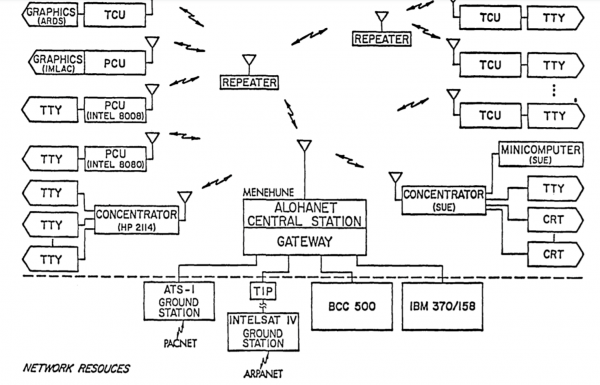
The fully deployed ALOHAnet by the late 1970s, with several computers in the network.
Traditionally, the engineering approach to process such a shared bandwidth was to divide it into segments with time-sharing or frequency separation, allocating each terminal a segment. However, to handle messages from hundreds of terminals under such a scheme, each would have to be limited to a small fraction of the available bandwidth, while in reality, only a few could be operational at any given time. Instead, Abramson decided to allow the terminals to send messages simultaneously without interference. If two or more messages overlapped, the central computer detected this via error correction codes and simply discarded those packets. Without receiving confirmation of packet delivery, senders attempted to resend them after a random amount of time. Abramson estimated that this simple protocol could support hundreds of terminals operating concurrently, and due to the numerous overlapping signals, 15% of the bandwidth would be utilized. However, his calculations indicated that as the network grew, the entire system would descend into chaos and noise.
Office of the Future
Abramson's concept of 'packet broadcasting' initially did not cause much excitement. But several years later, it was reborn—this time on the mainland. This was tied to a new research center in Palo Alto opened by Xerox (PARC) in 1970, right next to Stanford University, in an area that had recently been dubbed 'Silicon Valley.' Some of Xerox's patents on xerography were about to expire, risking the company falling into the trap of its own success by not adapting due to unwillingness or inability to embrace the rise of computing technology and integrated circuits. Jack Goldman, head of Xerox's research department, persuaded the higher-ups that the new laboratory—separated from the influence of the headquarters, established in a comfortable climate with good salaries—would attract the talent necessary to keep the company at the forefront of progress by developing the information architecture of the future.
PARC has definitely excelled in attracting top talent in computer science, not only due to working conditions and generous salaries but also thanks to the presence of Robert Taylor, who launched the ARPANET project in 1966 while heading the ARPA Information Processing Technology Office. , a fiery and ambitious young engineer and computer specialist from Brooklyn, was one of those who joined PARC through connections with ARPA. He joined the lab in June 1972 after working part-time for ARPA as a graduate student, inventing an interface to connect MIT to the network. Once at PARC, he remained the 'intermediary' for ARPANET—traveling across the country, helping to connect new nodes to the network, and preparing ARPA’s presentation for the 1972 International Conference on Computer Communication.
Among the projects circulating in PARC at the time of Metcalfe's arrival was a plan proposed by Taylor to connect dozens, if not hundreds, of smaller computers to the network. Year after year, the cost and size of computers fell, obeying the relentless will of . Forward-looking engineers at PARC foresaw that, in the not-so-distant future, every office worker would have their own computer. As part of this vision, they designed and built the personal computer Alto, copies of which were distributed to every researcher in the lab. Taylor, who had spent the previous five years solidifying his belief in the usefulness of computer networks, also wanted to link all these computers together.
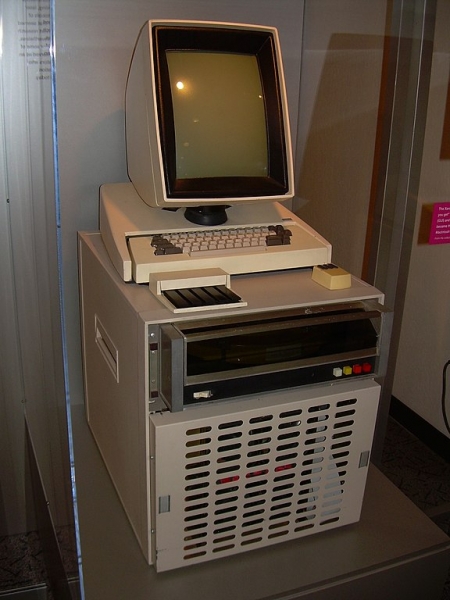
Alto. The computer itself is located below, in a cabinet the size of a mini-fridge.
Upon arriving at PARC, Metcalfe took on the task of connecting the lab's PDP-10 clone to ARPANET and quickly earned a reputation as a 'networking' expert. So when Taylor needed a network of Altos, his assistants turned to Metcalfe. Just like the computers in ARPANET, the Alto computers at PARC had virtually nothing to say to each other. Hence, an interesting application of the network once again became the task of facilitating communication between people—in this case, in the form of words and images printed via laser.
The key idea of the laser printer did not originate at PARC, but on the East Coast, in Xerox's original laboratory in Webster, New York. There, physicist Gary Starkweather demonstrated that a coherent laser beam could be used to deactivate the electrical charge of the xerographic drum, just like the scattered light used in photocopying up to that point. A correctly modulated beam could draw an image of arbitrary detail on the drum, which could then be transferred to paper (since only the uncharged parts of the drum attract toner). Such a computer-controlled machine could produce any combination of images and text that a person could imagine, rather than simply reproducing existing documents like a photocopier. However, Starkweather's wild ideas were not supported by his colleagues or his superiors in Webster, so he transferred to PARC in 1971, where he met a much more receptive audience. The laser printer's ability to output arbitrary images pixel by pixel made it the perfect companion for the Alto workstation, with its pixelated monochrome graphics. With a laser printer, half a million pixels on the user's display could be directly printed on paper with perfect clarity.
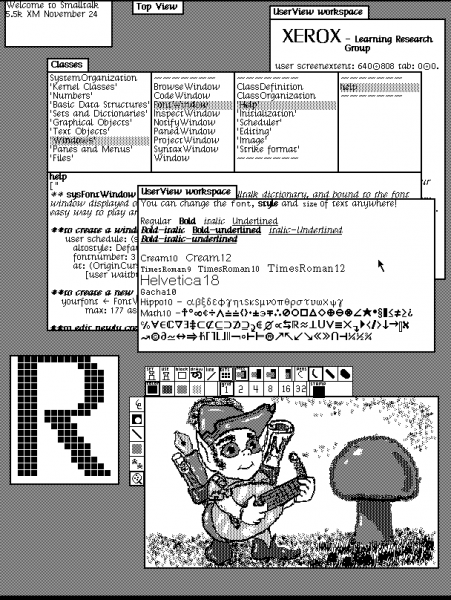
A bitmap image on the Alto. Nothing like this had ever been seen on computer screens before.
About a year later, Starkweather, with the help of a few more engineers from PARC, resolved the main technical issues and built a working prototype of the laser printer based on the Xerox 7000 workhorse chassis. It produced pages at the same speed—one per second—and with a resolution of 500 dots per inch. The character generator built into the printer printed text in preset fonts. Arbitrary images (different from those that could be created from fonts) were not yet supported, so the network did not need to transmit 25 million bits per second for the printer. However, to fully occupy the printer would require an incredible network bandwidth for those times—when 50,000 bits per second was the limit of ARPANET's capabilities.
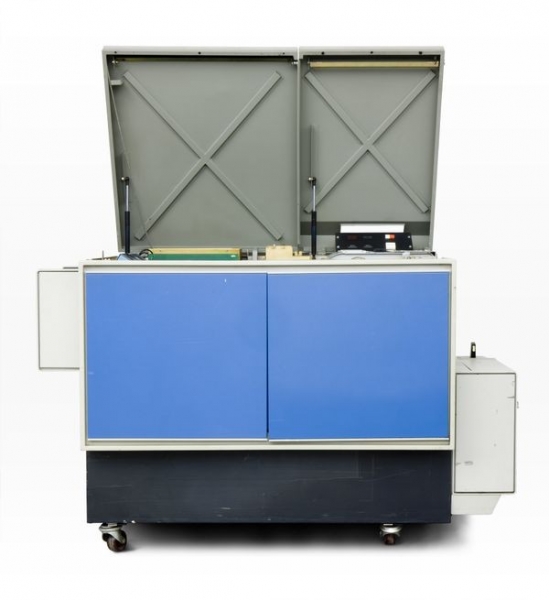
Second generation PARC laser printer, Dover (1976)
ALTO Aloha Network
How did Metcalfe manage to bridge this speed gap? We return to ALOHAnet – it turned out that Metcalfe was better than anyone at understanding packet broadcasting. A year prior, during the summer, while in Washington with Steve Crocker on ARPA business, Metcalfe studied materials from the upcoming fall computer conference and came across Abramson's work on ALOHAnet. He immediately grasped the brilliance of the underlying idea and recognized that its implementation was not good enough. By making some adjustments to the algorithm and its assumptions – for example, having senders listen to the channel first, waiting for a clear signal before attempting to send messages, and exponentially increasing the retransmission interval in case of a busy channel – he was able to achieve a bandwidth utilization of 90%, rather than the 15% indicated by Abramson's calculations. Metcalfe took a short vacation to Hawaii, where he incorporated his ideas about ALOHAnet into a revised version of his dissertation after Harvard rejected the initial version for lack of theoretical foundation.
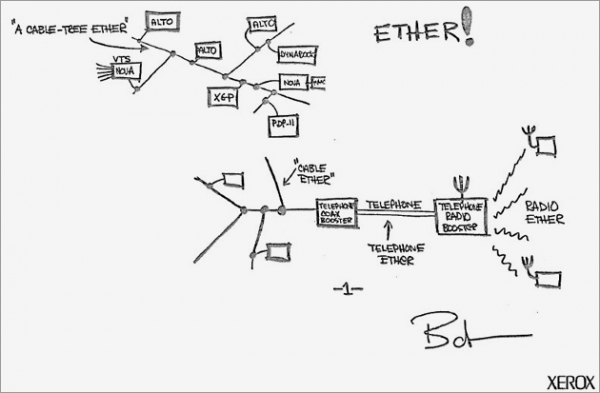
Initially, Metcalfe referred to his plan to implement packet broadcasting at PARC as the "ALTO ALOHA network." Then, in a memorandum from May 1973, he renamed it to Ether Net [ether network], referencing the luminous ether, a 19th-century physical concept of a substance that carries electromagnetic radiation. "This will facilitate the spread of the network," he wrote, "and who knows what other signal transmission methods might prove better than cable for broadcast networks; perhaps they will be radio waves, or telephone wires, or power lines, or cable television with frequency multiplexing, or microwaves, or some combinations of these."
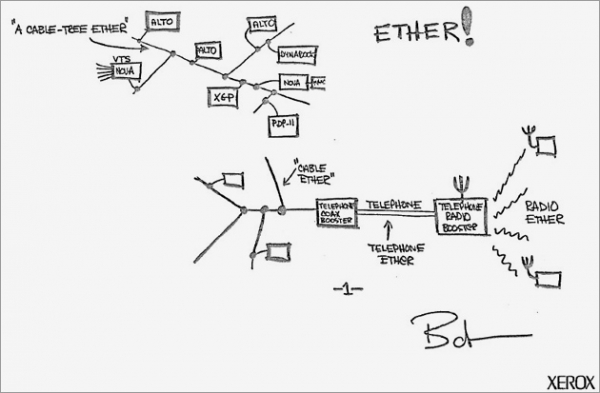
Excerpt from Metcalfe's 1973 memorandum
Since June 1973, Metcalfe worked with another engineer from PARC, David Boggs, on turning his theoretical concept of a new high-speed network into a functioning system. Instead of transmitting signals through the air like ALOHA, he confined the radio spectrum with coaxial cable, which drastically increased the bandwidth compared to the limited radio frequency range of Menehune. The transmission medium itself was completely passive and required no routers for message routing. It was inexpensive and allowed hundreds of workstations to be easily connected – PARC engineers simply ran coaxial cable through the building and added connections as needed – and was capable of transmitting up to three million bits per second.
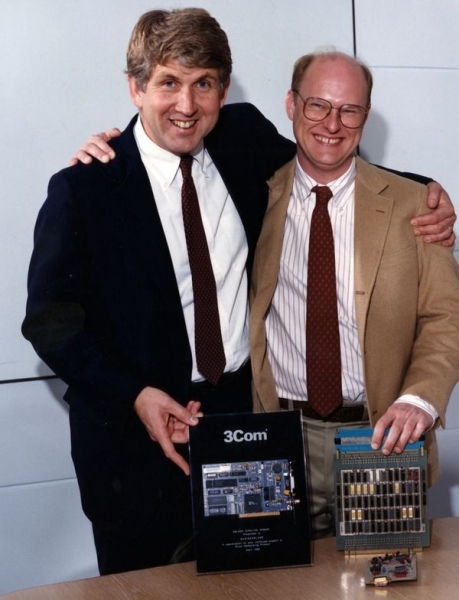
Robert Metcalfe and David Boggs, 1980s, a few years after Metcalfe founded 3Com to sell Ethernet technology.
By the fall of 1974, a complete prototype of the office of the future was deployed and operational in Palo Alto – the first batch of Alto computers, with drawing programs, email, and word processors, a prototype printer from Starckweiser, and an Ethernet network to connect all of this. The central file server, which stored data that could not fit on the local Alto disk, was the only shared resource. Initially, PARC offered the Ethernet controller as an optional accessory for Alto, but when the system was launched, it became clear that it was a necessary component; a steady stream of messages flowed through the coaxial cable, many of which came out of the printer – technical reports, memos, or research papers.
Alongside developments for Alto, another project from PARC attempted to further the ideas on resource separation in a new direction. The "PARC Online Office System" (POLOS), developed and implemented by Bill English and other escapees from Doug Engelbart's "Online System" (NLS) at Stanford Research Institute, consisted of a network of Data General Nova microcomputers. However, instead of dedicating each individual machine to specific user needs, POLOS allocated workloads among them to serve the interests of the system as a whole in the most efficient manner. One machine could handle generating images for user screens, another could manage ARPANET traffic, and a third could handle word processing. Yet, the complexity and costs of coordination in such an approach proved excessive, and the scheme collapsed under its own weight.
Meanwhile, nothing displayed Taylor's emotional rejection of the resource-sharing network approach better than his acceptance of the Alto project. Alan Kay, Butler Lampson, and other creators of Alto brought all the computational power that a user might need onto an independent desktop computer that they were not required to share with anyone. The purpose of the network was not to provide access to a heterogeneous set of computer resources but to facilitate message exchange between these independent islands or to store them on some distant shore—for printing or long-term archiving.
Although both email and ALOHA were developed under the auspices of ARPA, the emergence of Ethernet became one of several indications in the 1970s that computer networks had become too large and diverse for a single company to dominate, a trend we will trace in the next article.
Further reading
- Michael Hiltzik, Dealers of Lightning (1999)
- James Pelty, The History of Computer Communications, 1968-1988 (2007) [http://www.historyofcomputercommunications.info/]
- M. Mitchell Waldrop, The Dream Machine (2001)
Source: habr.com
