

Other articles in the series:
- The History of Relays
- The History of Electronic Computers
- The History of the Transistor
- The History of the Internet
The earliest electronic computers were unique devices created for research purposes. However, after their introduction to the market, organizations quickly integrated them into the existing data processing culture—where all data and processes were represented as stacks. .
developed the first tabulator capable of reading and counting data based on holes in paper cards for the U.S. Census in the late 19th century. By the middle of the next century, a colorful array of descendants of this machine had penetrated large enterprises and government organizations worldwide. Their common language was a card consisting of several columns, where each column (usually) represented a single digit that could be punched in one of ten positions indicating numbers from 0 to 9.
Entering data into the cards did not require complex devices, and this process could be distributed across several offices within the organization generating the data. When it was necessary to process the data—for example, to calculate revenue for a quarterly sales report—the relevant cards could be brought to the data center and queued for processing by suitable machines, which would produce a set of output data on the cards or print it on paper. Surrounding the central processing machines—tabulators and calculators—crowds of peripheral devices were present for punching, copying, sorting, and interpreting the cards.
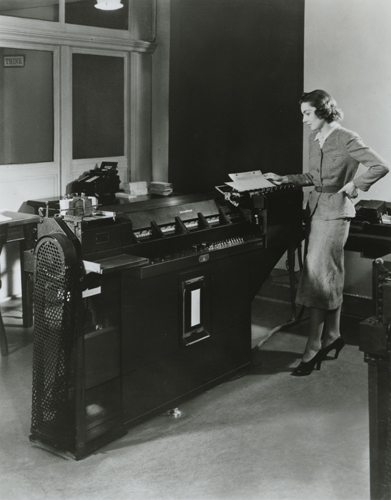
The IBM 285 tabulator, a popular device for working with punch cards in the 1930s and 40s.
By the late 1950s, almost all computers operated under the model of "batch processing." For the typical end user in sales, not much had changed. You brought a stack of punch cards for processing and received either a printed output or another stack of punch cards as the result. Throughout this process, the cards transformed from holes in paper into electronic signals and back again, but that didn’t concern you much. IBM dominated the market for punch card processing machines and remained one of the leading forces in electronic computers, largely due to established connections and a wide range of peripheral equipment. They simply replaced their clients’ mechanical tabulators and calculators with faster and more flexible data processing machines.
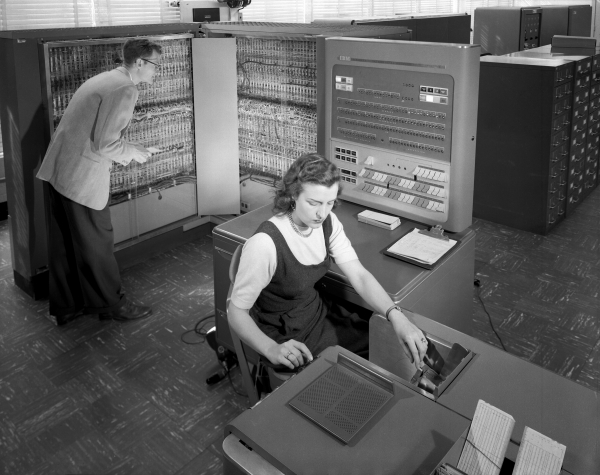
IBM 704 punch card processing unit. In the foreground, a woman is working with a reading device.
This punch card processing system functioned well for decades and did not decline—on the contrary. Yet, by the late 1950s, a marginal subculture of computer researchers began to assert that the entire workflow needed to change—they argued that computers should be used interactively. Instead of submitting jobs and then returning for results, users should interact directly with the machine and utilize its capabilities on demand. In "Das Kapital," Marx described how industrial machines—which people merely operated—replaced tools that people directly controlled. However, computers began their existence already as machines. Only later did some users repurpose them into tools.
And this transformation did not happen in data centers like the U.S. Census Bureau, insurance company MetLife, or United States Steel Corporation (all of these companies were among the first to acquire UNIVAC, one of the first commercially available computers). It is unlikely that an organization, where weekly payroll is considered the most efficient and reliable method, would want someone to disrupt this processing by fiddling with the computer. The value of being able to sit at the console and simply try this or that on the computer was more evident to scientists and engineers who wanted to study the problem, approaching it from various angles until its weak point was discovered, and quickly switching between thought and action.
Thus, such ideas originated among researchers. However, the funds to support such extravagant computer usage did not come from the heads of their departments. A new subculture (one could even say a cult) of interactive computer work emerged from a productive partnership between the military and elite universities in the U.S. This mutually beneficial cooperation began during World War II. Atomic weapons, radars, and other magical weapons taught military leaders that seemingly obscure activities of scientists could have incredible importance for the military. This convenient interaction lasted about a generation before it fell apart in the political upheavals of another war, in Vietnam. But during this time, American scientists had access to vast amounts of money, were largely unbothered, and could engage in almost anything that could be remotely linked to national defense.
The justification for interactive computers began with the bomb.
Whirlwind and SAGE
On August 29, 1949, a Soviet research team successfully conducted to Three days later, a U.S. reconnaissance aircraft detected traces of radioactive material in the atmosphere over the northern Pacific Ocean, remnants of the test. The Soviet Union had acquired a bomb, and their American rivals learned of it. Tensions between the two superpowers had been escalating for over a year, since the USSR severed ground routes to the Western-controlled sectors of Berlin in response to plans to restore Germany's former economic greatness.
The blockade ended in the spring of 1949, caught in a deadlock due to a massive operation undertaken by the West to support the city from the air. Tensions eased somewhat. However, American generals could not ignore the existence of a potentially hostile force with access to nuclear weapons, especially given the continuously growing size and range of strategic bombers. The U.S. had a chain of radar stations for detecting aircraft, established along the Atlantic and Pacific coasts during World War II. However, they relied on outdated technology, did not cover northern approaches through Canada, and were not connected to a central system for coordinating air defense.
To address the situation, the Air Force (an independent military branch of the U.S. since 1947) convened an anti-aircraft defense engineering committee (ADSEC). In history, it is remembered as the "Wally Committee", named after its chairman, George Wally. He was a physicist from MIT and a veteran of the military research radar group Rad Lab, which was transformed into a research lab for electronics (RLE) after the war. The committee studied the problem for a year, and Wally released the final report in October 1950.
One might assume that such a report would be a dull mix of bureaucratic jargon, ending with cautiously worded and conservative proposals. Instead, the report turned out to be a fascinating example of creative reasoning, containing a radical and risky action plan. This is clearly the achievement of another MIT professor, , who argued that the study of living beings and machines could be unified into a single discipline called Wally and his co-authors began with the assumption that a missile defense system is a living organism, and not just metaphorically, but literally. Radar stations serve as sensory organs, interceptors and missiles are the effectors through which it interacts with the world. They operate under the control of a director who uses information from the sensory organs to make decisions about necessary actions. They further argued that a director composed solely of humans would be unable to stop hundreds of incoming aircraft over millions of square kilometers within a few minutes, so as many functions of the director as possible need to be automated.
The most unusual of their conclusions is that it would be best to automate the director through digital electronic computers, which could take on some human decision-making: analyzing incoming threats, directing weapons against those threats (calculating interception courses and relaying them to fighters), and possibly even developing strategies for optimal forms of response. At that time, it was far from obvious that computers were suitable for such a purpose. There were exactly three operational electronic computers in the entire USA, and none of them remotely met the reliability requirements for a military system on which millions of lives depended. They were simply very fast and programmable number processors.
Nevertheless, Wally had reasons to believe in the possibility of creating a real-time digital computer, as he knew about the project [«Whirlwind»]. It started during the war in the servomechanisms laboratory at MIT under the guidance of a young graduate student, Jay Forrester. Its initial goal was to create a general-purpose flight simulator that could be reconfigured to support new aircraft models without needing to be rebuilt from scratch each time. A colleague convinced Forrester that his simulator should use digital electronics to process input parameters from the pilot and provide output states for the instruments. Gradually, the attempt to create a high-speed digital computer overshadowed its original purpose. The flight simulator was forgotten, the war that inspired its development was long over, and the oversight committee from the Office of Naval Research (ONR) was growing increasingly frustrated with the project due to a continually rising budget and ever-pushing completion deadline. In 1950, ONR drastically cut Forrester's budget for the following year, intending to completely shut down the project thereafter.
However, for George Valley, Whirlwind was a revelation. The real Whirlwind computer was still far from operational. However, what was to emerge was a computer that represented not just a mind without a body, but a computer with sensory organs and effectors. An organism. Forrester was already considering plans to expand the project into the main system of the country's military command and control center. Computer experts at ONR, who viewed computers as suitable only for solving mathematical problems, found this approach grandiose and absurd. Yet, this was exactly the idea that Valley was looking for, and he arrived just in time to save Whirlwind from oblivion.
Despite their great ambitions (or perhaps because of them), the Walli report convinced the Air Force command, and they launched an extensive new research and development program to first understand how to create an air defense system based on digital computers, and then to actually build it. The Air Force began collaborating with MIT to conduct fundamental research – this was a natural choice, considering the presence of Whirlwind and RLE at the institute, as well as a history of successful collaboration in air defense dating back to the Rad Lab and World War II. They named the new initiative the 'Lincoln Project' and built a new Lincoln Research Laboratory at Hanscom Field, 25 km northwest of Cambridge.
The Air Force named the computerized air defense project – a typical strange acronym for a military project, meaning 'Semi-Automatic Ground Environment'. Whirlwind was meant to be the test computer demonstrating the viability of the concept before moving to full-scale production and deployment of the equipment – this responsibility was placed on IBM. The working version of the Whirlwind computer, which was to be made by IBM, received the much less memorable name AN/FSQ-7 ('Army-Navy Fixed Special Equipment' – compared to this, the acronym SAGE seems quite accurate).
By the time the Air Force completed the full plans for the SAGE system in 1954, it comprised various radar installations, air bases, and air defense weapons – all controlled from twenty-three command centers, massive bunkers designed to withstand bombardment. To fill these centers, IBM would need to supply forty-six computers instead of twenty-three, which would cost the military many billions of dollars. This was because the company was still using vacuum tubes in the logic circuits, which burned out like light bulbs. Any of the tens of thousands of tubes in a working computer could fail at any moment. It would obviously be unacceptable to leave an entire sector of the country’s airspace unprotected while technicians conducted repairs, so a backup machine needed to be kept on hand.
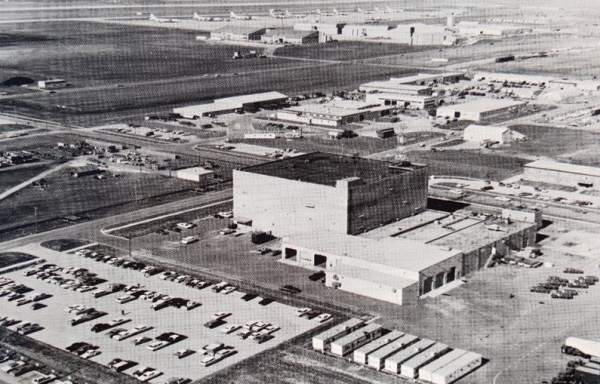
The SAGE command center at Grand Forks Air Force Base in North Dakota, where two AN/FSQ-7 computers were located.
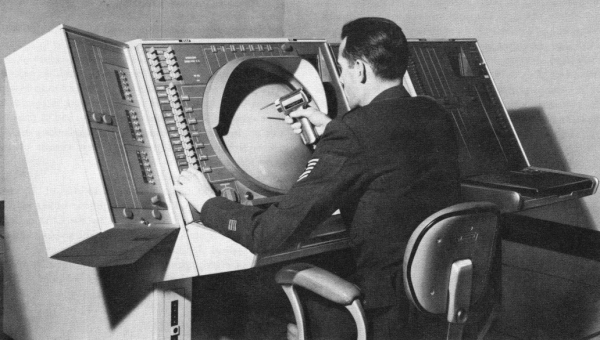
In each control center, dozens of operators worked, sitting in front of cathode ray screens, each monitoring a part of the airspace sector.
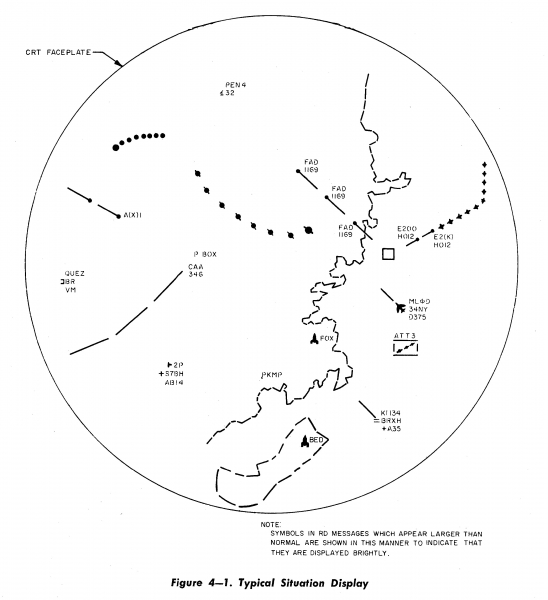
The computer tracked any potential aerial threats and visualized them as trails on the screen. The operator could use a light gun to pull up additional information about the trail and send commands to the defense system, while the computer converted them into a printed message for the available missile battery or Air Force base.
The Virus of Interactivity
Given the nature of the SAGE system—direct interaction between human operators and a digital computer via CRTs in real time, using light guns and consoles—it is not surprising that the Lincoln Laboratory nurtured the first cohort of advocates for interactive engagement with computers. The entire computer culture of the laboratory existed in an isolated bubble, cut off from the norms of batch processing developing in the commercial world. Researchers used Whirlwind and its descendants, reserving time slots for which they gained exclusive access to the computer. They became accustomed to using hands, eyes, and ears for direct interaction through switches, keyboards, brightly lit screens, and even a speaker, without any paper intermediaries.
This strange and small subculture spread into the outside world like a virus, through direct physical contact. And if we consider it a virus, then the index case should be named a young man named Wesley Clark. Clark dropped out of physics graduate school at Berkeley in 1949 to become a technician at a factory producing nuclear weapons. However, he didn’t enjoy the work. After reading several articles from computer journals, he began looking for opportunities to penetrate what seemed like a new and exciting field full of untapped potential. He learned of the recruitment of computer specialists at Lincoln Laboratory from a classified ad, and in 1951 he moved to the East Coast to work under Forrester, who had already become the head of the digital computer laboratory.
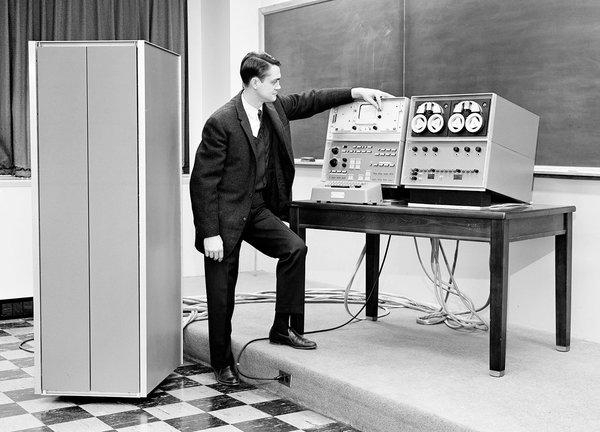
Wesley Clark demonstrating his biomedical computer LINC, 1962
Clark joined a team of advanced developers in a subdivision of the laboratory, embodying a relaxed state of collaboration between the military and universities at that time. Although technically the subdivision was part of the Lincoln Laboratory universe, this team existed in a bubble within another bubble, isolated from the day-to-day needs of the SAGE project, and was free to choose any computing direction that could in some way be tied to air defense. Their primary task in the early 1950s was to create a Memory Test Computer (MTC), designed to demonstrate the viability of a new, high-performance, and reliable method of storing digital information, , which was intended to replace the fickle core memory based on CRTs used in Whirlwind.
Since the MTC had no other users except its creators, Clark had full access to the computer for many hours each day. He became interested in the trendy cybernetic blend of physics, physiology, and information theory, thanks to his colleague Belmont Farley, who interacted with a group of biophysicists from RLE in Cambridge. Clark and Farley spent long hours on the MTC, creating software models of neural networks to study the properties of self-organizing systems. From these experiments, Clark began to extract certain axiomatic principles of computing from which he never deviated. In particular, he came to believe that "user-friendliness is the most important design factor."
In 1955, Clark joined forces with Ken Olsen, one of the developers of MTC, to create a plan for a new computer that would pave the way for the next generation of military control systems. By using very large magnetic core memory for storage and transistors for logic operations, it could be made much more compact, reliable, and powerful than the Whirlwind. Initially, they proposed a design dubbed TX-1 (Transistorized and eXperimental computer), which was much clearer than AN/FSQ-7. However, the leadership of the Lincoln Laboratory rejected the project as too expensive and risky. Transistors had only just hit the market a few years prior, and very few computers had been built using transistor logic. As a result, Clark and Olsen returned with a scaled-down version of the machine, the TX-0, which was approved.
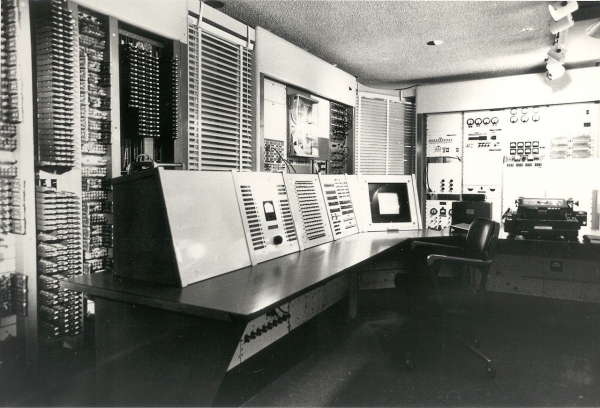
TX-0
The functionality of the TX-0 computer as a tool for managing military bases, while a pretext for its creation, interested Clark much less than the opportunity to promote his ideas for computer design. From his perspective, the interactivity of computing machines had ceased to be a fact of life at the Lincoln Labs and had become the new norm—a proper way to create and use computers, especially for scientific work. He granted access to the TX-0 to biophysicists from MIT, even though their work had nothing to do with air defense, and allowed them to use the machine's visual display to analyze electroencephalograms from sleep research. And no one objected to this.
The TX-0 turned out to be successful enough that in 1956, the Lincoln Laboratory approved its full-scale transistor computer, the TX-2, with a massive memory of two million bits. The project would take two years to realize. After that, the virus would escape the laboratory. Upon the completion of the TX-2, the laboratories would no longer need to use the early prototype, so they agreed to lease the TX-0 to Cambridge, specifically to RLE. It was installed on the second floor, above the batch processing center. It immediately infected computers and professors on the MIT campus, who began to compete for time slots in which they could gain full control over the computer.
It was already clear that it was practically impossible to write a computer program correctly on the first try. Moreover, researchers studying the new task often did not initially understand what the correct behavior should be. To get results from the computing center, they had to wait for hours, or even until the next day. For dozens of novice programmers on campus, the opportunity to climb the stairs, find an error, fix it immediately, try a new approach, and see improved results instantly was a revelation. Some used their time on the TX-0 to work on serious scientific or engineering projects, but the joy of interactivity also attracted more playful souls. One student wrote a text editing program that he called "the expensive typewriter." Another followed suit and wrote "the expensive desktop calculator," which he used to complete his homework in numerical analysis.
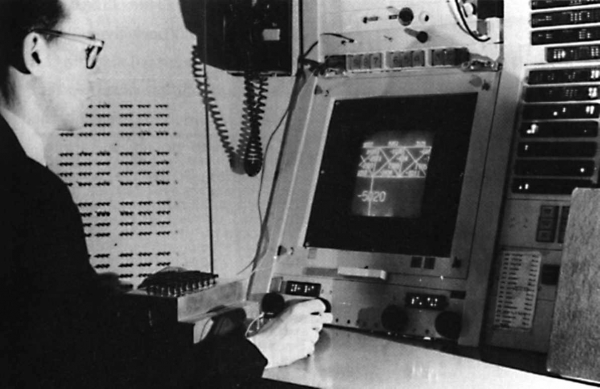
Ivan Sutherland demonstrates his Sketchpad program on the TX-2.
Meanwhile, Ken Olsen and another engineer from the TX-0, Harlan Anderson, frustrated by the slow progress of the TX-2 project, decided to bring to market a small-scale interactive computer for scientists and engineers. They left the laboratory to found Digital Equipment Corporation, setting up an office in a former textile mill on the Assabet River, ten miles west of Lincoln. Their first computer, the PDP-1 (released in 1961), was essentially a clone of the TX-0.
TX-0 and Digital Equipment Corporation began spreading the good news about a new way of using computers beyond the walls of the Lincoln Laboratory. Yet, for now, the virus of interactivity was geographically localized in Eastern Massachusetts. However, this was soon set to change.
What else to read:
- Lars Heide, Punched-Card Systems and the Early Information Explosion, 1880-1945 (2009)
- Joseph November, Biomedical Computing (2012)
- Kent C. Redmond and Thomas M. Smith, From Whirlwind to MITRE (2000)
- M. Mitchell Waldrop, The Dream Machine (2001)
Source: habr.com
