

Other articles in the series:
- The History of Relays
- The History of Electronic Computers
- The History of the Transistor
- The History of the Internet
The crucible of war laid the groundwork for the emergence of the transistor. From 1939 to 1945, technical knowledge in the field of semiconductors grew tremendously. There was a simple reason for this: radar. The most important technology of the war, with applications including: detecting air raids, locating submarines, directing nighttime air strikes at targets, and guiding air defense and naval artillery. Engineers even learned to cram tiny radars into artillery shells so that they would explode when flying near the target— . However, the source of this powerful new military technology came from a more peaceful realm: the study of the upper layers of the atmosphere for scientific purposes.
Radar
In 1901, the Marconi Wireless Telegraph Company successfully transmitted a wireless message across the Atlantic, from Cornwall to Newfoundland. This fact baffled contemporary science. If radio transmissions move in a straight line (as they should), such a transmission should have been impossible. There is no direct line of sight between England and Canada that does not cross the Earth, so Marconi's message should have shot off into space. American engineer Arthur Kennelly and British physicist Oliver Heaviside independently proposed that the explanation for this phenomenon must be related to a layer of ionized gas in the upper atmosphere capable of reflecting radio waves back to Earth (Marconi himself believed that radio waves followed the curvature of the Earth's surface, but physicists did not support him).
By the 1920s, scientists developed new equipment that allowed them to first prove the existence of the ionosphere and then study its structure. They used electronic valves to generate shortwave radio pulses, directional antennas to send them up into the atmosphere, and registered echoes, and to demonstrate the results. The longer the delay in the echo return, the further away the ionosphere must be. This technology was called atmospheric probing, and it provided the basic technical infrastructure for the creation of radar (the term 'radar', from RAdio Detection And Ranging, only emerged in the 1940s in the US Navy).
It was only a matter of time before individuals with the necessary knowledge, resources, and motivation recognized the potential for ground applications of such equipment (thus, the history of radar is the opposite of that of the telescope, which was originally intended for ground use). The likelihood of such a revelation increased as radio technology spread across the planet, and more people began to notice interference from nearby ships, aircraft, and other large objects. Knowledge from the field of upper atmosphere probing spread during the second (1932-1933), when scientists from various Arctic stations mapped the ionosphere. Soon after, teams in Britain, the USA, Germany, Italy, the USSR, and other countries developed their own rudimentary radar systems.
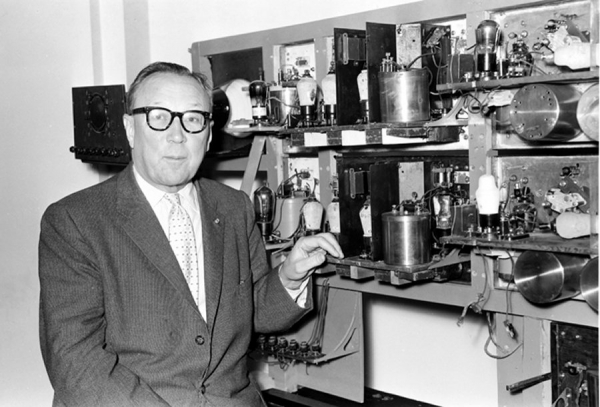
with his 1935 radar
Then the war broke out, and the importance of radars for countries – and the resources for their development – surged dramatically. In the USA, these resources coalesced around a new organization founded in 1940 at MIT, known as (named so specifically to mislead foreign spies and give the impression that the lab was investigating radioactivity – very few believed in atomic bombs back then). The Rad Lab project, not as renowned as the Manhattan Project, nonetheless attracted equally prominent and talented physicists from across the USA. Five of the lab's first employees (including and ) later received Nobel Prizes. By the end of the war, around 500 PhDs, scientists, and engineers worked in the lab, with a total workforce of 4,000 people. Half a million dollars – comparable to the entire budget for creating ENIAC – was spent solely on publishing the Radiation Laboratory Series, a twenty-seven volume collection detailing all the knowledge gained in the lab during the war (the US government's expenditures on radar technology were not limited to the Rad Lab budget; during the war, the government purchased radars totaling three billion dollars).
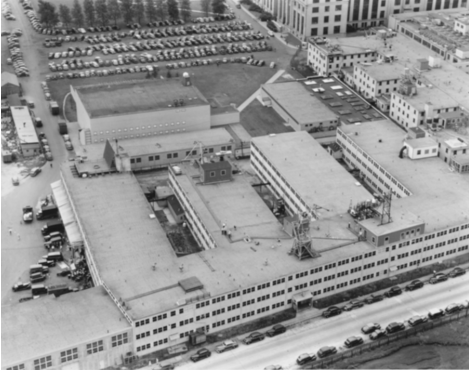
Building 20 at MIT, where the Rad Lab was located
One of the main areas of research at Rad Lab was high-frequency radar. Early radars used waves measured in meters. However, beams of higher frequency, with wavelengths measured in centimeters—microwaves—allowed for more compact antennas and less scattering over long distances, promising significant advantages in range and accuracy. Microwave radars could fit in the nose of an aircraft and detect objects the size of a submarine periscope.
The first to solve this challenge was a team of British physicists from the University of Birmingham. In 1940, they developed the, which operated like an electromagnetic "whistle," converting random electrical impulses into a powerful and precisely tuned beam of microwaves. This microwave transmitter was a thousand times more powerful than its nearest competitor, paving the way for the creation of practical high-frequency radar transmitters. However, it needed a companion receiver capable of detecting high frequencies. This is where we return to the history of semiconductors.
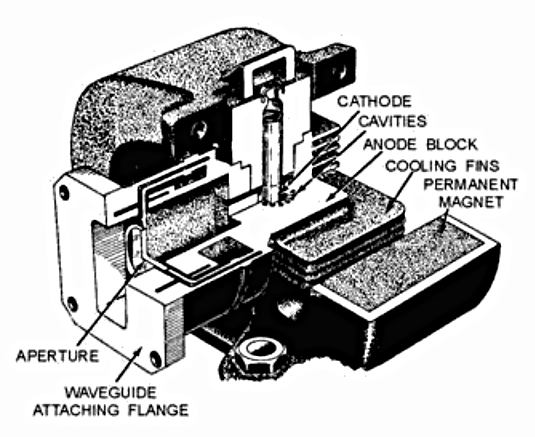
Cross-section of a magnetron
The Second Coming of the Cat's Whisker
It turned out that electronic tubes were ill-suited for receiving microwave radar signals. The gap between the hot cathode and the cold anode creates capacitance, causing the circuit to fail at high frequencies. The best technology available for high-frequency radars was the old-fashioned "", a small piece of wire pressed against a semiconductor crystal. Several individuals independently discovered this, but the events occurring in New Jersey are the closest to our story.
In 1938, Bell Laboratories signed a contract with the military to develop a fire control radar operating in the 40 cm range—this was much shorter and therefore higher in frequency than the radars existing before the era of resonant magnetrons. The primary research work was assigned to a lab division in Holmdel, south of Staten Island. The researchers quickly realized what they needed for a high-frequency receiver, and soon engineer George Southworth was scouring electronics shops in Manhattan for old 'cat whisker' detectors. As expected, it worked much better than a vacuum tube detector, but it was unstable. So, Southworth tracked down an electrochemist named Russell Hall and asked him to try and improve the uniformity of the response of the point-contact crystal detector.
Hall was quite an eccentric character, who saw the development of technology as his fate, and often spoke of periodic revelations with visions of the future. For example, he claimed that as early as 1939, he knew about the future invention of the silicon amplifier, but that fate had destined it to be invented by someone else. After exploring dozens of options, he settled on silicon as the best material for Southworth's receivers. The issue was controlling the material's composition to manage its electrical properties. At that time, industrial silicon billets were widely used in steel mills, but no one in that production cared, for example, about 1% phosphorus content in silicon. With the help of a couple of metallurgists, Hall set out to produce much purer billets than had been achieved before.
During their work, they discovered that some of their crystals conducted electricity in one direction while others conducted it in the opposite direction. They named them 'n-type' and 'p-type'. Further analysis revealed that different types of impurities were responsible for these types. Silicon is in the fourth column of the periodic table, meaning it has four electrons in its outer shell. In a pure silicon ingot, each of these electrons would bond with a neighbor. Impurities from the third column, such as boron, which has one less electron, created a 'hole', an additional space for current flow within the crystal. As a result, a p-type semiconductor was formed (with an excess of positive charges). Elements from the fifth column, like phosphorus, provided extra free electrons for current transport, resulting in an n-type semiconductor.
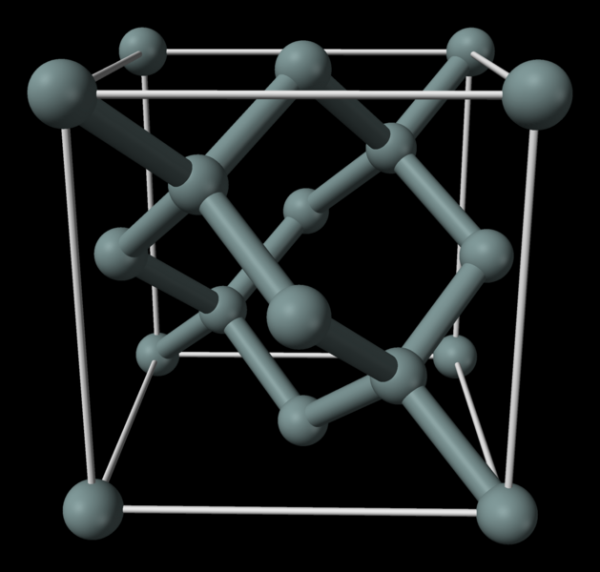
Crystalline Structure of Silicon
All of this research was very interesting, but by 1940, Southworth and Ohl had not come close to creating a working prototype of a high-frequency radar. The British government demanded immediate practical results due to the looming threat from the Luftwaffe, which had already produced microwave detectors ready for manufacture, operating in conjunction with magnetron transmitters.
However, soon the balance of technical achievements would tilt to the western side of the Atlantic. Churchill decided to reveal all of Britain's technical secrets to the Americans even before truly entering the war (as he anticipated it would happen anyway). He believed it was worth the risk of information leakage since all American industrial capabilities would then be directed toward solving challenges such as atomic weapons and radars. The British scientific and technical mission (better known as ) arrived in Washington in September 1940 and brought along a gift of technical wonders in its luggage.
The revelation of the incredible power of the resonance magnetron and the efficiency of British crystal detectors in receiving its signal revitalized American research in semiconductors as the foundation for high-frequency radars. A lot of work lay ahead, especially in the field of materials science. To meet the demands, semiconductor crystals had to be produced by the millions, far more than was previously possible. It was necessary to improve rectification, reduce sensitivity to shocks and the likelihood of burnout, and minimize the differences between various batches of crystals.
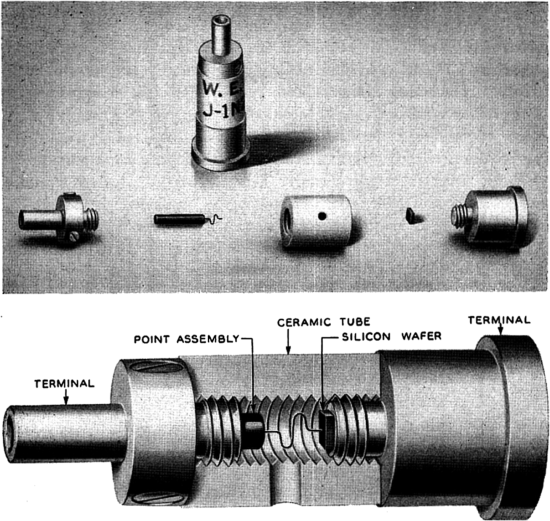
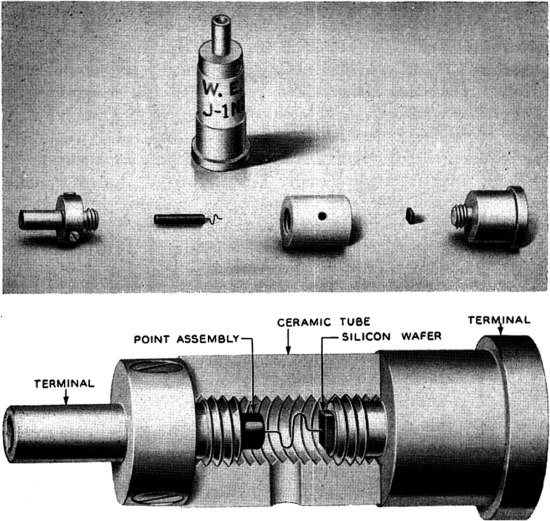
Silicon point-contact rectifier
At the Rad Lab, new research departments were established to study the properties of semiconductor crystals and how to modify them to maximize valuable properties as receivers. The most promising materials were silicon and germanium, so the Rad Lab decided to hedge its bets and launched parallel programs to study both: silicon at the University of Pennsylvania and germanium at Purdue. Industrial giants like Bell, Westinghouse, Du Pont, and Sylvania began their own semiconductor research programs and started developing new production capacities for crystal detectors.
Through joint efforts, the purity of silicon and germanium crystals was increased from 99% at the beginning to 99.999% — meaning one impurity particle per 100,000 atoms. In the process, the team of scientists and engineers became well-acquainted with the abstract properties of germanium and silicon and the practical technologies for controlling them: melting, crystal growth, and the addition of necessary impurities (like boron, which increased conductivity).
Then the war ended. The demand for radars disappeared, but the knowledge and skills gained during the war were not lost, and the dream of a solid-state amplifier was not forgotten. Now, the race was on to create such an amplifier. At least three teams were in a favorable position to secure this prize.
West Lafayette
The first was a group from Purdue University, led by an Austrian-born physicist named Karl Lark-Horowitz. Through his talent and influence, he single-handedly brought the university's physics department out of obscurity and influenced Rad Lab's decision to assign his laboratory to research germanium.
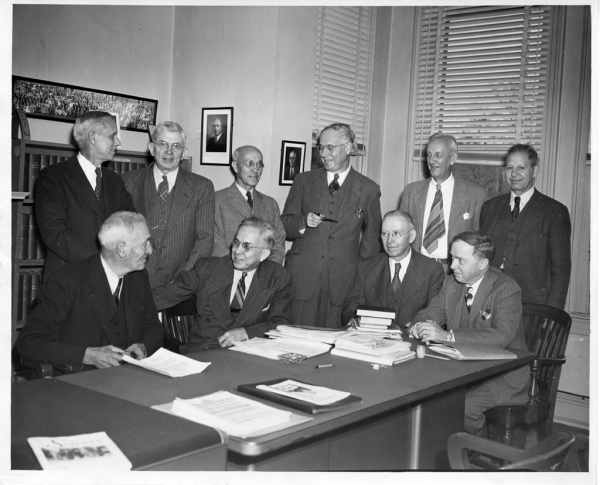
Karl Lark-Horowitz in 1947, in the center, with a pipe
By the early 1940s, silicon was considered the best material for radar rectifiers; however, the material directly below it in the periodic table also seemed worthy of further study. Germanium had a practical advantage due to its lower melting point, which made working with it easier: around 940 degrees, compared to 1400 degrees for silicon (almost as high as steel). Because of the high melting point, it was extremely challenging to create a ingot that would not flow into the molten silicon, contaminating it.
Therefore, Lark-Horowitz and his colleagues spent the entire war studying the chemical, electrical, and physical properties of germanium. The main obstacle was the 'reverse voltage': germanium rectifiers would stop rectifying current at very low voltages, allowing it to flow in the opposite direction. The reverse current pulse would burn out the other components of the radar. One of Lark-Horowitz's graduate students, Seymour Benzer, studied this problem for over a year and eventually developed a tin-based additive that stopped reverse pulses at voltages up to a hundred volts. Soon after, Western Electric, the manufacturing division of Bell Labs, began producing rectifiers based on Benzer's design for military needs.
The study of germanium at Purdue continued even after the war. In June 1947, Benzer, now a professor, reported an unusual anomaly: in some experiments, high-frequency oscillations appeared in germanium crystals. His colleague Ralph Bray continued the investigation of "bulk resistance" based on a project that began during the war. Bulk resistance described how electricity flowed through the germanium crystal at the rectifier contact point. Bray discovered that high-voltage impulses significantly reduced the n-type germanium's resistance to these currents. Unbeknownst to him, he was witnessing the so-called "non-basic" charge carriers. In n-type semiconductors, an excess negative charge serves as the main charge carrier, but positive "holes" can also carry current, and in this case, high-voltage impulses created holes in the germanium structure, resulting in the appearance of non-basic charge carriers.
Bray and Benzer tantalizingly approached the germanium amplifier without realizing it. Benzer caught Walter Brattain, a scientist from Bell Labs, at a conference in January 1948 to discuss bulk resistance with him. He suggested that Brattain place another point contact close to the first, which could conduct current, and then, perhaps, they would be able to understand what was happening beneath the surface. Brattain quietly agreed to this suggestion and left. As we shall see, he was all too aware of what such an experiment could reveal.
One-Su-Bois
The group at Purdue had both the technology and the theoretical foundations to make a leap towards the transistor. However, they could only stumble upon it by chance. They were interested in the physical properties of the material, rather than in searching for a new type of device. A completely different situation existed in One-Su-Bois (France), where two former radar researchers from Germany, Heinrich Welker and Herbert Matari, led a team aimed at creating industrial semiconductor devices.
Welker first studied and then taught physics at the University of Munich, which was managed by the famous theorist Arnold Sommerfeld. From 1940, he left the purely theoretical path and began working on radar for the Luftwaffe. Matare, of Belgian descent, grew up in Aachen, where he studied physics. He joined the research department of the German radio giant Telefunken in 1939. During the war, he moved his work from Berlin eastward to an abbey in Silesia to avoid air raids by the Anti-Hitler coalition and then back to the west to evade the advancing Red Army, ultimately ending up in the hands of the American army.
Like their counterparts from the Anti-Hitler coalition, the Germans by the early 1940s knew that crystal detectors were ideal receivers for radars and that silicon and germanium were the most promising materials for their creation. Matare and Welker during the war tried to improve the effective use of these materials in rectifiers. After the war, both underwent periodic interrogations regarding their military work and ultimately received an invitation from a French intelligence officer to Paris in 1946.
Compagnie des Freins & Signaux, a French subsidiary of Westinghouse, received a contract from the French telephone management to create solid-state rectifiers and was looking for German scientists to help them. Such a union of recent enemies may seem strange; however, this agreement turned out to be quite beneficial for both sides. The French, having been defeated in 1940, were unable to gain knowledge in the field of semiconductors and desperately needed the Germans' skills. The Germans could not engage in development in any high-tech fields in an occupied and war-destroyed country, so they seized the opportunity to continue their work.
Welker and Matare set up headquarters in a two-story house in the suburb of Paris, Ivry-sur-Seine, and with the help of a team of technicians, established successful production of germanium rectifiers by the end of 1947. They then turned to more serious prizes: Welker returned to his interest in superconductors, while Matare focused on amplifiers.
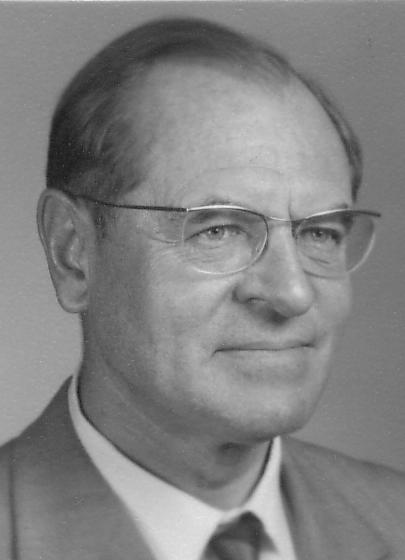
Herbert Matare in 1950
During the war, Mataré experimented with two-point contact rectifiers – 'diodes' – in an attempt to reduce noise in the circuit. He resumed his experiments and soon discovered that a second 'whisker,' positioned 1/100 millionth of a meter from the first, could sometimes modulate the current passing through the first whisker. He created a solid-state amplifier, albeit a rather useless one. To achieve more reliable operation, he turned to Welker, who had gained extensive experience working with germanium crystals during the war. Welker's team grew larger and purer samples of germanium crystals, and together with the improved material quality, by June 1948, Mataré's point-contact amplifiers became reliable.
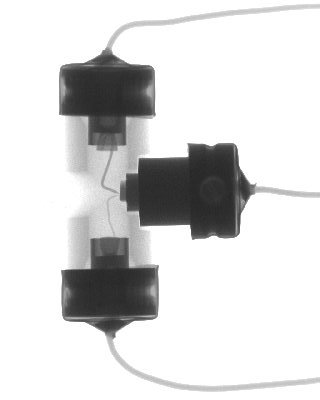
X-ray image of the 'transistron' based on Mataré's design, featuring two points of contact with germanium
Mataré even had a theoretical model for what was happening: he believed that the second contact created holes in the germanium, accelerating the passage of current through the first contact by supplying minority charge carriers. Welker disagreed with him, arguing that what was happening depended on some kind of field effect. However, before they could work out the device or the theory, they learned that a group of Americans had developed the exact same concept – a germanium amplifier with two-point contacts – six months earlier.
Murray Hill
At the end of the war, Mervin Kelly reformed the semiconductor research group at Bell Labs, led by Bill Shockley. The project expanded, received more funding, and moved from the original lab building on Manhattan to the expanding campus in Murray Hill (New Jersey).
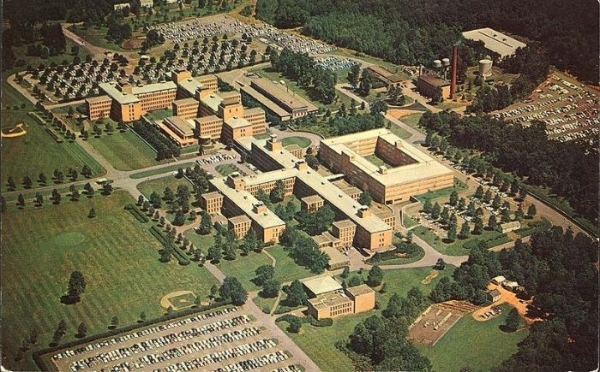
Campus in Murray Hill, circa 1960
To reintroduce himself to advanced semiconductors (after working on operations research during the war), in the spring of 1945, Shockley visited Russell Ohl's lab in Holmdel. Ohl had spent the war years working with silicon and did not waste any time. He showed Shockley a crude amplifier he had built himself, which he called a "deziester." He took a silicon point-contact rectifier and passed current through it from a battery. Apparently, the heat from the battery reduced the resistance at the contact point and turned the rectifier into an amplifier, capable of transmitting incoming radio signals to a circuit powerful enough to drive a speaker.
The effect was crude and unreliable, unsuitable for commercialization. However, it was sufficient to confirm Shockley's belief in the possibility of creating a semiconductor amplifier and that this should become a priority direction for research in solid-state electronics. This meeting with Ohl's team also convinced Shockley that silicon and germanium should be studied first. They demonstrated attractive electrical properties, and moreover, Ohl's colleagues, metallurgists Jack Scaff and Henry Terhune, had made remarkable progress in growing, purifying, and doping these crystals during the war, surpassing all technologies available for other semiconductor materials. Shockley's group was no longer willing to waste time on pre-war copper oxide amplifiers.
With Kelly's help, Shockley began to assemble a new team. Among the key players was Walter Brattain, who had assisted Shockley with his first attempt to create a semiconductor amplifier (in 1940), and John Bardeen, a young physicist and new employee at Bell Labs. Bardeen likely had the most extensive knowledge of solid-state physics among all the team members—his dissertation described the energy levels of electrons in the structure of metallic sodium. He was also another protégé of John Hasbrouck Van Fleck, just like Atanasoff and Brattain.
Just like Atanasov, Bardin and Shockley's dissertations required complex calculations. They had to use the quantum-mechanical theory of semiconductors, defined by Alan Wilson, to calculate the energy structure of materials using Monroe's desktop calculator. By helping to create the transistor, they essentially contributed to freeing future graduate students from such labor.
Shockley's first approach to the solid-state amplifier relied on what would later be called '.' He suspended a metal plate above an n-type semiconductor (with an excess of negative charges). Applying a positive charge to the plate pulled excess electrons to the surface of the crystal, creating a river of negative charges through which electric current could easily flow. The amplified signal (represented by the charge level on the plate) could modulate the main circuit (which passed across the surface of the semiconductor) in this way. His theoretical knowledge in physics hinted at the functionality of this scheme. However, despite numerous trials and experiments, the scheme did not work.
By March 1946, Bardin had developed a well-founded theory explaining the reason for this: the surface of the semiconductor behaves differently at the quantum level than its interior. The negative charges drawn to the surface become trapped in 'surface states' and block the penetration of the electric field from the plate into the material. The other team members found this analysis convincing and launched a new research program along three paths:
- Prove the existence of surface states.
- Study their properties.
- Devise a way to overcome them and create a functioning .
After a year and a half of research and experimentation, on November 17, 1947, Brettain made a breakthrough. He discovered that if he placed a liquid filled with ions, such as water, between a plate and a semiconductor, the electric field from the plate would push the ions towards the semiconductor, where they would neutralize the charges trapped in surface states. Now he could control the electrical behavior of a piece of silicon by changing the charge on the plate. This success gave Bardin an idea for a new approach to creating an amplifier: to surround the contact point of the rectifier with electrolytic water and then use a second conductor in the water to control the surface states, thus managing the level of conductivity at the main contact. Thus, Bardin and Brettain reached the final stretch.
Bardin's idea worked, but the amplification was weak and operated at very low frequencies, inaudible to the human ear — making it useless as a telephone or radio amplifier. Bardin suggested switching to reverse voltage-resistant germanium obtained at Purdue, believing it would accumulate fewer charges on its surface. Suddenly, they achieved powerful amplification, but in the opposite direction than expected. They discovered the effect of minority carriers — instead of the expected electrons, the current passing through germanium amplified holes coming from the electrolyte. The current in the wire within the electrolyte created a p-type layer (a region of excess positive charge) on the surface of the n-type germanium.
Subsequent experiments showed that the electrolyte was not needed at all: simply placing two contact points close together on the surface of the germanium allowed them to modulate the current from one to the other. To get them as close as possible, Brettain wrapped a triangular piece of plastic in a piece of gold foil and then carefully cut the foil at the tip. Then, using a spring, he pressed the triangle against the germanium, causing the two edges of the cut to touch its surface at a distance of 0.05 mm. This gave the Bell Labs transistor prototype its distinctive appearance:
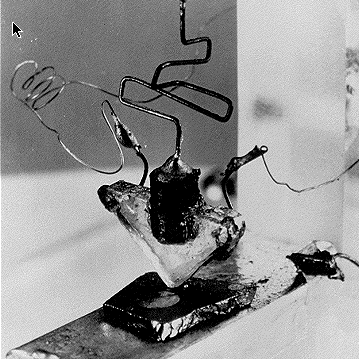
The prototype transistor by Brettain and Bardin
Like the devices of Mataré and Welker, this was essentially a classic 'cat's whisker', just with two contact points instead of one. On December 16, it delivered a significant increase in power and voltage, and a frequency of 1000 Hz within the audible range. A week later, after some minor improvements, Bardin and Brattain achieved a voltage gain of 100 times and a power gain of 40 times, demonstrating to the Bell directors that their device could reproduce audible speech. John Pierce, another member of the solid-state device development team, coined the term 'transistor' inspired by the name of Bell's copper oxide rectifier, varistor.
For the next six months, the laboratory kept the new creation a secret. Management wanted to ensure they had an edge in realizing the commercial potential of the transistor before anyone else could acquire it. A press conference was scheduled for June 30, 1948, just in time to shatter Welker and Mataré's dreams of immortality. Meanwhile, the semiconductor research group quietly fell apart. Hearing about Bardin and Brattain's achievements, their boss, Bill Shockley, began working to claim all the glory for himself. Although he played only an observational role, in the public presentation, Shockley received equal, if not greater, publicity – as seen in this published snapshot where he is right in the thick of it, directly at the laboratory table:
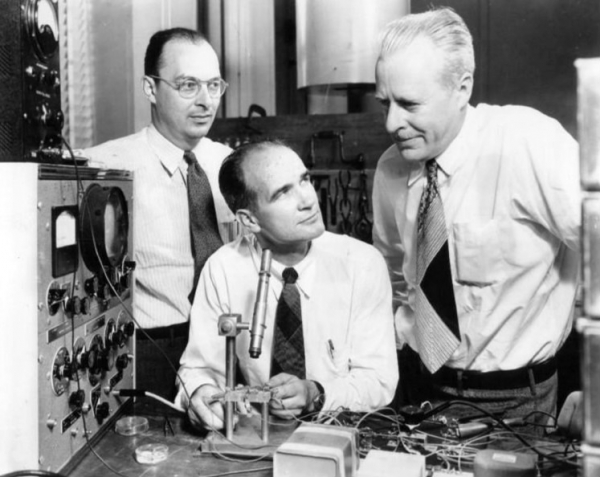
Promotional photograph from 1948 – Bardin, Shockley, and Brattain
However, it was not enough for Shockley to have equal glory. Even before anyone outside the Bell labs knew about the transistor, he set about reinventing it to claim it for himself. And this was just the first of many such re-inventions.
Further reading
- Robert Buderi, The Invention That Changed the World (1996)
- Michael Riordan, “How Europe Missed the Transistor,” IEEE Spectrum (Nov. 1, 2005)
- Michael Riordan and Lillian Hoddeson, Crystal Fire (1997)
- Armand Van Dormael, “The ‘French’ Transistor,” (1994)
Source: habr.com
