

Other articles in the series:
- The History of Relays
- The History of Electronic Computers
- The History of the Transistor
- The History of the Internet
The road to solid-state switches was long and complex. It began with the revelation that certain materials behave strangely in the presence of electricity – not as the theories of the time predicted. This was followed by a story of how, in the 20th century, technology became an increasingly scientific and institutional discipline. Dilettantes, novices, and professional inventors with little scientific education made significant contributions to the development of telegraphy, telephony, and radio. However, as we will see, nearly all advancements in the history of solid-state electronics occurred thanks to scientists educated at universities (usually holding a PhD in physics) and working at universities or corporate research laboratories.
Anyone with access to a workshop and basic material-handling skills can assemble a relay from wires, metal, and wood. Building electronic tubes requires more specialized tools capable of creating glass bulbs and evacuating air from them. Solid-state devices, however, vanished down a rabbit hole from which digital switches never returned, delving deeper into realms understood only by abstract mathematics and accessible only through prohibitively expensive equipment.
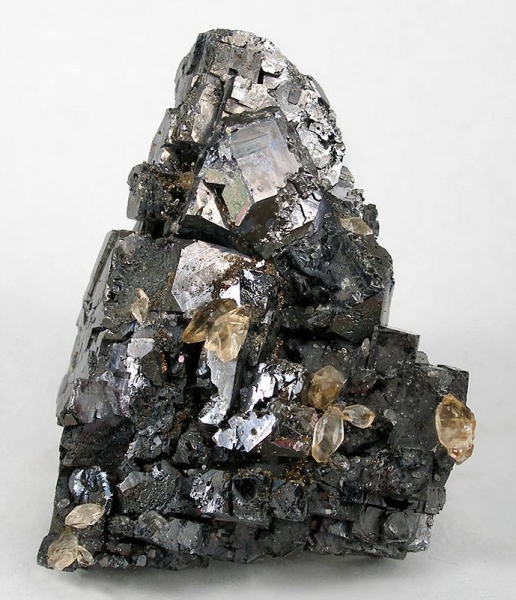
Galena
In 1874 , a 24-year-old physicist from St. Thomas School in Leipzig, published the first of many significant scientific papers in his long career. The paper "On the Passage of Electric Currents through Metal Sulfides" was accepted in Pogendorff’s Annalen, a prestigious journal dedicated to the physical sciences. Despite its dull title, Braun's work described several remarkable and puzzling experimental results.
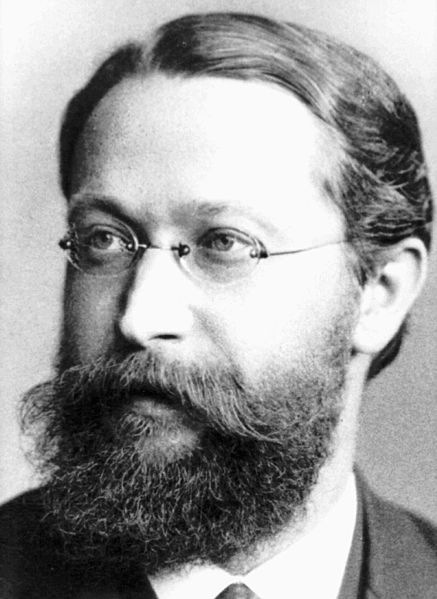
Ferdinand Braun
Braun was intrigued by sulfides – mineral crystals composed of compounds of sulfur with metals – due to the work of . In 1833, Michael Faraday noted that the conductivity of silver sulfide increases with temperature, which is completely opposite to the behavior of metallic conductors. Hittorf compiled a thorough quantitative report on measurements of this effect in the 1850s for sulfides such as silver and copper. Now, Brown, using a clever experimental setup that pressed a metal wire against a sulfide crystal with a spring to ensure good contact, discovered something even stranger. The conductivity of the crystals depended on the direction – for example, current could flow well in one direction, but when the polarity of the battery was reversed, the current could suddenly drop sharply. Crystals in one direction behaved more like conductors (like normal metals), while in the other, they acted more like insulators (like glass or rubber). This property became known as rectification due to its ability to straighten out the
At about the same time, researchers discovered other strange properties of materials such as selenium, which could be extracted from certain metal sulfide ores. Under the influence of light, selenium increased in conductivity and even began to generate electricity, and it could also be used for rectification. Was there any connection with sulfide crystals? Without theoretical models capable of explaining what was happening, confusion reigned in this field.
However, the absence of theory did not stop attempts at practical applications of the results. By the late 1890s, Brown became a professor at the University of Strasbourg – recently annexed from France during and renamed the Kaiser Wilhelm University. There he was drawn into the exciting new world of radio telegraphy. He accepted an offer from a group of entrepreneurs to co-create a wireless communication system based on the transmission of radio waves through water. However, he and his associates soon abandoned the original idea in favor of air transmission of signals, which was used by Marconi and others.
Among the aspects of radio that Brown's group sought to improve was the standard receiver at that time, It was based on the fact that radio waves caused metal shavings to clump together, allowing current from the battery to pass to the signaling device. This worked, but the system only responded to relatively strong signals, and constant tapping was required to break up the clump of shavings. Brown recalled his old experiments with sulfide crystals, and in 1899 recreated his old experimental setup with a new purpose – to serve as a detector for wireless signals. He used the rectification effect to convert the tiny oscillating current generated by passing radio waves into a direct current that could power a small speaker producing audible clicks for each dot or dash. This device later became known as the "" due to the appearance of the wire that lightly touched the top of the crystal. In British India (where Bangladesh is located today), scientist and inventor Jagadish Bose built a similar device, possibly as early as 1894. Others soon began making similar detectors based on silicon and carborundum (silicon carbide).
However, it was the , lead sulfide, which had been melted for lead production since ancient times, that became the preferred material for crystal detectors. They were simple and inexpensive to produce, resulting in their immense popularity among the early generation of radio enthusiasts. Moreover, unlike the binary coherer (with shavings that either clumped together or did not), the crystal rectifier could reproduce a continuous signal. Therefore, it could emit audible transmissions of voice and music, not just Morse code with its dots and dashes.
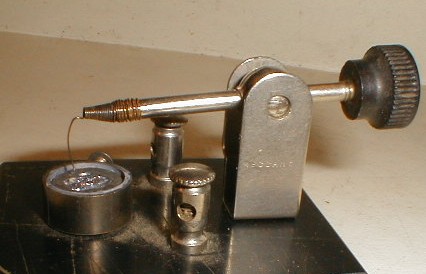
The "cat's whisker" detector based on galena. The small piece of wire on the left is the whisker, and the silvery material at the bottom is a galena crystal.
However, as disappointed radio enthusiasts soon discovered, finding the magical point on the surface of the crystal that would provide good rectification could take minutes or even hours. The signals without amplification were weak and had a metallic tone. By the 1920s, receivers with electron tubes and triode amplifiers had practically replaced crystal detectors almost everywhere. Their only attractive feature remained their low cost.
This brief appearance on the scene of radio receivers seemed to mark the limit of the practical application of the strange electrical properties of the material discovered by Braun and others.
Copper oxide
Then in the 1920s, another physicist named Lars Grondahl discovered something strange using his experimental setup. Grondahl, the first in a line of clever and restless men in the history of the American West, was the son of a construction engineer. His father, who emigrated from Norway in 1880, worked for several decades on railroads in California, Oregon, and Washington. Initially, Grondahl seemed to decide to leave behind his father's engineering world and went to Johns Hopkins University to obtain a PhD in physics, intending to follow an academic path. But then he also got involved in the railroad business and took a position as the Director of Research at Union Switch and Signal, a subsidiary of the industrial giant , which supplied equipment for the railway industry.
Various sources cite conflicting reasons that motivated Grondahl in his research, but be that as it may, he began experimenting with copper discs heated on one side to create an oxidized layer. Working with them, he noticed the asymmetry of current – the resistance in one direction was three times greater than in the other. A disc made of copper and copper oxide rectified current just like a sulfide crystal.
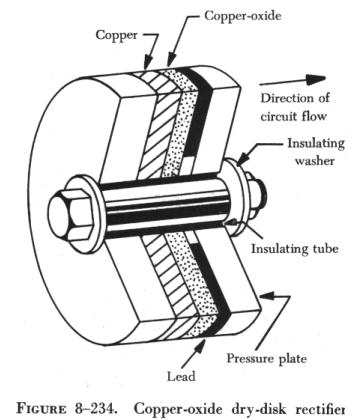
Copper oxide rectifier circuit
For the next six years, Grondahl developed a ready-to-use commercial rectifier based on this phenomenon, collaborating with another researcher from the USA, Paul Geiger, before filing a patent application and announcing his discovery at the American Physical Society in 1926. The device became an instant commercial success. Thanks to the absence of fragile wires, it was much more reliable than valve-based rectifiers based on Fleming's principle and was inexpensive to produce. Unlike crystal rectifiers, it worked on the first attempt, and due to the larger contact area between metal and oxide, it operated over a wider range of currents and voltages. It could charge batteries, detect signals in various electrical systems, and function as a safety shunt in powerful generators. When used as a photoelement, discs could function as light intensity meters and were especially useful in photography. Other researchers around the same time developed selenium-based rectifiers, which found similar applications.
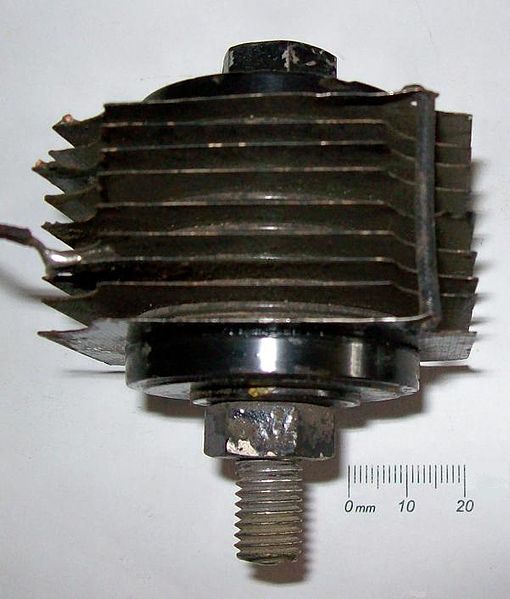
A pack of copper oxide-based rectifiers. Assembly of multiple discs increased the reverse resistance, allowing them to be used at high voltage.
A few years later, two physicists from Bell Labs, Joseph Becker and , decided to study the working principle of the copper rectifier – they were curious about how it worked and how it could be utilized at Bell System.
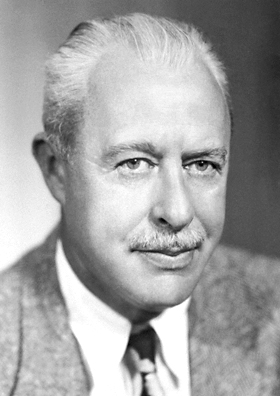
Brattain in his later years – circa 1950
Brattain hailed from the same area as Grondahl, from the Pacific Northwest, where he grew up on a farm located a few miles from the Canadian border. During high school, he developed an interest in physics and showed abilities in this field, ultimately earning a PhD at the University of Minnesota in the late 1920s and joining Bell Labs in 1929. Among other things, he studied the latest theoretical physics, which was gaining popularity in Europe and known as quantum mechanics (his advisor was , who also mentored John Atanasoff).
The Quantum Revolution
The new theoretical platform has been slowly developing over the past three decades, and in time it will be able to explain all the strange phenomena that have been observed for many years in materials such as galena, selenium, and copper oxide. A whole cohort of predominantly young physicists, mostly from Germany and neighboring countries, has triggered a quantum revolution in physics. Everywhere they looked, they discovered not the smooth and continuous world they had been taught about, but rather strange discrete clumps.
It all began in the 1890s. Max Planck, the renowned professor at the University of Berlin, decided to tackle a well-known unsolved problem: how does an "" (an ideal substance that absorbs all energy and reflects none) emit radiation in the electromagnetic spectrum? Various models were tested, but none matched the experimental results—they failed either at one end or the other of the spectrum. Planck found that if one assumes that energy is emitted by the body in small "packets" of discrete amounts, then a simple law relating frequency and energy can be written, perfectly matching empirical results.
Shortly after this, Einstein discovered that the same applies to the absorption of light (the first hint at photons), and J.J. Thomson showed that electricity is also carried not by a continuous fluid or wave, but by discrete particles—electrons. Then Niels Bohr created a model that explained how excited atoms emit radiation by assigning electrons distinct orbits within the atom, each with its own energy. However, this name can be misleading, as they do not behave in any way similar to planetary orbits—in Bohr's model, electrons jumped instantaneously from one orbit, or energy level, to another, without passing through an intermediate state. Finally, in the 1920s, Erwin Schrödinger, Werner Heisenberg, Max Born, and others developed a generalized mathematical framework known as quantum mechanics, which incorporated all the special quantum models created over the previous twenty years.
By this time, physicists were already convinced that materials such as selenium and galena, which demonstrate photovoltaic and rectifying properties, belong to a distinct class of materials that they called semiconductors. The classification took a long time for several reasons. First, the categories of 'conductors' and 'insulators' were quite broad. The so-called 'conductors' varied greatly in conductivity, and the same (to a lesser extent) was true for insulators, making it unclear how a particular conductor could fit into either of these categories. Moreover, until the mid-20th century, it was impossible to obtain or create highly pure substances, and any peculiarities in the conductivity of natural materials could always be attributed to impurities.
Now, physicists had both the mathematical tools of quantum mechanics and a new class of materials to which they could apply them. The British theorist was the first to bring all this together and built a comprehensive model of semiconductors and their operation in 1931.
Initially, Wilson argued that conducting materials differ from dielectrics in their energy band structure. Quantum mechanics asserts that electrons can exist at a limited number of energy levels inherent to the shells or orbitals of individual atoms. If these atoms are compressed together in the structure of a material, it is more accurate to envision continuous energy bands passing through it. In conductors, there are vacancies in the high energy bands, allowing the electric field to freely move electrons into them. In insulators, the bands are filled, and climbing up to a higher, conducting band, along which electricity can flow more easily, requires significant effort.
This led him to conclude that impurities—foreign atoms in the material structure—must contribute to its semiconductor properties. They can either supply excess electrons that easily move into the conduction band, or create holes—absence of electrons compared to the rest of the material—that create empty energy states where free electrons can move. The first option was later named n-type semiconductors (or electronic) for their excess negative charge, while the second was called p-type, or hole, for their excess positive charge.
Finally, Wilson suggested that the rectification of current by semiconductors could be explained in terms of quantum , a sudden jump of electrons over a thin electric barrier in the material. The theory seemed plausible, however, it predicted that current in the rectifier should flow from the oxide to copper, although in reality it was the opposite.
Thus, despite all of Wilson's breakthroughs, semiconductors remained complicated to explain. As became gradually clear, microscopic changes in the crystalline structure and impurity concentration disproportionately affected their macroscopic electrical behavior. Ignoring their lack of understanding—since no one could explain the experimental observations made by Brown 60 years prior—Brattain and Becker developed an effective manufacturing process for copper oxide rectifiers for their employer. The Bell System quickly began replacing vacuum tube rectifiers throughout the system with a new device that their engineers named , as its resistance changed depending on the direction.
Gold Medal
Mervin Kelly, a physicist and former head of the electronic tubes department at Bell Laboratories, became very interested in this achievement. Over the decades, electronic tubes provided invaluable service to Bell and could perform functions unavailable to the previous generation of mechanical and electromechanical components. However, they generated a lot of heat, often overheated, consumed significant power, and were complicated to maintain. Kelly intended to rebuild Bell's system from the ground up using more reliable and durable solid-state electronic components, such as varistors, which did not require sealed gas-filled or vacuum containers, nor heated filaments. In 1936, he became head of the research department at Bell Laboratories and began redirecting the organization onto a new path.
Having obtained a solid-state rectifier, the next obvious step was to create a solid-state amplifier. Naturally, like a tube amplifier, such a device could also function as a digital switch. This particularly interested Bell, as a vast number of electromechanical digital switches were still in operation in telephone exchanges. The company was searching for a more reliable, compact, energy-efficient, and cooler replacement for the electron tube in telephone systems, radios, radars, and other analog equipment where they were used to amplify weak signals to a level audible to the human ear.
In 1936, Bell Laboratories finally lifted the hiring freeze imposed during the . Kelly immediately began hiring experts in quantum mechanics to help launch his solid-state device research program, including , another West Coast native from Palo Alto, California. The topic of his recently completed dissertation at MIT was perfectly suited to Kelly's needs: "Electronic Zones in Sodium Chloride."
Brattain and Becker continued their research into the copper oxide rectifier, aiming to create an improved solid-state amplifier. The most obvious way to manufacture it was to draw an analogy with the electronic tube. Just as Lee de Forest took a tube amplifier and between the cathode and anode, so Brattain and Becker envisioned how they could insert a grid at the contact point between copper and copper oxide, where rectification was thought to occur. However, due to the thinness of the layer, they deemed it impossible to do so and were unsuccessful.
Meanwhile, other developments showed that Bell Laboratories was not the only company interested in solid-state electronics. In 1938, Rudolf Hillsh and Robert Paul published the results of experiments conducted at the University of Göttingen on a working solid-state amplifier created by embedding a grid into a potassium bromide crystal. This laboratory device had no practical value – mainly because it operated at a frequency of no more than 1 Hz. Still, this achievement was a cause for excitement among those interested in solid-state electronics. That same year, Kelly assigned Shockley to a new independent group for solid-state device research and gave him and his colleagues – Foster Nixon and Dean Woolridge – carte blanche to explore their potential.
At least two more inventors managed to create solid-state amplifiers before World War II. In 1922, the Soviet physicist and inventor published results of successful experiments with zincite semiconductors, but his work went unnoticed by the Western community; in 1926, American inventor Julius Lillenfeld filed a patent application for a solid-state amplifier, but there is no evidence of its functionality.
The first major insight for Shockley in his new position came while reading the work of British physicist Neville Mott, "The Theory of Crystal Rectifiers" from 1938, which finally explained the working principle of the Grondahl rectifier on copper oxide. Mott used quantum mechanics mathematics to describe the formation of an electric field at the junction of a conducting metal and a semiconductor oxide, and how electrons "jump" over this electric barrier instead of tunneling, as Wilson had suggested. Current flows more easily from the metal to the semiconductor than vice versa, as the metal has many more free electrons.
This led Shockley to the same idea that Brattain and Becker had considered and rejected many years earlier – to create a solid-state amplifier by inserting a mesh of copper oxide between copper and copper oxide. He hoped that the current flowing through the mesh would increase the barrier limiting the current from copper to oxide, creating an inverted, amplified version of the signal at the mesh. His first rough attempt completely failed, so he turned to someone with more refined lab skills who was well acquainted with rectifiers – Walter Brattain. And although he had no doubts about the outcome, Brattain agreed to satisfy Shockley's curiosity by creating a more complex version of the "mesh" amplifier. It also failed to work.
Then the war intervened, leaving Kelly's new research program in disarray. Kelly took charge of a radar working group at Bell Labs, supported by the main radar research center of the U.S. at MIT. Brattain worked with him for a short time before moving on to research magnetic detection of submarines for the military fleet. Wooldridge was working on fire control systems, Nix on gas diffusion for the Manhattan Project, and Shockley went into operations research, initially dealing with submarine warfare in the Atlantic and later strategic bombings in the Pacific.
However, despite this intervention, the war did not halt the development of solid-state electronics. On the contrary, it organized a massive influx of resources into this field and led to a concentration of research on two materials: germanium and silicon.
Further reading
Ernest Bruan and Stuart MacDonald, Revolution in Miniature (1978)
Friedrich Kurylo and Charles Susskind, Ferdinand Braun (1981)
G. L. Pearson and W. H. Brattain, “History of Semiconductor Research,” Proceedings of the IRE (December 1955).
Michael Riordan and Lillian Hoddeson, Crystal Fire (1997)
Source: habr.com
