

In this article, we will briefly discuss copyright, but mainly focus on choosing a free license for a RAD framework. and for open-source products based on it. We will talk about the permissive license. Apache 2.0, what led us to it, and what decisions we faced during the process.
The process of choosing a license is quite labor-intensive, and it should be approached by someone who is well-read. If you do not possess a legal education, you are faced with an uncharted field of information about various free licenses. The main task is to establish a set of limiting criteria. During discussions and reflections with your team, you will be able to understand what you want to allow users of your product and what to prohibit. Once you have a description in hand, you need to compare it with existing licenses and highlight the one with the most matching points. It may sound simple, but in reality, even after discussions, questions remain.
First — a link to , a useful site that we actively used. Pay special attention to the of licenses based on 13 main criteria. May English and patience be with you.
The agony of choice
Let's start with the general characteristics of licenses for . Free software implies exclusively a free license that does not restrict commercial and non-commercial distribution under a model of . Accordingly, releasing software under a free license online does not allow you to completely restrict its transfer, distribution, and sale by third parties, and you must be mentally prepared for this.
A free license gives the user the right to participate in reverse software development or modify it by any other means available. Most licenses do not allow renaming the product or making any manipulations that would alter the rights of the author and/or owner of the system.
The main questions that interested us about free licenses were:
- Changes made to the software must be documented and have no relation to the rights holder of the system?
- The name of the derivative software should not match the name of the copyright holder's software?
- Is it possible to change the license for any new versions to another, including a proprietary one?
Upon carefully reviewing the list of the most common licenses, we've selected a few that we examined in more detail. Potential licenses for were: GNU GPLv3, Apache 2.0, MIT, and MPL. MIT we almost immediately ruled out since it is a permissive non-copyleft license that allows the use, modification, and distribution of code in almost any manner. This option didn't suit us because we wanted the license to regulate the relationship between the copyright holder and the user. Most of the smaller projects on GitHub are indeed published under the MIT license or its various variations. The license itself is very short, and the only restriction is the attribution to the original author of the software.
Next was the license MPL 2.0. Admittedly, we didn't come to it right away, but after studying it more closely, we quickly ruled it out since its main drawback is that the license applies not to the entire project but to individual files. Additionally, if a user modifies a file, they cannot change the license. In fact, no matter how diligently you modify an open-source project, you won't be able to monetize it due to such a license. This, by the way, does not concern the copyright holder.
A similar problem exists with the license GNU GPLv3. It requires that any file remains under it. GNU GPL is a copyleft license that mandates that the source codes of derivative works must be open and remain under the same license. That is, if you rewrite two lines of code, you will be obliged to document your changes and, when further using or distributing, keep the code under GNU GPL. In this case, it is a limiting factor for the user of our project, rather than for us. However, switching from GPL to any other license is prohibited, even within versions of GPL. For example, if you change LGPL (a superset of GPL) to GPL, there will be no way back to LGPL. And this point was decisive in the vote against it.
Overall, our choice initially leaned towards GPL3 This is precisely due to the widespread distribution of modified code under the same license. We thought this would help us secure our product, but we observed fewer risks with Apache 2.0. According to the Free Software Foundation, GPLv3 is compatible with Apache License v2.0., which means there is always the possibility of switching the license from Apache License v2.0 to GPL v3.0.
Apache 2.0
— a balanced permissive license focused on copyright. Here are the answers it provided to our questions. Must the modifications to the software be documented and are they unrelated to the rights holder of the system? Yes, all changes must be documented, and we bear no responsibility for either the original code or the modified version. A file with the changes must be attached to the code where these changes were made. Must the name of the derivative software differ from the rights holder's software? Yes, derivative software should be released under a different name and trademark, but with acknowledgment of the rights holder's authorship. Can the license be changed for any new versions to another, including proprietary? Yes, it is possible to release under different licenses, Apache 2.0 does not restrict the application of any non-commercial and commercial licenses.
Additionally, when releasing new products based on code licensed under Apache 2.0 or products with added functionality, it is not mandatory to use the same license. Below you can see an image with the terms and conditions of the Apache 2.0 license.
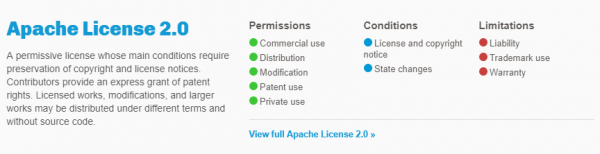
The license requires maintaining and mentioning the copyright and the license under which the software is released. The presence of copyright notice with the name of the rights holder and the license protects the rights of the original software author, as even if it is renamed, given away, or sold under a different license, the author's mark will still remain. A file named NOTICE can also be used and attached either in the source code or in the project documentation.
We release all our products under the Apache 2.0 license publicly on GitHub, except for , the source code of which was published in April of this year under the GPLv3 license on GitHub by the Far Eastern Center for Social Technologies. Currently, besides the and its has been published developed on the framework. We have already discussed this on Habr. and about .
Technical details about the framework
IONDV. Framework – an open-source framework based on node.js for creating high-level web applications based on metadata, which does not require advanced programming skills.
The core functionality of the application is based on a data registry — the Registry module. This is a key module designed specifically for working with data based on metadata structures — including project, program, event management, and more. The project also utilizes a portal module to display arbitrary data templates — the front-end of the archive registry is implemented on it.
MongoDb is used as the DBMS — it stores application settings, metadata, and the data itself.
How to apply a license to your project?
Add a file LICENSE with the license text to your project's repository, and voilà, the project is protected by Apache 2.0. You need to specify the copyright holder, which is the copyright notice. This can be done in the source code or in a file NOTICE (a text file listing all libraries licensed under the Apache license along with their creators' names). Place this file either in the source code or in the documentation distributed with the work. Here’s how it looks:
Copyright © 2018 LLC «ION DV».
Licensed under the Apache License, Version 2.0
Apache License 2.0 Text
Apache License
Version 2.0, January 2004
TERMS AND CONDITIONS FOR USE, REPRODUCTION, AND DISTRIBUTION
Definitions.
«License» shall mean the terms and conditions for use, reproduction,
and distribution as defined by Sections 1 through 9 of this document.«Licensor» shall mean the copyright owner or entity authorized by
the copyright owner that is granting the License.«Legal Entity» shall mean the union of the acting entity and all
other entities that control, are controlled by, or are under common
control with that entity. For the purposes of this definition,
«control» means (i) the power, direct or indirect, to cause the
direction or management of such entity, whether by contract or
otherwise, or (ii) ownership of fifty percent (50%) or more of the
outstanding shares, or (iii) beneficial ownership of such entity.«You» (or «Your») shall mean an individual or Legal Entity
exercising permissions granted by this License.«Source» form shall mean the preferred form for making modifications,
including but not limited to software source code, documentation
source, and configuration files.«Object» form shall mean any form resulting from mechanical
transformation or translation of a Source form, including but
not limited to compiled object code, generated documentation,
and conversions to other media types.«Work» shall mean the work of authorship, whether in Source or
Object form, made available under the License, as indicated by a
copyright notice that is included in or attached to the work
(an example is provided in the Appendix below).«Derivative Works» shall mean any work, whether in Source or Object
form that is based on (or derived from) the Work and for which the
editorial revisions, annotations, elaborations, or other modifications
represent, as a whole, an original work of authorship. For the purposes
of this License, Derivative Works shall not include works that remain
separable from, or merely link (or bind by name) to the interfaces of,
the Work and Derivative Works thereof.«Contribution» shall mean any work of authorship, including
the original version of the Work and any modifications or additions
to that Work or Derivative Works thereof, that is intentionally
submitted to Licensor for inclusion in the Work by the copyright owner
or by an individual or Legal Entity authorized to submit on behalf of
the copyright owner. For the purposes of this definition, «submitted»
means any form of electronic, verbal, or written communication sent
to the Licensor or its representatives, including but not limited to
communication on electronic mailing lists, source code control systems,
and issue tracking systems that are managed by, or on behalf of, the
Licensor for the purpose of discussing and improving the Work, but
excluding communication that is conspicuously marked or otherwise
designated in writing by the copyright owner as «Not a Contribution.»«Contributor» shall mean Licensor and any individual or Legal Entity
on behalf of whom a Contribution has been received by Licensor and
subsequently incorporated within the Work.Grant of Copyright License. Subject to the terms and conditions of
this License, each Contributor hereby grants to You a perpetual,
worldwide, non-exclusive, no-charge, royalty-free, irrevocable
copyright license to reproduce, prepare Derivative Works of,
publicly display, publicly perform, sublicense, and distribute the
Work and such Derivative Works in Source or Object form.Grant of Patent License. Subject to the terms and conditions of
this License, each Contributor hereby grants to You a perpetual,
worldwide, non-exclusive, no-charge, royalty-free, irrevocable
(except as stated in this section) patent license to make, have made,
use, offer to sell, sell, import, and otherwise transfer the Work,
where such license applies only to those patent claims licensable
by such Contributor that are necessarily infringed by their
Contribution(s) alone or by combination of their Contribution(s)
with the Work to which such Contribution(s) was submitted. If You
institute patent litigation against any entity (including a
cross-claim or counterclaim in a lawsuit) alleging that the Work
or a Contribution incorporated within the Work constitutes direct
or contributory patent infringement, then any patent licenses
granted to You under this License for that Work shall terminate
as of the date such litigation is filed.Redistribution. You may reproduce and distribute copies of the
Work or Derivative Works thereof in any medium, with or without
modifications, and in Source or Object form, provided that You
meet the following conditions:(a) You must give any other recipients of the Work or
Derivative Works a copy of this License; and(b) You must cause any modified files to carry prominent notices
stating that You changed the files; and(c) You must retain, in the Source form of any Derivative Works
that You distribute, all copyright, patent, trademark, and
attribution notices from the Source form of the Work,
excluding those notices that do not pertain to any part of
the Derivative Works; and(d) If the Work includes a «NOTICE» text file as part of its
distribution, then any Derivative Works that You distribute must
include a readable copy of the attribution notices contained
within such NOTICE file, excluding those notices that do not
pertain to any part of the Derivative Works, in at least one
of the following places: within a NOTICE text file distributed
as part of the Derivative Works; within the Source form or
documentation, if provided along with the Derivative Works; or,
within a display generated by the Derivative Works, if and
wherever such third-party notices normally appear. The contents
the NOTICE file is for informational purposes only and
does not modify the License. You may add your own attribution
notices within Derivative Works that you distribute, alongside
or as an addendum to the NOTICE text from the Work, provided
that such additional attribution notices cannot be construed
as modifying the License.You may add your own copyright statement to your modifications and
may provide additional or different license terms and conditions
for use, reproduction, or distribution of your modifications, or
for any such Derivative Works as a whole, provided your use,
reproduction, and distribution of the Work otherwise complies with
the conditions stated in this License.Submission of Contributions. Unless you explicitly state otherwise,
any Contribution intentionally submitted for inclusion in the Work
by you to the Licensor shall be under the terms and conditions of
this License, without any additional terms or conditions.
Notwithstanding the above, nothing herein shall supersede or modify
the terms of any separate license agreement you may have executed
with Licensor regarding such Contributions.Trademarks. This License does not grant permission to use the trade
names, trademarks, service marks, or product names of the Licensor,
except as required for reasonable and customary use in describing the
origin of the Work and reproducing the content of the NOTICE file.Disclaimer of Warranty. Unless required by applicable law or
agreed to in writing, Licensor provides the Work (and each
Contributor provides its Contributions) on an 'AS IS' BASIS,
WITHOUT WARRANTIES OR CONDITIONS OF ANY KIND, either express or
implied, including, without limitation, any warranties or conditions
of TITLE, NON-INFRINGEMENT, MERCHANTABILITY, or FITNESS FOR A
PARTICULAR PURPOSE. You are solely responsible for determining the
appropriateness of using or redistributing the Work and assume any
risks associated with your exercise of permissions under this License.Limitation of Liability. In no event and under no legal theory,
whether in tort (including negligence), contract, or otherwise,
unless required by applicable law (such as deliberate and grossly
negligent acts) or agreed to in writing, shall any Contributor be
liable to you for damages, including any direct, indirect, special,
incidental, or consequential damages of any character arising as a
result of this License or out of the use or inability to use the
Work (including but not limited to damages for loss of goodwill,
work stoppage, computer failure or malfunction, or any and all
other commercial damages or losses), even if such Contributor
has been advised of the possibility of such damages.Accepting Warranty or Additional Liability. While redistributing
the Work or Derivative Works thereof, you may choose to offer,
and charge a fee for, acceptance of support, warranty, indemnity,
or other liability obligations and/or rights consistent with this
License. However, in accepting such obligations, you may act only
on your own behalf and on your sole responsibility, not on behalf
of any other Contributor, and only if you agree to indemnify,
defend, and hold each Contributor harmless for any liability
incurred by, or claims asserted against, such Contributor by reason
of your accepting any such warranty or additional liability.END OF TERMS AND CONDITIONS
APPENDIX: How to apply the Apache License to your work.
To apply the Apache License to your work, attach the following
boilerplate notice, with the fields enclosed by brackets '[]'
replaced with your own identifying information. (Don’t include
the brackets!) The text should be enclosed in the appropriate
comment syntax for the file format. We also recommend that a
file or class name and description of purpose be included on the
same 'printed page' as the copyright notice for easier
identification within third-party archives.Copyright [yyyy] [name of copyright owner]
Licensed under the Apache License, Version 2.0 (the «License»);
you may not use this file except in compliance with the License.
You may obtain a copy of the License atUnless required by applicable law or agreed to in writing, software
distributed under the License is distributed on an «AS IS» BASIS,
WITHOUT WARRANTIES OR CONDITIONS OF ANY KIND, either express or implied.
See the License for the specific language governing permissions and
limitations under the License.
License = agreement
This is a free license, but it does not allow for unfettered use and we have already provided examples of limitations. Choose your license considering both your interests and those of the user, as open-source software is intended for them. The user of the project should view the license as a kind of agreement between them and the copyright holder, so before taking any action with the source code, carefully review the constraints imposed on you by the project's license.
We hope we have shed some light on the topic of licenses and, despite the complexity of the issue, it should not become an obstacle on your path in Open Source. Develop your project and remember rights, both yours and others'.
Useful links
Finally, here are some useful resources that helped us in finding information about existing licenses and choosing the most suitable one for our goals:
- Super useful from
Source: habr.com
